To avoid these ads, REGISTER NOW!

Why you need a milling machine

OccupantRJ

Well-known member
Joined
May 15, 2009
Messages
10,999
Location
Eastern North Carolina
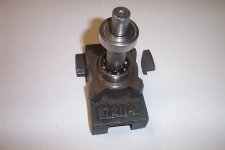
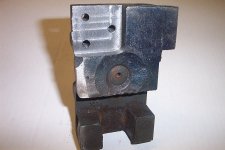
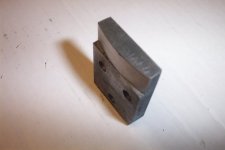
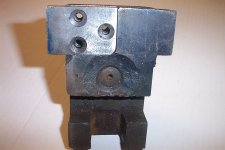
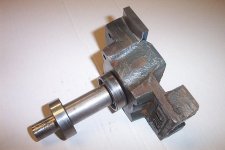
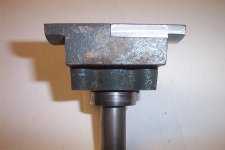
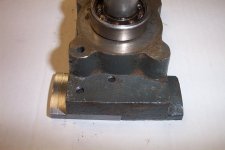
Upon bringing home my 20" Monarch woodcutting band saw, I set about to improve it's condition a little. I had the saw only a short while before the flood got me, so had not used it much. I had noticed, however, that the blade was tricky to track properly, so I decided now was the time to find out why. After some disassembly of the tensioner section of the saw, I found that the upper wheel mount tracking trunnion had an ear broken off the cast iron body. Since this ear is under a decent amount of load when the blade is properly tensioned, I felt that welding or brazing was not the way I wanted to go. Instead, I chose to do a purely mechanical repair, as pictured below. This is where the milling machine comes into play. Sometimes in repairs, you have to remove and give up something to get something. This is one of those cases. The back of the trunnion was milled away partially to accept a steel substitute for the cast ear. By milling back into the parent part this way, the ear will be under a cantilevered load in use. A steel piece was milled and drilled for countersunk bolts for attachment. The end of the piece required a radius for the rocking action of adjusting the trunnion, so it was also milled on the Bridgeport. I needed a 2-1/2" radius, and lo and behold, that happens to be the radius swing of a Bridgeport 6" milling vise, at the fixed jaw. I left the swivel bolts a little loose, and using the vice as a swinging radius cutter, advanced toward the end mill a few thousandths at a time as I swung the vice. The result is what you see below. Doing this type of emergency repair in the factory is how I make my living, and it's always challenging and interesting. Hope you all enjoy.
 

Attachments

  • Bandsaw trunnion 001.jpg
    Bandsaw trunnion 001.jpg
    92.7 KB · Views: 328
  • Bandsaw trunnion 002.jpg
    Bandsaw trunnion 002.jpg
    78.8 KB · Views: 311
  • Bandsaw trunnion 003.jpg
    Bandsaw trunnion 003.jpg
    124.4 KB · Views: 332
  • Bandsaw trunnion 006.jpg
    Bandsaw trunnion 006.jpg
    62.6 KB · Views: 306
  • Bandsaw trunnion 005.jpg
    Bandsaw trunnion 005.jpg
    129.3 KB · Views: 321
Last edited:
To avoid these ads, REGISTER NOW!
OP
O

OccupantRJ

Well-known member
Joined
May 15, 2009
Messages
10,999
Location
Eastern North Carolina
More repair pics
 

Attachments

  • Bandsaw trunnion 008.jpg
    Bandsaw trunnion 008.jpg
    123 KB · Views: 180
  • Bandsaw trunnion 007.jpg
    Bandsaw trunnion 007.jpg
    103.3 KB · Views: 169
  • Bandsaw trunnion 009.jpg
    Bandsaw trunnion 009.jpg
    101 KB · Views: 176
  • Bandsaw trunnion 010.jpg
    Bandsaw trunnion 010.jpg
    98.9 KB · Views: 181
OP
O

OccupantRJ

Well-known member
Joined
May 15, 2009
Messages
10,999
Location
Eastern North Carolina
I debated with myself about brazing the ear back on, but there's a decent amount of force constantly trying to break it off when the blade is tensioned. Besides, NASTYZEN already had a brazing thread. :bounce:
 

NASTYZEN

Well-known member
Joined
Jun 11, 2010
Messages
2,823
Location
St-Colomban,Que. Canada
Your fix is great and will do the job.:thumbup:More than one way to skin a cat.....
But brazing is super strong and great for absorbing vibrations.
I first replaced this cast ear with bronze on a 2 liter block when it got knocked off in a crash.
It came off again in a bigger crash and note where the ear broke. Next to the weld.

imgp5841.jpg


Just saying.:D
 

mike13u

Well-known member
Joined
Mar 1, 2008
Messages
616
Location
S.Florida
Great job man. Excellent fix. Curious, that rod and bearings came out of the trunnion so that you could chuck item up easily?
 
Last edited:

Aaron8x608

Member
Joined
Sep 11, 2011
Messages
18
Location
Los Angeles
Nice repair job. I had the same part on my Walker Turner break/wear out...yeah, it never would track right. Upon disassembly I found that it was an old repair. Looked like aluminum brazed zinc or something. The casting was on the lean side, having hollowed sides, so I cut the bad/fixed stuff off (with other band saw) and made a skeletal bolt on addition out of angle iron. Works like a charm now. But you gotta have a mill (or two) also.
 

rsanter

Well-known member
Joined
Dec 22, 2007
Messages
18,505
Location
visalia ca
damn good job there
good approach to the problem

after having a mill for a while it makes you wonder what you would do without one

bob
 

ZTFab

Well-known member
Joined
Jan 6, 2008
Messages
397
Location
Upland, CA
Nice job!!

I've had my Bridgeport for a little over 7 years...the last 4 of which the machine sat idle in my other garage waiting for me to make room for it.

Nothing like needing a mill and owning one but not being able to use it!! :lol_hitti

It's been back in service for a few months now...just whipped up 4 of these parts for a mobile bandsaw base.

PehakaBase5.jpg


PehakaBase6.jpg
 
Last edited:

Jack Olsen

Super Moderator
Staff member
Joined
Mar 22, 2009
Messages
6,678
Location
Los Angeles
I have no idea what I would have done. But that doesn't make me any less jealous of the fact that you have a milling machine. :)

...just whipped up 4 of these parts for a mobile bandsaw base.
Please post your progress on his.
 

Jack Olsen

Super Moderator
Staff member
Joined
Mar 22, 2009
Messages
6,678
Location
Los Angeles
Ah -- I'd seen that. Thanks. I saw 'mobile bandsaw' but in my head read 'portable bandsaw.' I just got a base for my portaband, and was interested in what you'd come up with. But the base you made is for a full-size piece of equipment.

And of course, it's beautiful. And strong like a tank. But that's how you roll. :)
 

ZTFab

Well-known member
Joined
Jan 6, 2008
Messages
397
Location
Upland, CA
Ah -- I'd seen that. Thanks. I saw 'mobile bandsaw' but in my head read 'portable bandsaw.' I just got a base for my portaband, and was interested in what you'd come up with. But the base you made is for a full-size piece of equipment.

And of course, it's beautiful. And strong like a tank. But that's how you roll. :)

Thanks Jack. :beer:

Ya, sorry about that...this bandsaw weighs 1200lbs.
 

fomocoforrester

Well-known member
Joined
Jun 13, 2008
Messages
3,061
A very nice repair that I'm sure will be adequate for the job.

However it does seem to me that the repair would have been quicker, stronger, and a more elegant solution, if you had continued the milling operation right across the trunion casting (thus eliminating the other cast ear of the type that had already failed) and replaced both ears with a single piece of steel.

This would also have the benefit of providing a stronger cantilever support for the ears.

For added security I would have brazed it as AP suggested. I don't have much faith in being able to generate the optimum clamping force with those type of screws if the allen keys are not a perfect fit.
 
To avoid these ads, REGISTER NOW!

gorilla

Well-known member
Joined
Dec 13, 2007
Messages
1,651
If I wanted to repair it I would have brazed it, If I wanted to play with my mill I would have made a whole new part. I think that your repair is excellent. You may want to think about buying a rotary table.
 
OP
O

OccupantRJ

Well-known member
Joined
May 15, 2009
Messages
10,999
Location
Eastern North Carolina
If I wanted to repair it I would have brazed it, If I wanted to play with my mill I would have made a whole new part. I think that your repair is excellent. You may want to think about buying a rotary table.

What makes you think I don't have a rotary table? :D If you read some of my other posts in this section, you'll see that I quite often do things in unusual ways to keep my skill set honed, not get burned out with the same old, same old techniques, and provide alternate methods for other people to see that there's more than one way to accomplish a task. I'm not posting these threads for me, I've been doing this stuff for most of my life. My purpose is to inspire other people to give things a try that they might not otherwise, and to share as part of a community.
 

GirlnAgarage

Well-known member
Joined
Jan 21, 2011
Messages
4,668
Location
Texas
The adage holds true, there are lots of ways to skin a cat. Just depends on how you wanna do it. Nice clean job.
 

gorilla

Well-known member
Joined
Dec 13, 2007
Messages
1,651
I'm sorry if I offended you with my comments, I would never have machined a radius that way if I had a rotary table available. I will admit that is a clever way to do it.
 
OP
O

OccupantRJ

Well-known member
Joined
May 15, 2009
Messages
10,999
Location
Eastern North Carolina
I'm sorry if I offended you with my comments, I would never have machined a radius that way if I had a rotary table available. I will admit that is a clever way to do it.

No offense taken, I grew up the hard way, and you have a right to your opinions. Check out my signature line for insight on my way of thinking.
 

A_Pmech

Well-known member
Joined
May 8, 2007
Messages
8,002
Location
IL
Swinging the radius with a vise is a tried-and-true method of doing that particular operation.

It's easier and faster to tram in a vise than it is to crane a 450lb rotary table on and off the machine for one non-critical radius!
 
OP
O

OccupantRJ

Well-known member
Joined
May 15, 2009
Messages
10,999
Location
Eastern North Carolina
Another way to machine out a curved slot on the mill is to make a plate about 6 inches long, and 4 inches wide, with a "T"shaped profile, to allow you to drop it into the mill vise without having to use parallels. That plate will be your friend for life. Drill and tap several holes in it to bolt flat plates and such to while being milled. By figuring out where the vise pivot pin is in relation to a point on this plate, the mill table can be cranked sideways to get to a needed radius. The center of the pivot point for the plate can be found easily if you make the plate with a stop tab to hook on the end of the vise jaw, to locate it in the vise in the same position each time. By blueing the plate and using a sharp scribing point in the spindle of the mill, the plate and vise can be rotated underneath it to scratch a circle on the accessory plate. The center of this circle will be the pivot point of your particular vise. After securing your part, the swivel vise is then loosened and used to advance the part you are going to mill in a curved manner while you plunge mill the slot in your part. Since most of my machining is repair, prototype, and rework machining, I don't necessariy have time to get bogged down in traditional machining setups, as I'm a one man show at work.
 
Last edited:

gorilla

Well-known member
Joined
Dec 13, 2007
Messages
1,651
Thanks for the information guy's, I've never seen anyone machine a radius that way. Just goes to show that you can always learn something new. In our shop it was not uncommon to see both a vice and a rotary table on a mill just slide one over as needed. We had a shelf that had about 20 rotary tables on some were motor driven and some were on sine plates. As CNC equipment became more prominent in the shop these fell out of use all our radius work was done on the CNC mills. Just before I was laid off I donated most of them to the local JC.
 
OP
O

OccupantRJ

Well-known member
Joined
May 15, 2009
Messages
10,999
Location
Eastern North Carolina
Thanks for the information guy's, I've never seen anyone machine a radius that way. Just goes to show that you can always learn something new. In our shop it was not uncommon to see both a vice and a rotary table on a mill just slide one over as needed. We had a shelf that had about 20 rotary tables on some were motor driven and some were on sine plates. As CNC equipment became more prominent in the shop these fell out of use all our radius work was done on the CNC mills. Just before I was laid off I donated most of them to the local JC.

I used a Bridgeport rotary table driven by a variable speed right angle Dewalt drill to built a specialized milling machine out of scrapped mills. It mills a chisel shape on a small copper tip at 500 pieces an hour. It is a Fray frame, Bridgeport J head, horizontal rotary table with 16 horizontal 200DA collets, and the parts pass through 45 degree cutters, followed with 2 Bosch trim routers taking off another .005 to skim off any remaining burrs from the V cutters. That dude will keep an operator busy as a cat in a sandbox keeping it loaded.:thumbup:
 
Last edited:

Griff93

Well-known member
Joined
Jul 25, 2009
Messages
1,121
Location
Huntsville, AL
Nice repair. I don't know how I got along without a mill. It seems like I use it almost daily for something when I'm in the shop. If nothing else, it makes a great drill press with having a power feed quill. I have a nice large craftsman drill press that only gets used if I need to drill a hole in something while something else it already setup on my mill. Now if I could just come up with some $$$ for a DRO.
 
OP
O

OccupantRJ

Well-known member
Joined
May 15, 2009
Messages
10,999
Location
Eastern North Carolina
Nice repair. I don't know how I got along without a mill. It seems like I use it almost daily for something when I'm in the shop. If nothing else, it makes a great drill press with having a power feed quill. I have a nice large craftsman drill press that only gets used if I need to drill a hole in something while something else it already setup on my mill. Now if I could just come up with some $$$ for a DRO.

LOL, it blows people's minds when they find out I don't use a DRO at work or at home. I guess people can't fathom not having something to tell them what to do, and when they need to do it. Don't get me wrong, it would be great to have it, but I'm also thankful that I can run machines manually, and can operate a lathe without cutting inserts and quick change tooling. If you want to see what a "machinist" is made of, hand him a drill ground flat on the end, or a blank toolbit to sharpen to do the job at hand. In the same perspective, being a repair and prototype machinist, I am in awe of some of the precision parts I encounter, thinking all the while that the poor dude's head had to be hurting from all the concentration, by the time he got off work that day. :bowdown:
 

bimmer1980

Well-known member
Joined
Feb 5, 2009
Messages
2,104
Location
York, PA
Another way to machine out a curved slot on the mill is to make a plate about 6 inches long, and 4 inches wide, with a "T"shaped profile, to allow you to drop it into the mill vise without having to use parallels. That plate will be your friend for life. Drill and tap several holes in it to bolt flat plates and such to while being milled. By figuring out where the vise pivot pin is in relation to a point on this plate, the mill table can be cranked sideways to get to a needed radius. The swivel vise is then loosened and used to advance the plate in a curved manner while you plunge mill the slot in your part. Since most of my machining is repair, prototype, and rework machining, I don't necessariy have time to get bogged down in traditional machining setups, as I'm a one man show at work.

This is a slick idea!!!! I've been thinking about purchasing a rotary table for my mill, but this may be an easier solution for short term. Not sure if I have a vise that rotates (my mill is all covered up in my little garage while the big garage is being built...)

tidbits like these are great! thanks for sharing!
 
OP
O

OccupantRJ

Well-known member
Joined
May 15, 2009
Messages
10,999
Location
Eastern North Carolina
This is a slick idea!!!! I've been thinking about purchasing a rotary table for my mill, but this may be an easier solution for short term. Not sure if I have a vise that rotates (my mill is all covered up in my little garage while the big garage is being built...)

tidbits like these are great! thanks for sharing!

You're welcome!
Depending on your brand of vise, a swivel base may be available for it.
 
Last edited:
OP
O

OccupantRJ

Well-known member
Joined
May 15, 2009
Messages
10,999
Location
Eastern North Carolina

Twiggss

Well-known member
Joined
Jul 3, 2011
Messages
425
Location
middle
Working in a machine shop I love the CNC stuff but always love using the Bridgeport..
 

rodm1

Well-known member
Joined
Feb 17, 2008
Messages
2,270
A classic example of why any company needs a milling machine. To this day I can't believe the company I work for doesn't have a full machine shop. They either farm it out (not all that bad) or mostly leave it broken.
 
To avoid these ads, REGISTER NOW!
Top Bottom