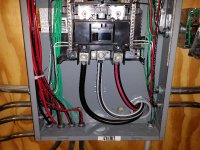
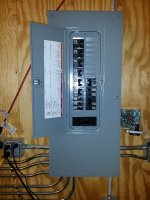
To avoid these ads, REGISTER NOW!

Will these 220 outlets pass wiring inspection?

pattenp

Well-known member
Joined
Jun 4, 2008
Messages
10,175
Location
Virginia - USA
(1)(a)(1-4)applies unless the equipment/devices are listed and marked otherwise, which means you can use 75C to size wire if the device is rated at 75C for conductors smaller than 1/0. You need to read (c)(1) to see when not to apply (a) or (b).

Here's a Mike Holt video explaining it. Start watching at about time 5:25.

See NEC 110.14(c)(1)(a)(1-4) and give us your comments. Thanks,

fnsane
 
To avoid these ads, REGISTER NOW!

pattenp

Well-known member
Joined
Jun 4, 2008
Messages
10,175
Location
Virginia - USA
Exactly. As an example if the breaker was listed as 60/75 and the outlet had no listing or was listed as 60C only then you'd have to use 60C and therefore size the conductor as 60C. That is when you follow the rule for 110.14(c)(1)(a).

This also shows it.

Kevin
 
OP
Y

ybnormal70

Well-known member
Joined
Jan 8, 2010
Messages
931
Location
Conway, SC
That is exactly what I am seeing also. My wire is marked 90 and the outlet and breaker are both 75. That to me at least means use the 75 table.

Kevin
 

alfredeneuman

Well-known member
Joined
Mar 3, 2011
Messages
4,580
Location
Fullerton, CA
There is a current thread on one of the Home Inspector forums dealing with this same subject.

"i understand 8 awg thhn wire is exceptable on a 50 amp circuit breaker if run three wire in conduit by itself , Question , does this mean that this would be a dedicated circuit to run a peice of equipment or is it ok to supply a subpanel that would run different circuits ?"

and the response:
"Respectfully, the question appears to indicate, to me, a sufficient lack of electrical understanding that I would recommend getting a qualified electrician to do what you need done."

When you read further they didn't question the #8 part, focusing just on the subpanel.
Even the Home Inspectors know that #8 is suitable for 50Amps

'Nuff Said
 
Last edited:
OP
Y

ybnormal70

Well-known member
Joined
Jan 8, 2010
Messages
931
Location
Conway, SC
Just spoke with our inspector!! I can NOT do multi outlets on any circuit over 20amps. I CAN use #8 THHN for a 50amp circuit circuit with #10 THHN for ground. He said "you will not have a problem with that".

This at least sums it up in my area for my particular situation going by 2012 IRC code anyway.

Thanks,

Kevin
 

green.bubbly

Well-known member
Joined
Dec 14, 2008
Messages
2,156
Location
Lafayette, LA
What is the reason you can not have multiple receptacles in a circuit over 20 amps? Just curious as to why you could have six 20A receptacles on a 20 amp circuit but can not have two 50 amp receptacles on a 50 amp circuit.
 
OP
Y

ybnormal70

Well-known member
Joined
Jan 8, 2010
Messages
931
Location
Conway, SC
2012 IRC code:

E3702.5 Branch circuits serving multiple loads or outlets.
General-purpose branch circuits shall supply lighting outlets, appliances, equipment or receptacle outlets, and combinations of such. Multi-outlet branch circuits serving lighting or receptacles shall be limited to a maximum branch-circuit rating of 20 amperes.

That is why.

Kevin
 
OP
Y

ybnormal70

Well-known member
Joined
Jan 8, 2010
Messages
931
Location
Conway, SC
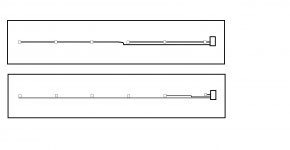
Lets see if I can get closer to getting this right this time. I know the first diagram will no longer work.

In the bottom diagram of this pic I am running the 2 outlets closest to the fuse panel completely separate. These 2 can continue to use the #8 with 3/4" conduit.

For the remaining 4 I'm thinking I can use 1-1/4" conduit with #6 hots. This would put 8 conductors and 1 ground wire in the conduit. I would derate the #6 from 75amp to 70% which would give me 52.5amps. This would be within fill at only 29%.

Due to the box fill I believe I would need to have a pass thru box that all the circuits pass thru and go up into each box separately like pictured.

Does this all sound correct? If not, please let me know what I can do differently. Is there a completely different way to do this that I am not thinking of? I just don't want to run 6 individual conduit runs to make it work.

Thanks to everyone for all the help.

Kevin
 

Attachments

  • wiring2.jpg
    wiring2.jpg
    55.2 KB · Views: 52

Mustang51js

Well-known member
Joined
Jan 24, 2014
Messages
1,734
Location
Haskell nj
Just get deep 1900 boxes and use bigger pipe. Pipe is cheap and easy to run if it's going straight. Prob better to run 2 -1 inch pipes than 1 -1 1/4 pipe.
 

green.bubbly

Well-known member
Joined
Dec 14, 2008
Messages
2,156
Location
Lafayette, LA
2012 IRC code:

E3702.5 Branch circuits serving multiple loads or outlets.
General-purpose branch circuits shall supply lighting outlets, appliances, equipment or receptacle outlets, and combinations of such. Multi-outlet branch circuits serving lighting or receptacles shall be limited to a maximum branch-circuit rating of 20 amperes.

That is why.

Kevin


Thanks but that did not explain why. :)
 
OP
Y

ybnormal70

Well-known member
Joined
Jan 8, 2010
Messages
931
Location
Conway, SC
That was the only explanation I was given by our inspector. I didn't question it. Figured it was like the little kid asking mom why, "because I said so". That's basically how I expected it to go anyway.

I would be interested to know why also, because I don't understand either.

Kevin
 
OP
Y

ybnormal70

Well-known member
Joined
Jan 8, 2010
Messages
931
Location
Conway, SC
Just get deep 1900 boxes and use bigger pipe. Pipe is cheap and easy to run if it's going straight. Prob better to run 2 -1 inch pipes than 1 -1 1/4 pipe.

I believe I already have those boxes. Mine are 4x4x2-1/8". Care to draw a diagram of how you recommend running it?

Thanks

Kevin
 

alfredeneuman

Well-known member
Joined
Mar 3, 2011
Messages
4,580
Location
Fullerton, CA
At some there's a point of diminishing returns both in materials and labor if you put too many wires in one conduit.
1-1/4" will be much harder to install, would require boxes that cost more, etc.

I'd personally run separate 1/2" conduit to the 4 remaining outlets. This would allow you to use #8 instead of #6 (at a saving of about 30 cents a foot). You'd expend less labor doing it that way, too.

Start at the panel, put the first length in, then the first length of the 2nd, and so forth. That way it will be easier to add or subtract from the length of the bends because you're doing them all one after the other. That way it's a cinch to run them parallel to each other.
 

wyliesdiesels

Well-known member
Joined
Aug 14, 2012
Messages
20,021
Location
Modesto, CA
(1)(a)(1-4)applies unless the equipment/devices are listed and marked otherwise, which means you can use 75C to size wire if the device is rated at 75C for conductors smaller than 1/0. You need to read (c)(1) to see when not to apply (a) or (b).

Here's a Mike Holt video explaining it. Start watching at about time 5:25.

Its always interesting and makes me chuckle when the nay sayers disappear after they make u go into extreme detail of how theyre misinterpreting code!!
 

Speedy Petey

Well-known member
Joined
Apr 22, 2012
Messages
1,430
Location
NY State
2012 IRC code:

E3702.5 Branch circuits serving multiple loads or outlets.
General-purpose branch circuits shall supply lighting outlets, appliances, equipment or receptacle outlets, and combinations of such. Multi-outlet branch circuits serving lighting or receptacles shall be limited to a maximum branch-circuit rating of 20 amperes.

That is why.

Kevin
It could very well be argued that this is not a "general use" branch circuit. That is certainly how I see it.
 
To avoid these ads, REGISTER NOW!

pattenp

Well-known member
Joined
Jun 4, 2008
Messages
10,175
Location
Virginia - USA
So what would you argue it as being? If you read the NEC definition of General Purpose Branch Circuit I guess you could argue it says appliances and not equipment. But if you read the definition of appliance that would kill that line of thought.

It could very well be argued that this is not a "general use" branch circuit. That is certainly how I see it.
 

Dick in Wisconsin

Well-known member
Joined
Mar 3, 2012
Messages
3,048
Location
Shawano, Wisconsin
I'm not an electrician.

I expect that the code is rooted in logic and valid engineering. What is the code protecting us from in this case?

If you put say four 50amp outlets on the same 50amp circuit (appropriate 50amp breaker and 50 amp wiring), what would happen if you plugged four 50amp devices in and turned them all on at the same time?

It would be interesting to know the logic and engineering behind this requirement in the code.
 

alfredeneuman

Well-known member
Joined
Mar 3, 2011
Messages
4,580
Location
Fullerton, CA
Exactly the same that would happen if you plug in a toaster, a microwave, a coffee maker, and electric grill into the same 20 amp kitchen circuit and turn them all on at the same time.

The circuit breaker would trip.
 
OP
Y

ybnormal70

Well-known member
Joined
Jan 8, 2010
Messages
931
Location
Conway, SC
That is about what I am thinking the code does, nothing really. This is a residential garage, the outlets are 10' apart. Pretty darn likely to never be used at the same time. Heck, I would even skip back and forth between circuits if they wanted me to. I have a dedicated air compressor outlet already, so that is not a concern. I just wanted to be able to move any item I have freely around the shop to use as and where it is needed at that moment in time.

I know I could make an extension cord cheaper, heck I already have a 50' one I purchased years ago. I just wanted them installed and to not have to worry about the cord 90% of the time. Oh well, still working on my decision as to how to fix.

Maybe I should make a semi-permanent extension cord splitter. Have a plug mounted in the back of a box, receptacle mounted on the front and a 10' cord going out the side with a box with receptacle mounted on it. Yeah, that sounds like the way to go. :) Probably no codes against that and definitely a whole lot safer "insert sarcasm here" :).

Thanks again for everyone's input,

Kevin
 
OP
Y

ybnormal70

Well-known member
Joined
Jan 8, 2010
Messages
931
Location
Conway, SC
Here's an update:

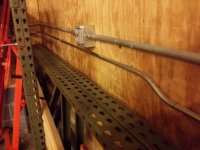
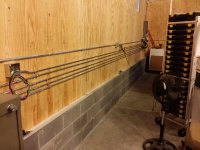
I pulled down my fist installation and started from scratch. I had to buy more wire and some 1/2" emt and fittings. Here are the pics of what I have run now. It is 6 individual circuits ran from the panel to each outlet. Don't much like the look of it, but it's growing on me.

Let me know what you think.

Kevin
 

Attachments

  • 220v 8awg wiring outlets (3).jpg
    220v 8awg wiring outlets (3).jpg
    131.4 KB · Views: 71
  • 220v 8awg wiring outlets (2).jpg
    220v 8awg wiring outlets (2).jpg
    135.3 KB · Views: 84
  • 220v wiring ran (15).jpg
    220v wiring ran (15).jpg
    90.8 KB · Views: 71
  • 220v wiring ran (12).jpg
    220v wiring ran (12).jpg
    87.3 KB · Views: 76
  • 220v wiring ran (9).jpg
    220v wiring ran (9).jpg
    90.3 KB · Views: 80
  • 220v wiring ran (6).jpg
    220v wiring ran (6).jpg
    96.9 KB · Views: 88
  • 220v wiring ran (1).jpg
    220v wiring ran (1).jpg
    105.6 KB · Views: 100

sublimate

Well-known member
Joined
Aug 4, 2010
Messages
776
Location
Colorado
It could very well be argued that this is not a "general use" branch circuit. That is certainly how I see it.

So what would you argue it as being? If you read the NEC definition of General Purpose Branch Circuit I guess you could argue it says appliances and not equipment. But if you read the definition of appliance that would kill that line of thought.

I did two circuits of 3 x 50amp outlets (for a total of 6 outlets) at my new build.
The electrician identified them as welding outlets (which is indeed what I plan to use them for) to pass inspection.

I got the impression that wiring for welding has special exemptions/rules in the code?
 

wyliesdiesels

Well-known member
Joined
Aug 14, 2012
Messages
20,021
Location
Modesto, CA
I did two circuits of 3 x 50amp outlets (for a total of 6 outlets) at my new build.
The electrician identified them as welding outlets (which is indeed what I plan to use them for) to pass inspection.

I got the impression that wiring for welding has special exemptions/rules in the code?

yes circuits for welders have special rules. the wire can be sized smaller than normal based on duty cycle of the welder, etc. The outlet(s) for the welder(s) has to be marked for welder only. Theres more but i wont go into it.
 
OP
Y

ybnormal70

Well-known member
Joined
Jan 8, 2010
Messages
931
Location
Conway, SC
My problem wasn't wire size. My issue was having more than one outlet per circuit is not allowed by our code.

Kevin
 

Aceman

Well-known member
Joined
Jan 28, 2007
Messages
2,513
Location
Eastern Oregon
Here's an update:

I pulled down my fist installation and started from scratch. I had to buy more wire and some 1/2" emt and fittings. Here are the pics of what I have run now. It is 6 individual circuits ran from the panel to each outlet. Don't much like the look of it, but it's growing on me.

Let me know what you think.

Kevin

You know you can run more than one circuit through a conduit/box right? You didn't need to pipe all six separately...
 
OP
Y

ybnormal70

Well-known member
Joined
Jan 8, 2010
Messages
931
Location
Conway, SC
That was the problem. Local code says only 1 outlet per circuit. Therfore I had to to run 6 circuits. Running 6 circuits in 1 conduit was going to be difficult. I would have to derate the wire and go with #6 and use I believe 1-1/4" conduit.

Doing the math on paper, this was the cheapest/easiest option for me that I knew of.

Kevin
 

laser3kw

Well-known member
Joined
Nov 17, 2012
Messages
7,276
Location
northen IL
here's how they solved it in upstate New York some time ago
just remember: you can't plug a 2 in with a 6....
 

Attachments

  • outlets.jpg
    outlets.jpg
    39.1 KB · Views: 107
Last edited:
OP
Y

ybnormal70

Well-known member
Joined
Jan 8, 2010
Messages
931
Location
Conway, SC
I have no idea what that pic is of. Looks like 2 outlets and a bunch of extension cords that are numbered to me. Is that what it is?

Kevin
 

moparsandharleys

Well-known member
Joined
Aug 21, 2013
Messages
81
Location
Gering NE
Sooo I am just starting wiring on my building.... If i were to mount and wire like your initial job but instead of having 6 50a outlets the first 5 i merely use as junction boxes w covers and put 1 outlet at the last location... ( to in theory move the receptacle to other locations if ever needed) Would this satisfy the code inspection?? Slippery slope logic...
 

pattenp

Well-known member
Joined
Jun 4, 2008
Messages
10,175
Location
Virginia - USA
If your locality enforces that code requirement then technically you could do that. The inspector may scratch his/her head as to why so many J-boxes.

Sooo I am just starting wiring on my building.... If i were to mount and wire like your initial job but instead of having 6 50a outlets the first 5 i merely use as junction boxes w covers and put 1 outlet at the last location... ( to in theory move the receptacle to other locations if ever needed) Would this satisfy the code inspection?? Slippery slope logic...
 
OP
Y

ybnormal70

Well-known member
Joined
Jan 8, 2010
Messages
931
Location
Conway, SC
I really don't see why you couldn't do that. That is something I actually thought about doing. Just leave a couple of loops of wire in each box to splice into later.

Kevin
 
OP
Y

ybnormal70

Well-known member
Joined
Jan 8, 2010
Messages
931
Location
Conway, SC
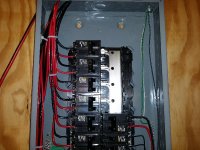
Finished wiring my panel yesterday. Ended up with 6 220v outlets down 1 wall and to the back of the shop, 1 dedicated 220v compressor outlet and 1 more outlet by the garage door for any possible outside work.

How does is look? Anything I need to possible change before I call for inspection? I know I still need to label the circuits on the door. Would labeling them 220 #1, 220 #2 and so on work? Or do I need to be more specific?

Thanks everyone for all the input.

Kevin
 

Attachments

  • 220v wiring finished (6).jpg
    220v wiring finished (6).jpg
    129.1 KB · Views: 38
  • 220v wiring finished (5).jpg
    220v wiring finished (5).jpg
    117.5 KB · Views: 37
  • 220v wiring finished (4).jpg
    220v wiring finished (4).jpg
    140.3 KB · Views: 44
  • 220v wiring finished (3).jpg
    220v wiring finished (3).jpg
    133.9 KB · Views: 42
  • 220v wiring finished (2).jpg
    220v wiring finished (2).jpg
    129.1 KB · Views: 49
  • 220v wiring finished (1).jpg
    220v wiring finished (1).jpg
    118 KB · Views: 58
  • 220v wiring finished (8).jpg
    220v wiring finished (8).jpg
    90.5 KB · Views: 39
To avoid these ads, REGISTER NOW!
Top Bottom