ganymede
Well-known member
Everyone knows about the old J.H. Williams pear head Superratchets . If not they’re shown in detail in us patent # 1,957,462 .
There are two important points to the patent. The first is the way the teeth of the pawl mesh with the gear when the ratchet is under load. The second is the connection between the selector lever and the pawl. They’re made with a bit of play between the two so the selector lever doesn’t flick back n forth as the ratchet is worked.
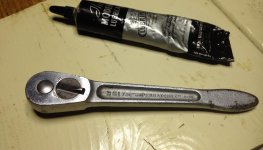
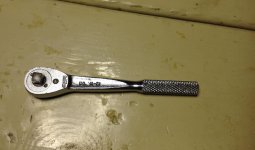
On my 3/8 drive b51 I noticed almost no play and the lever flicked annoyingly . I also noticed that unlike the patent drawings and other ratchets in my collection, the end of the selector lever didn’t pass though the body of the ratchet into a threaded hole (at least not one that was visible). I therefore had no choice but to ignore the fact that it was otherwise working perfectly and take it apart.
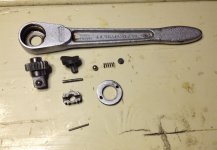
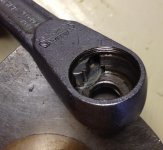
Inside there are slight differences. Everything is held in place by the wire that passes through the pawl and selector. Its made so that the ends fit in a small groove in the body of the ratchet. Also since the spring and ball are held in with a small set screw, taking it apart is much easier.
In the pics you can see two lengths of wire. The fat one (.098” thick) is the one that was in the ratchet when I got it. It was almost the same diameter as the hole through which it passed and that negated one of the provisions of the patent. I replaced it with thinner ( .055 “) but still rigid wire and that got everything almost perfect.
There are two important points to the patent. The first is the way the teeth of the pawl mesh with the gear when the ratchet is under load. The second is the connection between the selector lever and the pawl. They’re made with a bit of play between the two so the selector lever doesn’t flick back n forth as the ratchet is worked.
On my 3/8 drive b51 I noticed almost no play and the lever flicked annoyingly . I also noticed that unlike the patent drawings and other ratchets in my collection, the end of the selector lever didn’t pass though the body of the ratchet into a threaded hole (at least not one that was visible). I therefore had no choice but to ignore the fact that it was otherwise working perfectly and take it apart.
Inside there are slight differences. Everything is held in place by the wire that passes through the pawl and selector. Its made so that the ends fit in a small groove in the body of the ratchet. Also since the spring and ball are held in with a small set screw, taking it apart is much easier.
In the pics you can see two lengths of wire. The fat one (.098” thick) is the one that was in the ratchet when I got it. It was almost the same diameter as the hole through which it passed and that negated one of the provisions of the patent. I replaced it with thinner ( .055 “) but still rigid wire and that got everything almost perfect.