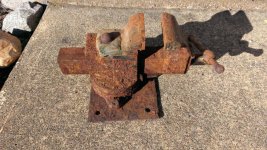
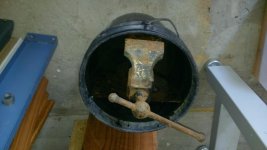
Barring the blasting, which is somethng I wouldn't suggest doing, getting the rear off and nut and handle out as you suggest would be simplest for persuading it apart. Rubber mallets, block of wood and hammer etc., pretty much anything subtle can also be used for doing the back and forwards shimmy for loosening the slide from the body.
Hello, Fretters,
I would, if I may, try to induce you to reconsider your opinion regarding salvage cleaning of rusted ferrous parts by media-blasting, particularly the use of 'ultra-fine' glass beads.
There are far too many bad examples of this class of work, done by those who won't take the time to learn the optimal techniques, and so leave the workpieces looking like the proverbial 'moon-scape'.
Blast-cleaning is a bit of a 'fine art', when done properly, with respect for the nature of the workpiece, and does require some care.
I've taught good technique to a great many of unskilled workers over the past thirty years' time, with those who are willing to be careful and patient achieving excellent result.
Its ever so simple, actually. The common form of blast system, which 'entrains' the media into the air blast stream, is not suitable for other than the 'rough' blasting commonly done for automotive cylinder heads and manifolds, where surface-texture is not a consideration.
The optimal blast system uses a 'pressure-pot', with air valving set up with regulators, so that the main blast stream may be varied down to 10-15psi., the feed air line above the media in the pot varied, and the density of media in the blast stream varied by a media valve at the bottom, or 'media feed' end of the pot, allowing for fine regulation of the media density in the blast-stream.
By varying the blast air pressure at the work-nozzle, and the density of the media in the blast-stream, one can adjust the actual abrasive quality of the blast-stream to suit the nature of the workpiece, and use 'just enough' media and pressure to remove surface rust or corrosion without pitting the surface of the workpiece.
One of the best examples of this work is the reclamation of the common older style of American carburetters, the Rochester, Stromberg, and Carter makes.
With varnish and dirt previously removed in a bath of ! part acetone to 1 part methylethylketone, water-rinsed, and dried, the various ports and bores are plugged, and the die-cast zinc-alloy bodies and air-horns gently blasted with ultra-fine glass beads, resulting in the parts looking 'bright' as new, with the smooth finish of the die-cast surfaces preserved. This is necessarily a slow and gentle process.
For cast iron and steel parts, indeed such as vices, one must use a higher blast pressure, and a higher density of media in the blast-stream. Again, done carefully, the original machined finishes are preserved, if not already rust-pitted. The blast cleaning will leave a bit of a 'frosted' appearance, which will clean up nicely with a gentle rub, using 400 or finer emery-paper, with some light oil/paraffin mix.
(yes, there are methods to artificially patinate a cleaned steel or iron surface, for an image of age and preservation, and fool all but the very knowledgeable, but such things are just not discussed in polite company)
It may be the case that, for example, a vice may have no rust, and a nice 'patina' on the machined surfaces, but many coats of paint of varying qualities and colours, often 'gummy' military enamel. To blast-clean the painted areas, one must first mask the machined areas with two or more thicknesses of masking-tape, then apply the strongest available 'paint-stripper' to the existing paint.
Allowing the paint-stripper to fully dry, and neutralise as much depth of paint as it will, the part is gently blasted to remove that layer of paint, and the stripper re-applied. Sometimes, with very thick paintwork, it may take several 'cycles' of stripper and blasting before the part comes clean.
This is easy work for an unskilled helper, who will work carefully, and always use suitable protective gear as provided, the best commercial paint-strippers being quite hazardous to human skin and especially to eyes.
cheers
Carla