1st year i had this heater on very windy days (west wind) it would kick out the heater and cycle. 2nd year i bought the endcap in the picture which is supposed to help, it did, no issues last year. Today the wind is heavy, swirling mostly out of the south and the heater kept cycling. Anything else i can do to help with this wind blowing out the heater issue?


You are using an out of date browser. It may not display this or other websites correctly.
You should upgrade or use an alternative browser.
You should upgrade or use an alternative browser.
Wind kicking out heater
- Thread starter mopar4u
- Start date


You could try a tee instead of the cap.
Going out the roof generally has less issues ove sidewall venting in regards to wind.
i knew out the side was a risk to this but was easier to do.
if i put a tee at the end instead of the cap, do i leave both ends of the tee open or cap one end? And would having the tee perp or parallel to the ground be better?
kelpaso1
MEMBER EMERITUS
You need a T and then a pipe up past the roof line for a proper draft. Why did you think this would work? Cap the bottom of the T.
nadogail
Well-known member
You have discovered that the easier way to addres a problem is often not the best way to solve it.
58Yeoman
Well-known member
I've got the same heater as you in my 24x40 metal building (75k), and I've got this cap on mine going out the wall. No problems what so ever in about 10 years.
Agree …….no up over the roof line on the horizontal power vent. TEE end cap will likely work. The TEE can be up and down or horizontal. Mushroom cap might also help.
Typical Instruction:
Horizontal Termination
The Horizontal Termination is used to terminate a horizontal vent system. There are several different Horizontal Termination styles available. These include the Mitered Termination Screen, an Elbow Termination and a Screen Termination. All Horizontal Terminations install the same way by connecting them to the vent pipe via standard Ring & Tab Connection method. The Horizontal Termination must terminate a minimum of 6” from the wall (See Fig. 16 & 17).


Typical Instruction:
Horizontal Termination
The Horizontal Termination is used to terminate a horizontal vent system. There are several different Horizontal Termination styles available. These include the Mitered Termination Screen, an Elbow Termination and a Screen Termination. All Horizontal Terminations install the same way by connecting them to the vent pipe via standard Ring & Tab Connection method. The Horizontal Termination must terminate a minimum of 6” from the wall (See Fig. 16 & 17).
FredWanaker
Well-known member
I am not a heater guy but a thought came to mind. Perhaps the wind gusts are essentially pressurizing and depressurizing the garage, or cross flowing thru that vent. Is the garage properly vented so that pressure differentials on different sides of the house can be equalized thru something other than the heater?
dfiler2
Well-known member
That is a proper install, you might try terminating it a little closer to the building. It may be that the wind coming over that roof may be affecting it, is the wind coming directly at the wall or from the opposite direction. Also, the above poster may be on to something , next time it happens try leaving a door or window to the outside open a little.
Last edited:
Thanks for all the ideas. Today wind was coming mostly out of the south which would be directly at the vent. I do have a little room to shorten the termination, i want to make sure i clear the soffit/keep warm exhaust out of attic
Attachments

dfiler2
Well-known member
If you had the problem with the wind blowing directly at the termination cap I would not expect that shortening it would do any good. My next step would be to try the other style of high wind cap.
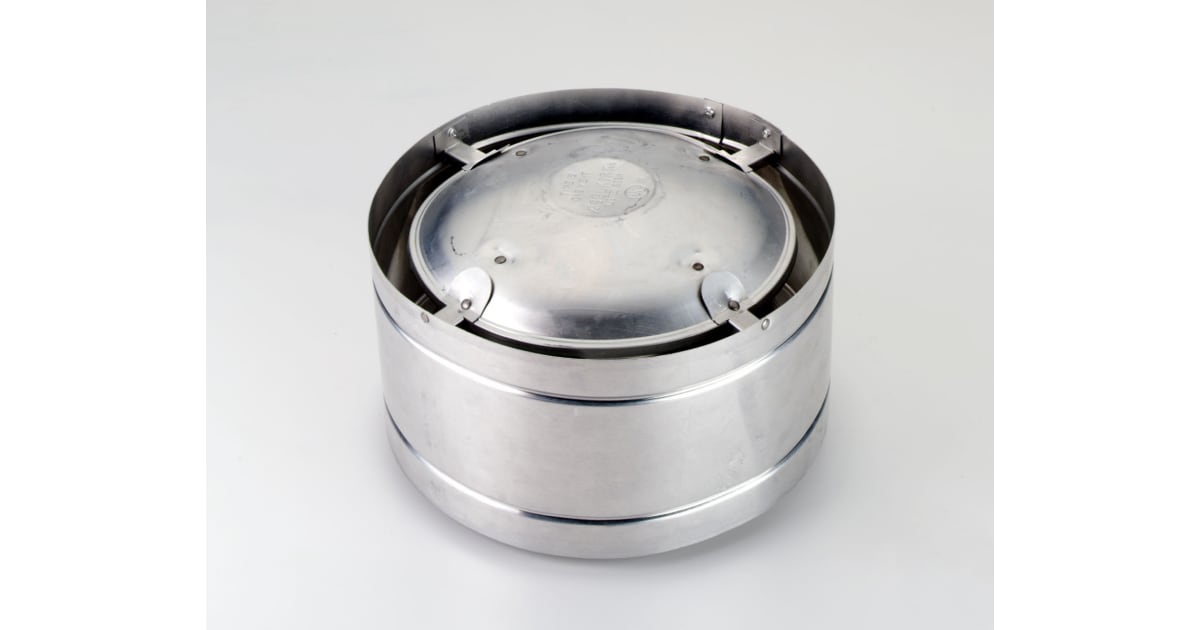
 www.build.com
Metalbest 106802 RV 6" Type B Gas Vent Hi-Wind Top | Build.com
Save on the Metalbest 106802 from Build.com. Low Prices + Fast & Free Shipping on Most Orders. Find reviews, expert advice, manuals, specs & more.
www.build.com
most codes are 18" clearance to the soffit, you will need to shorten the distance to the wall. This should help your problem with the wind getting in. however check your clearance on the install manual and the codes in your area.Thanks for all the ideas. Today wind was coming mostly out of the south which would be directly at the vent. I do have a little room to shorten the termination, i want to make sure i clear the soffit/keep warm exhaust out of attic
In order to have an approved UL listed system then no,All my venting is duravent. Can i only use duravent or will other type B brands work for the end piece?
Duravent also states no to use any other B vent brands "Do not mix and match"

It would be cheaper to build a wind shield out of sheet metal and fab around and fasten with zip screws. or buy a 24" and stick that through and silicone back up and throw cap back on? it looks like you have plenty of space from the soffit, but i could be wrong
you could try fabbing up something to see if it works firstI thought about a wind shield but wasnt sure about design.
ripperd
Well-known member
Wind is not even necessarily the problem, even if you shield it. The pressure differential of the inside of the garage to the vent outside could be increasing or decreasing the draft.
Another solution is to convert to separated combustion, and have the intake air coming in on the same side near where the exhaust is. Then the pressure differentail is minimal because they are both on the lee or windward side.
Another solution is to convert to separated combustion, and have the intake air coming in on the same side near where the exhaust is. Then the pressure differentail is minimal because they are both on the lee or windward side.
pcmeiners
Well-known member
Bring the oulet closer to the wall, then you need a barometric damper
Manuals for garage units that are power vented say NOT to use a barometric damper, if you did use one it has to be installed with safety measuresBring the oulet closer to the wall, then you need a barometric damper
A13. Do NOT use dampers or other devices in the vent or combustion air pipes. A14. Precautions must be taken to prevent degradation of building materials by flue products. A15. Single wall vent pipe must not pass through any unoccupied attic, inside wall, concealed space, or floor. A16. Uninsulated single wall vent pipe must not be used outdoors for venting appliances in regions where the 99% winter design temperature is below 32°F.
FredWanaker
Well-known member
did some quick googling. The cause is likely "back drafting" caused by pressure differential and not wind entering the combustion vent. Threads I could find indicated that horizontal vents are more prone to it because the momentum of the heat rising in the column is not present like in a vertical vent. You can test if it is a back draft by opening a door or window to see if it stops or lessens.
Surprised the pros have not weighed in:
If you look at the instructions B vent is NOT suppose to used in horizontal venting.
B vent may not be the cause of the “kicking out” the heater but it comes in play when swapping termination caps.
B vent in horizontal is subject to corrosion. Mine was a pro install prior to my purchased it rusted away in 5 years. Replaced with CAT III vent a few years back.
If you look at the instructions B vent is NOT suppose to used in horizontal venting.
B vent may not be the cause of the “kicking out” the heater but it comes in play when swapping termination caps.
B vent in horizontal is subject to corrosion. Mine was a pro install prior to my purchased it rusted away in 5 years. Replaced with CAT III vent a few years back.
OuchSurprised the pros have not weighed in:
E – HORIZONTAL VENTING – RESIDENTIAL 1. For horizontal residential installations these units are certified as Category I appliances. The vent may be single wall material minimum 26 GSG (0.46mm) galvanized steel or equivalent grade stainless steel. Venting A - General Recommendations and Requirements and C - Horizontal Venting General and E - Horizontal Venting - Residential.
As per the instructions
C – HORIZONTAL VENTING – GENERAL
Due to changes to Z83-8 2009 CSA2.6-2009, the use of single
wall B-Vent is no longer permitted as an acceptable material
when venting horizontally, this change covers both residential
and commercial installations. All horizontally vented units manufactured after July of 2011 must be vented as a CateroryIII Unit/Utility Heater in compliance with UL 1738 & ULS636. Common venting is not allowed when horizontally venting the unit
B – VERTICAL VENTS USING METAL VENT PIPE – COMMERCIAL AND RESIDENTIAL INSTALL ATIONS
MHU compact unit heaters are listed as Category I appliances for vertical vent installations.
1. MHU unit heaters are to be used with NFPA- or ANSI- approved chimneys, U.L. listed type B-1 gas vents, single wall metal pipe, or listed chimney lining system for gas venting where applicable, as well as the modifications and limitations listed in figure 2. Seal single wall vent material according to the section A - General Recommendations and Requirements.
C – HORIZONTAL VENTING – GENERAL
Due to changes to Z83-8 2009 CSA2.6-2009, the use of single
wall B-Vent is no longer permitted as an acceptable material
when venting horizontally, this change covers both residential
and commercial installations. All horizontally vented units manufactured after July of 2011 must be vented as a CateroryIII Unit/Utility Heater in compliance with UL 1738 & ULS636. Common venting is not allowed when horizontally venting the unit
B – VERTICAL VENTS USING METAL VENT PIPE – COMMERCIAL AND RESIDENTIAL INSTALL ATIONS
MHU compact unit heaters are listed as Category I appliances for vertical vent installations.
1. MHU unit heaters are to be used with NFPA- or ANSI- approved chimneys, U.L. listed type B-1 gas vents, single wall metal pipe, or listed chimney lining system for gas venting where applicable, as well as the modifications and limitations listed in figure 2. Seal single wall vent material according to the section A - General Recommendations and Requirements.
I saw it, and wasn't going to say anything. There are hundreds, probably thousands of these heaters installed every day with b-vent. I know, it is wrong, but it is pretty common practice. When I sold equipment at a HVAC supplier we sold ton of b-vent for unit heaters. Most installers did not care. We even had a disclaimer on the ordered that stated "Not for use with horizontal venting on unit heaters"
I didn't mention it because I doubt if he used the proper venting that it would matter for the problem he is having.
I didn't mention it because I doubt if he used the proper venting that it would matter for the problem he is having.
FredWanaker
Well-known member
so I did notice that the drywall isn't taped. Also noticed all the soffit vents, and that there appears to be no slope in the vent like the manufactures specify on horizontal installations. Hot air rises and does not goes sideways, air can flow thru all the drywall butts from the attic, and air can flow thru the attic with the soffit vents on that side. Who knows how much of a pressure differential is built into this installation, but it is enough to blow out the flame.
Picture angle, i did put a slope on the vent, 1/4” per foot down for water. Yes i used duravent type b, i know its not code. Before i decided to do it myself i had the vent install quoted by 3 hvac installers, all quoted type b, i know, doesnt make it right. Similar heater in my other garage was installed by an hvac installer, they used type b. Both heaters are power vents that dont get used much.
today, no wind, and worked fine. Im gonna play with the termination end cap. Heater doesnt get used much, i use about 100lbs LP every 2 years.
today, no wind, and worked fine. Im gonna play with the termination end cap. Heater doesnt get used much, i use about 100lbs LP every 2 years.
I stand corrected, my apologies.As per the instructions
C – HORIZONTAL VENTING – GENERAL
Due to changes to Z83-8 2009 CSA2.6-2009, the use of single
wall B-Vent is no longer permitted as an acceptable material
when venting horizontally, this change covers both residential
and commercial installations. All horizontally vented units manufactured after July of 2011 must be vented as a CateroryIII Unit/Utility Heater in compliance with UL 1738 & ULS636. Common venting is not allowed when horizontally venting the unit
B – VERTICAL VENTS USING METAL VENT PIPE – COMMERCIAL AND RESIDENTIAL INSTALL ATIONS
MHU compact unit heaters are listed as Category I appliances for vertical vent installations.
1. MHU unit heaters are to be used with NFPA- or ANSI- approved chimneys, U.L. listed type B-1 gas vents, single wall metal pipe, or listed chimney lining system for gas venting where applicable, as well as the modifications and limitations listed in figure 2. Seal single wall vent material according to the section A - General Recommendations and Requirements.
CraigStu
Well-known member
I can't find it now but..back in the day using wood stoves I 'think' I remember there was some kind of one way flapper for exhaust pipe. It let the exhaust out but would shut if wind tried to blow in toward the heater. Do these exist?
Its a draft blocker, yes they make them.I can't find it now but..back in the day using wood stoves I 'think' I remember there was some kind of one way flapper for exhaust pipe. It let the exhaust out but would shut if wind tried to blow in toward the heater. Do these exist?
CraigStu
Well-known member
Would a draft blocker help the OP's situation?