To avoid these ads, REGISTER NOW!

Winter Window Moisture

35k0

Well-known member
Joined
Feb 19, 2020
Messages
621
Location
Minnesota
We built our home in 2018, moved in Feb 2019. We have forced air with an air exchanger. We still get a lot of moisture on windows in the sub-zero winters here in Northern MN and it drives me nuts. When it's really cold, like today where it's -17 there is enough moisture to pool up on the sills and trim.
Anyone know of a solution, internet searches lead me to turn all ceiling fans on, kitchen exhaust, bathroom exhaust, yadda yadda yadda, that doesn't work. I have cranked the humidistat down to 25% just to see and no surprise, same issue just much less comfortable.
I talked to our HVAC guy and asked if the air exchanger was too small and he said no....
Honestly, I would rather have a less efficient, not frog's *** tightly sealed home than deal with this ****.
Anyone dealt with this and resolved it?
 
Last edited:
To avoid these ads, REGISTER NOW!

TurnipTruck

Well-known member
Joined
Aug 28, 2005
Messages
1,581
Location
Southcentral Alaska
What does the “air exchanger” look like? Is it a HRV or a ERV?
When my temperature is below approximately +10*F, my HRV spends up to half of its ON time defrosting itself before it even begins exchanging.
If you have an HRV, the exchanger has filters that get cleaned in the dishwasher annually. I don’t know anything about ERV maintenance; those are more of a Southern/humid thing.
 

pembol

Well-known member
Joined
Feb 13, 2014
Messages
274
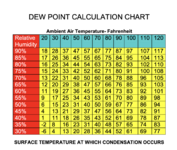
The condensation on your windows is because the temperature of the inside of your windows is below the dew point of the air inside your house. This causes the moisture in the air to condense on the windows b/c they are below the dew point. Here is the chart showing dew point temperature vs RH and ambient temperature:
1734015700840.png

There are only two ways to fix this, lower the humidity in the house, which reduces the dew point, or make the inside of the windows warmer to stay above the dew point. Lowering the humidity is easier, you can turn down your humidifier if you run one, or turn up your HRV. Keeping the windows warmer is harder - you can replace the windows with better windows, add storm windows or try adding film (which probably won't work as you will still get moist air between the film and window).

This has nothing to do with fans or how tightly sealed you house is.
 

fitter30

Well-known member
Joined
Jun 23, 2019
Messages
2,992
Location
Peace Valley,mo
Bath and kitchen stove hood fan all need to run 30 minutes after use to pull in drier outside air. Air vents should be centered in windows to help offset infiltration.
  • If the outdoor temperature is -20 degrees or lower, 15% indoor humidity is ideal.
  • If the outdoor temperature is -20 to -10 degrees, 20% indoor humidity is ideal.
  • If the outdoor temperature is -10 to 0 degrees, 25% indoor humidity is ideal.
  • If the outdoor temperature is 0 to 20 degrees, 30% indoor humidity is ideal.
  • If the outdoor temperature is 20 to 40 degrees, 35% to 40% indoor humidity is ideal.
 

4x4Pete

Well-known member
Joined
Aug 26, 2019
Messages
791
Location
Stroud
It sounds as though you aren't using a humidifier so the options are limited to more fresh air or finding and repairing the source of excess humidity. Is the air exchanger stand alone/fully ducted or is it dependant on the furnace operation? If it's fully ducted check the filters and make sure it operates as needed. It should have a humidistat connected. You will have to adjust it depending on the outdoor temperature as fitter30 described. If it is dependant on the furnace operation try running the fan constantly. Either way there is too much humidity and it needs to be dealt with for the well being of the house and occupants.
 

Fav Onefour

Well-known member
Joined
Jul 14, 2022
Messages
712
Location
MN cold and hot
@pembol , Summed it up nicely. Lower the humidity or warm the windows. There is no magic escape from the reality of window temp in relation to humidity level.

We have a frost setting on our controller. In simple terms the indoor humidity is adjusted for outdoor temps to prevent "frost" or condensation on windows.
You'd be shocked how dry indoor air will get to prevent condensation when it's super cold.

BTW, you can warm the windows some by letting air flow across the glass. Any type of blinds do better if you leave an airflow gap above the sill. Those fancy cellular blinds create a big temp differential if they are down all the way. Heavy drapes or curtains need to be opened.
 

lmg

Well-known member
Joined
Mar 17, 2023
Messages
96
pembol, fitter30 and BillK are all giving you good advise.

Let me tell you about my similar experiences. Living in north central New Mexico, we do have real winters here. I was using a wood stove for primary heat in my house, stove produced about 65k Btu/hr. The stove was in a south facing "sun room" which was originally built as a greenhouse, attached to the house. At some point this was converted to living space. I had fished electrical cable above the ceiling here, and saw there was about 2-3 inches of cellulose insulation above the ceiling. Cellulose was on clods like it was just dumped from the bags before the roof was decked, so minimal insulation in the ceiling since it was not mixed through the blower. Walls were almost all double pane windows, wood with aluminum cladding. Even with the wood stove in this room (about 12 ft wide and 24 ft long) the windows, especially the windows furthest from the wood stove had condensation on the glass which ran to the bottoms on the panes. I drilled holes in the ceiling (cathedral ceiling) at 2 ft OC and blew in fiberglass insulation until refusal at every hole. The next winter, there was no condensation as heat loss through the ceiling was greatly reduced, and the heat always takes the path of least resistance, through the windows now. So in my case, I warmed the window surfaces with ceiling insulation. Could do the same with wall insulation, but in both cases, it depends on what you have in place now.

So there you go, basic building science. Also warming the window glass by installing better windows will certainly help, you may have to do more.

By the way, my windows were wood with aluminum cladding. The worst ones rotted out from the inside out.

Not saying this is the fix for you, but this is something to consider. Here we are in the desert, so condensation on bottom of the roof deck is something to consider mostly in wetter climates. It has been about 5 years, but decking still feels solid to walk on. Will be reroofing this year so I will be pulling a couple of sheets of the decking and checking for moisture issues. If this is an issue, will replace the removed decking and install rigid foam over the deck then and deck over the added foam, and install new roof.

if you have to add rigid foam to the bottom or top of your roof deck, your international building code books prescribe how much rigid foam you need for your climate zone.

You may want to find an experienced person with a blower door and an infrared camera to look at your house. Improving performance of the building envelope conserves energy and makes the home more comfortable (warmer in winter), which would reduce the window condensation.

Good luck.
 

Denwood

Well-known member
Joined
Sep 22, 2014
Messages
4,200
Location
Thunder Bay, Ontario, Canada
We built our home in 2018, moved in Feb 2019. We have forced air with an air exchanger. We still get a lot of moisture on windows in the sub-zero winters here in Northern MN and it drives me nuts. When it's really cold, like today where it's -17 there is enough moisture to pool up on the sills and trim.
Anyone know of a solution, internet searches lead me to turn all ceiling fans on, kitchen exhaust, bathroom exhaust, yadda yadda yadda, that doesn't work. I have cranked the humidistat down to 25% just to see and no surprise, same issue just much less comfortable.
I talked to our HVAC guy and asked if the air exchanger was too small and he said no....
Honestly, I would rather have a less efficient, not frog's *** tightly sealed home than deal with this ****.
Anyone dealt with this and resolved it?
What kind of windows are we talking about? We're North of you, so colder. What works here are either triple glaze low E, or magnetic inner storms. No issues at -25 C, although cellular blinds completely covering the lower part of the window will still cause this issue as they insulate the glass/acrylic to the point that it drops below the dew point.

Obviously indoor humidity that is too high will cause this issue, but for most up north with an ERV or HRV, excessive drying is more the challenge. The ERV or HRV should set for about 20-25 CFM per occupant at minimum.
 

teknikfrog

Well-known member
Joined
Apr 29, 2023
Messages
216
1734015700840.png


This has nothing to do with fans or how tightly sealed you house is.
Yep.

Burden of living through winter months. It's cold and flu season and I want high humidity, but it's 5* outside so you have to run the humidifier lower.
 

allinon72

Well-known member
Joined
Jul 5, 2010
Messages
3,307
Location
Indianapolis
I have the same issue, my house was built in 2018. Humidity levels inside the house are normal at 45-50%, temp is set to 70-72 degrees. We have a fresh air intake system which doesn’t seem to do much. We’ve tried everything including keeping the curtains open to circulate the air around the windows. We’ve come to the conclusion that the windows **** and there isn’t much we can do about it. We live in a block of 8 homes, all by the same builder, who used the same line of windows (Anderson Silverline). Cheap junk, everyone complains about them.
 

Fav Onefour

Well-known member
Joined
Jul 14, 2022
Messages
712
Location
MN cold and hot
I have the same issue, my house was built in 2018. Humidity levels inside the house are normal at 45-50%, temp is set to 70-72 degrees. We have a fresh air intake system which doesn’t seem to do much. We’ve tried everything including keeping the curtains open to circulate the air around the windows. We’ve come to the conclusion that the windows **** and there isn’t much we can do about it. We live in a block of 8 homes, all by the same builder, who used the same line of windows (Anderson Silverline). Cheap junk, everyone complains about them.
How cold are outdoor temps when you see condensation? We can not run humidity that high in cold outdoor temps.

What do you mean by fresh air intake? Are you talking about a passive fresh air system or air exchanger? Even the best HRV exchangers bring in moisture. Outside cold air can still hold fairly high relative humidity percentages. If you are running high exchanger volume, it adds up.

As mentioned, condensation is mainly a result of temp differential on the glass surface combined with indoor humidity level. You need to know temps of the window glass and sash when talking about humidity levels to avoid condensation. You can check glass and sash temps with a cheap I.R. temp reader.

I don't know the glass units in Silverline windows. Most inert gas sealed units are fairly close in efficiency. Marketing is a big factor in price.
The bigger variation in window quality is seen around the edges of the glass. Shallow glazing doesn't isolate the edges as well. Some of the glass spacers on cheap units conduct temp through the unit. The I.R. reader will tell you if the edges are conducting cold temps. Junk windows with poor glazing may even leak air. In that case you would see condensation forming first around leaks.

I would not blame the windows until you know the exact surface temps relative to those 45-50% humidity levels. Verify temp readings on the glass and go to the chart to know what humidity level will prevent condensation.
 

allinon72

Well-known member
Joined
Jul 5, 2010
Messages
3,307
Location
Indianapolis
How cold are outdoor temps when you see condensation? We can not run humidity that high in cold outdoor temps.

What do you mean by fresh air intake? Are you talking about a passive fresh air system or air exchanger? Even the best HRV exchangers bring in moisture. Outside cold air can still hold fairly high relative humidity percentages. If you are running high exchanger volume, it adds up.

As mentioned, condensation is mainly a result of temp differential on the glass surface combined with indoor humidity level. You need to know temps of the window glass and sash when talking about humidity levels to avoid condensation. You can check glass and sash temps with a cheap I.R. temp reader.

I don't know the glass units in Silverline windows. Most inert gas sealed units are fairly close in efficiency. Marketing is a big factor in price.
The bigger variation in window quality is seen around the edges of the glass. Shallow glazing doesn't isolate the edges as well. Some of the glass spacers on cheap units conduct temp through the unit. The I.R. reader will tell you if the edges are conducting cold temps. Junk windows with poor glazing may even leak air. In that case you would see condensation forming first around leaks.

I would not blame the windows until you know the exact surface temps relative to those 45-50% humidity levels. Verify temp readings on the glass and go to the chart to know what humidity level will prevent condensation.

It starts happening in temps below freezing roughly, but more prevalent in the 25 or below range. The fresh air unit is a Aprilaire dehumidifier, but it's being used only on the air brought in from the outside. The thermostat is set to open a baffle that brings in the fresh air based on a curtain humidity setpoint (which I haven't messed with, can't remember what it is). The dehum function removes the humidity from the fresh air being brought in (not connected to the whole house to serve as a whole house dehumidifier). It also monitors outdoor humidity and will lock out and prevent this function if it's too high. I keep meaning to reverse engineer it to see if I can utilize it better.
 

BillK

Well-known member
Joined
Aug 24, 2006
Messages
9,360
Location
Beautiful Southern Maryland
I have the same issue, my house was built in 2018. Humidity levels inside the house are normal at 45-50%, temp is set to 70-72 degrees.
Wow. That would feel like an Amazon rain forest to me. We keep the temp at about 67-68 and run a humidifier to keep the humidity at about 35% That is with 20 - 35 degree outside temps.
 

Fav Onefour

Well-known member
Joined
Jul 14, 2022
Messages
712
Location
MN cold and hot
It starts happening in temps below freezing roughly, but more prevalent in the 25 or below range. The fresh air unit is a Aprilaire dehumidifier, but it's being used only on the air brought in from the outside. The thermostat is set to open a baffle that brings in the fresh air based on a curtain humidity setpoint (which I haven't messed with, can't remember what it is). The dehum function removes the humidity from the fresh air being brought in (not connected to the whole house to serve as a whole house dehumidifier). It also monitors outdoor humidity and will lock out and prevent this function if it's too high. I keep meaning to reverse engineer it to see if I can utilize it better.
I wonder if all the homes with window condensation are plumbed the same?

A dehumidifier moves a lot of air. That would be more than needed if used as an exchanger.
Which model do you have? I'm not familiar with their units using a baffle to switch between indoor and outdoor air.

I bet the lockout function is also monitoring outdoor temp.
It looks your condensation can be addressed with settings to get humidity to correct levels in relation to outdoor temp.

Try an experiment and turn off your exchanger. Heck, just unplug the thing. Let your heating system run and monitor indoor humidity. (I love those little digital units that can be used anywhere.) Keep an eye on humidity levels in various parts of the home. Buildings dry slowly and moisture in the materials takes time to draw. You will have drier air long before the materials. It helps to wipe water off the glass during the process of lowering humidity levels. With your scenario, the windows will stay clear with around ten points of humidity drop if the windows are installed correctly.

Once you confirm proper humidity levels, adjust the HVAC system to run in that range. It might take a little time figuring out the controls, but newer stuff is close to set and forget. I am a firm believer in the proper use of bath fans and hood vents as well. There is no need to have condensation on windows in newer homes unless it is by choice.
 

allinon72

Well-known member
Joined
Jul 5, 2010
Messages
3,307
Location
Indianapolis
I wonder if all the homes with window condensation are plumbed the same?

A dehumidifier moves a lot of air. That would be more than needed if used as an exchanger.
Which model do you have? I'm not familiar with their units using a baffle to switch between indoor and outdoor air.

I bet the lockout function is also monitoring outdoor temp.
It looks your condensation can be addressed with settings to get humidity to correct levels in relation to outdoor temp.

Try an experiment and turn off your exchanger. Heck, just unplug the thing. Let your heating system run and monitor indoor humidity. (I love those little digital units that can be used anywhere.) Keep an eye on humidity levels in various parts of the home. Buildings dry slowly and moisture in the materials takes time to draw. You will have drier air long before the materials. It helps to wipe water off the glass during the process of lowering humidity levels. With your scenario, the windows will stay clear with around ten points of humidity drop if the windows are installed correctly.

Once you confirm proper humidity levels, adjust the HVAC system to run in that range. It might take a little time figuring out the controls, but newer stuff is close to set and forget. I am a firm believer in the proper use of bath fans and hood vents as well. There is no need to have condensation on windows in newer homes unless it is by choice.

Actually it is made by Envirowise, an Ingersol Rand company. I think it's a rebadged Santa Fe. It states on the unit that it's a "70V ventilator/dehumidifier." To be clear, the baffle does not switch between the house return and the outside. The way it's plumbed, if the baffle is opened, it will pull from both, but the short run is from the outdoor air so that would be what's mainly pulled in. It has a switch on it that allows you to switch from "vent" to "dehum", I have it on dehum.
 
To avoid these ads, REGISTER NOW!
OP
3

35k0

Well-known member
Joined
Feb 19, 2020
Messages
621
Location
Minnesota
Wow, thanks for all the replies! Lots of good info.
The moisture tends to happen when we get to the -10 or lower temps.
the windows are Gerkin 4800 series
HRV is Broan 90S, it has no settings other than High and low speed (not sure what is best or what this is set to currently) that I can see other than the humidistat upstairs and the filter has never been cleaned. I took it out last year it showed no signs of being dirty. I should probably clean it anyways?
Main level home is finished 28x64 with 9' celings
Basement is unfinished, same dimensions (9' ICF basement).
 

pembol

Well-known member
Joined
Feb 13, 2014
Messages
274
The HRV should reduce the humidity in the house (assuming you are not also running an humidifier), you could try turning it up to high and see what happens to humidity and condensation.
 

Fav Onefour

Well-known member
Joined
Jul 14, 2022
Messages
712
Location
MN cold and hot
The HRV should reduce the humidity in the house (assuming you are not also running an humidifier), you could try turning it up to high and see what happens to humidity and condensation.
That works to a point.

Moisture holding capacity is different as temps change. The relative humidity numbers are often quite high in cold temps. I don't know how much the ratio drops as air is warmed in the home.

I'm sure there is a nice pretty chart for the exact ratios, but I can't find one.
 
OP
3

35k0

Well-known member
Joined
Feb 19, 2020
Messages
621
Location
Minnesota
The HRV should reduce the humidity in the house (assuming you are not also running an humidifier), you could try turning it up to high and see what happens to humidity and condensation.
Thanks! I have cranked it down to like 20% for a week or more and that is miserable. I do not run a humidifier.
I will check the unit and see if it is set to low or high and change that.
 

Denwood

Well-known member
Joined
Sep 22, 2014
Messages
4,200
Location
Thunder Bay, Ontario, Canada
Gerkin 4800 are double hung vinyl, sliders? If so, also likely double glazed. Unfortunately double hung sliders are about the worst for air sealing, and double glazing is not helping.

So playing with humidity may not offer a lot of relief. Inner magnetic acrylic storms will work.
 

hobie18

Well-known member
Joined
Apr 29, 2024
Messages
1,181
Earlier posts.
In general around 70 degrees, it takes 20 degrees to double or half the amount of moisture air can hold. Hotter air can hold more moisture. Colder air can hold less moisture than warmer air. Hence condensation, warming issues, recirc, fresh air. Etc. Clouds.

With insulation and seal... at least two issues arise.
Fresh air!
Moisture.
In a few places (should be everywhere) a heat exchanger etc., can be used to bring fresh air in and keep some of the conditioning. (Heat or cooling). Moisture can be handled too. Ever used a European clothes dryer?
If the windows are wet, imagine behind the walls and in obscure places.
Lower humidity. Lower the work load.
Where is the hunidifier in relation to the fresh air? Adding humidity to the fresh air, or to the dryest air, (usually at its highest temp fresh out of the furnace), defeats the purpose.
More info if needed
Tlwr
 
Last edited:

pembol

Well-known member
Joined
Feb 13, 2014
Messages
274
That works to a point.

Moisture holding capacity is different as temps change. The relative humidity numbers are often quite high in cold temps. I don't know how much the ratio drops as air is warmed in the home.

I'm sure there is a nice pretty chart for the exact ratios, but I can't find one.
Dew point is a conservative quantity unlike RH - so as the temperature of air changes, the RH will change (without adding or removing moisture) but the dew point stays the same - as long as you are above the dew and therefore are not condensing water out. Using the table I posted earlier you can figure out the change - for example if the outside RH is 90% and the temperature is 30F, if you take that same air and warm it up just to 60F, the RH drops to 30% - the dewpoint is the same at 28F.

If it is 0F out, and the RH is 99%, once you heat that air up to 70F, the RH is now 6%.
 

nadogail

Well-known member
Joined
Jan 23, 2009
Messages
32,032
Location
Coronado, CA
Obviously your house is in a location that has Cold weather and the moisture in the air condenses one the glass.

Raise the temperature, and the condensate won't freeze on the glass. Improved air circulation can help, moving to warmer location can eliminate the problem.

Global Warming might eventually make the problem go away.
 

couch67

Well-known member
Joined
Mar 18, 2016
Messages
1,409
Location
Ontario Canada
We're in similar climates, and I have found that running the furnace fan on low continously makes a big difference. We do have one window in a spare bedroom that is lower quality than the others, and it accumulates a lot of moisture even with the fan running. So we use the window film on that one and it eliminates the problem.
 

jollygreengiant

Well-known member
Joined
Nov 10, 2013
Messages
2,368
Location
Ontario, Canada
Good info in here on humidity levels in hones and condensation in windows. I was having that in a new addition with new windows. There was quite a bit of condensation in the windows anytime the outside temp dropped below freezing. I put a dehumidifier in that room and dropped the humidity from 60% or so down to the 40% range, and we are getting a lot less condensation.
 
OP
3

35k0

Well-known member
Joined
Feb 19, 2020
Messages
621
Location
Minnesota
The condensation on your windows is because the temperature of the inside of your windows is below the dew point of the air inside your house. This causes the moisture in the air to condense on the windows b/c they are below the dew point. Here is the chart showing dew point temperature vs RH and ambient temperature:
1734015700840.png

There are only two ways to fix this, lower the humidity in the house, which reduces the dew point, or make the inside of the windows warmer to stay above the dew point. Lowering the humidity is easier, you can turn down your humidifier if you run one, or turn up your HRV. Keeping the windows warmer is harder - you can replace the windows with better windows, add storm windows or try adding film (which probably won't work as you will still get moist air between the film and window).

This has nothing to do with fans or how tightly sealed you house is.

@pembol
Thank you, we have a Broan 90S HRV. I assume by "turning it up" you mean to drop the humidistat? All we have is a humidistat, I can adjust the humidity dial but I can't tell it to run constantly, if that makes sense?
This is the controller we have.
1735935586839.png

I have ran that at like 20% and we still get moisture.
We have an ICF basement, with a sump pit, the sump pit always has some water in it, even in the winter. The basement is unfinished. Not sure how much the sump pit water would affect whole home moisture? We get no moisture on the egress windows.
If the HRV isn't handling it for the upstairs humidity, should we look at adding a whole home dehumidifier?
 

hobie18

Well-known member
Joined
Apr 29, 2024
Messages
1,181
Less humidity. More heat. More exchanger. Make sure mold is not growing in the nether areas. Walls too. Get a moisture detector/humidity detector. Use in all the rooms. Find out what the humidity is in different parts. Kepp the humidifier off until the exchanger etc is up to speed. And the other issues are solved.
 
OP
3

35k0

Well-known member
Joined
Feb 19, 2020
Messages
621
Location
Minnesota
Less humidity. More heat. More exchanger. Make sure mold is not growing in the nether areas. Walls too. Get a moisture detector/humidity detector. Use in all the rooms. Find out what the humidity is in different parts. Kepp the humidifier off until the exchanger etc is up to speed. And the other issues are solved.
Thanks,
I don't have a humidifier.
I don't have a Dehumidifier
I DO have an HRV, running it at 20% isn't helping a ton.
Is the solution to get a whole house DE-humidifier?
 

danski0224

Well-known member
Joined
Jan 29, 2005
Messages
13,516
Location
Near Naperville, IL
Thanks,
I don't have a humidifier.
I don't have a Dehumidifier
I DO have an HRV, running it at 20% isn't helping a ton.
Is the solution to get a whole house DE-humidifier?
How many people? Showers every day? Cooking at home?

If there's enough people and those people are doing things that generate moisture, and if the house is "tight" (whatever that means), then the normal ambient humidity level might be too high.

Is the sump pit sealed? As in a lid that fits tightly?

Do you know what the humidity level is, inside your home?

These are good general guidelines for indoor humidity:


If you are consistently higher than the recommended humidity levels at the given temperature ranges, then you might need a dehumidifier- but a dehumidifier that is made to operate in a basement... but there could be building issues too.
 

pembol

Well-known member
Joined
Feb 13, 2014
Messages
274
@pembol
Thank you, we have a Broan 90S HRV. I assume by "turning it up" you mean to drop the humidistat? All we have is a humidistat, I can adjust the humidity dial but I can't tell it to run constantly, if that makes sense?
This is the controller we have.
1735935586839.png

I have ran that at like 20% and we still get moisture.
We have an ICF basement, with a sump pit, the sump pit always has some water in it, even in the winter. The basement is unfinished. Not sure how much the sump pit water would affect whole home moisture? We get no moisture on the egress windows.
If the HRV isn't handling it for the upstairs humidity, should we look at adding a whole home dehumidifier?
Yes, drop the humidistat so that it runs more often and hopefully lower the humidity enough to prevent condensation, it looks like you could even try turning it to continuously on. If that doesn't solve the issue, it seems like a dehumidifier is your next best option, followed by doing something about the windows. Good luck!
 
OP
3

35k0

Well-known member
Joined
Feb 19, 2020
Messages
621
Location
Minnesota
Just an update on this, When the temps are near zero or below, I started running the humidistat between 20-25% when the moisture just starts to develop on the windows and that has made a huge difference.
Thanks everyone for all the help.
 

Denwood

Well-known member
Joined
Sep 22, 2014
Messages
4,200
Location
Thunder Bay, Ontario, Canada
Just an update on this, When the temps are near zero or below, I started running the humidistat between 20-25% when the moisture just starts to develop on the windows and that has made a huge difference.
Thanks everyone for all the help.
That sounds about right. That humidistat likely triggers high speed mode on your HRV. When you mentioned the HRV filters were clean, that would suggest it has not run much. Moisture is one way to control an HRV, but modern building science suggests that interior air quality is of primary concern. We don’t look at moisture at all with our system…it’s automated on CO2 and VOC levels.

You should confirm that the HRV is also running even if the humidistat is set above interior moisture levels.
 
To avoid these ads, REGISTER NOW!
Top Bottom