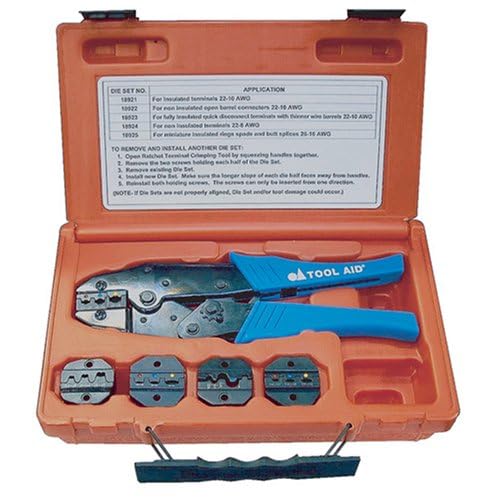
Overpriced, I'm sure. I've used 20 or more ratcheting crimpers in my time on the water, and I've yet to find any that were different, other than ones with removable/replaceable crimp dies. Intheir page, the exclaim "smallest gripping width ever known". That's not a good thing at all. If its too narrow for the crimp connector, it's useless. Maybe its a German-English translation error, I dunno.
I'm not saying thats not a good crimper, I'm sure it is. I just don't believe that you have to spend $200 on a ratcheting crimper for regular crimps. You DO for the MS (MilSpec) connectors we use on some oceanographic equipment. Just the turrets and dies are in the thousand dollar range for some of them.
Like sharkytm, I too do a lot of 12/24V marine wiring. If you plan to do more than a couple of crimps, definitely get a ratcheting crimper. They won't release until you have made a good crimp, and the Ancor brand also double crimps - providing a second crimp for strain relief.
A dedicated stripper is well worth the savings in time and frustration.
Also I found that the nylon insulated terminals are more reliable than the PVC covered type which will occasionally crack during crimping.
And yes, wiring exposed to moisture should be "tinned" to prevent corrosion.
Anchor makes the best, for sure. They are extremely pricey, and I've found that nylon ones covered with 2 layers of glue-lined heatshrink are just as good. Even the Anchors I cover with one extra layer of heatshrink, as an insurance policy.
"I could go on for hours about this (I do marine wiring, and encounter this debate a lot), but for most things, solder and 2 layers of glue-lined heatshrink is better than any crimp."
When I was redoing the wiring in my boat I was going to go with solder (yes I can solder correctly) and three boat guys all told me to use crimps instead because of the vibration, they claim it breaks down the solder joint. It sounded like BS until the 3 one said the same thing. Big debate among the boat guys, solder VS crimp?
Yup, still an ongoing debate. Here's my take:
An electrical connection is only as good as the material and tool being used, and the tool (ha) doing the work.
A bad solder joint with heatshrink covering it will fail just as often as a bad quality crimp improperly crimped with a pair of needle-nose pliers.
Here's the difference. If the solder joint fails, the heatshrink will keep the wires from separating. If the crimp fails, the wires will come apart, possibly starting a fire, shorting out the battery, or draining the battery. The solder joint has one kind of electrical connection (the solder) and one kind of mechanical connection (the heatshrink). The crimp has a 2-in-1 system.
No matter what, use good quality crimps, good tools, and ADHESIVE-LINED heatshrink tubing, or use a good soldering iron, hi quality solder and flux, and ADHESIVE-LINED heatshrink tubing. Anything exposed to water or corrision should use tinned marine-grade wire.
I really like this crimper. I have the matco version but the matco one is just a rebadged version of this.
Same as the S-O, and the Klein.
I got the right amount of force applied when I hear my knuckles pop.

There's a good chance you've over crimped the connector, and induced fatigue in the crimp. It'll fail when it gets whacked and the crimp falls apart. Also, what if you are crimping 22G wire (like for radars) and 10G wire (for 20A applications), your hands are more than strong enough to completely obliterate the insulation on the 22G crimp, and nowhere near strong enough to cause the cold-welding in the 10G.
Ratcheting is the way to go. Hands are not usually strong enough to get a good crimp. You should be able to pull hard on the wire and not have it come out.
I bought this set years ago. Taiwan but good quality. I don't use the one with yellow handles anymore.
The good old ABYC "3 tugs" method.
That set is probably identical to the one I linked to earlier, I really like the removable and replaceable jaws, plus it lets me work with non-insulated crimps too.


 OUCH!
OUCH!


 I know the crimpers are pretty expensive, like $300+. They work great though.