To avoid these ads, REGISTER NOW!

Wire Crimping set

To avoid these ads, REGISTER NOW!

HolisticPerformance

Well-known member
Joined
Jan 24, 2009
Messages
104
Location
LKY
When it comes to crimping, buy and use only this:

http://buy1.snapon.com/catalog/item.asp?P65=&tool=hand&item_ID=15611&group_ID=797&store=snapon-store&dir=catalog

Perfect crimps are a mandatory part of my job, and a less than perfect crimp will lead to big issues. When it comes to stripping, I use a separate tool altogether:

http://www.professionalequipment.com/klein-tools-wire-strippers-cutters-solid-stranded-wires-10-18-awg-11055/wire-strippers/


I'm not nearly as passionate about the strippers, but I like them very much. As far as a two-in-one tool, I am not in favor of them. Stripping/crimping can be a three-********, and having seperate tools to do the job properly seems to make it much easier.
 
Last edited:

mickeyone

Well-known member
Joined
May 31, 2007
Messages
198
Location
northern NJ
Thomas and Betts crimping tools rock.The ratcheting ones are great.The Ones from Klein are also pretty standard in pro circles.The cheesy ones that come with the crimps ****.Dont waste your time on the cheapies,They are not all that pricey and having a good crimp is essential for optimum conductance.
 

sharkytm

ALLIANCE MEMBER
Joined
May 17, 2008
Messages
596
Location
Pocasset, MA
DON'T!
Buy a high-quality RATCHETING crimper. The jaws on that POS are so narrow you'll just crush the connectors without cold-welding the copper. I could go on for hours about this (I do marine wiring, and encounter this debate a lot), but for most things, solder and 2 layers of glue-lined heatshrink is better than any crimp.
If you have to crimp, get high quality tin-coated copper connectors, use at least one layer of glue-lined heatshrink over the whole thing if its a **** crimp, or at least covering the crimp if its a connector, and use a ratcheting crimper with the correct die, and the wire inserted the correct way.
If done correctly, both are very reliable. Solder, IMHO, is superior in a lot of ways, but a properly done crimp is good.

They make crimps with built-in heatshrink. They are very good, but I'd still put another layer of heatshrink on them.

:edit: The snap-on crimper linked earlier is just a WAY overpriced copy/same thing as others sell. Klein sells one for way less, plus thats not the best tool for insulated crimps.
http://www.amazon.com/dp/B0006M6Y5M/?tag=atomicindus08-20
Here's a cheap, decent ratcheting crimper. The interchangable dies match different kinds of crimps, non-insulated, insulated, etc.
http://www.sjdiscounttools.com/ta18920.html
 
Last edited:

Monte

Well-known member
Joined
Dec 23, 2008
Messages
12,665
Location
Germany
6191003.jpg


http://rennsteig.us
 

LoneGunman

Well-known member
Joined
Mar 27, 2007
Messages
2,081
Location
The Gunshine state
Yup, I just had to laugh when I clicked the SO link, that is NOT a QUALITY crimper. Is it fine for the stuff you will most likely use it for? You bet it is, there are also a TON of identical crimpers out there for less money. When you speak of quality crimpers you are now in the ratcheting crimper category, a quality ratcheting crimper will not crimp without the proper amount of force where the non ratcheting type can be over or under torqued.

Odds are you do not need a ratcheting crimper and I am not suggesting you get one unless you feel you need one, my point to this post is that it is laughable to claim a Snap On non ratcheting hand crimper is the only way to get quality crimps as suggested by the poster above, in fact ,odds are his crimps are not very high quality nor would most peoples crimps be high quality with that type of crimper, too many variables come into play, fatigue, strength, ETC.
 

HolisticPerformance

Well-known member
Joined
Jan 24, 2009
Messages
104
Location
LKY
Yup, I just had to laugh when I clicked the SO link, that is NOT a QUALITY crimper. Is it fine for the stuff you will most likely use it for? You bet it is, there are also a TON of identical crimpers out there for less money. When you speak of quality crimpers you are now in the ratcheting crimper category, a quality ratcheting crimper will not crimp without the proper amount of force where the non ratcheting type can be over or under torqued.

Odds are you do not need a ratcheting crimper and I am not suggesting you get one unless you feel you need one, my point to this post is that it is laughable to claim a Snap On non ratcheting hand crimper is the only way to get quality crimps as suggested by the poster above, in fact ,odds are his crimps are not very high quality nor would most peoples crimps be high quality with that type of crimper, too many variables come into play, fatigue, strength, ETC.

yep, you win.
 

redsky49

Well-known member
Joined
Jan 21, 2009
Messages
582
Location
near the coast in eastern North Carolina
Like sharkytm, I too do a lot of 12/24V marine wiring. If you plan to do more than a couple of crimps, definitely get a ratcheting crimper. They won't release until you have made a good crimp, and the Ancor brand also double crimps - providing a second crimp for strain relief.
A dedicated stripper is well worth the savings in time and frustration.
Also I found that the nylon insulated terminals are more reliable than the PVC covered type which will occasionally crack during crimping.
And yes, wiring exposed to moisture should be "tinned" to prevent corrosion.
 

LoneGunman

Well-known member
Joined
Mar 27, 2007
Messages
2,081
Location
The Gunshine state
"I could go on for hours about this (I do marine wiring, and encounter this debate a lot), but for most things, solder and 2 layers of glue-lined heatshrink is better than any crimp."

When I was redoing the wiring in my boat I was going to go with solder (yes I can solder correctly) and three boat guys all told me to use crimps instead because of the vibration, they claim it breaks down the solder joint. It sounded like BS until the 3 one said the same thing. Big debate among the boat guys, solder VS crimp?
 

LoneGunman

Well-known member
Joined
Mar 27, 2007
Messages
2,081
Location
The Gunshine state
I got the right amount of force applied when I hear my knuckles pop. :D

LOL and at what PSI does Merk's knuckles pop? I visited your links, crimps look perfect, my only problem was a claim that a manual crimper is the BEST there is. I have an Idea ratcheting crimper with the changeable jaws, I have the jaws but I rarely use it, I usually just grab my Klein crimpers.
 

HolisticPerformance

Well-known member
Joined
Jan 24, 2009
Messages
104
Location
LKY
Mercedes Benz provides solder-filled **** connectors, connectors with lots of our replacement pig-tails, etc. Work very nicely - crimp and heat. Takes care of the shrink wrap as well as the solder inside. Have seen them elsewhere online, but $$$$.
 

Tool Pants

Well-known member
Joined
Oct 4, 2008
Messages
1,249
Location
San Jose CA
Ratcheting is the way to go. Hands are not usually strong enough to get a good crimp. You should be able to pull hard on the wire and not have it come out.

I bought this set years ago. Taiwan but good quality. I don't use the one with yellow handles anymore.
 

Attachments

  • crimper.JPG
    crimper.JPG
    58.7 KB · Views: 149
To avoid these ads, REGISTER NOW!

JB740i

Well-known member
Joined
Jan 3, 2007
Messages
615
Location
Central Florida
Ratcheting is the way to go. Hands are not usually strong enough to get a good crimp. You should be able to pull hard on the wire and not have it come out.

I bought this set years ago. Taiwan but good quality. I don't use the one with yellow handles anymore.

I just got the same one off of Amazon. Checked it out with a guy who works for me who is an electrician by trade. Thought it looked okay.

I'm using an American Autowire wiring harness to redo my FJ40. Haven't really started yet beyond removing the old harness...
 

sharkytm

ALLIANCE MEMBER
Joined
May 17, 2008
Messages
596
Location
Pocasset, MA
Overpriced, I'm sure. I've used 20 or more ratcheting crimpers in my time on the water, and I've yet to find any that were different, other than ones with removable/replaceable crimp dies. Intheir page, the exclaim "smallest gripping width ever known". That's not a good thing at all. If its too narrow for the crimp connector, it's useless. Maybe its a German-English translation error, I dunno.
I'm not saying thats not a good crimper, I'm sure it is. I just don't believe that you have to spend $200 on a ratcheting crimper for regular crimps. You DO for the MS (MilSpec) connectors we use on some oceanographic equipment. Just the turrets and dies are in the thousand dollar range for some of them.
Like sharkytm, I too do a lot of 12/24V marine wiring. If you plan to do more than a couple of crimps, definitely get a ratcheting crimper. They won't release until you have made a good crimp, and the Ancor brand also double crimps - providing a second crimp for strain relief.
A dedicated stripper is well worth the savings in time and frustration.
Also I found that the nylon insulated terminals are more reliable than the PVC covered type which will occasionally crack during crimping.
And yes, wiring exposed to moisture should be "tinned" to prevent corrosion.
Anchor makes the best, for sure. They are extremely pricey, and I've found that nylon ones covered with 2 layers of glue-lined heatshrink are just as good. Even the Anchors I cover with one extra layer of heatshrink, as an insurance policy.

"I could go on for hours about this (I do marine wiring, and encounter this debate a lot), but for most things, solder and 2 layers of glue-lined heatshrink is better than any crimp."

When I was redoing the wiring in my boat I was going to go with solder (yes I can solder correctly) and three boat guys all told me to use crimps instead because of the vibration, they claim it breaks down the solder joint. It sounded like BS until the 3 one said the same thing. Big debate among the boat guys, solder VS crimp?
Yup, still an ongoing debate. Here's my take:
An electrical connection is only as good as the material and tool being used, and the tool (ha) doing the work.
A bad solder joint with heatshrink covering it will fail just as often as a bad quality crimp improperly crimped with a pair of needle-nose pliers.
Here's the difference. If the solder joint fails, the heatshrink will keep the wires from separating. If the crimp fails, the wires will come apart, possibly starting a fire, shorting out the battery, or draining the battery. The solder joint has one kind of electrical connection (the solder) and one kind of mechanical connection (the heatshrink). The crimp has a 2-in-1 system.

No matter what, use good quality crimps, good tools, and ADHESIVE-LINED heatshrink tubing, or use a good soldering iron, hi quality solder and flux, and ADHESIVE-LINED heatshrink tubing. Anything exposed to water or corrision should use tinned marine-grade wire.

I really like this crimper. I have the matco version but the matco one is just a rebadged version of this.
Same as the S-O, and the Klein.
I got the right amount of force applied when I hear my knuckles pop. :D
There's a good chance you've over crimped the connector, and induced fatigue in the crimp. It'll fail when it gets whacked and the crimp falls apart. Also, what if you are crimping 22G wire (like for radars) and 10G wire (for 20A applications), your hands are more than strong enough to completely obliterate the insulation on the 22G crimp, and nowhere near strong enough to cause the cold-welding in the 10G.
Ratcheting is the way to go. Hands are not usually strong enough to get a good crimp. You should be able to pull hard on the wire and not have it come out.
I bought this set years ago. Taiwan but good quality. I don't use the one with yellow handles anymore.
The good old ABYC "3 tugs" method. :)
That set is probably identical to the one I linked to earlier, I really like the removable and replaceable jaws, plus it lets me work with non-insulated crimps too.
 
Last edited:

FakeName

Well-known member
Joined
Nov 10, 2008
Messages
171
Location
San Diego, CA
Sharky- I'd be interested in more details of the tools and tech you use. Which crimps do you like? Which soldering iron and solder meets your specs?

Crimping and connectors has always been an area for my self-improvement.

Thanks.

fn
 
OP
R

RickP330

Well-known member
Joined
Apr 12, 2007
Messages
831
Location
Middle Island, NY
:shocking:
I just wanna buy a tool and now I have to read through all this
:lol_hitti
Awsome stuff, thank's for that thread Merk - I guess I have some studying to do before I pull the trigger.
RickP
 

48548

Well-known member
Joined
May 14, 2008
Messages
4,015
Location
Phoenix
Toptul, some people on here love them and i am thinking about them also... Mike will hook you up if you order before this weekend... Look up the reviews on this site.
 

cweagle

Active member
Joined
Aug 16, 2007
Messages
31
Hot spit, DMC makes some nice crimpers.

I am mostly an electrical engineer, and do some wrenching on the side. I know that some EE's never get out from behind their computers, but I started as an assembly tech while in college and worked my way up from there. I've crimped and soldered probably tens of thousands of connectors, from maybe 8GA to smaller than 30GA.

There's no universal answer, but here's my input. A well-soldered connection is an excellent electrical conductor. Really really good. 'Well-soldered', however, means that you have shiny copper, good solder, flux, a clean iron tip, and enough hand-steadiness (or a clamp or something) to not make a cold solder joint (this is what happens when you jiggle or move the connection while it is still semi-liquid). This is not always easy to do, say, under a dashboard. A soldered connector also needs to be properly strain-relieved. When you solder multi-core wire (throw away the solid-core if the thing you are wiring moves or vibrates even a little, it will fatigue on you very quickly) the solder wicks into the strands and stiffens them into a virtual solid core. Where the solder ends, the wire quickly goes from stiff to flexible. This is where any stress on the wire will concentrate, and cause it to fatigue. If you can support the wire past this point (say, with well-fitting cable clamp) you can reduce the vibration and fatigue.

In many places, however, this is not really possible. The wiring harness hanging off your distributor on the way over to the ignition box has a connector on it that would be hard to immobilize. So crimped wire is the way to go here. The crimp, and the houing for the crimp, spread the stress out over more wire length and reduce fatigue. (As an aside, NASA uses a lot of crimped connections on flying equipment for this reason).

Every crimped wire connection that I have made that I want to trust, I have used a ratcheting crimper. Every connector type (and there are thousands, trust me!) has it's own special crimper. And I have worked at places that won't brink and eye at buying a $600 hand crimper for one kind of connector, because that's what guarantees a good connection. Now, at home, I'm not going to pay that much, but I will spend $50 for a ratcheting crimper for the common barrel/spade/etc type connectors. It means that I don't have to worry about the integrity of my connections. Every one is the same as the other, and a manufacturer has figured out how much pressure is required to properly crimp a given size.

It's like a torque wrench for your wires. Yeah, you could snug those lug nuts down with a breaker bar, and _maybe_ you'll be close too, but don't you want to be _sure_ ?
 

Merkava_4

Banned
Joined
Dec 26, 2007
Messages
14,518
Location
Clovis, CA.
Hot spit, DMC makes some nice crimpers.

I am mostly an electrical engineer, and do some wrenching on the side.

crimp-12.jpg


Have you tried the circular indent tools? They're for **** splice connections. They have 4 pins and the splice connector is in the center of them. When you squeeze the handles, the pins move in simultaneously and put a crimp on all 4 sides of the connector.

The tool is a ratcheting crimper like the terminal crimper above, and so it won't let go until the proper crimp is completed.

The splice connectors are proprietary to the tool and color coded per wire size. They also have a color coded matching heat shrink tube that goes with them.

When the Aviation Electrician is repairing an engine wiring harness that requires multiple splices, he'll cut the wires at different lengths so the that the splices are staggered like this:

.........._____
..................._____
............................_____
....................................._____

That way when the wires come together in a zip tied bundle, they'll have a narrow streamlined profile. ;)
 
Last edited:

redsky49

Well-known member
Joined
Jan 21, 2009
Messages
582
Location
near the coast in eastern North Carolina
Those HF crimpers look very similar to the Ancor brand of Crimper. What is not clear from a pic is how accurately they will work. Glad you are satisfied. Ratchets are definitely the way to go.

Speaking of tool lust, I borrowed an 18V portable hydraulic crimper to install crimp-on connectors on 500MCM cable. For those not familiar with this designation, this is a wire about the size of a fire hose. From start to finish took about 6 seconds to apply 12 tons of pressure to the fitting. Now that was a definite Tim Allen moment. Way cool. This was for a high output inverter installation. Really hurt to give that tool back.
 

CAT_serviceman927

Well-known member
Joined
Jun 25, 2008
Messages
569
Location
Michigan
crimp-12.jpg


Have you tried the circular indent tools? They're for **** splice connections. They have 4 pins and the splice connector is in the center of them. When you squeeze the handles, the pins move in simultaneously and put a crimp on all 4 sides of the connector.

The tool is a ratcheting crimper like the terminal crimper above, and so it won't let go until the proper crimp is completed.

The splice connectors are proprietary to the tool and color coded per wire size. They also have a color coded matching heat shrink tube that goes with them.

When the Aviation Electrician is repairing an engine wiring harness that requires multiple splices, he'll cut the wires at different lengths so the that the splices are staggered like this:

.........._____
..................._____
............................_____
....................................._____

That way when the wires come together in a zip tied bundle, they'll have a narrow streamlined profile. ;)

These look similar to the crimpers we use at work for our terminals. They are from a company called Deutsch (sp?) I think.:headscrat I know the crimpers are pretty expensive, like $300+. They work great though.
Edit: Here is the website: http://www.deutsch.net/deutsch-home.aspx
 

Treeman

Well-known member
Joined
Jan 4, 2008
Messages
545
Location
Michigan
Wow! When I asked about crimping technique some months ago, some asked if I was stupid, and implied that crimping was easier than ***.....just do it. Yet I knew that the marine, aviation, and others took this procedure VERY serious.

This thread has not helped the OP much, since it has varied from recommendations of Harbor Freight tools to VERY expensive industrial tools.

Could we discuss this more in depth and come up with a set of recommendations for the serious diy'er for auto and home care? I appreciate the industrial quality crimp systems for the marine/aviation industry, but I am not going to spend hundreds of $ for this.

What are good crimpers to consider?

Pliar type (Ideal, KLein, Channellock, others?)

Ratchet type: Solid vs. multiple jaws???? Brands...can we narrow a few brands down to ease us OCD types.

Connectors: How about ones that are available over the counter or locally.


I have a few observations/questions. The Klein pliar types I looked at were machined poorly compared to Merks Ideals. I saw three variations in the shape of the "male" crimp part.......poor quality control in my view on the Kleins.


Connectors....will these pliar types, and especially the different ratchet types, work with all brands of connectors??? Or, should I use Thomas and Betts connectors with T and B crimpers???? Are crimpers/connectors standardized among brands?

Insulated vs. plain connectors?

Again, is it possible to develop some cook book recommendations here for a handful of affordable brands and basic workable techniques?
 
Last edited:

Stephenw

Well-known member
Joined
Dec 21, 2006
Messages
1,911
Location
Utah
Speaking of tool lust, I borrowed an 18V portable hydraulic crimper to install crimp-on connectors on 500MCM cable. For those not familiar with this designation, this is a wire about the size of a fire hose.

That's a bit of an exaggeration. 500 MCM with THHN insulation has a diameter of .95 inches.
 

tsumetai-kokoro

Well-known member
Joined
May 15, 2007
Messages
48
many of the big headache intermittent failures i've had to dg in the past have been due to good and bad solder joints failing. GOOD AND bad ones. the problem isn't the solder, it's the wire. most everything important on a car was designed to survive 100kmi. nothing wire-wire on a car comes from the factory soldered because the joint won't handle the environment. people think they're so smart soldering tyco/amp, molex, weatherpacks either because they think solder is the best or they don't have the crimper for it. they all fail. the only thing solder is really good at is pipe and PCB- ideally niether are allowed to flex at all

fancy ratchet crimper is nice, but it's also slower. i use the klein for everything but i also have an interchangeable jaw non-ratcheting crimper for amp and weatherpack connections. i also have that stupid deutshe crimper someone gave it to me. i've never used it because i do cars not airplanes.

so basically. do you torque your lugs with a NIST traceable +-.5% torque wrench? no? klein crimper at home depot will do the job outstanding and last damn near forever. practice until perfect. get the feel of too much and too little. i get crimps bulk from TRC12volt.com and waytekwire.com.
 

paramudduck

Well-known member
Joined
May 24, 2007
Messages
1,758
Location
ohio
About the size of the reel mounted booster lines on old pumpers. We used them on small brush fires and such.
 
OP
R

RickP330

Well-known member
Joined
Apr 12, 2007
Messages
831
Location
Middle Island, NY
redsky49;385301I borrowed an 18V portable hydraulic crimper to install crimp-on connectors on 500MCM cable. For those not familiar with this designation said:
Just happen to have 1000 MCM cable bundle on my desk. We have the same crimper, nice stuff, but I'm doing automotive and electronic type work :bounce:
RickP
0_IMAG0500.jpg
 

redsky49

Well-known member
Joined
Jan 21, 2009
Messages
582
Location
near the coast in eastern North Carolina
Just happen to have 1000 MCM cable bundle on my desk. We have the same crimper, nice stuff, but I'm doing automotive and electronic type work :bounce:
RickP
0_IMAG0500.jpg

There you go. :) Though in my case I used a diesel locomotive cable with, I think, 1400+ strands. This let me make a 6" radius turn which the large strand cables can not do. Crimp-on fittings looked very similar. My crimper formed a triangular crimp on the fitting that worked real well for me.
Sorry for the thread hijack.
 

george4

Well-known member
Joined
Feb 18, 2006
Messages
773
Location
N California
Could we discuss this more in depth and come up with a set of recommendations for the serious diy'er for auto and home care? I appreciate the industrial quality crimp systems for the marine/aviation industry, but I am not going to spend hundreds of $ for this.

What are good crimpers to consider?

Pliar type (Ideal, KLein, Channellock, others?)

Ratchet type: Solid vs. multiple jaws???? Brands...can we narrow a few brands down to ease us OCD types.

Connectors: How about ones that are available over the counter or locally.

Connectors....will these pliar types, and especially the different ratchet types, work with all brands of connectors??? Or, should I use Thomas and Betts connectors with T and B crimpers???? Are crimpers/connectors standardized among brands?

Insulated vs. plain connectors?

Again, is it possible to develop some cook book recommendations here for a handful of affordable brands and basic workable techniques?

Good questions? Bump
 

burger

Well-known member
Joined
Jun 6, 2005
Messages
981
Location
Erf
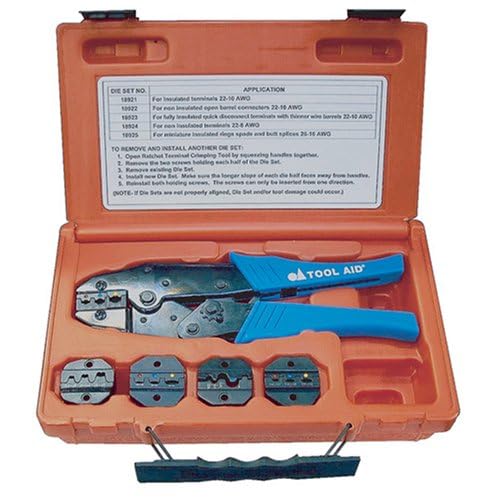
Treeman: I consider myself a "serious diy'er" as you describe. I have a Tool Aid brand ratcheting crimper similar to this one:

51ae53xPZhL._SS500_.jpg


I originally purchased mine specifically for Weatherpak connections, but ended up so pleased with it that I purchased additional dies to do spark plugs and insulated and uninsulated connectors. It's a really nice tool.

I also have a Klein non-ratcheting crimper that does the job well and is easier to use in tight spaces.
 
To avoid these ads, REGISTER NOW!
Top Bottom