To avoid these ads, REGISTER NOW!

Wiring through a duplex receptacle

bczygan

Well-known member
Joined
Nov 4, 2009
Messages
22,002
Location
DETROIT! Arsenal of Scrappers
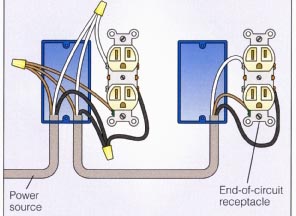
So I'm pulling power off an existing receptacle for an additional one or switch and light. I see diagrams online like this:
2-outlets-in-series.jpg


Is there any reason I can't avoid the use of so many pigtails by doing it like this:
elcircuitend.jpg


Bill
 
To avoid these ads, REGISTER NOW!

ForceFed70

Well-known member
Joined
Apr 27, 2010
Messages
3,441
Location
BC, Canada
What you want to do would work but is bad practice. Those stab-lock connections at the back of the plug are prone to failure and it makes replacing the plug a bigger job.
 

wyliesdiesels

Well-known member
Joined
Aug 14, 2012
Messages
19,983
Location
Modesto, CA
What you want to do would work but is bad practice. Those stab-lock connections at the back of the plug are prone to failure and it makes replacing the plug a bigger job.

Huh? The OP made no mention of using the push terminals aka back stabs, on the outlet.

The main reason for pig tailing as shown in the first pic is that if the outlet fails, the downstream outlets will still work.

If u wire through the outlet, just be sure to wrap the wire around the screqs or use backwired spec grade outlets with pressure plates. At home depot, theyre called professional grade and are $5-$6 each.
 

Richard Cranium

Well-known member
Joined
Apr 22, 2011
Messages
18,552
Location
central Washington
Most people use the pigtail to keep from all the power you use down stream don't have to go through the first outlet. It will cause the first outlet to burn out.
 

nadogail

Well-known member
Joined
Jan 23, 2009
Messages
31,894
Location
Coronado, CA
Pig tails are IMHO the best way to go. You can replace an outlet without having remake all the connections in the box.
 

theoldwizard1

Well-known member
Joined
Feb 22, 2011
Messages
43,073
Location
SE MI
DIY electrician. I have installed my fair share of duplex outlet and never have used the pigtail method.
 

finn

Well-known member
Joined
Mar 27, 2005
Messages
16,179
Location
The UP, God's country
The metal connecting bars on the sides of the outlet look to be as large a cross section as the 14 or 12 gage wire used to run the circuit. That's why they are made like that.

I'm no electrician but I have never seen pigtails used in outlet circuits.

Through wire the outlets.

Pigtails would make replacing a bad outlet easier, but I've never had an outlet fail, either.
 

Eriehunter

Well-known member
Joined
Mar 14, 2014
Messages
189
I have installed thousands of outlets in residential and commercial buildings.

Install according to first diagram, the second is prone to problems because you are using the outlet itself as the connection instead of a pig tail. Don't use the stab in on the back of the outlets, use the screw connections, the stab ins are prone to failure.
 
OP
B

bczygan

Well-known member
Joined
Nov 4, 2009
Messages
22,002
Location
DETROIT! Arsenal of Scrappers
What befuddles me, is that even on the first diagram, the white and black wires connect to different sides of the duplex, utilizing the pass through to power the other half, so it must be adequate, right?

Bill
 

wingnut_1

Well-known member
Joined
May 25, 2012
Messages
335
Location
Midwest USA (Wisconsin)
What befuddles me, is that even on the first diagram, the white and black wires connect to different sides of the duplex, utilizing the pass through to power the other half, so it must be adequate, right?

Bill

I noticed that also BC. FWIW, I have always used the screws and not the push-in method.
 

MikeF2316

Well-known member
Joined
Dec 29, 2012
Messages
9,605
Location
Thornhill, ON
Not to hijack the thread, but do you need to use a wire nut on the grounds? Is that just to hold them together better?
Plus in all the "pro" jobs I see, the ground wire always goes straight to the ground screw in the bottom of the box before it goes on to its other jobs.
 
OP
B

bczygan

Well-known member
Joined
Nov 4, 2009
Messages
22,002
Location
DETROIT! Arsenal of Scrappers
Not to hijack the thread, but do you need to use a wire nut on the grounds? Is that just to hold them together better?
Plus in all the "pro" jobs I see, the ground wire always goes straight to the ground screw in the bottom of the box before it goes on to its other jobs.

For metal boxes?

These boxes are all plastic. And the system has no ground wires, so the grounds are of no use anyway.

Bill
 

Ironhorse74

MEMBER EMERITUS
Joined
Nov 10, 2014
Messages
998
Location
The Pacific North Wet
Not to hijack the thread, but do you need to use a wire nut on the grounds? Is that just to hold them together better?
Plus in all the "pro" jobs I see, the ground wire always goes straight to the ground screw in the bottom of the box before it goes on to its other jobs.


I am interested in the answer to this also. On my first circuit I just twisted the grounds together without a wire nut. The more I thought about it the more I didn't like it. So on the next two circuts I wire nutted the grounds.

Brad
 
OP
B

bczygan

Well-known member
Joined
Nov 4, 2009
Messages
22,002
Location
DETROIT! Arsenal of Scrappers
I am interested in the answer to this also. On my first circuit I just twisted the grounds together without a wire nut. The more I thought about it the more I didn't like it. So on the next two circuts I wire nutted the grounds.

Brad

I think there is some kind of crimp as well.


rtaImage


My biggest worry is routing the bare ground wires so they don't contact the power wires or screws.

Bill
 

larry4406

Well-known member
Joined
Jan 27, 2006
Messages
18,940
Location
Northern Virginia
I use the screws. In on one set and out on the other. So does the electricians that wire all the homes for the company I work with.
 
To avoid these ads, REGISTER NOW!

theoldwizard1

Well-known member
Joined
Feb 22, 2011
Messages
43,073
Location
SE MI
I'm no electrician but I have never seen pigtails used in outlet circuits.

Through wire the outlets.

Pigtails would make replacing a bad outlet easier, but I've never had an outlet fail, either.

Replacing some outlets at my son's house a while ago, he insisted on pigtail because an apprentice friend of his says that was the way he was taught. The only reason was to make replacements easier. I told him it that was the way he wanted it, then he could do it himself. It took him more than twice as long.
 

Showkey

"MEMBER EMERITUS"
Joined
Aug 9, 2014
Messages
8,638
Location
Wausau WI
If we are talking potential point of failure or problems down the road ..........pig tail with twist cap or screw connection on the outlet. My vote screw connection wins for a "better" connection.

Especially in DIY situation were the pig tail, wire twist and cap can all be done wrong or poorly.
 
Last edited:

theoldwizard1

Well-known member
Joined
Feb 22, 2011
Messages
43,073
Location
SE MI
And the system has no ground wires, so the grounds are of no use anyway.

Consider installing some 3 prong GFCI outlets. They ARE legal on non-grounded system (with the supplied sticker) and make it SO MUCH EASIER to plug in 3 wire appliances or power strips.
 
OP
B

bczygan

Well-known member
Joined
Nov 4, 2009
Messages
22,002
Location
DETROIT! Arsenal of Scrappers
Consider installing some 3 prong GFCI outlets. They ARE legal on non-grounded system (with the supplied sticker) and make it SO MUCH EASIER to plug in 3 wire appliances or power strips.

Well, I could do that.

I'm working my way back from the outside of the system toward the panel. Right now it's just adding a receptacle here and a switch and light there, where I need them. When I get to the old work, I will be pulling new grounded wire to replace the existing cloth covered stuff.

Bill
 
OP
B

bczygan

Well-known member
Joined
Nov 4, 2009
Messages
22,002
Location
DETROIT! Arsenal of Scrappers
My other question was going to be about pre-made pigtails or make your own from the NMB. Another discussion on the net says everyone makes their own unless the customer is paying for pre-made.

Bill
 

wyliesdiesels

Well-known member
Joined
Aug 14, 2012
Messages
19,983
Location
Modesto, CA
For metal boxes?

These boxes are all plastic. And the system has no ground wires, so the grounds are of no use anyway.

Bill

Are u extending the existing 2-wire circuits or just replacing outlets and switches?

If extending then that is NOT code permissable.
 

Slowgsr

Well-known member
Joined
Nov 14, 2014
Messages
610
Location
Southern ontario
My other question was going to be about pre-made pigtails or make your own from the NMB. Another discussion on the net says everyone makes their own unless the customer is paying for pre-made.

Bill

I didn't even know their was premade.

I've installed literally thousands of ressy grade, always around the screw. Pigtail on rare occasions like... If I have 3 or more wires in the box.

I use spec grade depends on the receptacles use, or lack of ever being used.
 

checkthisout

Well-known member
Joined
Sep 5, 2008
Messages
5,232
Pigtails save time during replacement????

You're talking like 10 extra seconds to undo 2 more screws. With pigtails, you're adding more wiring to stuff into the box and another point of failure that can't be easily seen once the nuts are stuffed into the box (LOL).
 

Dick in Wisconsin

Well-known member
Joined
Mar 3, 2012
Messages
3,048
Location
Shawano, Wisconsin
You can't just twist the ground wires together, you must use a nut or a crimp.
I like these
27631d1393809444-ground-wire-question-green-wire-nut.jpg

So do I. Just put 30 or 40 outlets in new 1000sf shop and wish I would have had them.

DIY electrician who has read scores and scores of posts about wiring on the GJF (and take very special note when a pro electrician speaks), watched a bunch of YouTube videos, and talked to the master electrician on my building about my strategy.

This is my approach to wiring outlets:

1. I will NOT buy "back stabbed" outlets. Those are the ones that "look" easy to use because you "just" push the wire in and away you go. In my opinion, they are POS especially if you're going to be running serious amps through them. The might be fine for a lamp or clock radio ... but if you're going to plug a compressor or tool in that uses 10 or 12 amps you could be asking for trouble. Over time the spring in back gets weak, the contact point is limited, and arcing can occur (I've seen arcing in outlets I've looked at in our 25 y/o house.

2. If you are working in existing remove the back stabbers and toss them (don't give them away). If you're working in new (or have tossed the back stabbers) buy ONLY "back wired" outlets. Those are the "pro", "performance" outlets at the big box store. You have MUCH larger contact points for the electricity to flow through and those contact points are held in very tightly with a screw. The link below helps explain the differences. Rather than use the term "back stab", they use the term "back wire using the QuickWire (tm) method". It also provides some explanation for the difference between "residential" and "commercial" outlets (i.e. why commercial are more expensive).

http://www.handymanhowto.com/electrical-outlets-side-wire-versus-back-wire/

3. If you have downstream outlets or a switch or a fixture, don't put the incoming wire on the top of the outlet and the outgoing on the bottom. That forces the electricity for the downstream outlets to "flow through the outlet". Put the incoming and outgoing wires on either the top or the bottom under the same screw.

4. I don't like to pigtail. Takes up too much room in the box in my opinion.

5. The ground wires should be linked together with a wire nut. I make a pigtail out of spare wire when I need it. I like what's in the picture above.

I don't understand/have trouble with three things, maybe the pro electricians can help me:

1. On the better outlets that are "back wired", why isn't the ground back wireable? Why only the screw.

2. When I do have to pigtail and use a wire nut, I have one hell of time getting all the wires in the wire nut to stay put while I tighten the wire nut, and one wire often is prone to not getting seated properly and coming out of the wire nut. Any suggestions?

3. I would rather not side wire, because when I get the loop in there and tighten the screw down, it seems like the wire wants to escape from under the screw and I'm concerned I'm not getting as good of contact with the side wiring that I get with back wiring under the clip.
 
Last edited:

checkthisout

Well-known member
Joined
Sep 5, 2008
Messages
5,232
3. If you have downstream outlets or a switch or a fixture, don't put the incoming wire on the top of the outlet and the outgoing on the bottom. That forces the electricity for the downstream outlets to "flow through the outlet". Put the incoming and outgoing wires on either the top or the bottom under the same screw.

I don't think that's within code or a good idea.

It would be ok on outlets (Decora GFCI's come mind) that have a screw and a tab designed to anchor two wires, but on normal outlets, not. One wire per screw. The bus bar can more than adequately handle the current.
 
Last edited:

Dick in Wisconsin

Well-known member
Joined
Mar 3, 2012
Messages
3,048
Location
Shawano, Wisconsin
I don't think that's within code or a good idea.

What isn't within code or a good idea?

Putting both the incoming and outgoing wires on either the top or bottom of the outlet (under the same screw and clip)?

Or putting the incoming and outgoing under different screws and clips? (i.e. incoming on the top and outgoing on the bottom)

Let me clarify. I'm using either Decora GFCI or Decora duplex and back wiring them.

I can see that putting two wires under the screw of a side wired outlet would be wrong and bad to do.
 
Last edited:

checkthisout

Well-known member
Joined
Sep 5, 2008
Messages
5,232
What isn't within code or a good idea?

Putting both the incoming and outgoing wires on either the top or bottom of the outlet (under the same screw and clip)?

Or putting the incoming and outgoing under different screws and clips? (i.e. incoming on the top and outgoing on the bottom)

You can't put two wires under the same screw unless the outlet is designed to put two wires under one screw in which case it will have a clip and two slots for wires.
 
To avoid these ads, REGISTER NOW!
Top Bottom