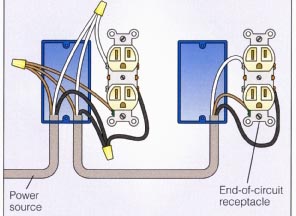
You can't just twist the ground wires together, you must use a nut or a crimp.
I like these
So do I. Just put 30 or 40 outlets in new 1000sf shop and wish I would have had them.
DIY electrician who has read scores and scores of posts about wiring on the GJF (and take very special note when a pro electrician speaks), watched a bunch of YouTube videos, and talked to the master electrician on my building about my strategy.
This is my approach to wiring outlets:
1. I will NOT buy "back stabbed" outlets. Those are the ones that "look" easy to use because you "just" push the wire in and away you go. In my opinion, they are POS especially if you're going to be running serious amps through them. The might be fine for a lamp or clock radio ... but if you're going to plug a compressor or tool in that uses 10 or 12 amps you could be asking for trouble. Over time the spring in back gets weak, the contact point is limited, and arcing can occur (I've seen arcing in outlets I've looked at in our 25 y/o house.
2. If you are working in existing remove the back stabbers and toss them (don't give them away). If you're working in new (or have tossed the back stabbers) buy ONLY "back wired" outlets. Those are the "pro", "performance" outlets at the big box store. You have MUCH larger contact points for the electricity to flow through and those contact points are held in very tightly with a screw. The link below helps explain the differences. Rather than use the term "back stab", they use the term "back wire using the QuickWire (tm) method". It also provides some explanation for the difference between "residential" and "commercial" outlets (i.e. why commercial are more expensive).
http://www.handymanhowto.com/electrical-outlets-side-wire-versus-back-wire/
3. If you have downstream outlets or a switch or a fixture, don't put the incoming wire on the top of the outlet and the outgoing on the bottom. That forces the electricity for the downstream outlets to "flow through the outlet". Put the incoming and outgoing wires on either the top or the bottom under the same screw.
4. I don't like to pigtail. Takes up too much room in the box in my opinion.
5. The ground wires should be linked together with a wire nut. I make a pigtail out of spare wire when I need it. I like what's in the picture above.
I don't understand/have trouble with three things, maybe the pro electricians can help me:
1. On the better outlets that are "back wired", why isn't the ground back wireable? Why only the screw.
2. When I do have to pigtail and use a wire nut, I have one hell of time getting all the wires in the wire nut to stay put while I tighten the wire nut, and one wire often is prone to not getting seated properly and coming out of the wire nut. Any suggestions?
3. I would rather not side wire, because when I get the loop in there and tighten the screw down, it seems like the wire wants to escape from under the screw and I'm concerned I'm not getting as good of contact with the side wiring that I get with back wiring under the clip.