You're being given some quality advice. From some that are probably master craftsman. Enough to drown you. I respect AE Adam and his opinion, and I think he's spot on. Save his advice, and look at it again and again, as you learn enough to make use of it. In the interest of where you are at, and how to learn, I'm going to give you some not as good, but I think more applicable advice for your level. Remember the principle of how we learned as a baby: Crawl, Walk, Run. Learn to crawl, then walk, and then apply the nuances of the experts.
I have no woodworking pedigree. I'm a hack, a guy that can do some specific wood carving, enough to be well respected for it. I am not a fine woodworker, not a wood carver, not an expert. But, I think I can speak to the level of someone that is starting out and wants to learn.
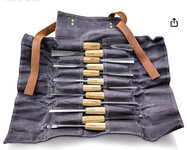
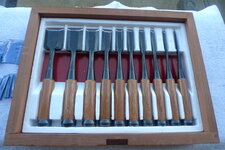
You've got some appropriate chisels. That's a good start, and light years ahead of where many start with a couple of old nail dented, grinder sharpened carpenters chisels. Now your tasks should be to learn to use them, and learn to sharpen them.
For general learning purposes, I'm going to put in a plug for a book. Yes, an old fashioned, paper book. This guy address how blades cut, how to sharpen them, etc. Not just for chisels, but for everything, it's an incredible learning experience that will help you sharpen AND use blades.

For the purpose of wood chisels, sharpening can be as simple or as complex as you want to make it. Fine woodworkers argue and share techniques all the time, how to hone, strop, polish, multi bevel, shape, grind, etc. Great advice if you need it; you'll know when you need it, but that won't be at first. At first, concentrate on getting a consistent bevel and a good edge. Personally, I've never moved beyond that. I just sharpen the chisels and use them. No fancy honing, stropping, multiple stones, etc. I have japanese stones, india stones, multiple arkansas grades, carborundum, machinist slip stones, a belt grinder, a wet sharpener system, a planer and chisel sharpener, etc. I typically use a total of 4 diamond hones, and could get by with 1.
I use a jig similar to the one you referenced earlier, a Veritas system one from Lee Valley. It's great for putting on the initial correct bevel, and for correcting poorly sharpened chisels you pick up used. I normally sharpen by hand after the first setup, and rarely go back to the jig unless I damage an edge. For severely damaged tools, I use the belt grinder, wet grinder and planer blade sharpener to shape them to rudimentary form.
When you start out, use the jig to shape (if needed) the edge of the flat chisels, and to sharpen it. Use a medium diamond or other stone, and then touch up the edge and the back flat of the straight chisels with a fine diamond or stone. Now, go and use that to do some cuts. If you bought the book, use his advice on shearing, rocking, etc cuts to test different techniques so you can learn how the blades work. Test different angles with the blade, and try bevel up or down to see how that affects the cut. Resharpen the edge or touch it up as needed. See how the sharpening and different cut techniques work and affect the cut. Try for some really thin cuts, thin enough to see through the curl you bring up. You're just learning how the tool cuts, and how the factors affect it. If the chisel won't cut well enough, try some resharpening and honing, and see how it affects the cut.
Once you get the feel for the flat chisels, try one of the rounded gouges. You'll have to sharpen by hand for those, the experience on the flat ones should help you there. Then, try them on the wood like you did the flat. You're in the CRAWL stage of learning here.
Once you get a feel for the work, you're into the WALK stage of learning. Pick a project to do that has some relatively simple, but varied elements to it. Slowly and carefully apply the principles you learned in the first stage to try to execute a project. The project forces you to do certain things to accomplish objectives, so it makes you learn things you otherwise might not easily do. It also shows you limitations in your tools and your sharpening and use of them, and makes you solve the problems. Now's the time to start looking at some of the more expert advice, as you'll know enough to utilize it.
The thing I would advise most is to just sharpen one or more of your chisels and use them. Don't get inundated and drown in too much good advice, until you know enough to apply it. As you learn to use the tools, you'll find the deficiencies quickly, and then can solve them. It's hard to apply the advice before you know even the basics.
Too long a post, I know already. But, get out there and use the tools you have, and learn. You'll do great.