To avoid these ads, REGISTER NOW!

Woodshop Layout for Power Purposes

tealetm

Well-known member
Joined
Jan 21, 2020
Messages
131
Location
NY
Hi all-

I'm in the interior planning phase of building my woodshop. There is already shop thread on it, but the interior shop space is 20x36 with 10' sidewalls and a 15' vaulted ceiling.

I'm nearly done with the siding so the next step is to work on electric, then insulation and interior walls.

I will be putting a lot of standard quad boxes at 50" above the floor and a few on the ceiling so those are pretty easy to place.

A lot of my larger tools are 240v (planer, jointer, tablesaw, shaper, dust collector, large bandsaw) so those outlets I'd like to have placed pretty well for actual tool use. Most items will be on mobile bases so they can be adjusted as needed (pulled out away from the wall when in use for instance).

What do you think about this preliminary layout? I'm also not sure how to bring power to the tools on the center of the floor, should I do 240v ceiling drops or run chords on the floor? For lighting I will have two rows of LED lights running lengthwise on the ceiling, and I plan to use a few pendant fixtures for task lighting hung from the ceiling along the perimeter where work areas are (i.e. two high over the work benches, etc).

This is my first dedicated woodshop space so any feedback would be appreciated, thanks!
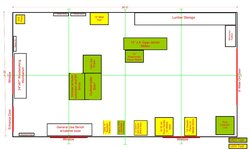
shop layout.jpga.jpg
 
Last edited:
To avoid these ads, REGISTER NOW!

bdbecker

ALLIANCE MEMBER
Joined
Nov 18, 2015
Messages
5,581
Location
Iowa
What is right for today may not be for tomorrow, especially a few years down the road when you catch a deal on a piece of equipment that you've always wanted, but also requires you to reconfigure your entire shop. I think running the 110v in the walls, provided you give yourself plenty of outlets, is a safe bet for the long term. For the 220v, I'd be inclined to go with surface mount conduit/boxes. This will allow you to place everything exactly where needed, and also allow you to adjust when things change.
 
OP
T

tealetm

Well-known member
Joined
Jan 21, 2020
Messages
131
Location
NY
I'm of the same mindset- I'm always changing layout and uses (for instance I may want to someday downsize the woodshop and put a vehicle lift in). I'm also always buying and selling tools for upgrades.

I like the idea of surface mounting for 240v and then stick to recessed for the 120v.

I've never had a shaper before so I don't know where that really fits into the shop layout. I'm almost thinking of putting that on a walls and pulling it out when in use. Planning for it to be near the tablesaw looks like just another obstacle to maneuver around.
 
Last edited:

bdbecker

ALLIANCE MEMBER
Joined
Nov 18, 2015
Messages
5,581
Location
Iowa
I'm of the same mindset- I'm always changing layout and uses (for instance I may want to someday downsize the woodshop and put a vehicle lift in). I'm also always buying and selling tools for upgrades...

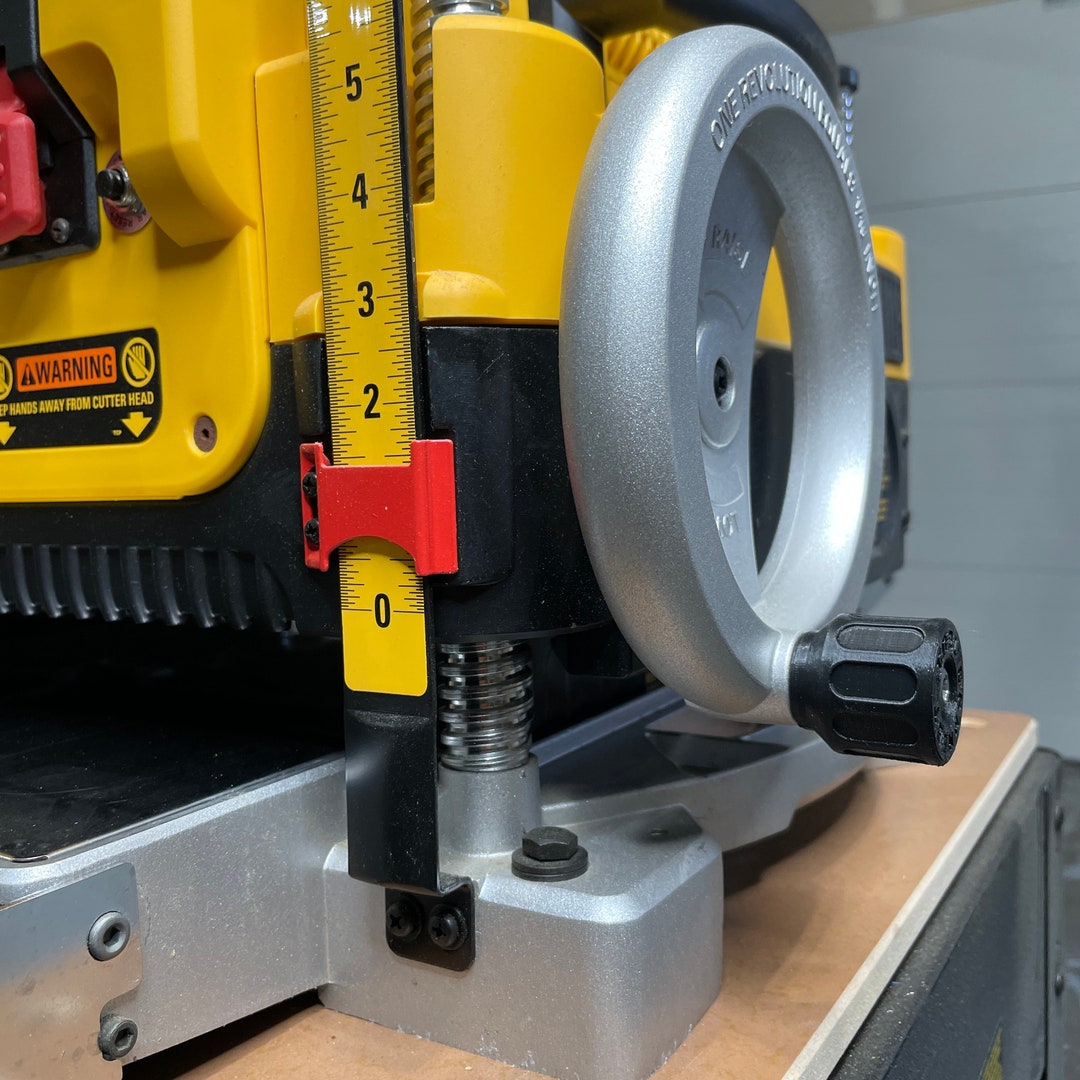
I hear you... I do a lot of layout work for my day job and if I've learned anything over the years its that no preconceived layout is perfect. There will always be adjustments once implemented. If you do a good job, they are usually minor, but sometimes you completely miss something and don't realize it until you're working in the area. Even something silly like needing an extra few inches between machines because a handle sticks out and always catches you in the hip as you walk by (I'm looking at you Dewalt 735 planer).

Speaking of that darn handle, looks like someone's come up with a fix for it...
 

Max

ALLIANCE MEMBER
Joined
Jun 16, 2018
Messages
3,348
Location
Georgia
Like you I have a unisaw in my shop, and it really wants to be in the center. I'm not a fan for a ceiling power drop for a table saw as it'll be in the way unless it's far to the sides anyway. And at that point why not just feed it from the wall?

What I did was to take a piece of 3/4" x 2" wide wood and cut a dado in it that was the right depth for my power cord. I then cut 45 degree angles on the edges of the board so it wasn't so abrupt at the edges. Alternately you can try some PVC cord protector for the same effect. I tried that at first, but it wouldn't stay flat for me and I didn't want to glue or tape it down.


Mainiac Mat

Well-known member
Joined
Sep 2, 2020
Messages
405
Location
Maine
The book Setting Up Shop by Sandor Nagyszalanczy has a comprehensive overview of laying out and setting up a woodworking shop. I have it and highly recommend it. Grizzly used to have a shop layout tool, but tech. updates have it shut down these days.

If your 220 v machines are in the middle of the room, I'd recommend cord drops from ceiling boxes with the appropriate strain relief, or non-load bearing power pole with outlets on it located in the middle of a machine cluster.

I layout manufacturing spaces as part of my job and we use the concept of "activity areas" with all machines, tools, materials used for a particular activity (i.e. breaking down panel stock) located in one area, to minimize movement of men and materials. With this in mind, I suggest you place your mechanics tool chest next to the general use bench.

We map the flow of materials through the shop and place our activity areas sequentially, such that one feeds the other. In our crating department (40,000 s.f.) we process panel stock (plywood) and linear stock (cants and boards) in two parallel lines that both terminate at the assembly benches...

For a small shop, I'd store your plywood vertical in some type of bin arrangement on a wall off to one side of the OHD. I'd recommend you get a vertical panel saw (Milwaukee and Safety Speed Cut are two good ones) and park it right next to the panel storage. This way you break down panels without moving full sheets very far. And if you do move the smaller cut panels to the TS for finish cuts or datos, you're moving something smaller than 4'x8'.

I'd store the linear stock horizontally on wall racks, and have your jointer and planer nearby, just as your layout shows.

Try to keep your DC close to the machines that generate the heaviest chip load (probably the jointer, planer and shaper) so you minimize head loss and maximize extraction where you need it most. Perhaps on the back wall would work well. Or better yet, build a 4'x4' lean-to DC shed just outside of the back wall to minimize noise. Putting you compressor in an attached lean-to shed is also a nice touch. Tucking the DC away in a corner gets it out of your way, but it also presents the longest duct runs.

We've switched from copper to PVC clad AL pipe from Rapid Air. It's great stuff and saves a ton of time not having to sweat Cu joints. Run your air lines in the overhead with drops where needed.

Not many folks can justify a dedicated finishing room... but that said, you could set up portable (tent like) walls by the OHD and then set up portable fans to remove the fumes associated with spraying.

Sandor's book is very good. Nothing is an earth shattering revaluation, but he brings all the pertinent topics together into a pretty comprehensive discussion.

I'm very jealous of the new and sizeable space you're able to dedicate to your own woodshop. I'm in a 24'x20' basement room with lumber storage in the other side of the basement and the barn. It works, but I'd love to have a seperate building.
 
Last edited:
OP
T

tealetm

Well-known member
Joined
Jan 21, 2020
Messages
131
Location
NY
Thanks for the thorough responses! I agree that dust collection would be more effective closer- maybe I'll locate it on the back wall between the miter saw and the lumber storage.

I'm trying to keep an open space by the overhead door to give me flexibility. I could hang poly from the door tracks fairly easily to create a temp spray booth, or the space will be good for storage or working on larger projects. I occasionally work on motorcycles but I'm not sure if I'm going to mix the spaces yet or not. Like some of you, I intend on moving things around and using it for different uses so flexibility is key. (I'm not sure if I even want to do rigid dust collection drops or just move the collector machine to machine).

Having the woodworking bench against the wall also has me thinking if that's a good idea or if I should shift everything so the bench can be pulled out enabling me to work on all four sides of it.

I usually use a 4x8 sheet of insulation board on the floor with a track saw for breaking down plywood so that should eliminate the need for a panel saw- but yes I'd agree that'd be the best way to do it for sure.

Looks like the consensus on bringing power to the floor machines is that overhead is best. I like the idea of a rigid power pole to run a few circuits down, but i wonder if I'd ever want to have the ability to move it out of the way like I could do with cord drops. But then again, if I did rigid poles I could have one larger duct drop in the same location serving the machines. The is a lot of space in the building so I'm not sure that an overhead drop would really be an inconvenience or not.

For cord drops, do you usually replace the cords on the machines with longer ones or drop cords cords from the ceiling that have outlets on the ends so the machine plugs in at floor level with the factory length cords?
 

niget2002

Well-known member
Joined
Oct 2, 2012
Messages
11,213
Location
Josephine, TX
You have a dust collector going to most of these tools... is that going to be permanently ran, or do you have a hose you'll move around as needed?

Can you run the power along the side of the dust collector hose?

Personally, I just use extension cords to everything. I don't have many 240 tools, so the extension cords are zip tied to the dust collection hoses I have around the shop. It does mean I have one spot in the shop where I have to step over a dust collection hose when moving around. I spray painted it bright orange so I see it.
 

jar944

Well-known member
Joined
Jul 26, 2010
Messages
5,951
Location
Northern VA
Since you already have an least one owwm (that F&E) one can reasonably assume it will eventually take over your shop so the ability to reconfigure dc and electrical when you eventually buy a 4000lb 24" planer, or add 3 phase will be important.. Keeping open floors will allow moving everything on a pallet jack (or forklift) as you rotate machinery in and out. Imho mobile bases leave a lot to be desired once machines are over 400-500lbs.

Is also be inclined to turn your table saw 90 degrees. In its current configuration you are limited to 8' rips. It's suprising how often you need 10'+
 
OP
T

tealetm

Well-known member
Joined
Jan 21, 2020
Messages
131
Location
NY
Since you already have an least one owwm (that F&E) one can reasonably assume it will eventually take over your shop so the ability to reconfigure dc and electrical when you eventually buy a 4000lb 24" planer, or add 3 phase will be important.. Keeping open floors will allow moving everything on a pallet jack (or forklift) as you rotate machinery in and out. Imho mobile bases leave a lot to be desired once machines are over 400-500lbs.

Is also be inclined to turn your table saw 90 degrees. In its current configuration you are limited to 8' rips. It's suprising how often you need 10'+

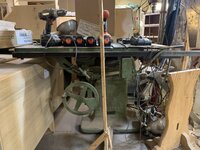
I hear you on the OWWM sickness... I am picking up that jointer shortly along with an American No.1 tablesaw. Not sure if I'll use the tablesaw or not but I can't beat the $50 price tag on it. I literally went back and forth with the seller about the 24" crescent planer they had for cheap but I just couldn't rationalize something that large (yet). The jointer is 3 phase so I'm digging into the rotary phase converter world now figuring out what to get.

The unisaw will be oriented lengthwise in the shop so I can indeed rip long pieces.

I've been contemplating a pallet jack- the space looks big but I have a feeling it will become small very quickly and hiding a pallet jack will only add to the eventual cluster.JA Fay and Egan1.jpgAmerican No. 1 1.jpg
 

Jackfre

Well-known member
Joined
Dec 26, 2010
Messages
4,411
Location
N CA
I’m installing wall power and a couple 220 drops out of the ceiling. I am going to have hooks in the ceiling to be able to get them out of the way when not in use. I just received my Harvey G700 dust processor yesterday. I’m in a two car garage and as I’m seeing it now, the 700 and my Sawstop will be center of floor. Welder, jointer, planer, BS and DP will be wheeled out. My current shop had all perimeter outlets and I lived in a sea of cords and hoses. Drove me nuts and it is just not safe.
 

bdbecker

ALLIANCE MEMBER
Joined
Nov 18, 2015
Messages
5,581
Location
Iowa
...I've been contemplating a pallet jack- the space looks big but I have a feeling it will become small very quickly and hiding a pallet jack will only add to the eventual cluster.

The nice thing about a pallet jack is that the square footage required to store it is much smaller than it actually is if you park it under whatever piece of equipment is least used. They also come with different fork lengths and widths, so just look for something that best fits your needs. No sense in getting one that has 5' forks when all you need is maybe 3' forks to move your equipment around.
 

niget2002

Well-known member
Joined
Oct 2, 2012
Messages
11,213
Location
Josephine, TX
I hear you on the OWWM sickness... I am picking up that jointer shortly along with an American No.1 tablesaw. Not sure if I'll use the tablesaw or not but I can't beat the $50 price tag on it. I literally went back and forth with the seller about the 24" crescent planer they had for cheap but I just couldn't rationalize something that large (yet). The jointer is 3 phase so I'm digging into the rotary phase converter world now figuring out what to get.

The unisaw will be oriented lengthwise in the shop so I can indeed rip long pieces.

I've been contemplating a pallet jack- the space looks big but I have a feeling it will become small very quickly and hiding a pallet jack will only add to the eventual cluster.JA Fay and Egan1.jpgAmerican No. 1 1.jpg
Good lord both of those are a thing of beauty.

I've been wanting a large jointer for ages, but other hobbies have gotten in the way. My little 4" is so unusable it's comical, but it's better than nothing.

And that table saw is awesome.
 

jar944

Well-known member
Joined
Jul 26, 2010
Messages
5,951
Location
Northern VA
I hear you on the OWWM sickness... I am picking up that jointer shortly along with an American No.1 tablesaw. Not sure if I'll use the tablesaw or not but I can't beat the $50 price tag on it. I literally went back and forth with the seller about the 24" crescent planer they had for cheap but I just couldn't rationalize something that large (yet). The jointer is 3 phase so I'm digging into the rotary phase converter world now figuring out what to get.

The unisaw will be oriented lengthwise in the shop so I can indeed rip long pieces.

I've been contemplating a pallet jack- the space looks big but I have a feeling it will become small very quickly and hiding a pallet jack will only add to the eventual cluster.JA Fay and Egan1.jpgAmerican No. 1 1.jpg

If the 24" crescent is still available and cheap, get it. Get it now, don't over think the justification... seriously. Stuff it in a corner for a couple years and pull it back out when you inevitably want/need it. Big planers work better then small planers.

I park my pallet jack under my planer when not in use. I can't imagine not having one at this point as most of my machines are 1000 - 2000lbs.

Also that American #1 will be a nice machine for ripping. Add a powerfeeder and you have a really nice setup for volume cutting.
 
Last edited:
To avoid these ads, REGISTER NOW!

stingry

Well-known member
Joined
Oct 14, 2006
Messages
732
Location
Western Nebraska
F7A3D6A4-D137-48FA-ADC3-D466B7913AC6.jpeg

this is my 14 x30 woodshop. My layout table and Unisaw are centrally located and are at the same height as is the workbenches and the RA saw. This allows me use the table as an Infeed support for long stock being ripped. The worktops on the cabinets support long stock being crosscut. Most of my work is centered around these three items. I plug the unisaw in when I use. Not ideal but it works. I now wish I had put electrical and dust collection in the floor for the table saw. The shaper and planer in the far corner are on wheels as I don’t have space for them to be permanently located. To the far right is my panel saw which I highly recommend if you do much work with sheet goods.
cheers
Steve
 

Norcal

Well-known member
Joined
Mar 16, 2008
Messages
13,769
I’m installing wall power and a couple 220 drops out of the ceiling. I am going to have hooks in the ceiling to be able to get them out of the way when not in use. I just received my Harvey G700 dust processor yesterday. I’m in a two car garage and as I’m seeing it now, the 700 and my Sawstop will be center of floor. Welder, jointer, planer, BS and DP will be wheeled out. My current shop had all perimeter outlets and I lived in a sea of cords and hoses. Drove me nuts and it is just not safe.
No power company in California supplies 220V.
 

mikeyr

Well-known member
Joined
Sep 16, 2005
Messages
1,971
Location
Santa Barbara, CA
I wired 4 50AMP 220V plugs, one on each wall and also 2 20AMP 220V one in the middle of each long wall. My table saw is 220V and that gives me the option of moving it from one long wall to the other, the 4 50AMPs were so I could plug in my TIG anywhere in the shop...within a week of building, I realized I had not put in a circuit for my air compressor. Then this summer, I put in a mini-split, had to run the conduit outside the wall instead of behind drywall. My point is think of what you might put in, in the future. I thought I had planed it all out but never thought I would put in a mini-split. Spend the money now, putting in 4 50AMP was not cheap but my welder can move where I need it. I also put in more than I will ever need 4-gang 110V about 50" high so they are above my workbench. I ran coax cable for television to all 4 corners up near the ceiling and cat5 cables there also, no I don't have 4 TVs :) but I didnt know which corner would have the TV at the time. And this was 14 years ago which is why it was cat5 and not 6 before someone tells me i messed up :)

Not sure what the previous poster means by no power company in Calif. supplies 220V, because I am in Calif.
 

dave*99

Well-known member
Joined
May 5, 2009
Messages
4,275
Location
Coastal NJ
Not sure what the previous poster means by no power company in Calif. supplies 220V, because I am in Calif.
Connect your voltmeter to your "220" receptacle. I bet it it reads 240V. Supply voltages in the US are 120 and 240. Calif is right on the edge, but it's still in the US. ;)
 

mikeyr

Well-known member
Joined
Sep 16, 2005
Messages
1,971
Location
Santa Barbara, CA
ok, I will give you that one...everyone calls it 220 but you are right, 120x2=240 Same with 110V, its technically 120 although in my house it always 119 even with different volt meters.
 

Norcal

Well-known member
Joined
Mar 16, 2008
Messages
13,769
I wired 4 50AMP 220V plugs, one on each wall and also 2 20AMP 220V one in the middle of each long wall. My table saw is 220V and that gives me the option of moving it from one long wall to the other, the 4 50AMPs were so I could plug in my TIG anywhere in the shop...within a week of building, I realized I had not put in a circuit for my air compressor. Then this summer, I put in a mini-split, had to run the conduit outside the wall instead of behind drywall. My point is think of what you might put in, in the future. I thought I had planed it all out but never thought I would put in a mini-split. Spend the money now, putting in 4 50AMP was not cheap but my welder can move where I need it. I also put in more than I will ever need 4-gang 110V about 50" high so they are above my workbench. I ran coax cable for television to all 4 corners up near the ceiling and cat5 cables there also, no I don't have 4 TVs :) but I didnt know which corner would have the TV at the time. And this was 14 years ago which is why it was cat5 and not 6 before someone tells me i messed up :)

Not sure what the previous poster means by no power company in Calif. supplies 220V, because I am in Calif.
What I am saying you DO NOT HAVE 220 VOLTS if you are in CA. You can get 208 volts, or you can get 240 volts, unless you have a transformer you will not have 220 volts, it is not a option available.
 

Jackfre

Well-known member
Joined
Dec 26, 2010
Messages
4,411
Location
N CA
To relaxed in my terminology. It was a general statement indicating I can run my more powerful machines.
 

86turbodsl

Well-known member
Joined
Jul 1, 2005
Messages
6,558
Location
Michigan
I hear you on the OWWM sickness... I am picking up that jointer shortly along with an American No.1 tablesaw. Not sure if I'll use the tablesaw or not but I can't beat the $50 price tag on it. I literally went back and forth with the seller about the 24" crescent planer they had for cheap but I just couldn't rationalize something that large (yet). The jointer is 3 phase so I'm digging into the rotary phase converter world now figuring out what to get.

The unisaw will be oriented lengthwise in the shop so I can indeed rip long pieces.

I've been contemplating a pallet jack- the space looks big but I have a feeling it will become small very quickly and hiding a pallet jack will only add to the eventual cluster.JA Fay and Egan1.jpgAmerican No. 1 1.jpg
$50 for an American #1??? YOU ****!!!!
 

u2slow

Well-known member
Joined
Nov 20, 2011
Messages
3,610
Location
BC
I purposely didn't wire my shop first. Too many variables, and exhaustive wiring not in my budget. Also permit costs and timeline.

Insulation and boarding is a no-brainer... get on with it.

Also, have made great use of lighting that's closer to my work surfaces - not hung on the ceiling.
 
OP
T

tealetm

Well-known member
Joined
Jan 21, 2020
Messages
131
Location
NY
I purposely didn't wire my shop first. Too many variables, and exhaustive wiring not in my budget. Also permit costs and timeline.

Insulation and boarding is a no-brainer... get on with it.

Also, have made great use of lighting that's closer to my work surfaces - not hung on the ceiling.

So did you wire everything up in conduit exposed on the walls/ceiling then?

I'm leaning towards wiring the overhead strip lights and a whole bunch of quad 120v boxes prior to insulating/finishing the walls and ceiling but then leaving overhead task lighting and 240v circuits for later on.
 

Joemctag

Well-known member
Joined
Aug 11, 2017
Messages
813
Location
Outside raleigh nc
Thanks for the thorough responses! I agree that dust collection would be more effective closer- maybe I'll locate it on the back wall between the miter saw and the lumber storage.

I'm trying to keep an open space by the overhead door to give me flexibility. I could hang poly from the door tracks fairly easily to create a temp spray booth, or the space will be good for storage or working on larger projects. I occasionally work on motorcycles but I'm not sure if I'm going to mix the spaces yet or not. Like some of you, I intend on moving things around and using it for different uses so flexibility is key. (I'm not sure if I even want to do rigid dust collection drops or just move the collector machine to machine).

Having the woodworking bench against the wall also has me thinking if that's a good idea or if I should shift everything so the bench can be pulled out enabling me to work on all four sides of it.

I usually use a 4x8 sheet of insulation board on the floor with a track saw for breaking down plywood so that should eliminate the need for a panel saw- but yes I'd agree that'd be the best way to do it for sure.

Looks like the consensus on bringing power to the floor machines is that overhead is best. I like the idea of a rigid power pole to run a few circuits down, but i wonder if I'd ever want to have the ability to move it out of the way like I could do with cord drops. But then again, if I did rigid poles I could have one larger duct drop in the same location serving the machines. The is a lot of space in the building so I'm not sure that an overhead drop would really be an inconvenience or not.

For cord drops, do you usually replace the cords on the machines with longer ones or drop cords cords from the ceiling that have outlets on the ends so the machine plugs in at floor level with the factory length cords?
Not an expert on woodworking shops, but I do fab stuff large and small. I can advise you to do yourself a favor and start off right and do you assembly outin the middle where you can get all around your work
Thanks for the thorough responses! I agree that dust collection would be more effective closer- maybe I'll locate it on the back wall between the miter saw and the lumber storage.

I'm trying to keep an open space by the overhead door to give me flexibility. I could hang poly from the door tracks fairly easily to create a temp spray booth, or the space will be good for storage or working on larger projects. I occasionally work on motorcycles but I'm not sure if I'm going to mix the spaces yet or not. Like some of you, I intend on moving things around and using it for different uses so flexibility is key. (I'm not sure if I even want to do rigid dust collection drops or just move the collector machine to machine).

Having the woodworking bench against the wall also has me thinking if that's a good idea or if I should shift everything so the bench can be pulled out enabling me to work on all four sides of it.

I usually use a 4x8 sheet of insulation board on the floor with a track saw for breaking down plywood so that should eliminate the need for a panel saw- but yes I'd agree that'd be the best way to do it for sure.

Looks like the consensus on bringing power to the floor machines is that overhead is best. I like the idea of a rigid power pole to run a few circuits down, but i wonder if I'd ever want to have the ability to move it out of the way like I could do with cord drops. But then again, if I did rigid poles I could have one larger duct drop in the same location serving the machines. The is a lot of space in the building so I'm not sure that an overhead drop would really be an inconvenience or not.

For cord drops, do you usually replace the cords on the machines with longer ones or drop cords cords from the ceiling that have outlets on the ends so the machine plugs in at floor level with the factory length cords?
Start off right and plan on assembly out in the middle where you can get all around your work. Doesn’t have to be an actual table; can be some trestles with boards and plywood fastened to get the size you need for your particular job. It’s Allright to make parts and sub-assemblies at workbenches against walls, and those will be where you can keep tools for those operations and where you can stack all your parts and pieces. All your machines and storage around the perimeter, with your table saw and joiner probably having to be at least able to be moved when you need more space around them.
I really love the exterior of the bldg, including the lean-to! We’d love to see more pics! I think power cords on the floor is a personal thing. Some can’t stand them. We pretty much have to have them and I’ve trained myself not to step on them or drop things on them. 120v and 240v both.
We’ll, good luck!
 
To avoid these ads, REGISTER NOW!
Top Bottom