To avoid these ads, REGISTER NOW!

Woodworking 101--Tools and Tips

rrich1

Well-known member
Joined
Oct 7, 2015
Messages
793
Everything seemed to be square the last time I did it. The wood just seemed to shift a bit in the clamps even with cauls.


Sent from my iPhone using Tapatalk
You might be applying too much pressure. Ease up a bit.

Sent from my Pixel XL using Tapatalk
 
To avoid these ads, REGISTER NOW!

rlitman

Well-known member
Joined
Oct 18, 2010
Messages
24,576
Location
Long Island
Everything seemed to be square the last time I did it. The wood just seemed to shift a bit in the clamps even with cauls.

Yeah, it can do that. The wet glue acts like a greasy lubricant and the pieces will always want to slide around as you tighten the clamps.

But a tongue and groove tight enough to prevent this sort of motion will not glue well, so it will be weaker than just a plain glue joint.

Perhaps you need to rethink how you use the cauls. If everything isn't sitting perfectly flat, then plain cauls will flatten the boards, but may not necessarily prevent the ridges you get when there is an offset. But you can reduce the offset by putting a shim under the cauls right around the glue line. Because that is really the place where you want to be putting pressure.

That's why I use biscuit joints.

I too like to use biscuits for this, but biscuits fit loosely enough that they cannot completely eliminate ridges at the glue line. That's still only done by your clamping setup. They do make assembly easier, and at least limit the shifting quite a bit.

The good thing about biscuits is that unlike a tongue and groove, they don't hurt the strength of the joint, and don't waste wood.
 
Last edited:
OP
J

jimreed2160

Well-known member
Joined
Aug 7, 2016
Messages
3,589
Location
Tallahassee FL
Observations on T&G joints
I don't want to argue the strength issue because T&G joints are generally not appropriate for glue ups. They really shine in NON glue situations because they provide lots of shear strength while allowing seasonal movement of the wood.

But T&G can be used for glue ups. In fact, late 19th century factory furniture panels were often T&G with glue but that was probably more for alignment than for strength. And late 19th century furniture should probably not be studied for fine woodworking techniques.

I like the biscuit idea for alignment and often use it myself. But I really like to glue and plane.

Clamping pressure is a good place to look. Optimal clamp pressure depends on your glue technique and the particular wood you are using. Moisture content affects it also. Do some tests on scrap wood. The objective is to clamp the wood tightly without forcing too much glue squeezeout. These days I let the glue soak for a few minutes longer than in days of old. I also use much less pressure than I did. My joints (glue joints only) seem to be getting better with age.
 

Leveleer

Well-known member
Joined
May 19, 2016
Messages
272
Location
Superior/Duluth
Can someone explain why so many use orbital sanders for finishing flat panels instead of flat reciprocating sanders? The only real answer I've gotten so far is it is less fatiguing.
Thanks

Frank:dunno:
 

jonshonda

Well-known member
Joined
Jul 17, 2017
Messages
4,731
Location
Wisconsin
jons--Welcome to the ww thread. Good to note that your grandfathers were also ww and you followed in their footsteps. It does get into your blood. Good luck acquiring your tools and don't forget to add a few handplanes.

Right now I am much more of rough carpenter then a finish or cabinet type. But there is only so much fun you can have with 2x4's. :dunno:

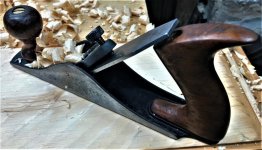
I did manage to have a nice old stanley hand plane passed onto me from my wife's grandfather. I have used it a few times, but just appreciate looking at it sometimes.
 

rlitman

Well-known member
Joined
Oct 18, 2010
Messages
24,576
Location
Long Island
Observations on T&G joints
I don't want to argue the strength issue because T&G joints are generally not appropriate for glue ups. They really shine in NON glue situations because they provide lots of shear strength while allowing seasonal movement of the wood.

But T&G can be used for glue ups. In fact, late 19th century factory furniture panels were often T&G with glue but that was probably more for alignment than for strength. And late 19th century furniture should probably not be studied for fine woodworking techniques.

I like the biscuit idea for alignment and often use it myself. But I really like to glue and plane.

Clamping pressure is a good place to look. Optimal clamp pressure depends on your glue technique and the particular wood you are using. Moisture content affects it also. Do some tests on scrap wood. The objective is to clamp the wood tightly without forcing too much glue squeezeout. These days I let the glue soak for a few minutes longer than in days of old. I also use much less pressure than I did. My joints (glue joints only) seem to be getting better with age.

Yeah, I don't want to sound like I'm against T&G. For a back panel, where seasonal movement needs to be accommodated, there is nothing better, and they certainly have their place. But for a long grain edge joint, a T&G would have to be excessively tight to keep the surfaces co-planar (a loose joint not only would not help with the ridges, but would also be nearly impossible to clamp over its entire length, since clamping force that brings the joint together, does nothing to compress the glue joint). So tight, that it runs the risk of wiping off all the glue during assembly. And in order for a gap not to be left when assembled, the groove must be necessarily deeper than the tongue, so the wiped off glue that ends up in that gap may be all that holds the piece together. It's a perfect storm of how now to glue something.

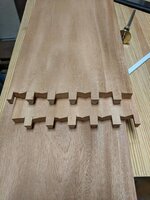
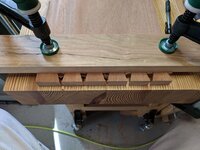
Contrast that with a router cut finger joint (which will work on long edges, but is kind of pointless). These use tapered fingers that meet matching sockets. By using a tapered "tongue", the joint is only tight when it bottoms out, and that eliminates any glue wiping. And by having the pieces meet at angles, compression across the joint actually compresses the glue as it should.

Or with biscuits. Biscuits by design fit loosely into their sockets, so as to not wipe off the glue. But being compressed during their manufacture, the glue causes them to swell into a tight fit after assembly (though the swelling is slow, so they remain loose during clamp up, so they provide only limited alignment).

As for clamping pressure, it is impossible to squeeze all (or even too much) glue out of a joint. That should never be a concern. You need to limit clamping pressure based on two things.

First, you don't want the clamps to crush the wood fibers where they are applied. And second, you don't want to overly warp the piece, so that when released and it springs back, the glue line is under excessive tension.

Though a little tension can be useful to stiffen up a piece. For example, say you are joining two pieces that look like this:
)(
After gluing and clamping, you may be able to end up with something straight, and with the natural bending tendencies of both pieces in balance, this glued piece may be more stable over time than either one by itself (assuming you don't overdo it and it splits).

Can someone explain why so many use orbital sanders for finishing flat panels instead of flat reciprocating sanders? The only real answer I've gotten so far is it is less fatiguing.
Thanks

Frank:dunno:

Are you talking about a round pad random orbital sander vs rectangular pad like a 1/3 sheet finishing sander? edit: I started writing this before your last post, so now I see that yes, that is what you're talking about.

Both have an orbital action that can leave swirls, and in that sense, both actually use the same method of action to remove stock, which is to make the pad orbit around small (3/16" or so) circles. But the round pad sanders have two HUGE advantages that made the rectangular pads obsolete (even with the disadvantage of being bad in inside corners).

1) Random orbital sanders allow the pad to freely rotate. The rotation doesn't actually contribute directly very much to the stock removal rate (they don't sand by being a spinning disc), but it does continually reorient the pad. This is the "random" motion that reduces (but does not eliminate) swirl marks by moving around the grit pattern, so it does not follow the same path again and again. That's why you cannot use coarse paper on a 1/3 sheet finishing sander. The high spots in the grit would find a groove and keep working it deeper and deeper, leaving awful tracks that are impossible to sand out with the same grit. By randomly changing the pad's orientation with each orbit, the grit shouldn't follow the same path twice, and that limits the depth of the swirls. Still, you will get swirls, so you need to slowly step up in grits, with each one removing the swirls of the previous, for a good finish.

and

2) The pad rotates. Ok, I know this sounds like the same thing I just said, but bear with me here, as the rotation does yet another big thing. The rotating pad has dust collection holes. These holes move around, and allow the dust collection to remove the entirety of the dust under the pad. Dust under the pad stops the pad from cutting, so dust collection really helps your stock removal rate. With a rectangular pad that doesn't rotate, if you had dust collection holes, each hole would allow dust to be sucked from its neighborhood, but you'd end up with more holes than pad to give enough access for collection, and then you'd have too much open area for good suction. By rotating, just a few holes can cover much more area.
 
Last edited:

rlitman

Well-known member
Joined
Oct 18, 2010
Messages
24,576
Location
Long Island
My thanks to rlitman for the detailed answer to my question.

:)

I'll add a #3 to my list. Though it's not as big an issue as the first two, there's also the potential for less felt vibration.

I grew up using the venerable Porter Cable 330 quarter sheet (palm) and the 505 half sheet (aluminum monster) sanders. While their moving parts were well balanced, the sanding action still passed much more vibration back to your hands than my Dynabrade random orbit sanders do. That vibration can be both fatiguing, and even damaging to the nerves in your hand.

And while you'd think that a rectangular pad could get into an inside corner, it really couldn't as it would bang into things badly as it moved. Nowadays, you've got all sorts of good options for those corners, such as mouse sanders and oscillating tools with triangular pads (the best option).
 

cheechi

Well-known member
Joined
Feb 29, 2012
Messages
4,384
Location
Triad, NC
I'd like some advice. I have both Minwax oil based wood stains & Watco Danish oils, in several tints each. In the Watco instructions it lists mineral spirits can be used as a step in surface prep. In the Minwax instructions it lists mineral spirits can be used to clean up. Can I assume from this that I can use mineral spirits to thin either or both of these tinted stains for a lighter colour? Both products also have a 'natural' which I assume is untinted, and can be mixed with tinted product for a lighter colour also.

What about BLO, denatured alcohol, or other oils such as tung or teak? Would any of these be unsafe to mix? As far as darkening, I'm assuming Rit dye can be added to both of these safely right?

Thanks in advance for sharing your experience with this.
 
OP
J

jimreed2160

Well-known member
Joined
Aug 7, 2016
Messages
3,589
Location
Tallahassee FL
I have used Minwax stains for years. Mineral spirits (MS) appears to be the solvent used and is great for cleanup--especially hands. It will thin the stain but the effect is not what you might think. In normal use, I splash on the minwax liberally with a brush and then wipe it down with a rag. Thinning with MS does not seem to change the color or the shade much. If I want a lighter effect, I wipe the wood with MS first and then rub the minwax on lightly with a rag and the wood seems to absorb less. I also mix by wiping on different stains. First I put one down and wipe it off. Then I follow with stain #2. Sometimes I make it darker by wiping down a third time after the first coat(s) dry.

Minwax is a pigmented stain and in my experience gets darker with more setting time and with repeated applications. If I don't get what I want, I sand it lightly after it dries and try some more. But I always use a test sample, usually a cut off from the project. If you are really picky, use a test sample, let it dry, and then apply final finish.

I really like MW. My favorites are Special Walnut, Mahogany, Cherry, and Tudor Oak.
 

Duker

Well-known member
Joined
Sep 25, 2010
Messages
10,861
Location
Livingston, TX
I'd like some advice. I have both Minwax oil based wood stains & Watco Danish oils, in several tints each. In the Watco instructions it lists mineral spirits can be used as a step in surface prep. In the Minwax instructions it lists mineral spirits can be used to clean up. Can I assume from this that I can use mineral spirits to thin either or both of these tinted stains for a lighter colour? Both products also have a 'natural' which I assume is untinted, and can be mixed with tinted product for a lighter colour also.

What about BLO, denatured alcohol, or other oils such as tung or teak? Would any of these be unsafe to mix? As far as darkening, I'm assuming Rit dye can be added to both of these safely right?

Thanks in advance for sharing your experience with this.


Watco is tung oil that has been thinned with mineral spirits to create a “wiping finish” and includes a Japan drier additive to accelerate curing. All Tung & Teak oil finishes can be thinned with MS. You can also use tinting agents (my favorite is Transtint - http://homesteadfinishingproducts.com/transtint-liquid-dyes/) in Tung and Teak oil. You can also use Aniline Dyes that have been dissolved with Alcohol (NOT water) to add color to a tung oil finish but that can present challenges if you are using a tung oil finish over a lacquer finish.


Sent from my iPad using Tapatalk Pro
 

jonshonda

Well-known member
Joined
Jul 17, 2017
Messages
4,731
Location
Wisconsin
Scored a Craftsman 113.xxxxx table saw yesterday at a thrift sale. Bought it for $40, which included delivery to my house! Now I just need to build a nice mobile base with pneumatic casters for transporting it across my yard to the shed.

List of items I want to do for the saw:
1) Delta T2 or T3 fence
2) Diablo blade
3) Ditch the stamped out feed tables in favor of custom wood
4) integrate a router table into the out feed table so I can utilize the fence for both applications
5) Build cross cut sled
6) New on/off switch and wiring


Should be a pretty slick setup after all that is done.
 
OP
J

jimreed2160

Well-known member
Joined
Aug 7, 2016
Messages
3,589
Location
Tallahassee FL
jons--Glad you found your saw. The price seems sweet. Good luck with your rehab project. The tools that I fix up are usually the ones I like the best.
 

cheechi

Well-known member
Joined
Feb 29, 2012
Messages
4,384
Location
Triad, NC
actually now have some followup questions.

Does the 'natural' imply undyed/untinted for either the Minwax or the Watco?

If I mix the MS into a small batch of either stain, will it result in a lighter colour, or do you have to wipe the thinner after application of 'full strength' stain? or will it just mess things up? For the danish oil, would mixing plain tung oil or MS be more effective in terms of predictability or controllability?

Thanks again for the info.
 
Last edited:
OP
J

jimreed2160

Well-known member
Joined
Aug 7, 2016
Messages
3,589
Location
Tallahassee FL
Chi--I only have experience with Minwax. Thinning the stain with MS just means less pigment. But it is applied as a brush on, wipe off stain so the project usually gets flooded with pigment anyway. You can wipe it on with a rag but that does not make it a lot lighter. As I said, the only way I have found is to saturate the wood with MS and then wipe on small amounts of stain. When the wood is full of MS, the stain is less likely to penetrate. Lighter results are best achieved by using a lighter color of Minwax.
 

rrich1

Well-known member
Joined
Oct 7, 2015
Messages
793
I finally was able to get some more work done today. I got the reat of the pieces mapped out on my boards. I had just enough. Then I got the dovetails layed out and cut. I used a coping saw for the waste. I thinner blade would be nice. They turned out pretty well so far.

My chisels are in dier need of sharpening so I'm done for the night. Don't like to hammer late anyways. Hopefully I will get them chiseled out tomorrow. 4930009278a71896602de99d6fba16fa.jpg15d690cfc2d2d3af74369f15f76b65aa.jpg14ec1b9292927ab27533e9979089c9d0.jpg478fa7f617e7e68d6b2b38486e7a34ce.jpge2ab1f309e9f1e7de5f63d7f4f78e191.jpg

Sent from my Pixel XL using Tapatalk
 

Attachments

  • 4930009278a71896602de99d6fba16fa.jpg
    4930009278a71896602de99d6fba16fa.jpg
    99.2 KB · Views: 0
  • 15d690cfc2d2d3af74369f15f76b65aa.jpg
    15d690cfc2d2d3af74369f15f76b65aa.jpg
    67.2 KB · Views: 0
  • 478fa7f617e7e68d6b2b38486e7a34ce.jpg
    478fa7f617e7e68d6b2b38486e7a34ce.jpg
    97.5 KB · Views: 0
  • e2ab1f309e9f1e7de5f63d7f4f78e191.jpg
    e2ab1f309e9f1e7de5f63d7f4f78e191.jpg
    97.2 KB · Views: 0
  • 14ec1b9292927ab27533e9979089c9d0.jpg
    14ec1b9292927ab27533e9979089c9d0.jpg
    68 KB · Views: 1
To avoid these ads, REGISTER NOW!

Duker

Well-known member
Joined
Sep 25, 2010
Messages
10,861
Location
Livingston, TX
actually now have some followup questions.

Does the 'natural' imply undyed/untinted for either the Minwax or the Watco?

If I mix the MS into a small batch of either stain, will it result in a lighter colour, or do you have to wipe the thinner after application of 'full strength' stain? or will it just mess things up? For the danish oil, would mixing plain tung oil or MS be more effective in terms of predictability or controllability?

Thanks again for the info.


Oil finishes in natural have an amber finish so you will have a subtle tint to the wood with just those. Also, as Jim suggested you can apply mineral spirits before you apply the finish to dilute the pigments as you apply the oil finish of your color choice. That process is basically the same as making a homemade “wood conditioner” which is usually two parts of finish to six to eight parts MS which helps to reduce penetration of pigment or blotchiness in pine.

Another way to add color is to apply your oil finish in natural (or starting color) then apply cuts of shellac which comes in blondes to deep garnets to create the color shade of your choice.


Sent from my iPad using Tapatalk Pro
 

CRSINMICH

Well-known member
Joined
Aug 15, 2015
Messages
2,393
Location
Southeastern Michigan
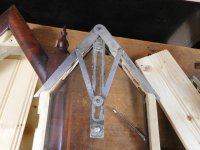
For anyone interested in mastering dovetails.
EZ: I like watching Frank Kausz's videos. He has probably forgotten more about woodworking than I'll ever learn. His dovetail methods do seem easy and foolproof. However, as with other masters of any craft, the directions should always be something like: Do it this way and, after a lot of practice, it'll come out right.
 
Last edited:
OP
J

jimreed2160

Well-known member
Joined
Aug 7, 2016
Messages
3,589
Location
Tallahassee FL
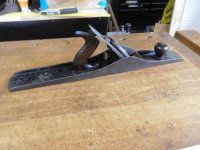
#7 greaseball

I finally finished restoration of the #7 greaseball. By the time I cleaned up the wood, it needed a coat of poly and I did that yesterday. Turns out it is really a type 10, which dates from 1907-1909. It sure does make some nice shavings. I think #7s are my favorite size of bench planes.
 

Attachments

  • DSCN6451.jpg
    DSCN6451.jpg
    143.2 KB · Views: 48
  • DSCN6449.jpg
    DSCN6449.jpg
    121.8 KB · Views: 43
OP
J

jimreed2160

Well-known member
Joined
Aug 7, 2016
Messages
3,589
Location
Tallahassee FL
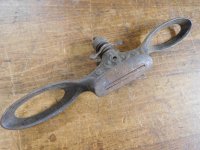
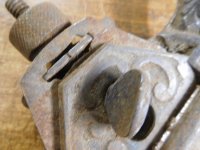
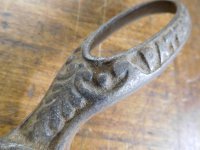
Preston shave

I was prowling around in the "good" plane closet and found this little jewel--a round bottom Preston shave. It is a great example of Victorian tools as art. This one looks like it needs a little TLC so I put it on the restore list.
 

Attachments

  • DSCN6467.jpg
    DSCN6467.jpg
    151.6 KB · Views: 32
  • DSCN6468.jpg
    DSCN6468.jpg
    151.2 KB · Views: 33
  • DSCN6469.jpg
    DSCN6469.jpg
    118.4 KB · Views: 32
  • DSCN6470.jpg
    DSCN6470.jpg
    91.3 KB · Views: 28
  • DSCN6471.jpg
    DSCN6471.jpg
    118.4 KB · Views: 31

drivesitfar

Well-known member
Joined
Oct 23, 2013
Messages
35,988
Location
Pacific Northwest
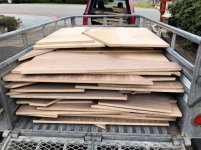
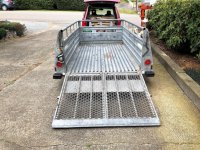
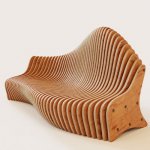
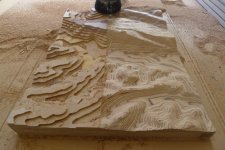
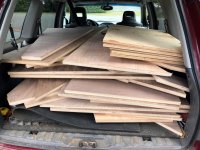
ALL: i'm getting ORGANIZED and i've got more than a little GOOD QUALITY SCRAPS to figure out what to make out of them. here's a good example I've got a couple trailers full of 1 inch oak and birch plywood (yes the pricey stuff) and i've got a few cabinets in mind with the bigger pieces and wondering what some of you might do with your scraps or decent size pieces?

here's a few ideas i've found of and looking for a few more that maybe I could use around my shop or house.
 

Attachments

  • moving inch thick plywood scraps 1 (2).jpg
    moving inch thick plywood scraps 1 (2).jpg
    150.6 KB · Views: 52
  • moving inch thick plywood scraps (2).jpg
    moving inch thick plywood scraps (2).jpg
    153.5 KB · Views: 50
  • moving inch thick plywood scraps 2 (2).jpg
    moving inch thick plywood scraps 2 (2).jpg
    140.4 KB · Views: 49
  • moving inch thick plywood scraps 3 (2).jpg
    moving inch thick plywood scraps 3 (2).jpg
    154.9 KB · Views: 54
  • Caldwell-Paper-Topography-Map-768x1024.jpg
    Caldwell-Paper-Topography-Map-768x1024.jpg
    80.1 KB · Views: 78
  • DQ-5.jpg
    DQ-5.jpg
    46.9 KB · Views: 76

rlitman

Well-known member
Joined
Oct 18, 2010
Messages
24,576
Location
Long Island
actually now have some followup questions.

Does the 'natural' imply undyed/untinted for either the Minwax or the Watco?

If I mix the MS into a small batch of either stain, will it result in a lighter colour, or do you have to wipe the thinner after application of 'full strength' stain? or will it just mess things up? For the danish oil, would mixing plain tung oil or MS be more effective in terms of predictability or controllability?

Thanks again for the info.

Chi--I only have experience with Minwax. Thinning the stain with MS just means less pigment. But it is applied as a brush on, wipe off stain so the project usually gets flooded with pigment anyway. You can wipe it on with a rag but that does not make it a lot lighter. As I said, the only way I have found is to saturate the wood with MS and then wipe on small amounts of stain. When the wood is full of MS, the stain is less likely to penetrate. Lighter results are best achieved by using a lighter color of Minwax.

Oil finishes in natural have an amber finish so you will have a subtle tint to the wood with just those. Also, as Jim suggested you can apply mineral spirits before you apply the finish to dilute the pigments as you apply the oil finish of your color choice. That process is basically the same as making a homemade “wood conditioner” which is usually two parts of finish to six to eight parts MS which helps to reduce penetration of pigment or blotchiness in pine.

Another way to add color is to apply your oil finish in natural (or starting color) then apply cuts of shellac which comes in blondes to deep garnets to create the color shade of your choice.


Sent from my iPad using Tapatalk Pro
To reinforce the responses, and explain a little (everything said above here is completely right, and I have no corrections to offer, just my own insights):

Minwax and similar oil finishes use pigments, and not dyes. Dyes chemically change the color of what they dye. Pigments are solid colorful particles that are mixed into the finish. This may help you understand a little more about they work, where they work well, and why they are bad in some cases.

The "natural" Minwax is the base finish without any pigments, and is the most important can you can own if you choose to use this as a finish, though as stated, it has a bit of an amber hue (if you want a water clear finish, say to keep the color of purpleheart, then use a water based finish, and do not use Minwax).

Yes, this can be thinned into a pre-stain conditioner, OR, if you want a light finish, you can just use natural as your first coat. The first coat will soak in, and prevent the pigments from soaking in too much in the second coat. As you layer coats, less and less soaks in, and more pigment is only able to be trapped in the surface texture. So, another key to a light finish is to finish with a finer grit sandpaper. You can always keep layering on more color, but once the pigment has soaked into the wood, you're not going to be able to take it off (without sanding deeply), so unless you're going for something very dark, be careful with your first coat.

Now, some of these pigments are coarser than others, which means that they will settle out at different rates. I used to follow the directions and stir well (do not shake!) to mix them all together, but I've learned that you can actually use the settling to your advantage. It allows you to have a wider palette at your disposal. For example, you could skim off the liquid at the top of a can that has had time to settle, to get more of the chestnut brown, or use the dregs at the bottom to get more red, orange or yellow

Now, the downside to pigments. Being solid particles, they obscure the grain a little, as they cover it. So, as you add more, you get less of the nice wood look. Now with some woods, that may be offset by the fact that the stain soaks in differently into summer and winter wood, so it may make the grain pop a little more, but that's not always the case, and I've found that pigmented stains make figured wood lose some of their figure (i.e. anything other than the natural on curly or birdseye maple may be a mistake). OTOH, stain doesn't soak as well into oak's rays, so this can really highlight quartersawn oak.,

The opposite of this is a dye. With a dye, there are no particles to obscure the grain, so you could turn birdseye maple bright blue, and still see all the figure (yeah, it sounds weird, until you see it on an electric guitar).

One last warning. NOTE WELL, the cans sitting next to the Minwax that say they're comparable stains, but that they dry in half an hour are NOT oil based stains (they're basically a thinned alkyd), and are NOT compatible. That's not to say that you cannot use them to good effect, but I'm just warning everyone that their marketing and labeling is VERY misleading.
 
OP
J

jimreed2160

Well-known member
Joined
Aug 7, 2016
Messages
3,589
Location
Tallahassee FL
Good points and you remind me of something else--drying time. Minwax needs time to dry. You can restain in a few hours to make it darker but should wait a day or two for final finishing. It depends on temperature and humidity. Finish too soon and your project will get sticky and take forever to dry. Let it dry completely and it can be ready to go in hours.

I always wait at least overnight. Then I smell the project. If you can smell the solvent, then your project needs more drying time. If it is dry to the touch and has very little smell, then it is ready for poly.
 

rrich1

Well-known member
Joined
Oct 7, 2015
Messages
793
Got the tails cut out and started on the pins. I got one corner chiseled out. Not the best but certainly not the worst. I probably should have practiced. Not horrible for my second time cutting dovetails though. I think I will go back and re establish the line up just a little. 44af53d2280af54ac71baa516b5055be.jpg861cde9220609c2a05723556cd875d95.jpg11260884d988394c921166dae911e20b.jpg16b9b65fd52a0b3be18a982cf4e3c372.jpge7ecea5332d2c6bcbbc963eba16580ad.jpg

Sent from my Pixel XL using Tapatalk
 

Attachments

  • 861cde9220609c2a05723556cd875d95.jpg
    861cde9220609c2a05723556cd875d95.jpg
    96.3 KB · Views: 1
  • 11260884d988394c921166dae911e20b.jpg
    11260884d988394c921166dae911e20b.jpg
    104.5 KB · Views: 1
  • 16b9b65fd52a0b3be18a982cf4e3c372.jpg
    16b9b65fd52a0b3be18a982cf4e3c372.jpg
    103.8 KB · Views: 1
  • e7ecea5332d2c6bcbbc963eba16580ad.jpg
    e7ecea5332d2c6bcbbc963eba16580ad.jpg
    77 KB · Views: 0
  • 44af53d2280af54ac71baa516b5055be.jpg
    44af53d2280af54ac71baa516b5055be.jpg
    93.5 KB · Views: 5
OP
J

jimreed2160

Well-known member
Joined
Aug 7, 2016
Messages
3,589
Location
Tallahassee FL
Drives--You win the plywood race! That is a nice stash. I say come up with a plan and make some bookcases.

rrich--Dovetails are lookin good! Those are joints you can be proud of.
 

cheechi

Well-known member
Joined
Feb 29, 2012
Messages
4,384
Location
Triad, NC
Hopefully one last question, what is the 'pre stain' that minwax sells? Is it just the oil base with no pigment?

The distinction you explained is exactly what I needed in terms of pigment vs dye. I was assuming a stain would have to be dye to be applied evenly. So what would be the process including the solvents needed if someone wanted to dye wood, ala electric guitars? This was some of my motivation in asking.

Very thorough clarification I want to thank all of you for the information.
 

rrich1

Well-known member
Joined
Oct 7, 2015
Messages
793
Hopefully one last question, what is the 'pre stain' that minwax sells? Is it just the oil base with no pigment?

The distinction you explained is exactly what I needed in terms of pigment vs dye. I was assuming a stain would have to be dye to be applied evenly. So what would be the process including the solvents needed if someone wanted to dye wood, ala electric guitars? This was some of my motivation in asking.

Very thorough clarification I want to thank all of you for the information.
The pre stain helps to keep the wood from looking blotchy when the stain is applied.

Sent from my Pixel XL using Tapatalk
 

rlitman

Well-known member
Joined
Oct 18, 2010
Messages
24,576
Location
Long Island
Good points and you remind me of something else--drying time. Minwax needs time to dry. You can restain in a few hours to make it darker but should wait a day or two for final finishing. It depends on temperature and humidity. Finish too soon and your project will get sticky and take forever to dry. Let it dry completely and it can be ready to go in hours.

I always wait at least overnight. Then I smell the project. If you can smell the solvent, then your project needs more drying time. If it is dry to the touch and has very little smell, then it is ready for poly.

YES! Drying time is SO important with Minwax, and any oil based finish. If each coat isn't allowed sufficient drying time, or is applied too thick, you may end up with an awful gummy surface that doesn't harden properly. I get the most consistent drying times if I wipe off as much finish as possible, and then return a day later to buff the surface with a rag, and let it dry some more.

Hopefully one last question, what is the 'pre stain' that minwax sells? Is it just the oil base with no pigment?

The distinction you explained is exactly what I needed in terms of pigment vs dye. I was assuming a stain would have to be dye to be applied evenly. So what would be the process including the solvents needed if someone wanted to dye wood, ala electric guitars? This was some of my motivation in asking.

Very thorough clarification I want to thank all of you for the information.

Minwax "Natural" 209 is the base oil finish, with no pigments. I believe that the pre-stain conditioner is this, thinned out VERY thin with probably mostly mineral spirits, and other "slow" thinners (such as odorless kerosene). You could probably make it yourself, but I've just bought it. The pre-stain conditioner rapidly soaks into the wood, like a paper towel that is dropped in water, and this limits how fast the next coat can soak in, and how deeply it travels. This can help, because the stain will be carried into the wood in the direction of the grain faster than it will across the grain. i.e. it soaks into end-grain like a sponge, but only penetrates a little into edge grain. Where this makes the most difference is in pieces where the grain waves up and down. That can lead to a weird mottled appearance as stain is taken up differently in spots, and the conditioner evens this out.

As for pigments, remember that some of these particles border the nano scale. The indigo color in blue jeans is actually a pigment that gets trapped between the cotton fibers. Some of the pigments are formed naturally into these tiny particles, and some are milled down, and the degree of the milling and nature of the pigment determines the final size.

Aniline dyes generally are either water or alcohol based. Many times, you dissolve the powdered dye in alcohol, and then thin it with water (wear gloves, this stuff is toxic!). They generally have less colorfastness than the pigments above, so they go best with a UV inhibiting finish above. e.g. polyurethane. Particularly the more vivid colors.
 

scarrylarry

Well-known member
Joined
Jun 26, 2010
Messages
494
Location
West Coast of Canada
ALL: i'm getting ORGANIZED and i've got more than a little GOOD QUALITY SCRAPS to figure out what to make out of them. here's a good example I've got a couple trailers full of 1 inch oak and birch plywood (yes the pricey stuff) and i've got a few cabinets in mind with the bigger pieces and wondering what some of you might do with your scraps or decent size pieces?

here's a few ideas i've found of and looking for a few more that maybe I could use around my shop or house.

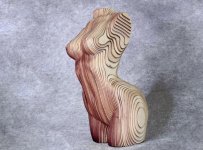
Hello Drivesitfar

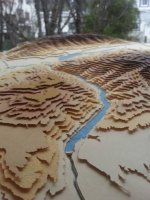
Is that photo a 3D topographic done in wood ? How do you do that ? Looks great !
scarrylarry
 
OP
J

jimreed2160

Well-known member
Joined
Aug 7, 2016
Messages
3,589
Location
Tallahassee FL
New projects

I need to get a few projects done before hot weather sets in. Today's list includes a clock and a pull out shelf.

The shelf is an under sink item from Costco. It has two heavy duty full extension slides and a metal basket. It looked like a bargain to me at $19 just for the slides. My under sink counter is a mess like everyone everywhere. This one just BARELY fits between the side wall and the sink trap. Lucky me who did not measure before purchase.

I hate to crawl around on my knees so I decided to mount mine to a piece of plywood and then screw the plywood into the counter base. It turned out being a simple workbench project. Mounting in the cabinet was a snap and now there is a little organization down there.
Now the clock is up for some work.
 

Attachments

  • DSCN6487.jpg
    DSCN6487.jpg
    147.5 KB · Views: 88
  • DSCN6486.jpg
    DSCN6486.jpg
    152.8 KB · Views: 89
  • DSCN6490.jpg
    DSCN6490.jpg
    143.4 KB · Views: 87
  • DSCN6489.jpg
    DSCN6489.jpg
    147.7 KB · Views: 87
  • DSCN6483.jpg
    DSCN6483.jpg
    152.8 KB · Views: 88

CRSINMICH

Well-known member
Joined
Aug 15, 2015
Messages
2,393
Location
Southeastern Michigan
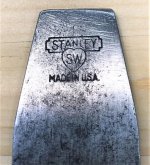
STANLEY #40 SCRUB PLANE​
This was a fleamarket find a couple years ago. After it was cleaned and sharpened it stayed on the shelf until yesterday. The next step in my current project is to reduce the thickness of three 6 X 30 inch boards from a little over 1" to 3/4". There are many ways that could be done, but I want to do this entire project using only hand tools. Getting the #40 off the shelf, I gave it a moderate set. My test board was a scrap of 3/4 pine. I ran the plane across the face of the board against the grain at about 45 degrees going from left to right. Then turning the plane to so that it was 45 degrees in the opposite direction, I went across the face from right to left. I then repeated the process one more time in each direction. Using a #5, I planed off the gouges in the face and a #4 smoother completed it. The test board ended up exactly 1/2". The total time was 6 minutes.

Notice the wide mouth opening and the heavy camber on the cutting iron. This plane was not meant to take wispy shavings. The wood was coming off in chips and chunks. For rapid stock removal, it's a real Sweetheart.
 

Attachments

  • Stanley #40 (7).jpg
    Stanley #40 (7).jpg
    65.1 KB · Views: 44
  • Stanley #40 (9).jpg
    Stanley #40 (9).jpg
    151.2 KB · Views: 37
  • Stanley #40 (3).jpg
    Stanley #40 (3).jpg
    134.6 KB · Views: 41
  • Stanley #40 (4).jpg
    Stanley #40 (4).jpg
    148.9 KB · Views: 41
Last edited:

drivesitfar

Well-known member
Joined
Oct 23, 2013
Messages
35,988
Location
Pacific Northwest
Scarry: I found the pictures I posted online while i'm looking for ideas on projects that I'd like to build with some of my material I own. i'm guessing they could be made with a CNC or the old school way with a bandsaw or jig saw and some glue. i'll let you know as i build some once i get the 9x12 portion of the back of my parent's garage turned into a small woodshop while i'm waiting to build my woodshop in my backyard. here's a few more ideas i found for some of my odd pieces of plywood and wood.

ALL: speaking of woodshops i've got about a 9x12 space to use at my parent's where my dad already has a shopsmith. i've got a lot of racks and benches and tools so just wondering how some of you might set it up? Jim already mentioned on my organizing thread that I could maybe put a couple things on wheels so when i pull out my parent's car I can use that space to spread out my work which is a great idea. the ceilings are only 7 foot tall and not a lot of power in that corner so i'll have to do a little wiring and lighting.

thanks for your ideas
 

Attachments

  • FSVYADHHJKBWYH1.LARGE.jpg
    FSVYADHHJKBWYH1.LARGE.jpg
    7 KB · Views: 55
  • woman's body without legs or head.jpg
    woman's body without legs or head.jpg
    88.4 KB · Views: 64
  • map of USA.jpg
    map of USA.jpg
    107.1 KB · Views: 50
  • parametric-bench-3d-model-max.jpg
    parametric-bench-3d-model-max.jpg
    45.3 KB · Views: 52
  • Box-LC-Fusion360.jpg
    Box-LC-Fusion360.jpg
    57.8 KB · Views: 46
  • cnc wood designs.jpg
    cnc wood designs.jpg
    115.6 KB · Views: 52
  • elk-head-made-of-plywood-3d-model-max.jpg
    elk-head-made-of-plywood-3d-model-max.jpg
    20.2 KB · Views: 44
OP
J

jimreed2160

Well-known member
Joined
Aug 7, 2016
Messages
3,589
Location
Tallahassee FL
Time passes

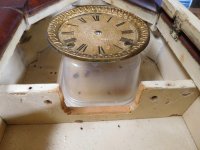
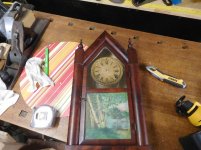
On to the clock project. These gothic steeple clocks were made from about 1840 until yesterday. My example has been refinished and is hard to date but it is made out of exceptional Santo Domingo mahogany so I am estimating 1875--1900, but it could be much older. The previous owner stripped out the works, added a few shelves, and painted the inside creamy white. Then they added a piece of wallpaper over the bottom, which was usually a reverse painted scene.

The Plan
My plan is to do a light restoration to make this clock functional and add a practical quartz movement. I will replace the wallpaper with something nicer--maybe a sailing ship.

So far I have found a nice vintage dial. Yesterday I cut some 1/4" beadboard for the back of the inside to cover the paint. It took a few specialized tools to measure and cut the proper angles on the beadboard.
 

Attachments

  • DSCN6491.jpg
    DSCN6491.jpg
    151.1 KB · Views: 52
  • DSCN6492.jpg
    DSCN6492.jpg
    139.8 KB · Views: 47
  • DSCN6495.jpg
    DSCN6495.jpg
    145.1 KB · Views: 47
  • DSCN6496.jpg
    DSCN6496.jpg
    134.1 KB · Views: 49
  • DSCN6498.jpg
    DSCN6498.jpg
    137.1 KB · Views: 46
  • DSCN6501.jpg
    DSCN6501.jpg
    147.2 KB · Views: 50

rrich1

Well-known member
Joined
Oct 7, 2015
Messages
793
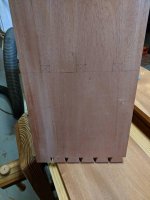
I've got a box! Sort of. All dovetails are cut. Some have more gaps than others. Practice would have actually been a good idea. I ordered a Katz Moses dovetail guide today to aid in future builds.

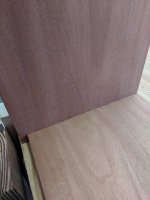
I did manage to get a crack somehow and not sure why or how. That one was one of the easier corners and it wasn't there until after it was all together. Thinking of either putting wood glue in it and clamping it or putting it together and just putting epoxy in it.

Next is the cut through mortise and tennons for the shelf. I got as far as laying out the mortises on the sides. Tomorrow I will drill them out, chisel them clean, and then cut the shelf to fit. IMG_20180425_101616.jpgIMG_20180425_101627.jpgIMG_20180425_101641.jpgIMG_20180425_101652.jpgIMG_20180425_142341.jpg

Sent from my Pixel XL using Tapatalk
 
To avoid these ads, REGISTER NOW!
Top Bottom