To avoid these ads, REGISTER NOW!

Woodworking 101--Tools and Tips

To avoid these ads, REGISTER NOW!

rlitman

Well-known member
Joined
Oct 18, 2010
Messages
24,591
Location
Long Island
Mine does not have the rigid spline...

Then you have a ryoba, but want a dozuki.

https://www.woodcraft.com/blog_entries/choosing-using-japanese-saws
JapaneseSaws2.jpg
 

byacey

Active member
Joined
Oct 6, 2019
Messages
30
Location
Alberta, Canada
I'm sure BYACEY is busy making stuff in his garage, so since I'm sitting around in the early afternoon still in sleepware and nursing a second cup o jo while I police the internet ..I'll just jump in here..OK? BYACEY can correct me when he's finished doing his important stuff. :bounce:
That's exactly the marking gauge I use. I build violins and guitars, and a sharp line is necessary for accuracy.

Sorry, I had to remove the photos from my reply because I'm a new kid on the block, and the forum won't let me post or link photos yet.
 

byacey

Active member
Joined
Oct 6, 2019
Messages
30
Location
Alberta, Canada
Marty: those look pretty fancy. i've got some that do the same job that are made of wood and have a sharp nail to do the marking.

thanks for that assist!! :beer:
Te problem with the "sharp nail" marking gauge is they tear the wood fiber, whereas the Veritas gauge has a very sharp cutting wheel type blade that severs the fiber, creating a very clean line.

The nail type is fine for rough lumber work, though.
 

drivesitfar

Well-known member
Joined
Oct 23, 2013
Messages
36,007
Location
Pacific Northwest
BYACEY: now that you should have enough posts how about posting up a few of your violins and guitars?

thanks for the great advice too!!

I know some of the guys selling old growth and better grade lumber call it FIBER, but i'm still more of a wood butcher so it's taking me some time to learn all the terms. also tooling up should be fun (and EXPENSIVE) to do it right.

welcome to GJ and thanks again for answering one of my many many questions.

cheers

ALL: question for all of you woodworkers or builders!! i'm planning on making a deck with 2x6 clear cedar and wanted to know the best way to attach them to my beams. I was thinking Camo screws in the sides of the 2x6's, but they seem so little compared to my cedar. any thoughts?

also should I plane and install or install it rough and sand it like a hardwood floor?

thanks in advance!!
 

Attachments

  • 7 (2).jpg
    7 (2).jpg
    147.7 KB · Views: 86

byacey

Active member
Joined
Oct 6, 2019
Messages
30
Location
Alberta, Canada
BYACEY: now that you should have enough posts how about posting up a few of your violins and guitars?

thanks for the great advice too!!

I know some of the guys selling old growth and better grade lumber call it FIBER, but i'm still more of a wood butcher so it's taking me some time to learn all the terms. also tooling up should be fun (and EXPENSIVE) to do it right.

welcome to GJ and thanks again for answering one of my many many questions.
Thanks for the nice welcome. I'm on holiday right now in the beautiful Canadian Rockies, but when I get back home I'll be sure to post a few pictures of my work. Here's a few things I have on my laptop that are sort of related.
 

Attachments

  • 22.JPG
    22.JPG
    89.4 KB · Views: 69
  • 33.JPG
    33.JPG
    132.2 KB · Views: 80

rlitman

Well-known member
Joined
Oct 18, 2010
Messages
24,591
Location
Long Island
Te problem with the "sharp nail" marking gauge is they tear the wood fiber, whereas the Veritas gauge has a very sharp cutting wheel type blade that severs the fiber, creating a very clean line.


The nail type is fine for rough lumber work, though.


Traditionally, a marking gauge is used for marking rip cuts, where the nail does a better job of not getting caught following in the grain, making a wandering line. And a marking knife is used for cross cuts, where the blade severs the grain more cleanly. The wheel is supposed to do both well, but I’ve still got the old style tools.
 

turbowoodworker

Well-known member
Joined
Mar 18, 2012
Messages
3,526
Location
Apex NC
Traditionally, a marking gauge is used for marking rip cuts, where the nail does a better job of not getting caught following in the grain, making a wandering line. And a marking knife is used for cross cuts, where the blade severs the grain more cleanly. The wheel is supposed to do both well, but I’ve still got the old style tools.

This.

The two gauges have different functions as described.
 

rrich1

Well-known member
Joined
Oct 7, 2015
Messages
793
The reason why I like the veritas marking gauge vs a nail type is that I can place the board that I want exact thickness for under the marking gauge and then drop the guage down to the material/work surface below that board (offset somewhat) and then tighten the guage. The veritas gauge has the blade all the way at the end of the guide so it will give the exact dimension. Where a knife style gauge is offset from the end. Make any sense?

Also I happen to love my veritas dovetail saw. I have a Japanese saw but always go back to the western style saw.

Sent from my Pixel XL using Tapatalk
 

rlitman

Well-known member
Joined
Oct 18, 2010
Messages
24,591
Location
Long Island
...The veritas gauge has the blade all the way at the end of the guide so it will give the exact dimension. Where a knife style gauge is offset from the end. Make any sense?...

Yes, makes perfect sense, and that's a great feature. As for the knife being offset, that depends on how you grind it.
 

byacey

Active member
Joined
Oct 6, 2019
Messages
30
Location
Alberta, Canada
The reason why I like the veritas marking gauge vs a nail type is that I can place the board that I want exact thickness for under the marking gauge and then drop the guage down to the material/work surface below that board (offset somewhat) and then tighten the guage. The veritas gauge has the blade all the way at the end of the guide so it will give the exact dimension. Where a knife style gauge is offset from the end. Make any sense?

Also I happen to love my veritas dovetail saw. I have a Japanese saw but always go back to the western style saw.

Sent from my Pixel XL using Tapatalk
Veritas produces some of the world's finest tools. In the hand planes arena, they rival and exceed Lee Nielsen in many respects.
 

rrich1

Well-known member
Joined
Oct 7, 2015
Messages
793
Veritas produces some of the world's finest tools. In the hand planes arena, they rival and exceed Lee Nielsen in many respects.
LN are prettier but LV has solved problems the older planes had. I have two LN planes but my other new ones are LV with plans to get more of them.

Sent from my Pixel XL using Tapatalk
 

Spacey_G

Well-known member
Joined
Dec 31, 2015
Messages
492
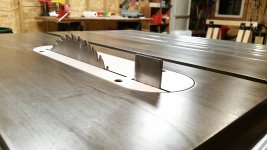
Here's a homemade splitter I made for the Rockwell Model 10. I tried the Microjig splitter...several times...and it didn't work out. This one works great.

20191010_223815 - Copy.jpg
 

lilredex

Well-known member
Joined
Apr 29, 2006
Messages
5,956
Location
Toronto
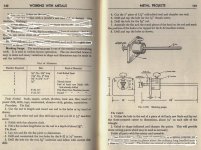
Here is a marking gauge that I made from an old book. The cutter is the end of a hacksaw blade, works well.
 

Attachments

  • Marking Gauge.jpg
    Marking Gauge.jpg
    158.1 KB · Views: 110

fartymarty

Well-known member
Joined
Nov 9, 2012
Messages
1,348
Location
Fort Worth
Here's a homemade splitter I made for the Rockwell Model 10. I tried the Microjig splitter...several times...and it didn't work out. This one works great.

20191010_223815 - Copy.jpg

What specifically was the problem with the Microjig that didn't work out for you?
I just want to know what to be on the lookout for problem-wise. I'm aware of one of their shortcomings: 90 degree cuts only (that appears to be a problem with your splitter as well, right?), but what are the others?
 

Spacey_G

Well-known member
Joined
Dec 31, 2015
Messages
492
What specifically was the problem with the Microjig that didn't work out for you?
I just want to know what to be on the lookout for problem-wise. I'm aware of one of their shortcomings: 90 degree cuts only (that appears to be a problem with your splitter as well, right?), but what are the others?

I tried several times, with new kits and inserts, and could not get the holes drilled in the right locations. They were always off just enough to not work.

At least with this splitter I can add and remove shims to adjust the location. Once you drill the holes for the Microjig kit, there's no adjusting beyond the tolerance range they give you with the different thickness splitters.
 

fartymarty

Well-known member
Joined
Nov 9, 2012
Messages
1,348
Location
Fort Worth
I tried several times, with new kits and inserts, and could not get the holes drilled in the right locations. They were always off just enough to not work.

At least with this splitter I can add and remove shims to adjust the location. Once you drill the holes for the Microjig kit, there's no adjusting beyond the tolerance range they give you with the different thickness splitters.

I guess I just lucked out the first time I did one (1/8th kerf), I did go at it a bit on the fastidious **** side. I think I'll do the same on the second one (thin kerf) which I have yet to do. I'm sorry it didn't work out for you, especially after I recommended it. :( But I'm happy you found a safe solution. :thumbup:
 

drivesitfar

Well-known member
Joined
Oct 23, 2013
Messages
36,007
Location
Pacific Northwest
ALL: thanks for posting the other quality planes that is Nielson's competition and happy you like them.

I've never seen a SPLITTER behind a blade on a table saw. do many of you use them?

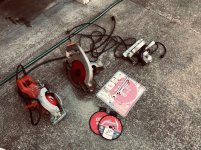
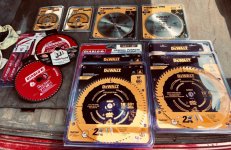
When I picked up a bunch of new Diablo blades for my saws I picked up a 60 tooth blade for my old 6.5 inch Black & Decker circular saw and the plywood and cross cutting cuts are so much better. I'm still a wood butcher, but i'm learning better methods so maybe one day i'll be a WOODWORKER.

hope you all have a great weekend!!
 

Attachments

  • changed saw blade to 10.25 beam saw diablo and cuts nicely now 1.jpg
    changed saw blade to 10.25 beam saw diablo and cuts nicely now 1.jpg
    145.1 KB · Views: 53
  • diablo and dewalt saw blades Aug 2019.jpg
    diablo and dewalt saw blades Aug 2019.jpg
    164.1 KB · Views: 49
To avoid these ads, REGISTER NOW!

turbowoodworker

Well-known member
Joined
Mar 18, 2012
Messages
3,526
Location
Apex NC
Drives,
All modern TS have a “splitter”. Recently, ten years, acceptance of a true “riving knife” has caught on and is the standard for the latest saws. I’ve heard it was a European concept that was slow to be accepted in the US due to additional cost.

Look at pictures of older Delta contractor saws and you’ll see the classic splitter with integral blade guard. Now check out the newest Delta cabinet saw and you can see the riving knife. The purpose of each is to keep the work piece from moving away from the fence (when ripping) and being propelled off the rising, reward half of the blade shooting back at the operator. Classic kickback!

The real difference and hence cost between riving knife and splitter is that the splitter is fixed and the riving knife moves up and down or left to right with the position of the blade. A good riving knife is also easy to tuck beneath the table to allow for nonthrough cuts or dados.

There is more to the description of these two important features and I would urge anyone interested to read up on them, especially if considering a TS purchase; no doubt I’ve left something out. Hope this helps.

Rick
 

turbowoodworker

Well-known member
Joined
Mar 18, 2012
Messages
3,526
Location
Apex NC
One more thing Drives. My short answer to your question about spitters is that if a modern TS does not have one, it is because the operator removed it!
 

rlitman

Well-known member
Joined
Oct 18, 2010
Messages
24,591
Location
Long Island
Drives,

All modern TS have a “splitter”. Recently, ten years, acceptance of a true “riving knife” has caught on and is the standard for the latest saws. I’ve heard it was a European concept that was slow to be accepted in the US due to additional cost...


Modern, as in saws since at least the ‘60’s have had splitters. But splitters behind the table **** and don’t protect you from wood that has tension. It’s too easy for a piece to pass the blade and as it bends, slam into the splitter, leaving you in a sticky situation. A knife, or an inset mounted splitter directly behind the blade doesn’t have this problem. I believe that’s why most manufacturer supplied splitters are tossed.

The reason riving knives were slow to catch up in the US is because classic American saw designs have pivoting arbors to raise the blade that make riving knife mechanisms either difficult or nearly impossible.

European saws have blades that rise vertically, specifically to make the riving knife work.
 
Last edited:

rlitman

Well-known member
Joined
Oct 18, 2010
Messages
24,591
Location
Long Island
See, I knew someone would explain it better. BTW, check out rlitmans new thread on the Powermatic 66. Good stuff right there.


Thanks. :) I’m still filling in the blanks. There’s been so much I’ve done on it, and my shop is too much of a mess to take all the pictures right I want to right now.
 

Alex K. Grant

Member
Joined
Oct 16, 2019
Messages
7
Location
Hopkinsville
I just made myself an English work bench last month. Probably one of my favorite work benches of all time. Having a level surface is incredibly important with woodworking. One thing that I did was I put an enclosed center brace on my table and ran 2-6' threaded rod through it; this helps eliminate any irregularities in cuts. I grew up spending almost every night in my grandfather's wood shop just watching him. He did all sorts of woodworking and I have learned a lot from him. His woodshop is roughly 60'x100' with every tool that has ever existed. I used a simple 2x4 table for the longest time though


Sent from my iPhone using Tapatalk

Great job!
 
OP
J

jimreed2160

Well-known member
Joined
Aug 7, 2016
Messages
3,589
Location
Tallahassee FL
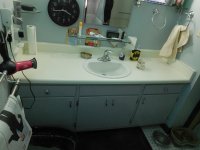
Bath Vanity Upgrade

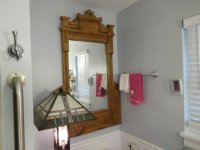
I know I have been MIA lately but only because of my recent ww project. I was cruising thru Lowes one day and spied a pallet of butcherblock countertops and it sparked an idea--I could upgrade my 40 year old countertop. So I checked around and found a butcherblock top from HD that was in European ash. I called up Wall Lumber and procured some 6/4 North Carolina ash for the backsplash. Great news because the room also has an antique ash dresser top mirror.

The sink I ordered was too deep for the plumbing so I jacked up the vanity height by 4 1/2 inches. Turns out that most new vanities are this tall anyway. I saved the kitchen cabinet doors (nice birch plywood) from a past upgrade so I had plywood that matched the vanity. A few biscuit joints made a perfect spacer. Since I had additional height, I also made a shallow center drawer from the false front. New hardware and toe kick lighting finished off the project. I have new wall lights on order.
 

Attachments

  • DSCN9170.jpg
    DSCN9170.jpg
    102.6 KB · Views: 94
  • DSCN9255.jpg
    DSCN9255.jpg
    93.5 KB · Views: 91
  • DSCN9251.jpg
    DSCN9251.jpg
    127.7 KB · Views: 95
  • DSCN9252.jpg
    DSCN9252.jpg
    114.1 KB · Views: 94
  • DSCN9253.jpg
    DSCN9253.jpg
    90.6 KB · Views: 88
  • DSCN9254.jpg
    DSCN9254.jpg
    115.3 KB · Views: 87
OP
J

jimreed2160

Well-known member
Joined
Aug 7, 2016
Messages
3,589
Location
Tallahassee FL
Thanks, TF. The top has over a dozen coats of brush on Varithane poly. Four or five on the wings. I sanded well, installed, taped for overdraft and then shot three coats of rattlecan Varithane.
 
OP
J

jimreed2160

Well-known member
Joined
Aug 7, 2016
Messages
3,589
Location
Tallahassee FL
Jim, did that project qualify you for a new tool or two? Room looks much more inviting.

Thanks for your kind words. And of course some new tools were essential. The actual project required a Milwaukee M18 cordless sander, a Craftsman belt sander and some bandsaw bearings. But during the project hurricane prep required a Milwaukee jobsite radio, two 6ah M18 batteries and a M18 usb adaptor.

All that and I am still under 1k. That beats the granite estimate. Tools rule!
 
OP
J

jimreed2160

Well-known member
Joined
Aug 7, 2016
Messages
3,589
Location
Tallahassee FL
Getting ready to finally buy a square to set up tools etc..
Are incra etc worth the money?

I square my tools with machinists tools mostly. But I have a broad acceptance of "square". Just how precise do your cuts need to be? And what tools are you squaring up?
 

raskal

Well-known member
Joined
Aug 16, 2005
Messages
290
Location
British Columbia
Their guaranteed precision squares? Stupidly overpriced.

Wow... $93 for a 7" square https://www.amazon.com/dp/B0000639X2/?tag=atomicindus08-20

One thing I often fight with, is how precise do I need to be

with the age of digital levels, etc. is there a need to have the blade tilt be at 45.00 degrees or is 44.90 close enough. Most of the time, yeah whatever is precise enough. I found a 12" carpenters square at the dollar store. It's as square as my tablesaw table, so it's fine for most things
 

acer66

Well-known member
Joined
Dec 4, 2010
Messages
4,418
Location
Western North Carolina
I square my tools with machinists tools mostly. But I have a broad acceptance of "square". Just how precise do your cuts need to be? And what tools are you squaring up?

Table saw blades, jointer fence etc., I am extending my ww skills into finer and stained projects so I need to be on a bit more precise level since there is little room to hide things.

No sure what level of squareness that requires.
 
To avoid these ads, REGISTER NOW!
Top Bottom