To avoid these ads, REGISTER NOW!

woodworking vise usage

PoorOwner

Well-known member
Joined
Feb 10, 2007
Messages
5,032
Location
CA
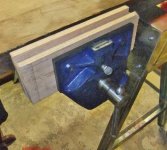
I am getting a wilton wood working vise with quick adjust to finish up the garage.

Internet pic
287255.jpg


Does anyone know, does the metal have to be flush with the bench.. or as long as the wood cleats you install is flush with the bench?

Also its been too long since wood class, but seems like when you try to saw a piece of wood you could cut into the bench, if the bench was continuous and no open corner, or do you use a 4x4 to space out the piece?

I mostly do automotive stuff but do you find a WW vise useful? . the larger surface area and lower pressure is, well, good for wood obviously. For example I could use it to hold an oil jug to drain out the residual oil easily, or hold a little tool tray to make up the lost of space, which isn't much since it is undermounted. I am no woodworker but maybe I can work with chisels and coping saws easier after installing this. I know you can drill a couple of holes on the bench for stops/dogs for more serious use as well.

I already have large bench vises so everything is covered.
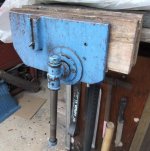
 
To avoid these ads, REGISTER NOW!

Zapp Branigan

Well-known member
Joined
Mar 16, 2014
Messages
220
I use mine mostly for automotive stuff, like for holding a stripped down transfer case housing half, to polish the casting, or to hold my chain sharpener. Never really used it for woodwork. It's mostly used as an extra set of hands, so I mounted it on the front of my bench.
 

Mark in Indiana

Well-known member
Joined
Aug 11, 2010
Messages
3,057
Location
Southern Indiana
Very nice setup with the pivoting jaw faces.
The idea for the top of the iron jaws to be flush with the bench top is so that the "dog" can be used. The dog is the sliding piece in the moving jaw. Large dowels are inserted in the bench at the opposite end of the vise, so large workpieces can be clamped.
A WW vise is very handy for clamping with soft jaws, over a larger area than a standard bench vise. However, I've never needed to use the dog.
 

lilredex

Well-known member
Joined
Apr 29, 2006
Messages
5,956
Location
Toronto
Install the wooden jaws like in your picture and install a step in them, you can then grab smaller pieces. It is also nice to build in a slight inward cant to that front jaw, if you can. WW vises are less than precise and have some built in slop.

http://www.leevalley.com/US/Hardware/page.aspx?p=49980&cat=1,41659


Two of mine...
 

Attachments

  • Wood Vise - Shop Made.jpg
    Wood Vise - Shop Made.jpg
    139.2 KB · Views: 61
  • Wooden Vise Jaws.jpg
    Wooden Vise Jaws.jpg
    144.7 KB · Views: 73
  • Wooden Vise Jaws 1B.jpg
    Wooden Vise Jaws 1B.jpg
    143.8 KB · Views: 61
Last edited:

alfazer

Well-known member
Joined
Nov 1, 2011
Messages
393
Location
N. Ireland
You ask about cutting into the bench when sawing wood. This is why you also need a bench hook to cut the wood onto for fine woodworking, using a tenon saw for example. You can clamp the bench hook in the vice or simply hook it on the edge of the bench.
If you just want to make rougher cuts and not too bothered about grain breaking out at the bottom of the cut, then clamp the wood in the vice with it hanging out on the left while using left hand to support the waste. If right handed, better to mount the vice at the right end of the bench.
 
OP
P

PoorOwner

Well-known member
Joined
Feb 10, 2007
Messages
5,032
Location
CA
Just reporting back, great vise,

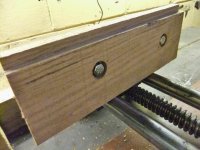
quick adjust both directions, made in Taiwan, finishing is good if not better than USA wilton. The only negative thing is that you cannot really turn it counter clockwise to open the jaw, it just disengage the screw for quick adjust, but the work can be released without lifting out the jaw once turned counter clockwise. There is a pivot piece like in my first post but I didn't install it. It sits on a pin and can be lifted up full width, I am going to drill a couple of holes on the back of the bench for dogs that will help when I need to paint something like a piece of plywood and have it sit off the bench slightly.

I got a question for you guys, should I route out a recess on the bench to clear the static/back jaw. It's about 1/2 inch without the jaw pad. I don't see it accomplish a whole lot besides the appearance. The static jaw isn't really a uniform thickness and is not a perfect 90 degrees on the back side like some of the WW vises, it's tapered a little in every direction. So it won't sit completely flush even if I mortise 1/2" off the front edge of the bench. (the whole vise is supported from the thick flange on the bottom mount).
 

Attachments

  • IMG_0439.jpg
    IMG_0439.jpg
    136.6 KB · Views: 93
  • IMG_0440.jpg
    IMG_0440.jpg
    136.8 KB · Views: 83

Packard V8

Well-known member
Joined
Mar 16, 2009
Messages
7,380
Location
Spokane, WA
It appears in the photo your vise is on the left end of the bench. If so, that means you're left-handed sawyer. A right-handed sawyer would want his vise on the right end of the bench so the saw would clear on through-cuts.

jack vines
 

Zeke

Well-known member
Joined
Aug 13, 2009
Messages
17,176
Location
Long Beach CA, the sewer by the sea.
I use mine all the time for wood and metal. Easy to replace the jaws when they get nasty.

lilredex, good suggestion on the step. I may go out there and do that right now. But, I want to make sure I can turn the jaw upside down if the step is hindering the set up.

Also wood vises tend to tweak when you put work in the end of the jaws (like a vertical piece). To offset that I installed a carriage bolt in a buried nut on the inboard side. I screw the CB out to contact the static jaw at the point that the work on the other side of the hand screw starts to hold. Keeps the jaw face square to the bench to allow square clamping of smaller work.
 
To avoid these ads, REGISTER NOW!
OP
P

PoorOwner

Well-known member
Joined
Feb 10, 2007
Messages
5,032
Location
CA
It appears in the photo your vise is on the left end of the bench. If so, that means you're left-handed sawyer. A right-handed sawyer would want his vise on the right end of the bench so the saw would clear on through-cuts.

jack vines

Thanks for pointing that out. I am right handed but Any sawing at this point have to be above the vise with a bench hook or miter box. the other side is against the wall and no where to stand actually.
 
OP
P

PoorOwner

Well-known member
Joined
Feb 10, 2007
Messages
5,032
Location
CA
I use mine all the time for wood and metal. Easy to replace the jaws when they get nasty.

lilredex, good suggestion on the step. I may go out there and do that right now. But, I want to make sure I can turn the jaw upside down if the step is hindering the set up.

Also wood vises tend to tweak when you put work in the end of the jaws (like a vertical piece). To offset that I installed a carriage bolt in a buried nut on the inboard side. I screw the CB out to contact the static jaw at the point that the work on the other side of the hand screw starts to hold. Keeps the jaw face square to the bench to allow square clamping of smaller work.

I didn't realize it does not have any guide rods so the whole thing is wobbly until cinched up. I think some sort of guide or roller wouldn't be a bad idea
 

Maui

Well-known member
Joined
Sep 16, 2012
Messages
2,901
Location
Upstate NY
You could also use a coachman's vise like the one in the attachment. It's a Reed 224 1/2, and was designed for use with wood and sheet metal. It can accommodate a piece up to approximately 11" in width, and has 4 1/2" wide jaws. This particular vise also has a swivel jaw. They are nice vises if you can find them.

Maui
 

Attachments

  • Reed Coachman Vise 20160111_170801_resized.jpg
    Reed Coachman Vise 20160111_170801_resized.jpg
    150.9 KB · Views: 45

RonnieC

Well-known member
Joined
Aug 7, 2013
Messages
814
Location
Orlando, FL
I'm right handed and have my woodworking vise on the left corner of the bench. I occasionally do through crosscuts, which leaves my left hand to support the offcut. But for more precise cutting of smaller parts, yes a bench hook followed up by planing on a shooting board.
 
OP
P

PoorOwner

Well-known member
Joined
Feb 10, 2007
Messages
5,032
Location
CA
I had to add a block of wood but route out to the exact 3 inch height specified.
It is mounted now.
 

Attachments

  • image.jpg
    image.jpg
    8.4 KB · Views: 60
OP
P

PoorOwner

Well-known member
Joined
Feb 10, 2007
Messages
5,032
Location
CA
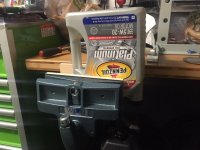
Here is the installed product. I am not a woodworker or making furniture, so the precision of the install isn't such a big deal. It's going to help hold a base for other vises, small bench grinder, tool tray etc, and as a 3rd hand.
 

Attachments

  • wwvise.jpg
    wwvise.jpg
    135.2 KB · Views: 63
Last edited:

rlitman

Well-known member
Joined
Oct 18, 2010
Messages
24,683
Location
Long Island
It appears in the photo your vise is on the left end of the bench. If so, that means you're left-handed sawyer. A right-handed sawyer would want his vise on the right end of the bench so the saw would clear on through-cuts.

jack vines

What the heck are you talking about?

Have you seen a Roubo workbench? Far and away this is the most common style used for woodworking benches. The vice goes on the left, EXACTLY as pictured, for right handed uses. Around the corner on the right goes the tail vise.

I don't think I fully understand you question but if you install yours like the pic you'll be fine. The vise should be flush/below the surface of the bench and you can pop up the dogs to clamp boards flat.

Yep. The first pic shows wood jaw faces that are too tall to effectively use the dog.

Here's how I do it.

The metal jaws of the vise are set around 1/16" beneath the surface of the bench (or a little less, but nowhere near as low as the pic), with the left side being about an inch or two (depending on how much wood jaw overhang you're comfortable with) from the left end of the bench (you never want your work touching the metal jaws, so they're always a little out of reach).

I backset the rear metal face, so that it is completely incised into the bench front, with room to insert a wooden jaw face nearly, but not totally flush.

The wood jaw faces are made to be exactly flush with the bench top (protecting your work from the now slightly inset metal), and overhang the metal faces on the sides, by as much as you like on the right, and until exactly flush with the left edge of the bench on the left.
Being flush on the top means that a piece overhanging the bench over the vise will sit flat, and you can actually extend the vise out as a mini extension wing.

The static wood face sits proud of the bench front, around 1/8", so that you do not need to pad it out to hold a long piece of straight stock without it binding on the bench front (though arguments could be made to make this flush instead; this is a personal preference on my part).

The front face of the right bench leg is drilled for hold fasts, just like the bench top. With a long piece in the vise, you can use dowels in this (or a holdfast and an 1/8" shim to make up for the gap if necessary) for extra support.

Here's one other CRITICAL often overlooked detail. The jaw faces need to grab a little more tightly at the top, than at the bottom. This is done with the static jaw being perfectly perpendicular to the bench top, but the dynamic jaw should lean in (only a LITTLE, and how much so needs to be determined by how much flex is in the vise), so that it only ends up parallel to the static jaw when under clamping pressure.
My Wilton woodworking vise came with the dynamic jaw leaning in at the perfect angle, so flat parallel surfaced stock could be used for the jaw faces.
Cheaper woodworking vises often come with jaws that are parallel when loose, so they bow out under clamping pressure, and you need to compensate for this by using a tapered piece of wood on the dynamic jaw.
 
Last edited:
To avoid these ads, REGISTER NOW!
Top Bottom