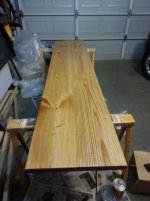
If you choose to make a solid top, make sure you account for expansion of the wood. It will expand more the 'short' way, than the long way. If you glue together one, wide board, you have a couple of options for fastening to the bench.
- At the center of the DEPTH of the bench (I will use DEPTH to talk about the short distance on the top...the distance between the place where you stand in front of the bench and the wall), fasten the top to the support in the center with a heavy lag screw or two (drill up through the support and drill pilot holes in the bottom of the top), then do not fasten it anywhere else.
- Put lag screws from the bottom, up into the top, pretty much anywhere you want, but make sure you drill the holes in the cross braces big enough to really let the top move around (something like a 1/2" hole for a 5/16" lag screw. Use a fender bolt on the lag screw. You could pick a couple of places (again, the center of the short sides of the bench) to make the correctly-sized hole (5/16" hole for 5/16" lag screw), to keep the bench top from moving out of place in general.
- You could, of course, do any variation on this theme, as long as you keep the 'tight' lag screws in one line, in line with the LEAST movement of the wood (the long length). You could put a row of correctly-spaced lag screws across the front support of the bench, then use loosely-spaced holes for the holes in the short sides and the rear of the bench.
The whole point is that solid wood, unlike plywood, WILL MOVE. The larger the slab, the more movement you will have and the more you have to account for it. This seasonal movement is like heat from welding...it has significant power to move things around and will literally pull your bench apart, if you do not account for it.
That said, I think it's a great idea. If I was going to do it, I would get some kiln-dried pine 2x4's and make the top thick--3.5" thick, with the 'short' edge of the 2x4 on the top and bottom. I'd individually pick my boards to be absolutely straight. I would run one edge of each through the table saw, reset the saw, then run the opposite edge through the table saw.
You are going to need a LOT of clamps...or, you could make a caul. find a 2x4 with only a bow in it (no twist, just a bow) for each side of the bench top. Prep and glue the boards (always do a dry setup first...you won't have time for major problems, once the glue is drying). Use wax paper (from the kitchen) between the glued-up bench top and the cauls. place the tips of the caul against the ends of the bench (At the start of this process, the ends of the caul will touch the ends of the bench top boards, but the center will be bowed out a few inches). Put a clamp on the center of the caul and tighten until glue squeezes out everywhere. As you squeeze the centers of the cauls together, it will apply (relatively) even pressure across the whole length of the bench top. DEFINITELY practice this before you do it 'live.' There is a LOT that has to be done in a relatively short period of time and you want to practice it before a pint of glue is quickly drying on you. This is going to take a very hefty clamp or two or three or four (the classic Pony pipe clamp where you use your own black pipe--or the better, more modern, versions from Bessy and others.)
I like relatively narrow bench tops, because I like to be able to move my benches into the middle of the room and work all the way around them. I like 28" wide. That gets your bench through any man door. If you like a permanent bench against the wall, you may choose wider, if you like to put drill chargers and small sets of drawers and other supplies across the back, near the wall. That leaves you enough space to work on the bench. If I need a wider or longer bench, I'd much rather have two smaller benches with identical heights than one large bench. That gives you a great deal of versatility.
You can, of course, glue the 2x4's the narrow way, and make a 1.5" thick top. If I was going to go through this much effort, though I'd want a thick enough bench top to drop some jaws when people walk into the garage. I've seen some super straight 4x4s and 4x6s at Home Depot lately. That would certainly cut down on the work and you could still have a 4"-thick top.
I haven't done this, but if I wanted a solid top, that is the technique I would use. I hope it gives you a few ideas.
I personally really like the double 3/4" plywood top. Unbelievably durable. Unbelievably sturdy. Can be turned 3 times to give you a fresh surface. Dead flat. No seasonal movement. If you really do dirty stuff, then add one layer of tempered hardboard to the top. If you look at the top of the smaller bench I built with this top, I even cut some square bench dog holes in it (drilled a round hole, then squared it up with a chisel, then cut oak bench dogs to fit the holes). I also installed a basic woodworking vise on the front, right edge...
View media item 20570
NO MATTER what you do for the top, make sure you design the bench to give you a few inches to use clamps on all the edges. There is no single reason you will want to kick yourself later, than if you cannot properly clamp projects to an amazingly-steady bench (ask me how I know and ask me why I designed nearly six inches of clamping room into the front and back of my behemoth baileigh bench...
View media item 18635
Yikes! I'm typing and I cannot shut up...I'll let some others jump in here now.
Kev


 and build myself a new workbench for out in the garage. My current bench I built about 9 years ago has suited me well but like anything there is room for improvement. Here is the design that I plan on basing my after http://www.oneprojectcloser.com/how-to-build-heavy-duty-workbench/print/ I was really impressed how these guys put flat steel along the lengths of the bench to make the bench more ridgid. I also like the simpson ties idea. But I'm not so sure about having the bench on casters. Seems like more of a pain than a benefit. Not sure if I like the plywood top. Currently I am using 2x6's which I like but also hate the gaps between the boards. Also I think I will build my legs out of 4x4's and have a place to slide a shop vac under the bench. I currently have that feature and really like that. Then I need to decide what to do with the vise. Currently it is mounted to the bench but it might be nice to have it be portable.
 - just remove the old and put a new sheet on top.