To avoid these ads, REGISTER NOW!

Yet another concrete question...

BeeKay

New member
Joined
Aug 29, 2012
Messages
2
Hello friends..... I'm relatively new to TGJ and have been fascinated by what I've read here about the journey on which I am about to embark!

Some details to help with your responses:

I live in Florida, approx 40 miles due west of Daytona Beach
I am having a 30x40x10 workshop/storage barn built behind our house.
We are going to build on a monolithic slab, current specs are:
4" thick, 3000 PSI, fiber mesh reinforcement with rebar (not sure of the size) with 3 foot door aprons for the walk in door, two 10x8 garage doors and one 16x8 garage door.

Note that the rebar is only around the perimeter of the foundation - builder said the rebar is intended to help prevent perimeter cracks and chunks coming off due to the weight of things like vehicles being driven up into the building. So throughout the rest of the slab, its only the fiber mesh... no wire mesh or rebar. How does that sound???

I plan to use it for storage, and parking a honda pilot on one end of the 40' length, and a Kubota B2320 tractor on the other end across from the pilot.
I will also have the usual miscellaneous workbench, table saw, drill press and other items the average weekend garage warrior would need... No car lifts, no industrial equipment, nothing as heavy else as the tractor or pilot.

We live on 3 acres of mostly sandy dirt.

It was mostly undisturbed until the construction began this week and trees were removed (stumps and all) and the ground was "raked" to pull up the remaining saplings and minor roots. 6 truck loads of import fill dirt were also brought in to prepare the pad for the slab.

As with almost everyone who asks about concrete, I want to minimize the inevitable cracking as best as I can... I read a number of threads in here about compacting the dirt, and then once poured, keeping the surface of the concrete wet for at least 7 days starting at about 2 hours after the pour.

Though, I have a few specific questions and would also appreciate any additional feedback.

1) I asked our builder about "upgrading" the specs for the concrete and was told:
  • Cost difference to change from 3,000 to 4,000 PSI including fiber reinforcement: +$410.00
  • Cost difference to change to 5” thick, 3,000 PSI including fiber reinforcement: +$790.00

I was thinking that better specs may help with the cracking that we have already experienced in our house just 75 feet away. What would the appropriate specs be for my particular application of this building/slab? Is the originally proposed 3"/3000PSI satisfactory? Would upgrading help minimize problems with cracking? Is upgrading to 5"/4000PSI enuff? Your thoughts on this?

2) I would like advice from the pros out there, please, on what you would do to prepare before the pour and if you would actually keep gentle but constant watering going on for at least 7 days after the pour. I was thinking of either using those cheap plastic sprinkler heads they sell at Walmart or Home Depot or perhaps several of the soaker type of garden hoses. The temps are still in the mid to upper 80s here and I wont be around to baby sit... so if the sprinkler method is not a no-no, I think that will work better than periodic wetting throughout the day and a plastic sheet cover.

3) Besides the plastic sheeting / barrier that will be laid before the pour, I dont know if he plans to use gravel or anything else. I think its gonna be the fill dirt that was build up to create the pad, the plastic sheet and then POUR.... your thoughts on that?


Thanks for your help folks!
 
Last edited:
To avoid these ads, REGISTER NOW!

Al Bundy

Well-known member
Joined
Aug 1, 2011
Messages
2,026
Location
Upstate NY
Personally I would go a minimum of 4". Anything beyond that for your purposes would be overkill. The fiber will help to prevent cracking until the concrete is fully cured. Your main concern should be pouring on top of fresh fill. If you aren't pouring on virgin ground it really needs to have every couple inches compacted. Much like a lot of other things the success of your project depends on the proper preparation.
 

joes169

Well-known member
Joined
Sep 19, 2011
Messages
663
Location
WI
Though, I have a few specific questions and would also appreciate any additional feedback.

1) I asked our builder about "upgrading" the specs for the concrete and was told:
  • Cost difference to change from 3,000 to 4,000 PSI including fiber reinforcement: +$410.00
  • Cost difference to change to 5” thick, 3,000 PSI including fiber reinforcement: +$790.00

This seems excessive to me for both upgrades, as my cost HERE would be an additional $130 for the 4000 psi upgrade, and the additional 1" of concrete thickness would be about $350. I can't speak for the minimum psi needed in Florida, as it's a much different environment than here, but we always opt for 4000 psi here as, among other more obvious reasons, it finishes much better and faster, giving a superior finished product and offsetting the additional material cost by labor savings. Win-win for me as a contractor.

I was thinking that better specs may help with the cracking that we have already experienced in our house just 75 feet away. What would the appropriate specs be for my particular application of this building/slab? Is the originally proposed 3"/3000PSI satisfactory? Would upgrading help minimize problems with cracking? Is upgrading to 5"/4000PSI enuff? Your thoughts on this?

Personally I think a 4" floor is adequate, but feel that the slab should have a thickened edge/grade beam around the entire outside perimeter, likely at least 8" thick. This means an extra yard or two of concrete but with the addition of rebar (2 - #4 (1/2") running continuous around the perimeter really should be the minimum) makes a huge increase in long term performance, as the "dead-load" of the building rests entirely on the outside perimeter.

2) I would like advice from the pros out there, please, on what you would do to prepare before the pour and if you would actually keep gentle but constant watering going on for at least 7 days after the pour. I was thinking of either using those cheap plastic sprinkler heads they sell at Walmart or Home Depot or perhaps several of the soaker type of garden hoses. The temps are still in the mid to upper 80s here and I wont be around to baby sit... so if the sprinkler method is not a no-no, I think that will work better than periodic wetting throughout the day and a plastic sheet cover.

Ideally, you need to start misting very lightly as soon as you can, and you'd put a cover of some kind (think absorbant rather than water-resistant) and water it once or twice a day. Maybe go to your local thrift store and buy as many old bed sheets or thin blankets as you can find....:lol:

That being said, we rarely ever wet cure here in residential construction, but apply a curing sealant to assist in slowing down the rapid release of moisture from the slab.


3) Besides the plastic sheeting / barrier that will be laid before the pour, I dont know if he plans to use gravel or anything else. I think its gonna be the fill dirt that was build up to create the pad, the plastic sheet and then POUR.... your thoughts on that?


Thanks for your help folks!

Sand can have it's own laundry list of issues when it comes to pouring over, but the plastic sheeting should take care of all of those issues. As someone who's been in this trade for nearly 25 years, I find verbal explanation of soils,gravels, etc... is all over the map. As long as you fell the base is relative stable before the concrete, it should be fine.
 

DoyleDee

Well-known member
Joined
Jun 17, 2007
Messages
689
Location
North Texas
They guarantee two things with concrete......it will get hard and it will crack....all we can try to do is minimize the cracks. You definitely need a good solid base...from there 4" of concrete (I used wire mesh in my pad) and keep it wet for at least 7 days..it should be fully cured in 28days.
There are many ways to do it...wire mesh, rebar, fiber....
 

brownbagg

Well-known member
Joined
Mar 20, 2006
Messages
5,208
all is good but I would do five with 4000, its not that much more money, if you wanted a lift, the safety factor be there, remember, the finisher going wet it up so your 3000 will really be a 2500. you can only do it once so pay a little more to sleep easier at night
 

ConCretin

Well-known member
Joined
Jan 20, 2011
Messages
3,378
Location
Central Maine
Beekay, before I respond to your specific questions, I'd offer a couple comments about your primary concern, which appears to be random cracks.

While it is possible to construct a slab the size of yours without cracks, not every contractor is willing or able to do it. Your primary defense against unsightly random cracks is saw cut or tooled control joints. The joints induce cracks below and so you don't see them. For a slab your size, I'd do one joint in each direction at least 1" deep.


Note that the rebar is only around the perimeter of the foundation - builder said the rebar is intended to help prevent perimeter cracks and chunks coming off due to the weight of things like vehicles being driven up into the building. So throughout the rest of the slab, its only the fiber mesh... no wire mesh or rebar. How does that sound???

I assume the rebar he's referring to around the perimeter is in a thickened haunch, which is appropriate. Fibermesh is often used in lieu of rebar in slabs although the two materials perform different functions.

The fibermesh helps control early age plastic shrinkage cracks buying you time to cut control joints. Rebar is less effective at controlling this type of cracking (you'll still need control joints) but will hold the concrete together across cracks or joints so you don't get separation and vertical displacement.

If you are building on a well compacted granular base, the fibermesh is fine. If you have any concerns about the sub grade, rebar is a better choice. Something like #4's at 18" centers supprted every 4' would work.


1)I was thinking that better specs may help with the cracking that we have already experienced in our house just 75 feet away. What would the appropriate specs be for my particular application of this building/slab? Is the originally proposed 3"/3000PSI satisfactory? Would upgrading help minimize problems with cracking? Is upgrading to 5"/4000PSI enuff? Your thoughts on this?

Neither of these upgrades will have a major effect on cracking. The base as I mentioned earlier is more important. 4" of 3000 psi concrete is more than adequate for a residential slab.

2) I would like advice from the pros out there, please, on what you would do to prepare before the pour and if you would actually keep gentle but constant watering going on for at least 7 days after the pour. I was thinking of either using those cheap plastic sprinkler heads they sell at Walmart or Home Depot or perhaps several of the soaker type of garden hoses. The temps are still in the mid to upper 80s here and I wont be around to baby sit... so if the sprinkler method is not a no-no, I think that will work better than periodic wetting throughout the day and a plastic sheet cover.

Your goal is to keep the concrete in a continuously moist condition for at least seven days. You can achieve this with sprinkling but a better method is to thoroughly water down the slab and then cover it with poly or better yet a curing fabric. Start curing as soon as the finishers are done (including saw cuts). Monitor the slab and re-wet if neccessary

3) Besides the plastic sheeting / barrier that will be laid before the pour, I dont know if he plans to use gravel or anything else. I think its gonna be the fill dirt that was build up to create the pad, the plastic sheet and then POUR.... your thoughts on that?

Just make sure the 'dirt' is a granular, drainable material. Up here we'd use 6 to 12 inches of gravel or crushed stone. It should be compacted in lifts.

Ask your contractor what slump he intends to place the concrete at. If he wants a slump of more than 4", consider asking the concrete supplier to provide a mid range water reducer, which will give your contractor a workable slump without adding too much water. Excessive water is a common cause of shrinkage cracks, low strength and surface problems

Finally, mention that you'd like him to avoid adding a lot of water during the finishing process. Sometimes its better to sprinkle a little water if it's needed to get a good finish but you want to keep it to a minimum

If you pay attention to the base, install control joints, limit mix water and cure the slab properly you'll end up with a good slab and are very unlikely to get and random cracks. Good luck.
 
Last edited:

wssix99

Well-known member
Joined
Mar 2, 2011
Messages
5,161
Location
Chicago, IL
1) I asked our builder about "upgrading" the specs for the concrete and was told:
  • Cost difference to change from 3,000 to 4,000 PSI including fiber reinforcement: +$410.00
  • Cost difference to change to 5” thick, 3,000 PSI including fiber reinforcement: +$790.00

I was thinking that better specs may help with the cracking that we have already experienced in our house just 75 feet away. What would the appropriate specs be for my particular application of this building/slab? Is the originally proposed 3"/3000PSI satisfactory? Would upgrading help minimize problems with cracking? Is upgrading to 5"/4000PSI enuff? Your thoughts on this?

You are on the right track as-is with your 3000 psi plan. The psi rating is the compressive strength of the concrete. Slabs crack in tension, so the psi rating doesn't give you any defense here. The reinforcement is what counteracts tension.

A 4" depth may be overkill unless you are going to have the floor see heavy duty - like a lift. Lifts and heavy weights put the floor under increased bending tension, which the depth of the slab counteracts.


The cracking you are trying to avoid is shrinkage cracking. As the slab cures, it shrinks slightly, putting the slab in tension. Then the cracks come - there is NO way to avoid this. Relief cuts will control where the cracks happen to make the slab look better and other methods will help minimize the cracking or have it occur on a microscopic level.

As mentioned above, your fibers are providing the reinforcement to counteract this cracking. (Fibers can be used in place of steel wire mesh - or in conjunction.)

If you want to do more to counteract shrinkage cracking, you could:
- Inquire in to using mesh AND fibers. (Key to mesh - the mesh must be placed exactly in the middle of the slab. This a PITA for contractors, as its hard to work around and must be rested on stand-offs to raise it above the grade. If the mesh rests on the ground and ends on the bottom of the slab, it will do nothing for you.)
- Use a drier mix. Ask for a low slump, dry mix. The less water that is in the mix, the lesser the cracking will be. Again, the drawback here is that its harder for the contractor to work with.
 
To avoid these ads, REGISTER NOW!

dirttracker18

Well-known member
Joined
Aug 10, 2009
Messages
3,191
Location
Slate River, ON
They guarantee two things with concrete......it will get hard and it will crack....all we can try to do is minimize the cracks.

Hmm

That's funny, my 5 year old slab has no cracks.

In fact I specifically hired the guy I did to prep and form because he does not get cracks.

It is ALL in the prep work, remove any soil that may be loose.

Bring in and correctly compact your subfoundation, usually gravel around here. Lay 6" with lots of water and compact, 6" more water and compact, repeat until desired elevation is reached.

Hire a good concrete finisher who will ensure the concrete is mixed correclty.
 

LutzTD

Well-known member
Joined
Dec 31, 2011
Messages
3,673
Location
Lutz, Florida
on my slab, on the same sand as you, they poured 4" thick in the center and the last 2 feet on all edges was taken to 6" thick, I had knee walls so they rebarred into the knee every 2 feet. there is 6x6 wire mesh on top of 6 inches gravel with a plastic sheet between the gravel and slab. also they had to put down termite treatment before the gravel. after 3-4 days they came back and cut it to 10x10 sections (20X40 floor) the cuts in mine were lined up to the pilasters in the wall. the cuts are only a saw width ad are hardly noticable in practical use. of course you can see them, but the old hand formed ones you would get a caster stuck in, these not at all.
 
Last edited:

BWS

Well-known member
Joined
Sep 3, 2006
Messages
923
Location
Mnts of Va
Theres data available for rebar sizing and spacing.It only makes sense to research it.Throwing money away....using too big and too close....isn't accomplishing a dang thing.And in suspended work can cause more problems than the inverse.Just sayin.
 

rustyjames

Well-known member
Joined
Dec 28, 2008
Messages
1,077
Location
central nj
Hmm

That's funny, my 5 year old slab has no cracks.

In fact I specifically hired the guy I did to prep and form because he does not get cracks.

It is ALL in the prep work, remove any soil that may be loose.

Bring in and correctly compact your subfoundation, usually gravel around here. Lay 6" with lots of water and compact, 6" more water and compact, repeat until desired elevation is reached.

Hire a good concrete finisher who will ensure the concrete is mixed correclty.

I agree, prep, proper placement and easy with the H2O is just about everything.
 

nmanitou

Well-known member
Joined
Mar 17, 2009
Messages
221
Location
Michigan
LLWillysfan answer #6 is spot on. Couldn't have said it better myself.

You can stop reading answers now!
 
OP
B

BeeKay

New member
Joined
Aug 29, 2012
Messages
2
Guys, Thank you all so much for your replies so far. My apologies for the delay in a follow up post, work has been bogging me down.... that and continuously checking on the progress of the garage :) I work at home and, well, this is a huge distraction!
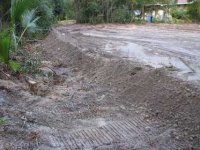
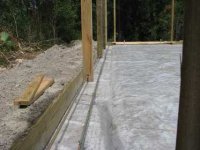
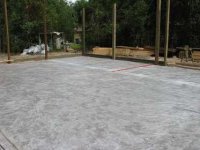
The work has indeed started, and is moving rather quickly this week.... way faster than I expected. Pix attached for your review.

The first one shows what we looked like on Tuesday. The rest are from Thurs this week... 7 loads of fill were brought in. An unknown mix of "sand and soil". All 7 were spread out all at once using an RC-85 posi trac. You can see the final height of the pad in the second picture. There was no gravel or water used in the process, though it has rained and the fill was moist and sticking together... not muddy, but wet enuff that you could make a dirt ball... FL equivalent of a snowball I suppose....

The builder and the concrete guy (who the builder uses for most of his jobs) told me that the only compaction they normally apply to the fill is from the posi trac.

The above is their typcial prep for a building of this type and the builder and the concrete guy have repeatedly told me that they rarely see very much cracking and almost never any substantial gaps.

They plan to pour the slab on Mon next week. and will probably be cutting the slab (30x40) into 6 or 8 sections.. prob at each of the 6x6 posts. Once the cutting is done, I do plan to water gently with lawn sprinklers "constantly" for 7 days. But the guys will be working on the walls and roof during that time and so we'll see how constant I can keep it going. I may have to go the poly cover route - What should I buy from Lowes or Home Depot for this purpose? any particular product name and/or thickness youd recommend?

Slab will be 3000psi at 6" depth.

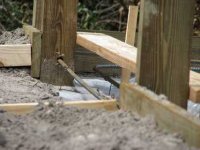
That's 6 mil visqueen over the pad now. You can see the rebar around the perimeter. They used 5/8"x20' lengths. The pour will have the fiber mesh, no additional rebar or steel mesh.

You can see how they ran the rebar thru the posts to help lock the posts in place even more than just dirt (4' depth) All the 6"x6" posts are pressure treated CCA 0.6. The rest of the wood is pressure treated Copper Azole 0.15 pcf CA-C.

The builder is reputable and trustworthy. His record with previous customers is better than any of the other companies I looked into for the past TWO YEARS before finally making a decision. It was funny, when I showed him a "generic" picture of what we wanted to build (a pic I found online) he said "I like it when people compare me to Morton..." He nailed that picture as soon as he saw it. The quality of his work is akin to Morton... but he's truly local and has a better price.

I shared many your recommendations with him and he stood firmly on his past prep work for other jobs and fully plans to stand behind his work... 25+ yrs in the business under the same name.
 

Attachments

  • IMG_3821_1.JPG
    IMG_3821_1.JPG
    26.6 KB · Views: 29
  • IMG_3832_1.JPG
    IMG_3832_1.JPG
    28.5 KB · Views: 30
  • IMG_3900_1.JPG
    IMG_3900_1.JPG
    22.8 KB · Views: 32
  • IMG_3904_1.JPG
    IMG_3904_1.JPG
    22.5 KB · Views: 34
  • IMG_3906_1.JPG
    IMG_3906_1.JPG
    21.4 KB · Views: 33
  • IMG_3872_1.JPG
    IMG_3872_1.JPG
    33.8 KB · Views: 25
Last edited:

camarotoolman

Banned
Joined
Mar 12, 2011
Messages
2,372
Location
cocoa Fl.
Too late now, but I would have compacted the pad fill. Soak it down with water or rented a jumping jack or plate compacter. I would add some extra thickness for a lift.
 
To avoid these ads, REGISTER NOW!
Top Bottom