Hello friends..... I'm relatively new to TGJ and have been fascinated by what I've read here about the journey on which I am about to embark!
Some details to help with your responses:
I live in Florida, approx 40 miles due west of Daytona Beach
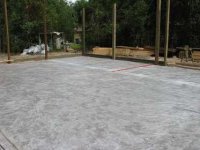
I am having a 30x40x10 workshop/storage barn built behind our house.
We are going to build on a monolithic slab, current specs are:
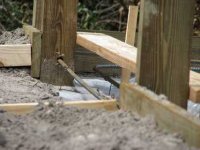
4" thick, 3000 PSI, fiber mesh reinforcement with rebar (not sure of the size) with 3 foot door aprons for the walk in door, two 10x8 garage doors and one 16x8 garage door.
Note that the rebar is only around the perimeter of the foundation - builder said the rebar is intended to help prevent perimeter cracks and chunks coming off due to the weight of things like vehicles being driven up into the building. So throughout the rest of the slab, its only the fiber mesh... no wire mesh or rebar. How does that sound???
I plan to use it for storage, and parking a honda pilot on one end of the 40' length, and a Kubota B2320 tractor on the other end across from the pilot.
I will also have the usual miscellaneous workbench, table saw, drill press and other items the average weekend garage warrior would need... No car lifts, no industrial equipment, nothing as heavy else as the tractor or pilot.
We live on 3 acres of mostly sandy dirt.
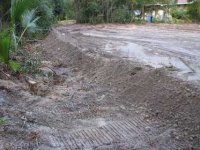
It was mostly undisturbed until the construction began this week and trees were removed (stumps and all) and the ground was "raked" to pull up the remaining saplings and minor roots. 6 truck loads of import fill dirt were also brought in to prepare the pad for the slab.
As with almost everyone who asks about concrete, I want to minimize the inevitable cracking as best as I can... I read a number of threads in here about compacting the dirt, and then once poured, keeping the surface of the concrete wet for at least 7 days starting at about 2 hours after the pour.
Though, I have a few specific questions and would also appreciate any additional feedback.
1) I asked our builder about "upgrading" the specs for the concrete and was told:
I was thinking that better specs may help with the cracking that we have already experienced in our house just 75 feet away. What would the appropriate specs be for my particular application of this building/slab? Is the originally proposed 3"/3000PSI satisfactory? Would upgrading help minimize problems with cracking? Is upgrading to 5"/4000PSI enuff? Your thoughts on this?
2) I would like advice from the pros out there, please, on what you would do to prepare before the pour and if you would actually keep gentle but constant watering going on for at least 7 days after the pour. I was thinking of either using those cheap plastic sprinkler heads they sell at Walmart or Home Depot or perhaps several of the soaker type of garden hoses. The temps are still in the mid to upper 80s here and I wont be around to baby sit... so if the sprinkler method is not a no-no, I think that will work better than periodic wetting throughout the day and a plastic sheet cover.
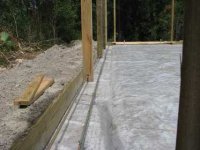
3) Besides the plastic sheeting / barrier that will be laid before the pour, I dont know if he plans to use gravel or anything else. I think its gonna be the fill dirt that was build up to create the pad, the plastic sheet and then POUR.... your thoughts on that?
Thanks for your help folks!
Some details to help with your responses:
I live in Florida, approx 40 miles due west of Daytona Beach
I am having a 30x40x10 workshop/storage barn built behind our house.
We are going to build on a monolithic slab, current specs are:
4" thick, 3000 PSI, fiber mesh reinforcement with rebar (not sure of the size) with 3 foot door aprons for the walk in door, two 10x8 garage doors and one 16x8 garage door.
Note that the rebar is only around the perimeter of the foundation - builder said the rebar is intended to help prevent perimeter cracks and chunks coming off due to the weight of things like vehicles being driven up into the building. So throughout the rest of the slab, its only the fiber mesh... no wire mesh or rebar. How does that sound???
I plan to use it for storage, and parking a honda pilot on one end of the 40' length, and a Kubota B2320 tractor on the other end across from the pilot.
I will also have the usual miscellaneous workbench, table saw, drill press and other items the average weekend garage warrior would need... No car lifts, no industrial equipment, nothing as heavy else as the tractor or pilot.
We live on 3 acres of mostly sandy dirt.
It was mostly undisturbed until the construction began this week and trees were removed (stumps and all) and the ground was "raked" to pull up the remaining saplings and minor roots. 6 truck loads of import fill dirt were also brought in to prepare the pad for the slab.
As with almost everyone who asks about concrete, I want to minimize the inevitable cracking as best as I can... I read a number of threads in here about compacting the dirt, and then once poured, keeping the surface of the concrete wet for at least 7 days starting at about 2 hours after the pour.
Though, I have a few specific questions and would also appreciate any additional feedback.
1) I asked our builder about "upgrading" the specs for the concrete and was told:
- Cost difference to change from 3,000 to 4,000 PSI including fiber reinforcement: +$410.00
- Cost difference to change to 5” thick, 3,000 PSI including fiber reinforcement: +$790.00
I was thinking that better specs may help with the cracking that we have already experienced in our house just 75 feet away. What would the appropriate specs be for my particular application of this building/slab? Is the originally proposed 3"/3000PSI satisfactory? Would upgrading help minimize problems with cracking? Is upgrading to 5"/4000PSI enuff? Your thoughts on this?
2) I would like advice from the pros out there, please, on what you would do to prepare before the pour and if you would actually keep gentle but constant watering going on for at least 7 days after the pour. I was thinking of either using those cheap plastic sprinkler heads they sell at Walmart or Home Depot or perhaps several of the soaker type of garden hoses. The temps are still in the mid to upper 80s here and I wont be around to baby sit... so if the sprinkler method is not a no-no, I think that will work better than periodic wetting throughout the day and a plastic sheet cover.
3) Besides the plastic sheeting / barrier that will be laid before the pour, I dont know if he plans to use gravel or anything else. I think its gonna be the fill dirt that was build up to create the pad, the plastic sheet and then POUR.... your thoughts on that?
Thanks for your help folks!
Last edited:

 I work at home and, well, this is a huge distraction!