I'm preparing for the imminent lighting of my 36' x 27' garage and workshop which, for all intents and purposes, has a 12' ceiling throughout.
Effectively, the left two thirds consist of two oversized single-width parking bays. Each contains a four-post stacking lift behind a 10' x 9' door. The remaining third contains space for a workshop. Enough clearance exists between the doors to ensure cars on both sides can fully open doors without touching. The additional clearance can accommodate a fifth car in a pinch, albeit not very comfortably.
Normally, the lighting configuration would've been relatively straightforward and I would've run tandem T5 fixtures longitudinally along each side of each bay. I also would've included a final column over the workshop and used additional site-specific fixtures to fill-in any holes or remove any inadvertent shadows. Unfortunately, one aspect of the garage's construction makes this proposition challenging. Two longitudinal beams protrude about 1' from the ceiling and effectively separate the garage ceiling into three distinct sections.
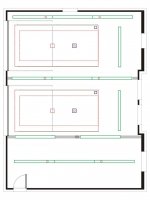
Flanking each bay with lights would place them too close to the beams and essentially obscure one side of each row. Other rows, and a single tandem fixture traversing each bay to provide lighting for open hoods and foot paths, should effectively eliminate shadows, but not without enough light going to waste throughout to make me reluctant to light the garage this way notwithstanding the configuration's other inherent benefits.
This configuration would require 13 tandem T5HO strips casting about 20,000 lumens each or about 250,000 in total (before diminishing factors). Spread over about 900 sqft, that's a damned well lit space. Tandem T8 HO strips would cast about 10,000 lumens per and still yield a more-than-acceptable total amount of light throughout. With this configuration, how much light isn't as much of a concern as how well it illuminates.
See scale depiction below:

An obvious alternative would be to orient several tandem rows across each the entire depth of each bay as pictured below.
This would reduce the fixture count by two. With tandem T5HOs, the amount of light still would be staggering. The garage still would be very well-lit using T8 HO tandems at about 100 lumens per square foot overall. Of course, this trades to obtain better overall lighting by sacrificing the longitudinal lights running down the sides of each bay.

With the support beams leaving no ideal solution, I'd appreciate any insight others may have about the particular benefits or drawbacks they see for both configurations and any suggestions for improving either design to hopefully overcome both scenarios' shortcomings.
Many thanks in advance.
Effectively, the left two thirds consist of two oversized single-width parking bays. Each contains a four-post stacking lift behind a 10' x 9' door. The remaining third contains space for a workshop. Enough clearance exists between the doors to ensure cars on both sides can fully open doors without touching. The additional clearance can accommodate a fifth car in a pinch, albeit not very comfortably.
Normally, the lighting configuration would've been relatively straightforward and I would've run tandem T5 fixtures longitudinally along each side of each bay. I also would've included a final column over the workshop and used additional site-specific fixtures to fill-in any holes or remove any inadvertent shadows. Unfortunately, one aspect of the garage's construction makes this proposition challenging. Two longitudinal beams protrude about 1' from the ceiling and effectively separate the garage ceiling into three distinct sections.
Flanking each bay with lights would place them too close to the beams and essentially obscure one side of each row. Other rows, and a single tandem fixture traversing each bay to provide lighting for open hoods and foot paths, should effectively eliminate shadows, but not without enough light going to waste throughout to make me reluctant to light the garage this way notwithstanding the configuration's other inherent benefits.
This configuration would require 13 tandem T5HO strips casting about 20,000 lumens each or about 250,000 in total (before diminishing factors). Spread over about 900 sqft, that's a damned well lit space. Tandem T8 HO strips would cast about 10,000 lumens per and still yield a more-than-acceptable total amount of light throughout. With this configuration, how much light isn't as much of a concern as how well it illuminates.
See scale depiction below:
An obvious alternative would be to orient several tandem rows across each the entire depth of each bay as pictured below.
This would reduce the fixture count by two. With tandem T5HOs, the amount of light still would be staggering. The garage still would be very well-lit using T8 HO tandems at about 100 lumens per square foot overall. Of course, this trades to obtain better overall lighting by sacrificing the longitudinal lights running down the sides of each bay.
With the support beams leaving no ideal solution, I'd appreciate any insight others may have about the particular benefits or drawbacks they see for both configurations and any suggestions for improving either design to hopefully overcome both scenarios' shortcomings.
Many thanks in advance.