To avoid these ads, REGISTER NOW!

Your Biggest Fantasy Tool (That Doesnt Exist)

DGersic

Well-known member
Joined
Mar 12, 2017
Messages
6,257
Location
DeKalb, IL
Anyhoo, I've said it before and I'll say it again: I want a selectable load tester for 12VDC work.

I envision a box with a knob on the front, two wires sticking out (or banana plugs), and a window with an incandescent 12V light bulb inside.

I want to turn the knob to select different amounts of load; say, 1/2amp, 1 amp, 2.5 amps, 5 amps, and 10 amps.

A voltage readout, perhaps, if we want to be fancy. I'd also like some sort of audio feedback, in case I can't watch the magic box from where I'm working. Maybe a squeaker that squeaks louder the more current it's seeing.

The simple version of this seems like you could use a few high watt cement resistors. There‘s your load. Add a rotary select knob, there’s your 1/2.5/5 amp load selector. Get fancy, add volt and amp meters, but you probably don’t really need those since it’s a 12V circuit, and you selected the load already. Couple of banana plugs for the leads.

I can’t think of an easy way to do auditory feedback on this.

I can’t see a market for selling enough of these to be a viable product. But a few bucks at Mouser would get you all the parts you need to build one.
 
To avoid these ads, REGISTER NOW!

BTL-A4

Well-known member
Joined
Feb 28, 2018
Messages
1,250
Location
Santa Clarita
I want sockets that have easy to read markings on them that have contrast against the chrome. I hate squinting. I applied a paint pen to the stamped letters on my impact sockets, and the sized show up well against the black.

I want a homing device for all 10mm sockets.
 

richfinn

Well-known member
Joined
Jan 29, 2011
Messages
4,809
Location
Leeds, Yorkshire, England
I want to build myself a hybrid jump pack with a combination of a small AGM battery (for diagnostic support) and a Li-on booster/power bank like a NOCO (for a strong surge to get big Diesels going)

I've got most of the parts, I just need a decent box and a control panel, and maybe on board tyre inflation and a socket for my OBD battery saver.

I might call it the "GJ Multi-Start" if I ever get around to cobbling it together 😎
 

ArcReactorKC

Well-known member
Joined
Jun 1, 2019
Messages
2,237
Location
Out in the county NE of KCMO
I envision a box with a knob on the front, two wires sticking out (or banana plugs), and a window with an incandescent 12V light bulb inside.

I want to turn the knob to select different amounts of load; say, 1/2amp, 1 amp, 2.5 amps, 5 amps, and 10 amps.

A voltage readout, perhaps, if we want to be fancy. I'd also like some sort of audio feedback, in case I can't watch the magic box from where I'm working. Maybe a squeaker that squeaks louder the more current it's seeing.

Many of us have a collection of salvaged light bulbs of various wattages we use for load-testing automotive electrical circuits, and as far as I'm aware, a commercial substitute for the messy collection of wires and bulbs does not yet exist. I've brought this up several times here on GJ, and no one in the GJ Hive Mind has ever heard of such a thing, although all acknowledge how useful it could be.

And honestly, someone needs to start making this ASAP before all the incandescent bulbs are gone. I have a salvaged LED headlight bulb that pulls almost exactly one amp. My incandescent version pulls about five, and is quite useful even though it gets very hot.

The light inside the box, of course, is so that I can see the results even if the box is not in my hand. And the color of the light is informative as well; a nice strong glow vs. a sickly yellow can tell you a lot, so using an incandescent bulb is important (something common like an 1156, perhaps.)

Too many times I've been fooled by strong voltage readings on a circuit that fails under load because all but one strand of wire are broken. And I'd love to be able to find intermittents by hooking up my test load and wiggling and pulling wires until the glow or squeaker tells me I've located an issue.

Somebody in China, or maybe Poughkeepsie, needs to start making my magic load tester box ASAP and PDQ. Every mechanic on the planet will want one. Holler if you need details on where to send the massive royalty checks.

(Yes, I know what a Power Probe is and does. This isn't the same thing. Yes, I know some Power Probes do have a simple load test function. That's a good start, but the variable load function is missing.)

I literally have almost exactly this tool. It was originally (mistakenly) called a "relay tester" because when we do a switchgear PM we pull out every single relay and test them in the test set. It has approximately 30 relay bases built into the top of it so you can plug in a ton of different relays. There is a PLC inside that detects what voltage and type of coil the relay has using ohms law. It applies 5vdc to terminal a1 of the relay and connects a known load to the a2 of the coil. Using an analog input on the PLC it determines the coil resistance and checks it against the table of known resistances vs. voltages. It then tries the lowest estimated voltage at DC and then AC. If it seems any of the relay contacts close it continues the test, if not it continues testing voltages.

Anyway, the other features of this box is that using a 120vac input you can get 5vdc, 12vdc, 24vdc, 48vdc, 110vdc, 5vac, 12vac, 24vac, 48vac, 110vac, 220vac, 277vac, 480vac, and 600vac. Those are all hmi selectable voltages, it also has a variac output for 0-600vac with the upper limit, limited based on quality of the input voltage 110-125vac.

There are load elements also inside that are all rated for a minimum of 600vac at loads starting at 1watt and continuing in 10watt steps to 100watts, then 200w, 300w, 400, and 500w.

There isn't much we can't simulate with it.

Oh I also forgot it also have 0-20ma metering and loop power available as well.

I've got about $20,*** in it and it is still evolving. There are 5 of these in the wild that my company owns and 3 of the previous generation customers have purchased from us.

Purchase price on them is currently $8500

It never occured to me to make these for automotive use. I bet I could get the price under $200
 

bwringer

Well-known member
Joined
Jan 1, 2013
Messages
10,242
Location
Indianapolis
Pretty easy to build. A you need is a variable resistor, a voltmeter and an amp meter.

So why won't anyone build and sell them?

You need a market. How many do you think would sell?

Does it have a smart phone app?

OK, picture this: you're tracing an intermittent issue using your switchable load tester, crank it up to five amps, then connect a thermal camera to your phone to find the pinched spot where the wire is getting hot.


...It never occured to me to make these for automotive use. I bet I could get the price under $200
Pleeeeeeeease!
 

gorilla

Well-known member
Joined
Dec 13, 2007
Messages
1,649
A rheostat would do that. You just need to do some ohm's law to figure out what resistance and wattage rating you need.
 

isb cornbinder

Well-known member
Joined
Nov 3, 2010
Messages
7,073
Location
Pacific South West, BC, Canada
I made a bunch of these transfer markers to perfectly line up a new door panel to the holes in a car door.
The bent tool is for installing the spring behind the shift lever on a Saginaw Tilt column.
The device with the taper holds 4-40 fasteners in a lathe so the head can be modified,
The last tool is a weld positioner made from the Pacific Scientific 90 volt DC drive out of a treadmill. I machined a hub to hold the BBS wheels in a 4 jaw chuck. It is for painting. I used Canadian TREMCLAD rattle can paint. The paint is good after a decade.
If I were redoing these 5 BBS wheels in 2024, I would sent then to Leanne at https://phoenixspecialtycoatings.com/ She does beautiful work and she is easy on the eyes. I spent more than 10 hours on each wheel.
 

Attachments

  • TRANSFER PINS.jpg
    TRANSFER PINS.jpg
    32.5 KB · Views: 10
  • SPRING READ TO INSTALL.jpg
    SPRING READ TO INSTALL.jpg
    32.7 KB · Views: 9
  • screw holder 3.jpg
    screw holder 3.jpg
    42.9 KB · Views: 11
  • BBS ON THE WELD POSITIONER.jpg
    BBS ON THE WELD POSITIONER.jpg
    51 KB · Views: 11
  • WELD POSITIONER DEVELOPMENT.jpg
    WELD POSITIONER DEVELOPMENT.jpg
    38.4 KB · Views: 11
  • WELD POSITIONER MORE PARTS.jpg
    WELD POSITIONER MORE PARTS.jpg
    39.1 KB · Views: 10
Last edited:

Hannahranga

Well-known member
Joined
Mar 8, 2023
Messages
211
Does an aluminum magnet count?
You could make an electromagnet out of coils of aluminium but something tells me that's not what you're thinking off. Useless trivia, the Manhattan project used silver from the US treasury to make electromagnets as copper was too needed else where.
 

bwringer

Well-known member
Joined
Jan 1, 2013
Messages
10,242
Location
Indianapolis
Does an aluminum magnet count?
Actually...

There's a widget called an "eddy current separator" that's used in recycling machinery to separate aluminum (aluminum cans, mostly) from other waste.

Turns out you can use spinning magnets to repel aluminum. AFAIK, there's not a way to attract it...?


FTA:
When a piece of nonferrous metal, such as aluminum, passes over the separator, the magnets inside the shell rotate past the aluminum at high speed. This forms eddy currents in the aluminum, which in turn create a magnetic field around the piece of aluminum. The polarity of that magnetic field is the same as the rotating magnet, causing the aluminum to be repelled away from the magnet. This repulsion makes the trajectory of the aluminum greater than that of the nonmetallics, allowing the two material streams to be separated.
 

2ndGearRubber

Well-known member
Joined
Mar 24, 2014
Messages
14,185
Location
Pittsburgh
OK, picture this: you're tracing an intermittent issue using your switchable load tester, crank it up to five amps, then connect a thermal camera to your phone to find the pinched spot where the wire is getting hot.


Pleeeeeeeease!


Just buy some light bulbs, connectors, and stacking banana jacks. Load circuit, use meter to voltage drop, done.
 

bwringer

Well-known member
Joined
Jan 1, 2013
Messages
10,242
Location
Indianapolis
Just buy some light bulbs, connectors, and stacking banana jacks. Load circuit, use meter to voltage drop, done.
Yes, that's close to what I do.

You have wires everywhere and hot fragile light bulbs falling off and breaking and shorting and melting stuff, and it's a stupid, time-consuming mess.

I want one nice neat box with a switch on it and banana jacks in it, and a voltmeter and a light, and maybe a squeaker speaker. And perhaps an ammeter? Maybe some diodes and fuses for protection. Probably some other stuff better minds than mine can think of. And I don't want to cobble together my own.

Someone above couldn't figure out why variable loads made a difference. As one example, let's talk about testing a 12VDC relay. The usual failure mode for relays is that the contacts inside get pitted over time, and become intermittent, resistance builds, and finally the contacts are too burned to work. But until they fail completely, you'll still get a good voltage reading even though the contacts can't pass enough current to do much. You can also get a relay that will deliver an amp or two OK, but not more than that.

If I can load a, say, 40 amp rated relay with 5 amps, and then poke, tap, jiggle, and feel it, I can quickly tell by the sound of the squeaker or the brightness of the light, or by feeling the relay for heat (or scanning for IR if I'm feeling fancy), that it might be getting intermittent. At one amp it would probably work just fine and would not generate much heat.

In troubleshooting motorcycles, I've encountered many examples of pinched, corroded, or internally damaged wires and connectors that would pass a voltage test, or even pass an amp or two for a test light, but could not deliver, say, the three or five amps for a coil or headlight, or they'd start getting hot only at higher loads.

Same for many switches -- for example, horn, starter, and light switches. The current they can pass, and the resistance in the switch, is important.
 

bigredcornhead

Well-known member
Joined
Aug 9, 2011
Messages
430
Does anybody make an extra long flank drive plus set of open end wrenches? Same length as the ratcheting head Mountain but open end. I have had issues with the ratcheting head being to thick to fit over a fastener.
 
To avoid these ads, REGISTER NOW!
OP
O

oldschoolcraft

Well-known member
Joined
Dec 31, 2017
Messages
1,829
Location
Bay Area, California
Does anybody make an extra long flank drive plus set of open end wrenches? Same length as the ratcheting head Mountain but open end. I have had issues with the ratcheting head being to thick to fit over a fastener.
You literally read my mind this morning. A few hours ago I was re-considering buying those Kabo XL DBE ratcheting wrenches. And I thought "the thing that ***** about most ratcheting wrenches is the open end is useless, but the DBE is great because now both sides are useful"

and I thought "but it would be great if I could pair that with a double open end wrench from Snap On or some quality top tier company with the anti rotation design / flank drive"

16" long double open end flank drive open end wrenches in metric. LETS GO SNAP ON!

And now here we are. Fantasizing together, with friends.
 

Beerhippie

Well-known member
Joined
Oct 13, 2023
Messages
9,606
Location
Far NE Oregon
Yes, that's close to what I do.

You have wires everywhere and hot fragile light bulbs falling off and breaking and shorting and melting stuff, and it's a stupid, time-consuming mess.

I want one nice neat box with a switch on it and banana jacks in it, and a voltmeter and a light, and maybe a squeaker speaker. And perhaps an ammeter? Maybe some diodes and fuses for protection. Probably some other stuff better minds than mine can think of. And I don't want to cobble together my own.

Someone above couldn't figure out why variable loads made a difference. As one example, let's talk about testing a 12VDC relay. The usual failure mode for relays is that the contacts inside get pitted over time, and become intermittent, resistance builds, and finally the contacts are too burned to work. But until they fail completely, you'll still get a good voltage reading even though the contacts can't pass enough current to do much. You can also get a relay that will deliver an amp or two OK, but not more than that.

If I can load a, say, 40 amp rated relay with 5 amps, and then poke, tap, jiggle, and feel it, I can quickly tell by the sound of the squeaker or the brightness of the light, or by feeling the relay for heat (or scanning for IR if I'm feeling fancy), that it might be getting intermittent. At one amp it would probably work just fine and would not generate much heat.

In troubleshooting motorcycles, I've encountered many examples of pinched, corroded, or internally damaged wires and connectors that would pass a voltage test, or even pass an amp or two for a test light, but could not deliver, say, the three or five amps for a coil or headlight, or they'd start getting hot only at higher loads.

Same for many switches -- for example, horn, starter, and light switches. The current they can pass, and the resistance in the switch, is important.
https://www.bellnw.com/products/cla...j6zCFLccvunOCPztPvxTWfryQO4_aShRoC314QAvD_BwE

You could get the price down some by using fewer decades and going with higher-tolerance resistors. Add a voltmeter for use as a shunt ammeter and your light bulb.
 

bigredcornhead

Well-known member
Joined
Aug 9, 2011
Messages
430
You literally read my mind this morning. A few hours ago I was re-considering buying those Kabo XL DBE ratcheting wrenches. And I thought "the thing that ***** about most ratcheting wrenches is the open end is useless, but the DBE is great because now both sides are useful"

and I thought "but it would be great if I could pair that with a double open end wrench from Snap On or some quality top tier company with the anti rotation design / flank drive"

16" long double open end flank drive open end wrenches in metric. LETS GO SNAP ON!

And now here we are. Fantasizing together, with friends.
Well seeing as how we have a rep from Astro here, why not. It not a new idea for a wrench, but a new way to package them, and sell it, that is more consumer cost effective! If this happens Astro Chris i would request a freebie! lol
 

Beerhippie

Well-known member
Joined
Oct 13, 2023
Messages
9,606
Location
Far NE Oregon
Yeah, it's steep.

A ventilated enclosure, ten power resistors--open coil or ceramic, depending on the amperage--1 ten-step rotary switch and you're about two-thirds of the way there.
 

chevy.stroker

Well-known member
Joined
Dec 31, 2010
Messages
389
Location
Waco, TX
Just my thoughts;

If I can unload the circuit I use a LOADpro to check for frayed, green, weak wires. It is just to easy. I know many think this is a joke.


To check things that have variable resistance such as a thermistor or fuel gauge I use a cheap 99999 ohm 1 watt decade box. I got mine from AliExpress

For shorts I just use an 1157 in place of a fuse.

If you want 5 amps then you can put a 2 ohm 100 watt resistor in series with a 10 amp circuit breaker.

Again, just my thoughts.

100 w = 12 volts x 4 amps x ohms

2 ohms is close enough


Sportsman762

Well-known member
Joined
Aug 24, 2018
Messages
122
Location
OH
A light weight battery powered compound pipe wrench. Perhaps add a percussion feature to beat tough joints into submission. Something that could handle 1"-2" range with a small footprint so it could be used in tight areas. I also need a minimum of 50 joints per battery.
 
OP
O

oldschoolcraft

Well-known member
Joined
Dec 31, 2017
Messages
1,829
Location
Bay Area, California
Thought of a few ratcheting wrenches that I haven't come across in these particular formats that I think would be interesting:

1) Extra Long Double Box End, Same size both ends, one side is 15 degree fix box end, other side is flex head reversible ratcheting
The idea is you could break the fastener loose on the fix box end side, and then flip over to ratchet. Might not be too popular because I think most mechanics would rather just use warrantable tools and abuse them, so just use the regular DBE ratcheting wrenches to break the fastener and eventually when you break the wrench, screw it, just get it replaced.

But for me, if I'm working on my personal and only car and break my tool, then I'm screwed. Also, I understand GJ bans political discussion so I'll be vague,, but there's some probability I might not be able to get that Taiwan-made broken wrench replaced in the coming years.

2) Stubby combination wrenches, flank drive on open end, flex box end on other side from Snap On, Proto, or another high end US-brand. As far as I can tell, Icon is the only brand to make these and their open end wrenches are not exciting to me. Would make for a great rarely used access tool.
 

JWC86

Well-known member
Joined
Sep 4, 2021
Messages
270
A electric ratchet wrench that is the same size as a normal ratchet wrench. Doesn’t have to be powerful. Just enough to turn run in bolts and nuts.
 
OP
O

oldschoolcraft

Well-known member
Joined
Dec 31, 2017
Messages
1,829
Location
Bay Area, California
Packout Compatible Battery Powered Shopvac with the following features:
  • Ability to plug in multiple batteries for longer run time and will work off any number of batteries, dont need to fill all slots for it to work, adding more batteries just makes it last longer
  • Ability to plug at least one battery into the side of the unit so it can function as a shop vac from within a packout stack without taking it out
  • A folding recessed handle like the XL toolbox that folds down flush so the whole unit can fit into the packout stack but can be unfolded to carry separately.
  • A male 3-prong AC plug, fixed into the case, with no wires to break or snap, recessed into the case. That you can plug any regular 3-prong AC extension cords into.
    • Plugging into a wall AC power will activate a higher power setting than is capable from battery
    • Plugging into wall AC will charge any batteries plugged into the unit
  • I want two versions of this, one in M12 that's smaller and one in M18 that's larger
  • Let's add some task lighting to the sides of it too. One light on the front, and on each side, with separate recessed buttons for each depending on how many you want to turn on. Maybe 100 lumens.
  • I want some easy to way switch between wet and dry mode, so if I remove the HEPA filter, there should be some external attachment I can extend out to put the filter in as I use it in wet mode.

The above is 100% possible to be made with current technology. The question is, at what cost and at what size? I'd gladly drop $500 for one.
 

isb cornbinder

Well-known member
Joined
Nov 3, 2010
Messages
7,073
Location
Pacific South West, BC, Canada
I made a bunch of these transfer markers to perfectly line up a new door panel to the holes in a car door.
The bent tool is for installing the spring behind the shift lever on a Saginaw Tilt column.
The device with the taper holds 4-40 fasteners in a lathe so the head can be modified,
The last tool is a weld positioner made from the Pacific Scientific 90 volt DC drive out of a treadmill. I machined a hub to hold the BBS wheels in a 4 jaw chuck. It is for painting. I used Canadian TREMCLAD rattle can paint. The paint is good after a decade.
If I were redoing these 5 BBS wheels in 2024, I would sent then to Leanne at https://phoenixspecialtycoatings.com/ She does beautiful work and she is easy on the eyes. I spent more than 10 hours on each wheel.
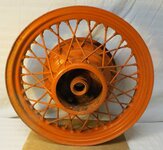
Today a 1930s Ford wire wheel appeared in Craigslist. This is the wheel I like. I repurposed my BBS alloy wheels to fit my Old Ford. I think the BBS pattern is similar to the original Ford spoke offering.
 

Attachments

  • ford wheel.jpg
    ford wheel.jpg
    29.7 KB · Views: 5
  • BBS ON THE WELD POSITIONER.jpg
    BBS ON THE WELD POSITIONER.jpg
    51 KB · Views: 4
  • PIN STRIPE HUBCAP.jpg
    PIN STRIPE HUBCAP.jpg
    60.3 KB · Views: 5

bwringer

Well-known member
Joined
Jan 1, 2013
Messages
10,242
Location
Indianapolis
Yep, this is getting there... but it's still way too limited.

The LoadPro materials say that it applies a load of "approximately 0.5 Amps", so at 12 volts I think that's... 24 ohms?

This will diagnose a lot of things, and is reasonably safe for just about anything on a vehicle that's not a signal wire, but... sometimes you still need more. I've run across switches, relays, connectors etc. that will pass .5 or 1 amp just fine with little voltage drop or heating, but fail with a working load (headlight connectors are infamous for this sort of thing).

So, how about adding a dial with options for, say, 0.5 amps, 2 amps, and 5 amps?

Also, some of you are misunderstanding; there's no need at all for fine control over the resistance of the test load. Just a few options up to five amps would be plenty to "stress-test" any circuit aside from perhaps the starter or charging system.

And yep, you can indeed let the magic smoke out in a hurry with higher loads. The 0.5 amp load is indeed much safer. Like any tool, you have to use your brain.
 

WWheeler

Well-known member
Joined
Jun 23, 2015
Messages
4,105
Location
Middleofnowhere USA
May i ask for what?

Rusty stuff.

Most recently was a rusted out Nissan subframe. We managed to get a couple out by hammering full sizes from what they used to be onto what was left of those nuts, but had to cut and torch out the others. Was a bit of a fight for a while there. I'd like to think we might not have had to if we had deeps of those half size options, but I'll never know how useful or not the tool I didn't have might have worked. Would be nice next time I find myself in that sort of battle to have some different ordnance options to fire away at it.
 
To avoid these ads, REGISTER NOW!
Top Bottom