A few weeks back Matt at Eastwood called and asked if I would be interested in testing one of their new scroll compressors in the shop. I’ve never “reviewed” a compressor before and didn’t have a ton of interest in setting it all up for a test in my own shop, but Rex Rod & Chassis did have a need… and Keith was interested in trying out a scroll in his production shop. So, a prototype compressor was shipped and Keith got busy using it.
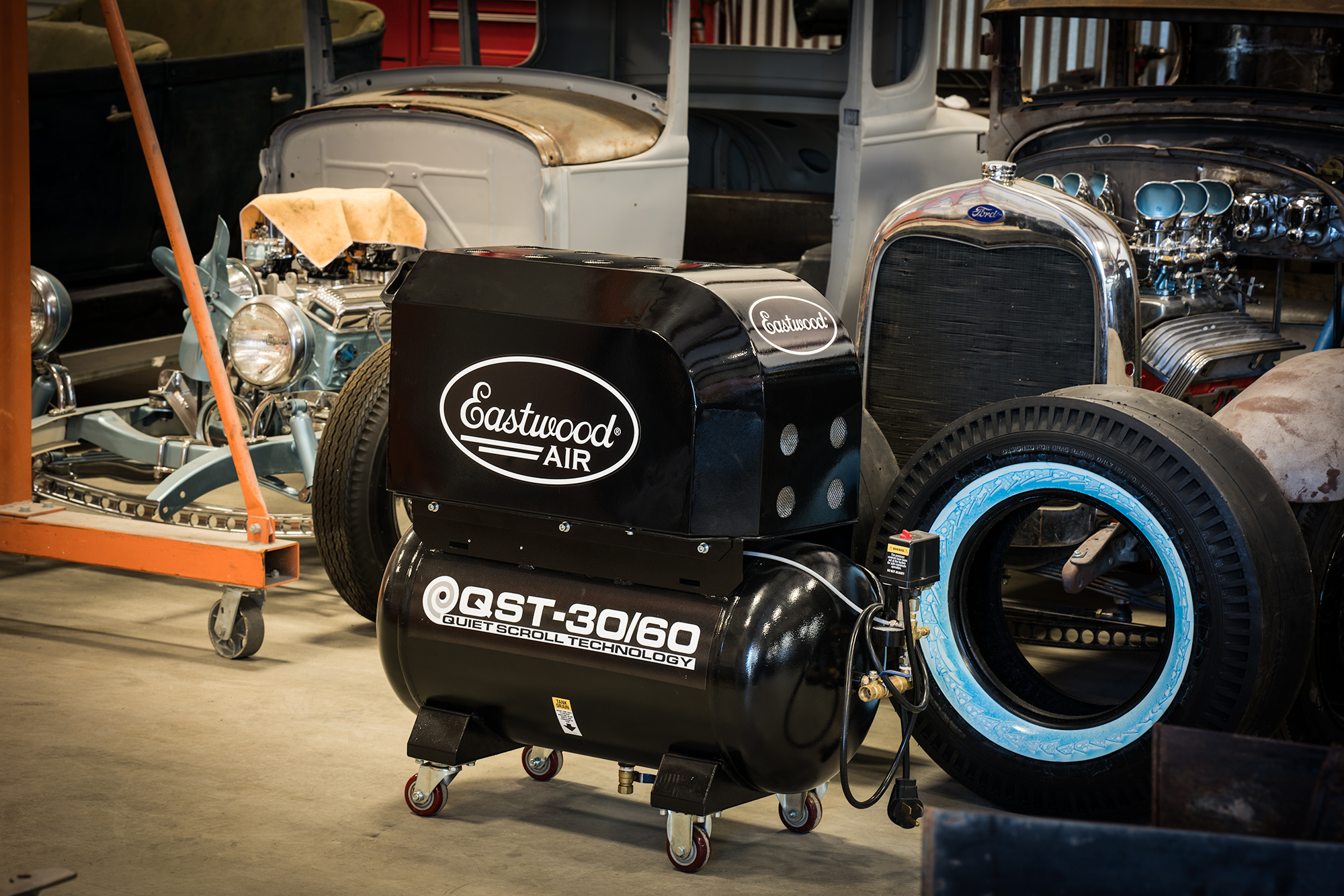
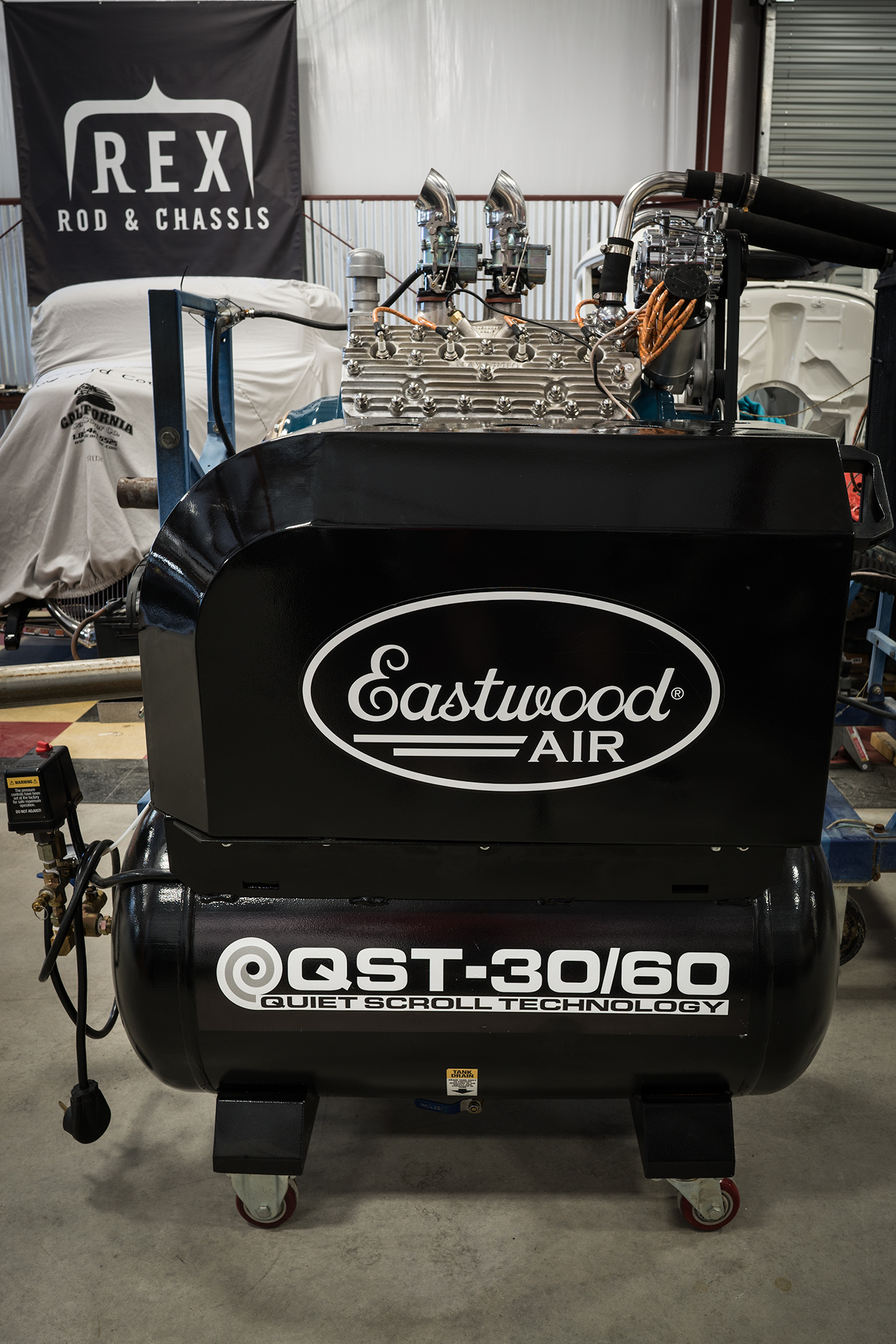
I think most compressor reviews start by giving you the numbers, so I will too… The QST-30/60 runs off of a 240v 20-amp circuit. It features a 30-gallon tank, a 3.3 HP continuous duty motor and puts out 12.0 cfm at both 40 and 90 psi with a 145 psi max pressure. It does all of this while only making 69 dB of noise at 1 meter.
If you are like me, all of those numbers and specs on paper don’t mean a hill of beans. They are just numbers… And the only real way to test a compressor is to use the **** out of it. Essentially, that’s what I had Keith and Rex Rods do.
Mobility
The unit Eastwood shipped us was a prototype and one that we had to ship back. As such, Keith didn’t want to hardwire or plumb the compressor into his shop for the time being. Instead, we put a plug on the unit’s cord and then used the compressor as a mobile station that could be rolled from job site to job site within the shop.
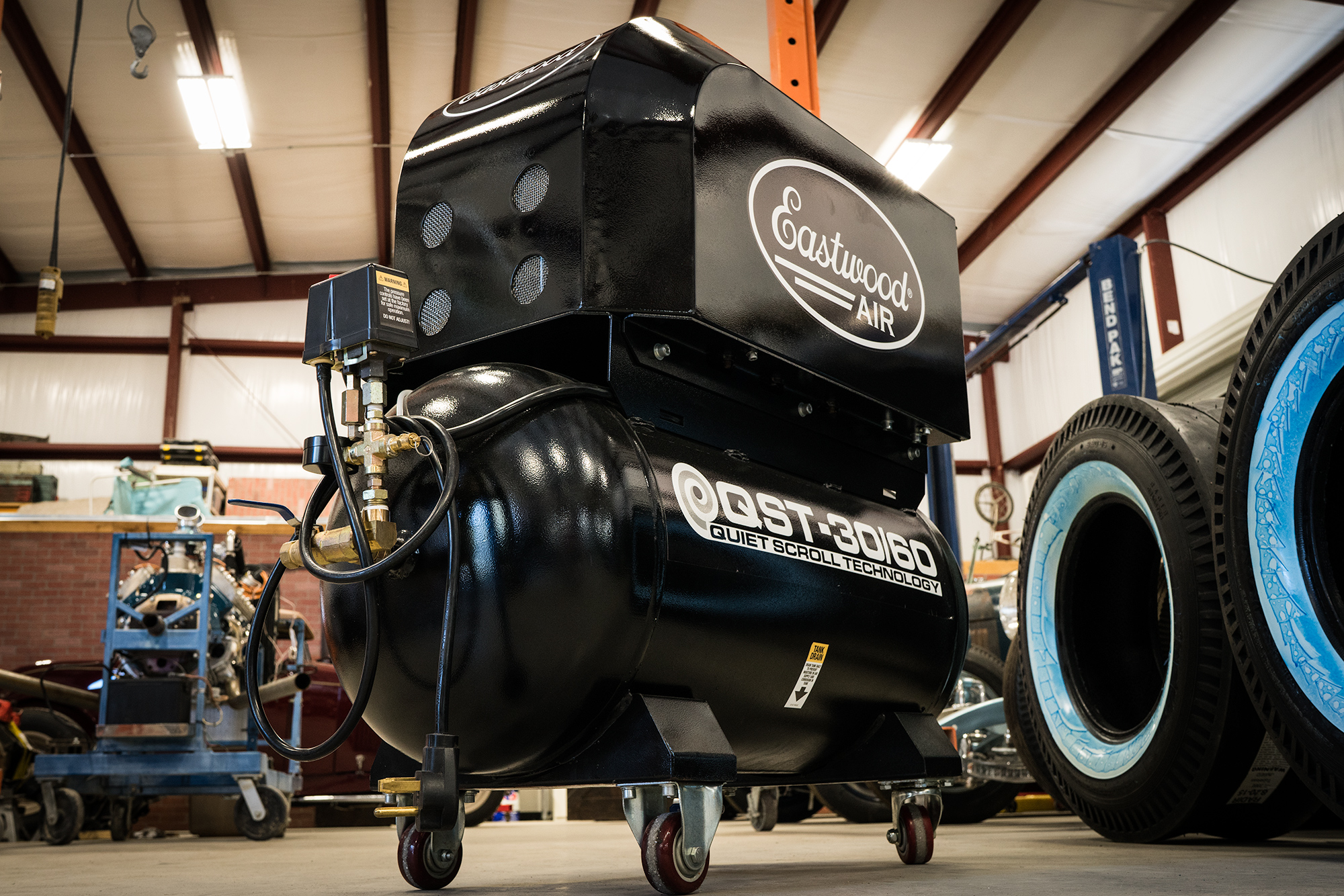
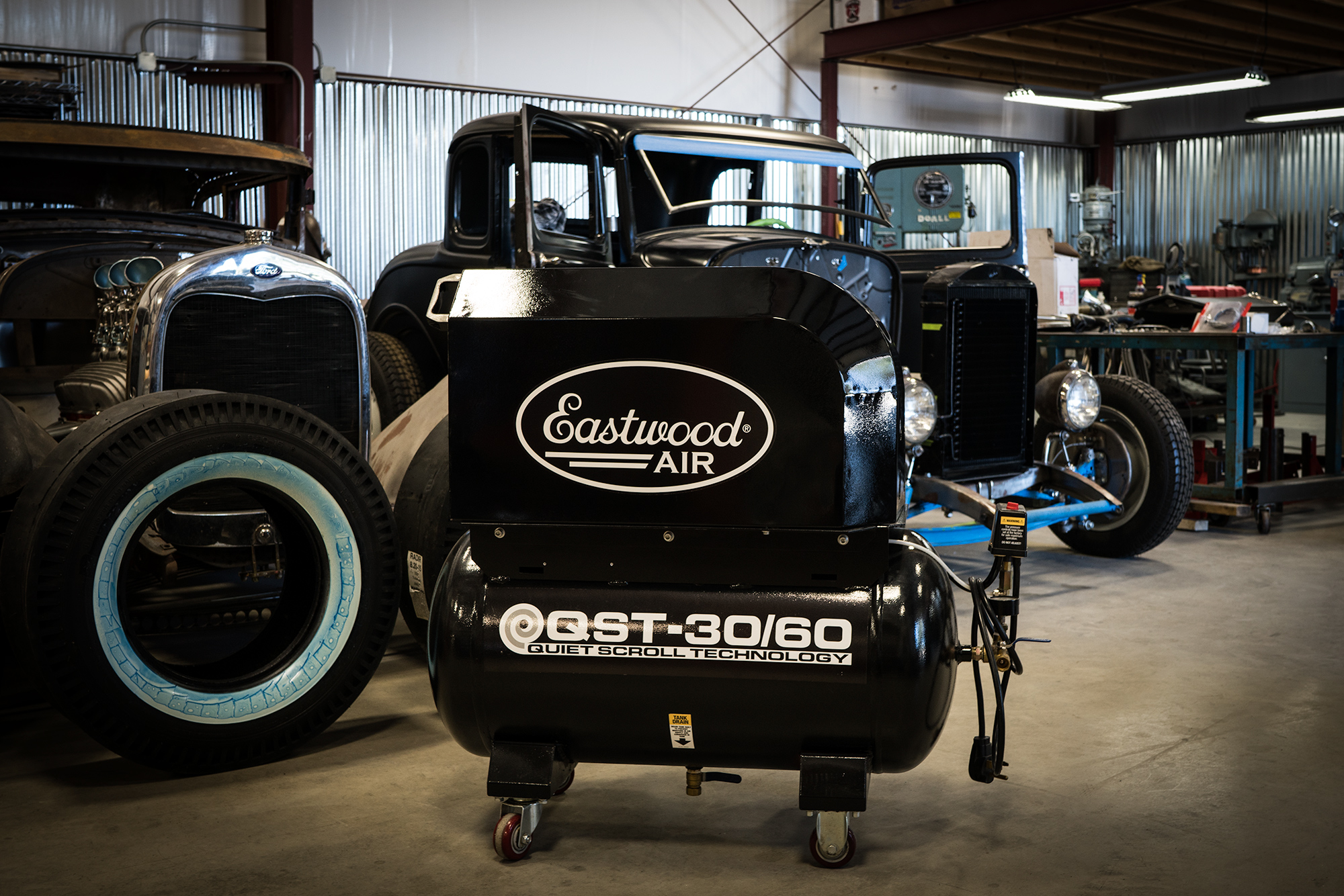
The QST-30/60 seems to be built for this application. Rather than a pair of cheap wobbly casters found on most mobile compressors, the Eastwood unit has a pair of heavy duty swivel casters on one end and a pair of fixed on the other. These combined with the push handles on the compressor itself makes this thing entirely more mobile than you would expect for something of it’s size – 44″ wide by 39″ tall by 21″ deep.
So basically, Keith and the fellas would roll the thing over to a work area, get to work and then put it away when finished. And while this might seem like a pain in the ***, it was actually kind of handy if you weren’t moving around too much. Of course, like any other compressor, the unit could be hard wired and plumbed into your shop as well.
Build Quality
My experience with 30-gallon compressors has mostly been limited to upright units sold by Craftsman or other big box stores. Typically, these feature a heavy motor on top, cheap plastic wheels on bottom, and some kind of light weight handle for awkwardly pushing it around. This is not that.
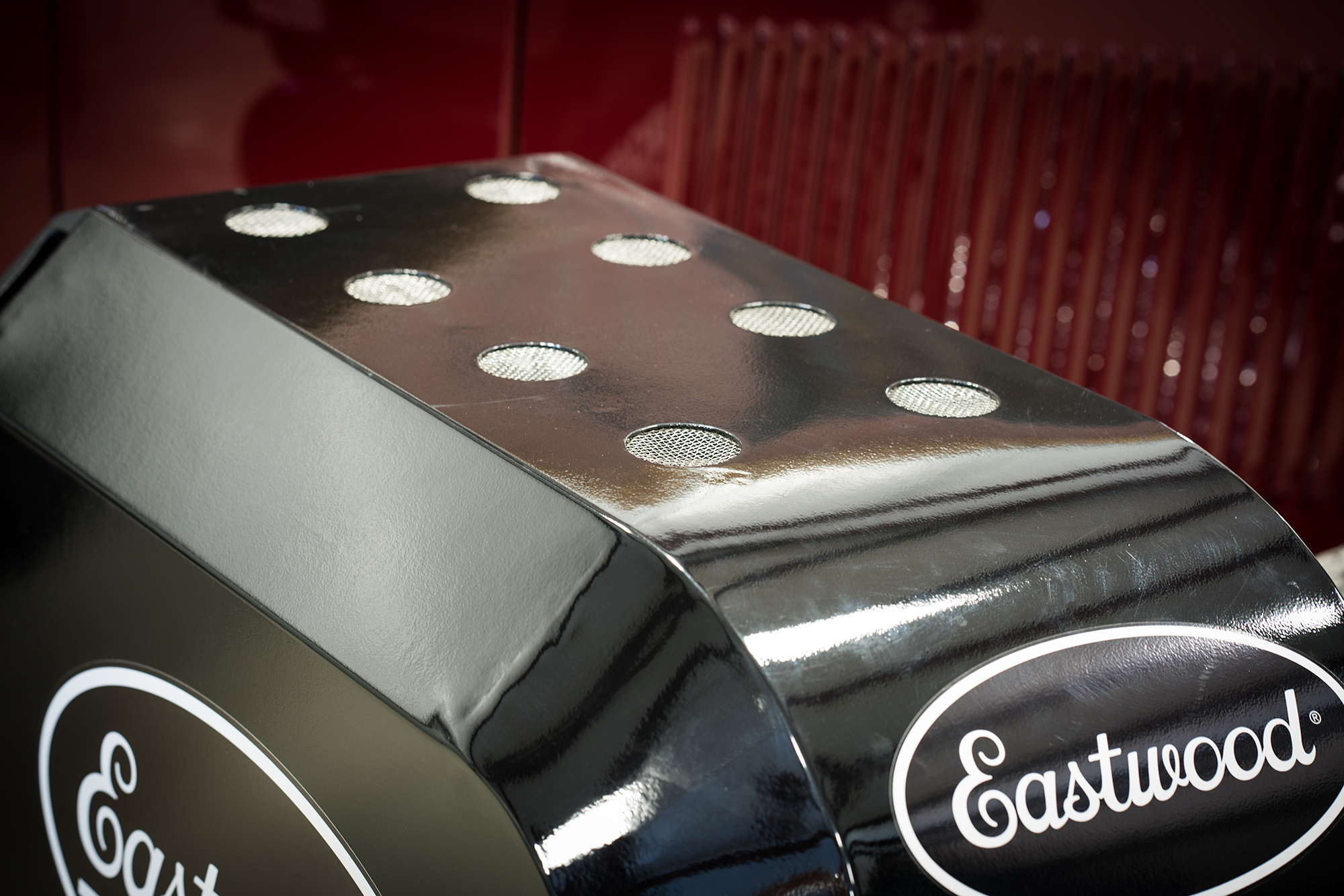
There’s very little plastic on the QST-30/60. The pump and motor are shrouded by a really slick and nicely formed piece of steel. The tank is nicely painted and all of the fittings are placed where you expect them to be.
To put it bluntly, it’s built like a brick **** house and feels like it. There’s just no comparing it to a typical 30-gallon compressor on any level. Plus, it just looks cool…
Performance
Again, most of what I’ve just typed is just gloss. What really matters with a compressor is performance. You wouldn’t think that a 30-gallon compressor would be all that productive in a commercial shop application for a couple of reasons:
First, 30-gallons just isn’t enough capacity to keep up when there is real work to be done. And secondly, even if it was, who wants to listen to a compressor run constantly when only backed with a capacity of 30-gallons?
The QST-30/60 combats these issues individually. First, scroll compressors are very efficient. At 3450 RPM, the QST produces 12fcm. Every bit of air taken in by the intake gets compressed – there’s no residual air. This means that the pump within compresses a **** load of air in a really big hurry.
A typical 60-gallon piston driven compressor does 11cfm at 90psi and 11.5cfm at 40psi. The QST does 12cfm at both 90 and 40psi. Again numbers, but consider this:
I pulled the valve on the QST and let all of the air out of the tank. Then, I closed the valve and kicked the compressor on – 2 minutes and 38 seconds later, the compressor had already filled the 30-gallon tank to 145psi. That’s quick y’all…
The other way the QST manages to punch above it’s weight class is by way of noise reduction. Few things are more annoying in the shop than a compressor running on the reg and when you only have a 30-gallon tank, that’s inevitably gonna happen. But the QST is so damned quiet, I found myself not caring if it was running or not. Here’s a quick video demonstration with typical shop background noise:
And here’s Eastwood’s own marketing video comparing the noise to a typical compressor:
Essentially, the QST sounds a lot like an air conditioner kicking on. If you listen for it, you can hear it… But if you aren’t really concentrating on it, you don’t really know it’s running. It’s that quiet – almost eerily so…
Price & Value
Eastwood is selling the QST for just under $1,200. There’s no way around it, that’s a whole lot of money for a 30-gallon compressor… or even a 60-gallon. I mean, you can get a cheap *** big box 60-gallon for less than half the price or you can get something highly regarded (such as this Quincy) for around the same money. But frankly, the QST doesn’t compare to either.
For one, the QST outperforms most cheap 60-gallons by leaps and bounds. And while there are some nice 60-gallons for the same money and similar performance, they do it while taking up more space and making a whole lot more noise.
Putting a value on something like the QST is hard to do really. There’s not a lot out there to compare it too. And while there are certainly other scroll compressors on the market, they are typically listed for two to three times the price of the QST.
I guess it comes down to how much you value your space and how much you loathe the sound of a traditional air compressor. In my opinion, Eastwood has a winner here and the QST is worth every bit of $1200 to the right guy.
Conclusion
The QST-30/60 was my first experience with a scroll compressor of any kind and frankly, I was super impressed. It’s made fantastically well, it produces enough air for one person in your shop to use just about any air tool continually, and it’s dead *** quiet while he’s doing so. And really, what more else can you say about a compressor in a review?
I can say that Keith and the fellas at Rex Rods were impressed enough that they have decided to get their own production unit. He’s planning on hardwiring and plumbing the unit into his shop. Hell, he’s even gonna keep his current 90-gallon tank in the system and let it ride… And to me, that’s saying something.
Anyway, I wasn’t paid for this review. And while Eastwood is an Alliance Vendor, they’ve never sent me a check or anything of the sorts. This review is 100% unbiased. Had I found anything that disagreed with my sensibilities, I would have mentioned it. It just so happens that I really like this thing.
You can learn more here.

***