To avoid these ads, REGISTER NOW!

Jacobs' Physics of Tools Debate Corner

2ndGearRubber

Well-known member
Joined
Mar 24, 2014
Messages
14,185
Location
Pittsburgh
What weighs more:

A 50lb. Sack of feed or a 50lb. Sack of feathers? Our subconscious minds quietly whisper lies to us all.

Weight? The same.

Which mass would apply more force when impacted into a load cell at terminal velocity of each mass? That would be the feed. The mind only lies if one considers force equivalent to mass or weight.
 
To avoid these ads, REGISTER NOW!

redwrench60

Well-known member
Joined
Sep 10, 2011
Messages
6,069
Location
East Tennessee
Weight? The same.

Which mass would apply more force when impacted into a load cell at terminal velocity of each mass? That would be the feed. The mind only lies if one considers force equivalent to mass or weight.
All things being equal the mind has a tendency to expect certain things. Prior to lifting a sack of feathers would you be reminding yourself to lift with your legs and not your back?

I bet the professor swinging his $125 titanium 14oz hammer definitely feels it outperforms a $22 steel 14oz hammer.
 

redwrench60

Well-known member
Joined
Sep 10, 2011
Messages
6,069
Location
East Tennessee
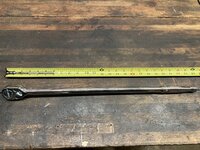
IMG_0460.jpegIMG_0462.jpeg
I’ve always wanted to know: why the top photo is considered tool abuse and the bottom photo ok. They are both Snap-on 1/2” drive ratchets, same head, same guts. One is standard length and the other is extra long.
 
OP
J

Jacobs976

Well-known member
Joined
Sep 11, 2020
Messages
830
Location
Indiana
IMG_0460.jpegIMG_0462.jpeg
I’ve always wanted to know: why the top photo is considered tool abuse and the bottom photo ok. They are both Snap-on 1/2” drive ratchets, same head, same guts. One is standard length and the other is extra long.
The only issue is distribution of force. With an ill fitting pipe you're putting all the force into the small section of the handle that's in contact towards the head. It won't cause issues with that size pipe but with an excess length you can bend the handle at that contact point.
 

Cc_windsurfer

Well-known member
Joined
May 1, 2015
Messages
260
Location
SB, ca
That's a marketing term, not a physical property.

Steel is stronger, stiffer and more dense. titanium is less dense, weaker and elongates more before rupturing

Both have similar Poisson ratio, so similar elastic behavior.
 

merkyworks

Well-known member
Joined
Nov 11, 2016
Messages
587
Location
Texas
Someone explain titanium hammers.

Yes, lower mass means more velocity for the same swinging force. So a 14oz ti hammer drives at higher speed (f=ma) and more kinetic energy (e=mv**2) then a 20oz steel hammer. But why would a 14oz ti hammer outperform a much cheaper 14oz steel hammer?

(Note: I hold a PhD in applied physics and have extensive experience in material science but I still don't understand why my 14 oz ti hammer performs so well)

I can’t tell if you stating you have a PhD in physics and extensive material science is satire or for real.

If for real you should get your money back cause that $100k degree was a waist. PhD in physics and this escapes you……
IMG_2025.jpeg

edit; For the record you asking the question is 100% perfectly fine. You dropping your PhD and extensive material science knowledge is why I’m busting your balls.
 
Last edited:

KnurledNut

Well-known member
Joined
Jan 28, 2011
Messages
8,152
Location
n/a
That's a marketing term, not a physical property.
Elemental composition disagrees.
Hexagonal closed packed structure and body centered cubic structure have two different impact reactions.

Steel is stronger, stiffer and more dense. titanium is less dense, weaker and elongates more before rupturing

Both have similar Poisson ratio, so similar elastic behavior.
Their modulus of elasticity is actually quite different from each other.

Commonly used Grade 5 Ti-6AI-4V has a higher tensile and yield strength than both low and ultra high carbon steel.
 

Wiz02

Well-known member
Joined
Jul 13, 2007
Messages
2,399
Location
Southeastern PA
Pass the popcorn, I love watching a good engineering/physics/materials science debate. Passionate debates advance people's knowledge if more than just opinions are exchanged.
 

2ndGearRubber

Well-known member
Joined
Mar 24, 2014
Messages
14,185
Location
Pittsburgh
That's a marketing term, not a physical property.

Steel is stronger, stiffer and more dense. titanium is less dense, weaker and elongates more before rupturing

Both have similar Poisson ratio, so similar elastic behavior.

Titanium is absorbing less energy, and instead imparting it to the work piece. So all else equal, the titanium hammer have fewer losses for a given input. Both are 16oz, being impacted into a nail at the same speed, but the steel is wasting more energy in rebound/vibration.

All else equal. As I understand, the goal of a titanium hammer is to use a lighter weight hammer, to achieve equal results to steel. With the higher efficiency of impact transfer, you only need for instance 70% of the weight of a steel hammer. So that's less mass being swung by the user, decreasing fatigue and lowering injury.


Some basic info.
 

Cc_windsurfer

Well-known member
Joined
May 1, 2015
Messages
260
Location
SB, ca
Elemental composition disagrees.
Hexagonal closed packed structure and body centered cubic structure have two different impact reactions.


Their modulus of elasticity is actually quite different from each other.

Commonly used Grade 5 Ti-6AI-4V has a higher tensile and yield strength than both low and ultra high carbon steel.

Both material are at best polycrystalline. Physical properties are dominated more by grain boundaries and grain packing than by the structure of the crystallites.

Modulus of elasticity is a measure of a materials ability to resist elastic deformation. Both hammers have elastic moduli well above what is needed for my pathetic desk jocky hammer blows.

Nobody is making hammers out of grade5 6-4 Ti.

A brief of my credentials was listed simply to show that this isn't a stupid question. 😂
 

seber

Well-known member
Joined
May 31, 2016
Messages
4,198
Location
Deep East Tx.
Elemental composition disagrees.
Hexagonal closed packed structure and body centered cubic structure have two different impact reactions.


Their modulus of elasticity is actually quite different from each other.

Commonly used Grade 5 Ti-6AI-4V has a higher tensile and yield strength than both low and ultra high carbon steel.
No. titanium isn't even close. Ultimate tensile for T5 is on 21,000 psi. Mild steel is around 60 to 80 K. the advantage for titanium is strength to weight.
 
OP
J

Jacobs976

Well-known member
Joined
Sep 11, 2020
Messages
830
Location
Indiana
Haven't researched titanium enough to throw my hat in the ring but I do want to thank @Cc_windsurfer for reminding me of a step I forgot to do on the sledge hammer problem as well as taking on the initiative of answering a question!

Also here's the updated spreadsheet(sorry @merkyworks but it's still in mixed measures for the moment) for the sledge hammer problem. Found out excel is available on mobile and added two more measures. I did skip on material physics too but the idea is just an estimate of the force applied to any material so rebound and imparted force are the last important things I can think of (unless I decide to convert rebound to force imparted on the hand).
Screenshot_20230820-200131~2.png
Also did find another procedure that estimates more force, 1500Lbs with 8Lb head at 20mph with same motion, so I'll be looking into it some more to see if I misstepped in my procedure. First glance, I did notice they factored in the handle being held by the very tip(actually by telekinesis) instead of a proper grip but I'll have to go through and check the rest when I have a chance.
 

redwrench60

Well-known member
Joined
Sep 10, 2011
Messages
6,069
Location
East Tennessee
There’s no doubt if you switch from a 28oz Estwing steel shank battle club to a 14oz titanium Stiletto you are going to feel a big measurable difference on multiple fronts. But a quality 14oz steel to a quality 14oz titanium will take a pretty calibrated arm to survive the blindfolded taste test.
 

Wiz02

Well-known member
Joined
Jul 13, 2007
Messages
2,399
Location
Southeastern PA
There’s no doubt if you switch from a 28oz Estwing steel shank battle club to a 14oz titanium Stiletto you are going to feel a big measurable difference on multiple fronts. But a quality 14oz steel to a quality 14oz titanium will take a pretty calibrated arm to survive the blindfolded taste test.
Not being a carpenter, I would agree with you, but I've read posts right here on GJ, saying that swinging an Estwing all day beats you up more than other brands and IIRC they weren't talking about titanium hammers, so I am not sure how the hammer head / handle design itself affects the model.

That being said, my leather wrapped Estwing is still my goto hammer.
 
To avoid these ads, REGISTER NOW!
OP
J

Jacobs976

Well-known member
Joined
Sep 11, 2020
Messages
830
Location
Indiana
Update on the challenger procedures.

Ignoring the telekinesis, his first step had an error that messed up everything else forward. He wrote out the equation wrong and skipped the work to get his given acceleration of 9.81m/s². Initially given variables are distance at 3.05m, weight at 3.63kg, initial velocity of 9.14m/s.

So that leads to a final velocity of 11.69m/s(actually 11.97m/s working backwards) or 26.15mph(26.77mph) with initial velocity being 9.14m/s or 20mph and then he has a figure of 248J(182.91ft/lbs) as the kinetic energy.

The huge figure, 2790Lb(1500lbs was just a chat bot giving an answer along with the challenger procedure), was actually a figure of force on a steel plate with no given measurements and the assumption it deforms 2cm.

Short form, challenger procedure failed.
 

F-22

Well-known member
Joined
Jan 23, 2022
Messages
1,830
What makes me very sceptical about the titanium hammers is the fact that they're only really advertised in the USA. For example, you can't find a german pattern framing hammer in titanium (the latthammer).

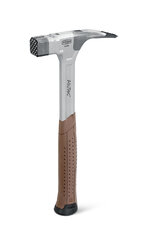
The 2023 Red Dot design award was in fact given to Picard for their AluTec Latthammer. It combined a steel head with a cast alloy handle.
Picard actually gives insight of why they did not use titanium. Here is my translation from their German text under their youtube video:

Revolution from Innovation and Tradition

He is the first of its kind worldwide: With the AluTec®, PICARD introduces a completely new type of roofing hammer, combining the best of both material worlds for the striking tool. The hammer head, combined with steel and for the first time with aluminum, with an all-aluminum design, is the first genuine hybrid roofing hammer.

Aluminum, as the material for the hammer's body, offers clear advantages: It is extremely robust and, as proven by extensive tests, more efficient for this application than titanium, which quickly shows material fatigue and breaks. With the AluTec®, aluminum demonstrates unexpected strength and resilience as a solid handle and frame of the hammer head, even under high stress. However, the use of aluminum also offers the opportunity to reduce the total weight of the hammer to 670 grams.

For this hammer, the power lies in the head

The new AluTec® develops striking force where it matters most – in the head: With the striking surface and the tip made of C45 steel, despite the overall reduced weight, a balanced head weight ensures precise, powerful, and effective strikes.

The new AluTec® is available with a rough and smooth striking surface; the slimly drawn tip and the nail pull are precisely worked out and inductively hardened in the steel elements. Thus, robust classic components, as well as the magnetic nail holder, integrate into the innovative framework of the AluTec®.

The Perfect Combination of Tradition and Innovation

In design, as well as in the equipment details, the hammer in its perfectly balanced shape is oriented to that of a classic roofing hammer. The proven vibration-damping 2-component handle, appreciated by users, is also included. Combined with the new solid aluminum handle, the ergonomics of the tool are further enhanced.

Picard delivers the innovative AluTec® in high-quality individual packaging, which on one hand ensures transparency and the possibility of a tactile product impression and, on the other hand, guarantees optimal protection of the hammer.


index.jpgindex.jpg
index.jpg


Now I am sure there is something to titanium too. But a HUGE part of it is marketing. I think most of us here are tool enthusiasts - and it does not take much to look through the history of almost any tool and see plenty of variations. There are usually pros and cons to every decision. I do believe the titanium hammers are extremely pricey and not worth it compared to other high quality choices, even if they're nice hammers. I am sure something like this Picard is at least very comparable if not even more pleasant to use.

The numbers people say, about absorbing vibrations and transmitting forces... I think those were all spread by the hammer manufacturers. Those numbers are very very hard to measure, and depend A LOT on the actual hammer shape and design rather than solely on the material.

Honestly, as an engineer I feel Picards claims about fatigue are weird too. Not so sure about the fatigue of titanium though surely the softer metal won't last as long as steel, but I do know that aluminium generally does not have very favourable fatigue life. Still, I'm sure it's a fine hammer and that line was more marketing talk to counter why they don't use titanium - in my opinion, it just isn't needed.

But TITANIUM sure sounds nice and people love to buy into that. It is still not a miracle metal. Steel is actually more unique cause it comes in so many countless variations and bonds with so many elements. It is not "just steel". You have so many variations of it that it is really hard to say that any titanium hammer head will perform better than any steel head. It most likely won't.
 

Hohn

Well-known member
Joined
Aug 25, 2016
Messages
2,659
Location
Diesel Central, Indiana
Someone explain titanium hammers.

Yes, lower mass means more velocity for the same swinging force. So a 14oz ti hammer drives at higher speed (f=ma) and more kinetic energy (e=mv**2) then a 20oz steel hammer. But why would a 14oz ti hammer outperform a much cheaper 14oz steel hammer?

(Note: I hold a PhD in applied physics and have extensive experience in material science but I still don't understand why my 14 oz ti hammer performs so well)
It's the mass distribution. The TI hammer might have the same total weight, but it probably has the lower MOI because the CoM is closer to the handle.
Which means that, for the same mass, you can accelerate the the hammer faster using the torque of your arm. Or stated differently, the Ti hammer has less "reaction torque" to a given acceleration force.
That means it achieves a higher head velocity for the same input force, giving more kinetic energy to the system and transferring more energy to the nail.
Think in terms of moments and rotational inertia vs linear and I think you'll see a potential advantage to Ti.
 
Last edited:

Hohn

Well-known member
Joined
Aug 25, 2016
Messages
2,659
Location
Diesel Central, Indiana
Got some new math, or rather the results for the somewhat decent spreadsheet, done for the force of an overhead swing with a sledge hammer. I had heard some people saying a 20lb sledge could generate 3500-5000lbf and I figured it might be fun to try modeling the problem.
For a 20lb sledge to generate 3500lb force, it would have to be accelerating at (3500/20=) 175 times the force of gravity. Recall that F=MA and that what we call "weight" is just force at 1g acceleration. This is not happening with manual force.

I think people are confusing the force with PRESSURE, which of course, is a different thing. And with the small surface area of a nail head and smaller still of a nail point, it's absolutely possible to hit very high pressure values.

Consider the automatic center punch that can leave a small dent in steels with a yield strength of 80ksi or more. And it does this with the potential energy generated by compressing a spring--by hand.
 

F-22

Well-known member
Joined
Jan 23, 2022
Messages
1,830
I think there are a lot of assumptions and speculations but no real data. It's not hard to actually calculate the centre of mass and moment of inertia for the hammers if you want to dwelve into that. I don't. I will always doubt such speculation unless someone actually proves it.


Really can't see a reason why the centre of mass of a steel forged hammer necessarily has to be different to the centre of mass of a titanium hammer of the same weight and same face size. It all only has to do with the shape of the forging.
 
OP
J

Jacobs976

Well-known member
Joined
Sep 11, 2020
Messages
830
Location
Indiana
For a 20lb sledge to generate 3500lb force, it would have to be accelerating at (3500/20=) 175 times the force of gravity. Recall that F=MA and that what we call "weight" is just force at 1g acceleration. This is not happening with manual force.

I think people are confusing the force with PRESSURE, which of course, is a different thing. And with the small surface area of a nail head and smaller still of a nail point, it's absolutely possible to hit very high pressure values.
I think it's also assumption via comparison with presses/jacks in practical use. Usually the figure, when stated on the assumption of the jacks measure or the part it moves specs, can be explained by the fact an impact works differently than a gradual increase in force(overcoming compression welding, the friction of rust/gunk in between the gaps in parts effectively welding two objects together, being higher with a sudden impact like using an impact gun to turn a seized bolt).

Basically, people use a hammer after failing to do something with a jack and assume the hammer has more force than the jack and disregard the physics involved.
 

Hohn

Well-known member
Joined
Aug 25, 2016
Messages
2,659
Location
Diesel Central, Indiana

Figured the request was made out of curiosity and to tease a bit at the same time so I had to reply in kind naturally.

Started messing with it but I need to find the right formula to calculate with the pivot(irregular formula since pivoting objects were usually just wrote up as the height and length transcribed as a high risk area and actual math wrote off/ignored, basically don't go in that area regardless of what it could actually do, usually good advice). Meanwhile though, static weight is .282Lb/In² on the flat. Not really useful yet but it's info.
The steel plate model can be simplified. I think we agree we can ignore air resistance.

At .284 pounds per cubic inch and 48x84x1=4032 cubic inches, we have a steel plate weighing ~1145lb.
This 1145lb is acting through the center of the plate since it has intersecting planes of symmetry. We can therefore model the entire plate as a 1145# point mass 2ft off the ground.

Pardon me as I convert to metric for clarity of thought. Let's just call it 520kg and 0.6m for simplicity.

The potential energy (PE=MGH) would be:
PE=520kg*9.82m/sec^2*0.6m
PE=3063.84 Joules

The process of falling over is the process of the plate converting the potential energy of gravity to kinetic energy. And since energy is conserved, we know that the PE must equal zero at the ground and the impact dissipates all ~3067 joules of energy.
So KE=1/2(mv^2). Do a bit of math and you get a velocity of ~11.8m/sec. This is the impact velocity at the center of mass.

But we are talking essentially about a moment here because we have a force acting at a distance through a pivot. Which means the velocity at the pivot is of course zero because it never moves. And at the other edge, it would be twice as fast because the edge is double the distance of the CoM from the pivot.

The pressure exerted by the plate on anything trapped under it will depend on the planar surface area in contact with the plate. Since pressure is force per unit area and the force here is fixed by the acceleration due to gravity, the pressure is inversely related to the surface area in contact with the plate. A small finger or toe would be crushed to pulp, but an entire arm might only have a break or two.
 

Samuel D

Well-known member
Joined
Apr 9, 2019
Messages
638
I confess I don’t believe in titanium hammers.

But I have learned that hammers have many subtle features, so I can’t rule out misunderstanding some important advantage of titanium in this application.

One of the most satisfying hammers I have used is a traditional upholstery hammer, though I never used it for upholstery tacks.

First of all, it has a narrow head that lets you work close to obstructions. That also helps keep unwanted damage from hammer blows to a small area, which is sometimes useful.

The head is curved at the top for the same access reasons, which additionally puts the whole mass of the head on a single path when swung mainly from the wrist.

One face is magnetised for starting tacks (try that with yer titanium!). Some hammers have this face split (see third photo) for magnetic reasons I don’t fully understand. Some have bronze heads with steel faces.

But the best feature of this hammer design is its elongated head. That long head has a high polar moment of inertia, which makes each blow solid and effective even if your aim is a bit off-centre (and given the narrowness of the head, you can’t be very far off-centre anyway).

I have wondered why more hammers aren’t a bit longer in the head for these benefits. There is the railway spike maul, but that’s a great brute. I’d like something in the 1 lb range for general-purpose whacking.
 

AEAdam

Well-known member
Joined
May 27, 2023
Messages
2,762
Location
SE PA
Someone explain titanium hammers.

Yes, lower mass means more velocity for the same swinging force. So a 14oz ti hammer drives at higher speed (f=ma) and more kinetic energy (e=mv**2) then a 20oz steel hammer. But why would a 14oz ti hammer outperform a much cheaper 14oz steel hammer?

(Note: I hold a PhD in applied physics and have extensive experience in material science but I still don't understand why my 14 oz ti hammer performs so well)
Equal weight hammers have equal inertia. At impact, the inertia is converted into an impulse. Impulse is force/time.

The time is a function of the modulus of the hammer head. The lower the modulus, the longer the time and the lower the force. You can say the softer face ti hammer head is like a shock absorber. So you can drive nails pretty effectively with a ti hammer but you don’t get the shock in your wrist and elbow.

The manufacturers say steel hammers with hardened faces hit so hard nails actually buckle elastically and that’s wasted effort.
 

AEAdam

Well-known member
Joined
May 27, 2023
Messages
2,762
Location
SE PA
Ti, steel, and aluminum all have mech properties roughly in proportion to their densities, meaning no one material is stronger for its weight. When selecting materials for aerospace applications, the decision comes down to manufacturing concerns, availability of raw materials, corrosion, heat, fatigue, and galvanic corrosion.

in general:
aluminum has a density of .10, modulus is 10million and UTS is around 80ksi
ti has a density of .16, modulus of 16million, and UTS around 150Ksi
steel density is .287, modulus is 28 million, and UTS of 220ksi isn’t hard to achieve.
 

Cc_windsurfer

Well-known member
Joined
May 1, 2015
Messages
260
Location
SB, ca
Equal weight hammers have equal inertia. At impact, the inertia is converted into an impulse. Impulse is force/time.

The time is a function of the modulus of the hammer head. The lower the modulus, the longer the time and the lower the force. You can say the softer face ti hammer head is like a shock absorber. So you can drive nails pretty effectively with a ti hammer but you don’t get the shock in your wrist and elbow.

The manufacturers say steel hammers with hardened faces hit so hard nails actually buckle elastically and that’s wasted effort.
If lower modulus is the goal, why choose something expensive and hard to work with like Titanium. Why not cast iron, simply and cheap. Or why not use a deadblow?
 

Rusted Nut

Well-known member
Joined
Dec 11, 2022
Messages
1,810
Location
Northern Arizona
Someone explain titanium hammers.

Yes, lower mass means more velocity for the same swinging force. So a 14oz ti hammer drives at higher speed (f=ma) and more kinetic energy (e=mv**2) then a 20oz steel hammer. But why would a 14oz ti hammer outperform a much cheaper 14oz steel hammer?

(Note: I hold a PhD in applied physics and have extensive experience in material science but I still don't understand why my 14 oz ti hammer performs so well)
Note: I don’t have a PhD in anything, but I’ve been a carpenter for over 35 years, driven a lot of nails. Titanium hammers don’t vibrate and there is very little bounce back; and they don’t shock your elbow like a steel handled hammer does.
 

Debcrow

Well-known member
Joined
May 14, 2019
Messages
4,061
Location
New Mexico
As an engineer I am enjoying this debate and the physics/properties/mathematics of the hammer variations.


As a person with a twisted sense of humor I have to wonder ......

a Molybdenum Carborundum Hammer would already have advantages.

The marketing is already in place. "Feel My Power" for the MC Hammer.
Completion? Ha! You can't touch this. :)
 

AEAdam

Well-known member
Joined
May 27, 2023
Messages
2,762
Location
SE PA
If lower modulus is the goal, why choose something expensive and hard to work with like Titanium. Why not cast iron, simply and cheap. Or why not use a deadblow?
Ti hammers function a little like dead blows, yes.

The equation is: mv = SFdt (the integral of F with respect to time)

You need a decent force to overcome the friction between wood and nail. So a dead blow isn’t always the best answer. You might need a heavier hammer to develop enough force to drive a nail.

Ti fills a sweet spot between a steel hammer, and other soft faced hammers. Brass and bronze have similar young’s moduli as titanium (as alloys there is a range of moduli). They can and are used, especially by machinists. Much higher densities compared to Ti.
 

AEAdam

Well-known member
Joined
May 27, 2023
Messages
2,762
Location
SE PA
Well cupcakes.... :bounce:

Use a 32oz ball peen DEAD BLOW!

Start 16D, one tap.

Sink 16D, one swing.
:bounce:(also, will welt yer blame thumb, right up!) :bounce:
:LOL:
I have a nice snap on steel faced dead blow, but I wouldn't want to drive nails with it. Too heavy. My framing hammer is 14oz and I have a 10oz trim hammer.

Also don’t want to carry a 32 oz hammer around on my toolbelt!

The ti hammers are nice.
 

F-22

Well-known member
Joined
Jan 23, 2022
Messages
1,830
Equal weight hammers have equal inertia. At impact, the inertia is converted into an impulse. Impulse is force/time.

The time is a function of the modulus of the hammer head. The lower the modulus, the longer the time and the lower the force. You can say the softer face ti hammer head is like a shock absorber. So you can drive nails pretty effectively with a ti hammer but you don’t get the shock in your wrist and elbow.

The manufacturers say steel hammers with hardened faces hit so hard nails actually buckle elastically and that’s wasted effort.
I don't see why it would be impossible to manufacture a steel hammer head of the same hardness as titanium?

mv = SFdt
That's the equation for a force impulse, the simplified equation being J=m*v and J is a constant force that acts for a certain time (F * delta t).

Yet, all I see in this thread is in my opinion without any basis. Knowing the equation and what it tells, is like talking about how to construct an atomic bomb and saying E=mc^2 is all you need. Theory is the basis for everything, but it's nowhere near actually doing it in practice. It's definitely not something that would convince me you can't have the same impulse with steel.
 

KnurledNut

Well-known member
Joined
Jan 28, 2011
Messages
8,152
Location
n/a
Note: I don’t have a PhD in anything, but I’ve been a carpenter for over 35 years, driven a lot of nails. Titanium hammers don’t vibrate and there is very little bounce back; and they don’t shock your elbow like a steel handled hammer does.
Underrated comment.
Sadly, many ignore experience and replace it with what they theorize. Think these types would even last one week on the jobsite without complaining their elbow hurts?
 

AEAdam

Well-known member
Joined
May 27, 2023
Messages
2,762
Location
SE PA
I don't see why it would be impossible to manufacture a steel hammer head of the same hardness as titanium?


That's the equation for a force impulse, the simplified equation being J=m*v and J is a constant force that acts for a certain time (F * delta t).

Yet, all I see in this thread is in my opinion without any basis. Knowing the equation and what it tells, is like talking about how to construct an atomic bomb and saying E=mc^2 is all you need. Theory is the basis for everything, but it's nowhere near actually doing it in practice. It's definitely not something that would convince me you can't have the same impulse with steel.
It’s not hardness. It’s stiffness, young’s modulus times moment of inertia or EI. When you harden steel, you don’t change its modulus. There are metallurgists here who can explain this better than I can.

The equation above is important because it tells a craftsperson exactly what they need to know and affirms what they already know.

1) If you swing your hammer faster, you get a more powerful impulse. Choosing a heavier hammer might get you a bigger impulse but only if you can swing it fast. If one hammer is double the weight of another, but you swing half as fast, the heavy hammer provides no advantage. I think all of us know this innately. Momentum is mv.

2) At impact, the ”sharp” hitting steel hammer (small delta time) generates a lot of force F, enough to crush wood, break metal etc. A hammer that takes even a little longer to come to rest, a softer hammer, really pushes. You need the high force of a steel hammer to over come friction. To bump a floor board into position without denting it, you want a dead blow or soft faced mallet.

To answer your question directly: you could match the EI of a ti hammer with steel by changing its geometry. You can’t change E but you could change I. Dewalt tried this by mig welding a hard hammer head onto a softer springier handle. The head of that hammer kinda bends on impact.
 
To avoid these ads, REGISTER NOW!
Top Bottom