To avoid these ads, REGISTER NOW!

Jacobs' Physics of Tools Debate Corner

F-22

Well-known member
Joined
Jan 23, 2022
Messages
1,830
When you harden steel, you don’t change its modulus.
No, this is not true. Hardening steel definitely changes the young's modulus. That factor tells you how much the material changes its shape under pressure. If you squeeze soft steel it will change its shape more than hardened steel. Other thing changing the young modulus of steel is its alloying elements or impurities in the steel.

For example, austenitic stainless steel can have a young modulus of ~180GPa, about 20-30GPa less than tool steel.

But if you do have a stainless hammer, it is most probably martensitic tool steel (magnetic), cause the preffered mechanical feature is its hardness for durability.
 
To avoid these ads, REGISTER NOW!

jayemm

Well-known member
Joined
Dec 18, 2018
Messages
1,538
Location
up high down low
What makes me very sceptical about the titanium hammers is the fact that they're only really advertised in the USA. For example, you can't find a german pattern framing hammer in titanium (the latthammer).

The 2023 Red Dot design award was in fact given to Picard for their AluTec Latthammer. It combined a steel head with a cast alloy handle.
Picard actually gives insight of why they did not use titanium. Here is my translation from their German text under their youtube video:

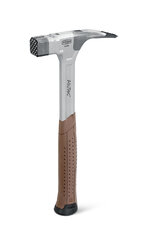


index.jpgindex.jpg
index.jpg


Now I am sure there is something to titanium too. But a HUGE part of it is marketing. I think most of us here are tool enthusiasts - and it does not take much to look through the history of almost any tool and see plenty of variations. There are usually pros and cons to every decision. I do believe the titanium hammers are extremely pricey and not worth it compared to other high quality choices, even if they're nice hammers. I am sure something like this Picard is at least very comparable if not even more pleasant to use.

The numbers people say, about absorbing vibrations and transmitting forces... I think those were all spread by the hammer manufacturers. Those numbers are very very hard to measure, and depend A LOT on the actual hammer shape and design rather than solely on the material.

Honestly, as an engineer I feel Picards claims about fatigue are weird too. Not so sure about the fatigue of titanium though surely the softer metal won't last as long as steel, but I do know that aluminium generally does not have very favourable fatigue life. Still, I'm sure it's a fine hammer and that line was more marketing talk to counter why they don't use titanium - in my opinion, it just isn't needed.

But TITANIUM sure sounds nice and people love to buy into that. It is still not a miracle metal. Steel is actually more unique cause it comes in so many countless variations and bonds with so many elements. It is not "just steel". You have so many variations of it that it is really hard to say that any titanium hammer head will perform better than any steel head. It most likely won't.
Reminds me of this Dewalt hammer I recently bought. I rarely use a claw hammer but had to have it and it felt pretty nice the few times I used for smaller nails. For 16 oz it feels on the light side compared to previous 16 oz I had.
1692713422441.png
 

AEAdam

Well-known member
Joined
May 27, 2023
Messages
2,777
Location
SE PA
No, this is not true. Hardening steel definitely changes the young's modulus. That factor tells you how much the material changes its shape under pressure. If you squeeze soft steel it will change its shape more than hardened steel. Other thing changing the young modulus of steel is its alloying elements or impurities in the steel.

For example, austenitic stainless steel can have a young modulus of ~180GPa, about 20-30GPa less than tool steel.

But if you do have a stainless hammer, it is most probably martensitic tool steel (magnetic), cause the preffered mechanical feature is its hardness for durability.
Heat treating steel changes modulus a small amount. Alloys make a bigger difference. Nothing you can do to steel will change its modulus to titanium’s. That’s alchemy.

Please look up the moduli of both materials then share that data. Steel and Ti are about 60% different. Closer to the ratio of their densities. This is text book stuff you’re debating for no reason.

I think you just don’t like ti hammers. That’s fine. That’s your opinion.

I’ve been wearing one on my belt every weekend for the last 7 years. I’ve worn the face off it. I like it because it doesn’t pull my pants down and my hand doesn’t buzz after work. 18” long and 14oz.

One thing I agree with: the manufacturers say you can sink nails with the same number of hits as you could with a hammer double it’s weight because you can swing it twice as fast. I cannot. But I don’t care if it takes me 2 more hits. Maybe when I was young. But I’m not honestly sure if I swung that hard I’d have the same control. I think potential buyers need to recognize a lighter hammer won’t sink nails as fast as a heavy hammer will.
 

Schurkey

Well-known member
Joined
Oct 27, 2011
Messages
2,369
Location
The Seasonally Frozen Wastelands
torque wrenches... ...If the wrench measures the torque exerted at the drive square, why does the handle length matter?

"Because it determines the lever arm" This is true only for open beam wrenches where the measurement is the bend of the beam.
Yup. The formula that includes the "handle length" was designed for deflecting-beam torque wrenches--the ancient, accurate, and cheap--but hard to use kind. The lever arm bent in use, unlike most modern torque wrenches with tubular bodes not intended to flex.

The handles on deflecting beam torque wrenches had a pivot in the middle, so the handle could be balanced on the pivot allowing proper, natural flex of the beam. Therefore, the length of the lever was from centerline of the drive square, to handle pivot.

What weighs more:

A 50lb. Sack of feed or a 50lb. Sack of feathers? Our subconscious minds quietly whisper lies to us all.
Which weighs more--a pound of iron or a pound of gold?

The iron, of course.

Extra credit: WHY?
 

AEAdam

Well-known member
Joined
May 27, 2023
Messages
2,777
Location
SE PA
Yup. The formula that includes the "handle length" was designed for deflecting-beam torque wrenches--the ancient, accurate, and cheap--but hard to use kind. The lever arm bent in use, unlike most modern torque wrenches with tubular bodes not intended to flex.

The handles on deflecting beam torque wrenches had a pivot in the middle, so the handle could be balanced on the pivot allowing proper, natural flex of the beam. Therefore, the length of the lever was from centerline of the drive square, to handle pivot.


Which weighs more--a pound of iron or a pound of gold?

The iron, of course.

Extra credit: WHY?
Okay I’ll play. I dont know the answer, but willing to expose my ignorance in yet another thread (thanks M635).

Obviously the mass is the same but lbs are units of force not mass. Force is mass time acceleration, but when we talk about lbs the acceleration is often gravity. Since our planets core is iron and magnetic, I’m guessing the iron, being a ferrous metal has some attraction to the core resulting in what appears to be a “heavier” object.
 
Last edited:

Schurkey

Well-known member
Joined
Oct 27, 2011
Messages
2,369
Location
The Seasonally Frozen Wastelands
Okay I’ll play. I dont know the answer, but willing to expose my ignorance in yet another thread (thanks M635).

Obviously the mass is the same but lbs are units of force not mass. Force is mass time acceleration, but when we talk about lbs the acceleration is often gravity. Since our planets core is iron and magnetic, I’m guessing the iron, being a ferrous metal has some attraction to the core resulting in what appears to be a “heavier” object.
Nope. The answer is much more simple.
 

Hohn

Well-known member
Joined
Aug 25, 2016
Messages
2,677
Location
Diesel Central, Indiana
Equal weight hammers have equal inertia. At impact, the inertia is converted into an impulse. Impulse is force/time.

The time is a function of the modulus of the hammer head. The lower the modulus, the longer the time and the lower the force. You can say the softer face ti hammer head is like a shock absorber. So you can drive nails pretty effectively with a ti hammer but you don’t get the shock in your wrist and elbow.

The manufacturers say steel hammers with hardened faces hit so hard nails actually buckle elastically and that’s wasted effort.
Equal weight hammers might have equal inertia, but MOI is a function of mass distribution (center of mass), and not just mass. For an analysis of a titanium hammer, the MOI is the more relevant frame of reference, not inertia per se.

I think it's more correct to say that impulse is the change in momentum, not the derivative of force.

Impulse has no inherent time component.
But force is the time derivative of momentum.
So impulse is the change in momentum. (delta p). Force is the RATE of change of momentum (dp/dx)
 

Hohn

Well-known member
Joined
Aug 25, 2016
Messages
2,677
Location
Diesel Central, Indiana
I don't see why it would be impossible to manufacture a steel hammer head of the same hardness as titanium?


That's the equation for a force impulse, the simplified equation being J=m*v and J is a constant force that acts for a certain time (F * delta t).

Yet, all I see in this thread is in my opinion without any basis. Knowing the equation and what it tells, is like talking about how to construct an atomic bomb and saying E=mc^2 is all you need. Theory is the basis for everything, but it's nowhere near actually doing it in practice. It's definitely not something that would convince me you can't have the same impulse with steel.
It's not impossible. Indeed, most steels can easily be made as soft as titanium. And you'll find most titanium hammers use a steel striking face for durability.
But it's not the hardness of titanium that gives it the desired properties.
Rather, it's the lack of "rebound" that approaches the effect of a deadblow. It's not that titanium hammers have more energy because they are swung faster because they are lighter...rather, it's that they do not return the delivered energy back to the user.

Think of it as being like the difference between a great anvil and a poor one. A great anvil is "lively" and the hammer bounces back up off of it. A poor anvil just thuds beneath the hammer.

The titanium hammer works like this but in reverse-- you don't want any energy coming back to the hammer when driving nails. That means the guy swinging it just spent energy to create vibration up his arm. That energy is better spent driving the nail.
 

Hohn

Well-known member
Joined
Aug 25, 2016
Messages
2,677
Location
Diesel Central, Indiana
It’s not hardness. It’s stiffness, young’s modulus times moment of inertia or EI. When you harden steel, you don’t change its modulus. There are metallurgists here who can explain this better than I can.

The equation above is important because it tells a craftsperson exactly what they need to know and affirms what they already know.

1) If you swing your hammer faster, you get a more powerful impulse. Choosing a heavier hammer might get you a bigger impulse but only if you can swing it fast. If one hammer is double the weight of another, but you swing half as fast, the heavy hammer provides no advantage. I think all of us know this innately. Momentum is mv.

2) At impact, the ”sharp” hitting steel hammer (small delta time) generates a lot of force F, enough to crush wood, break metal etc. A hammer that takes even a little longer to come to rest, a softer hammer, really pushes. You need the high force of a steel hammer to over come friction. To bump a floor board into position without denting it, you want a dead blow or soft faced mallet.

To answer your question directly: you could match the EI of a ti hammer with steel by changing its geometry. You can’t change E but you could change I. Dewalt tried this by mig welding a hard hammer head onto a softer springier handle. The head of that hammer kinda bends on impact.
All steel has a young's modulus of 200GPa, regardless of hardness. This is because hardness has more to do with movement within the steel matrix while modulus has more to do with the deflection of the matrix itself. I'm not a metallurgist, so I can't explain it much better. I do know some basics of metallurgy though.

So while all steel grades have the same modulus, that's NOT the same thing as saying all steel *objects* are equally stiff.

Your comment on the heavier hammer is not quite correct, or at least it's confusing. The heavier hammer can only fail to deliver more impulse if it's swung at a speed slow enough to offset the additional mass. Since impulse is momentum, it's mass and speed. 20% more mass will deliver 20% more impulse unless it's swung slower than -20% of the lighter hammer's speed.

Bending stiffness has been tuned for ages for all manner of striking objects. This is the point of different shafts on golf clubs, and partly why graphite got so popular.
 

AEAdam

Well-known member
Joined
May 27, 2023
Messages
2,777
Location
SE PA
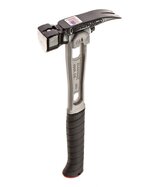
Not all ti hammers have steel faces. Mine doesn’t. I have the curved handles stiletto. It was about $90 and worth every penny. Head is from China and not 6AL4V. Assembly and handle are MUSA.
0B0C74E3-0D69-4677-9001-DD32856B5263.jpeg

AA705398-0698-4D1D-ACD7-1E8535743B7C.jpeg
Rereading: Sorry if this sounded argumentative, I just thought you guys would be interested in seeing this.

Spent today swinging this thing. Not my day job. Day job includes designing crash absorbing aircraft and spacecraft structures. I think it’s good to have the theory and be able to feel it in practice. Not looking to personally experience impulses in aircraft or spacecraft.
 
Last edited:

F-22

Well-known member
Joined
Jan 23, 2022
Messages
1,830
Heat treating steel changes modulus a small amount. Alloys make a bigger difference. Nothing you can do to steel will change its modulus to titanium’s. That’s alchemy.
Yes it's not called steel at that point - but lamellar cast iron has about the same modulus as titanium.

It's not impossible. Indeed, most steels can easily be made as soft as titanium. And you'll find most titanium hammers use a steel striking face for durability.
That's interesting to know, I thought most just use an all-titanium design. So it's really more about just the handle material?
But it's not the hardness of titanium that gives it the desired properties.
Rather, it's the lack of "rebound" that approaches the effect of a deadblow. It's not that titanium hammers have more energy because they are swung faster because they are lighter...rather, it's that they do not return the delivered energy back to the user.

Think of it as being like the difference between a great anvil and a poor one. A great anvil is "lively" and the hammer bounces back up off of it. A poor anvil just thuds beneath the hammer.

The titanium hammer works like this but in reverse-- you don't want any energy coming back to the hammer when driving nails. That means the guy swinging it just spent energy to create vibration up his arm. That energy is better spent driving the nail.
It sounds nice to be able to transmit all the force into the screw. But does that actuall happen, or does the titanium instead absorb that force into itself, kind of like how cast iron absorbs vibrations and is thus used for engine blocks and industrial machinery frames?

All steel has a young's modulus of 200GPa, regardless of hardness.
This is not true, the E modulus of steel is between 180-210GPa. Check any engineering book. Titanium I believe is around 100-120GPa. And aluminium around 70GPa.


If the modulus is really the key to the popularity of these hammers, then the Picard hybrid steel-aluminium design seems to make a lot of sense, with a hard steel head and an alloy handle that wouldn't absorb as many vibrations and be more elastic during each strike.
 

AEAdam

Well-known member
Joined
May 27, 2023
Messages
2,777
Location
SE PA
If the modulus is really the key to the popularity of these hammers, then the Picard hybrid steel-aluminium design seems to make a lot of sense, with a hard steel head and an alloy handle that wouldn't absorb as many vibrations and be more elastic during each strike.
A wood handle might do a better job. A little surprised by the Germans who are usually very practical and traditional engineers. We use American hickory which has excellent mech properties.
 

F-22

Well-known member
Joined
Jan 23, 2022
Messages
1,830
We use American hickory
I think this is a bit tongue-in cheek? :) I'm quite certain there are hammers used in America that do not have a wooden handle. I mean, wasn't all of this discussion specifically about that?

 

Hohn

Well-known member
Joined
Aug 25, 2016
Messages
2,677
Location
Diesel Central, Indiana
If *I* were designing a hammer, I'd skip the cost of the titanium handle and instead I'd put that into an insert to hold tungsten shot.
The deadblow concept is well-proven IMO. You'd probably need to tune the chamber size to tune the time between when the hammer head wants to rebound and when the shot goes from one end of the chamber to the other.
The idea is simple-- rather than using an expensive handle to try to eliminate or damp the rebound effect, prevent it from even getting to the handle.

I always thought there were smarter ways to secure the handle and design the handle.
 

AEAdam

Well-known member
Joined
May 27, 2023
Messages
2,777
Location
SE PA
If *I* were designing a hammer, I'd skip the cost of the titanium handle and instead I'd put that into an insert to hold tungsten shot.
The deadblow concept is well-proven IMO. You'd probably need to tune the chamber size to tune the time between when the hammer head wants to rebound and when the shot goes from one end of the chamber to the other.
The idea is simple-- rather than using an expensive handle to try to eliminate or damp the rebound effect, prevent it from even getting to the handle.

I always thought there were smarter ways to secure the handle and design the handle.
I think a dead blow framing hammer could work. The shot would have to be free flowing due to the rate at which we strike with a framing hammer, as opposed to a deadblow. I was beating a timber frame-ish together last night with a dead blow. That shot works both ways. It gets you on the back swing.

Not trying to convince anyone of anything: my hammer posted above is extremely popular for a reason. It’s not marketing hype as has been suggested or people misled by claims from the manufacturer. Side by side, I suspect all of you would choose it. The head material is honestly the only innovation. Otherwise it’s a tested California framer design, with a nicely executed axe handle.
 

Hohn

Well-known member
Joined
Aug 25, 2016
Messages
2,677
Location
Diesel Central, Indiana
I think a dead blow framing hammer could work. The shot would have to be free flowing due to the rate at which we strike with a framing hammer, as opposed to a deadblow. I was beating a timber frame-ish together last night with a dead blow. That shot works both ways. It gets you on the back swing.

Not trying to convince anyone of anything: my hammer posted above is extremely popular for a reason. It’s not marketing hype as has been suggested or people misled by claims from the manufacturer. Side by side, I suspect all of you would choose it. The head material is honestly the only innovation. Otherwise it’s a tested California framer design, with a nicely executed axe handle.
I don't think most deadblow hammers give any thought to the quantity of shot and the volume of the space that contains them. It seems to me that there are some real opportunities here to produce a hammer that has most of what you like about a titanium model without the backlash you correctly point out a typical deadblow would have.
That backlash is the result of having a lot of space for the shot to move-- or a relatively low fill ratio. This allows for more energy transfer at impact, but it also exaggerates the backlash effect.

The flip side would be a deadblow with compressed charge of shot. The shot would move very little, have very little backlash and very little improvement over a regular hammer.
 

Hohn

Well-known member
Joined
Aug 25, 2016
Messages
2,677
Location
Diesel Central, Indiana
No, this is not true. Hardening steel definitely changes the young's modulus. That factor tells you how much the material changes its shape under pressure. If you squeeze soft steel it will change its shape more than hardened steel. Other thing changing the young modulus of steel is its alloying elements or impurities in the steel.

For example, austenitic stainless steel can have a young modulus of ~180GPa, about 20-30GPa less than tool steel.

But if you do have a stainless hammer, it is most probably martensitic tool steel (magnetic), cause the preffered mechanical feature is its hardness for durability.
Dead soft 1015 steel: 200 GPa
1095 quenched and tempered to 31HRC: 205 GPa
4130 Chromoly, 35HRC: 205 GPA
304 Stainless Plate: 193 GPA
316 Stainless Spring wire: 193 GPa
A2 Tool Steel: 203 GPa
H13 Tool Steel: 210 GPA
4340, 40HRC: 200GPA
9310 gear steel: 200GPA
8620 carburized, 35HRC: 205GPA
Carpenter D3, 207GPA

This little survey suggests it's not the hardening that changes the young's modulus. Indeed AISI 4340 at 40HRC has the same 200GPa modulus as soft 1015 steel does.

Stainless grades with high chromium content do indeed have a slightly lower modulus-- on the order of 3.5% less.
But apart from those grades, a huge variety of ferrous alloys from mild steel to high alloy steels fall within the range of 200-210. I'm as pedantic as the next guy, but I'm not sure I'd be trying to argue that the general statement that "all steels have a modulus of 200GPa" is "wrong" because a few grades might be as much as 3%-5% more or less.
 

AEAdam

Well-known member
Joined
May 27, 2023
Messages
2,777
Location
SE PA
can we move on? New subject?

I have a tool physics question:

I’ve always hated air ratchets. Running a screw in, you pull the trigger and think ”this is great”, then the fastener goes home and the ratchet breaks your wrist. Are battery powered ratchets better? Are they like drill motors or are they like impacts?

Follow on question: I think impacts impact radially. How do drill drivers work. Are they axial? Or are the screw guns like mini impact guns?
 
OP
J

Jacobs976

Well-known member
Joined
Sep 11, 2020
Messages
830
Location
Indiana
can we move on? New subject?
We tend to go with multiple subjects when there's interest in the thread so we'll just toss them on as they come.
I've always hated air ratchets. Running a screw in, you pull the trigger and think ”this is great”, then the fastener goes home and the ratchet breaks your wrist. Are battery powered ratchets better? Are they like drill motors or are they like impacts?
Battery powered ratchets are basically low torque compact head drills really. They're not fast like pneumatic tools and they're not going to break anything going either direction. Overall they're meant for running stuff down/up if it's already loose.
Follow on question: I think impacts impact radially. How do drill drivers work. Are they axial? Or are the screw guns like mini impact guns?
Impacts and drills are both radial motion devices. Both act in a spinning motion(left or right) from the motor which would be the radial force while the axial force would be the force you exert on the device(pushing it into a fastener).

For impacts they have an extra step. They have a set of hammers that slip and strike the anvil under load. They're also acting radially since they're spinning around. They also don't have much of the slipping out of your hand to smack your wrist action a drill might.
 
To avoid these ads, REGISTER NOW!

F-22

Well-known member
Joined
Jan 23, 2022
Messages
1,830
This little survey suggests it's not the hardening that changes the young's modulus. Indeed AISI 4340 at 40HRC has the same 200GPa modulus as soft 1015 steel does.
Other things like alloying elements definitely have way more of an impact. That said, it does have an impact too. To see that, it would be better to look at a single type of steel at different hadnesses, rather than comparing different types of steel.
I'm not sure I'd be trying to argue that the general statement that "all steels have a modulus of 200GPa" is "wrong"
Yeah they're all in that ballpark, but when we'd talk about them being all the same in regard to the properties of materials, it seemed fair to me to point out that it's not the fact. Still, if that is the key difference between a titanium and steel hammer, then a stainless handle would have to perform better than a ferrous steel one?
 

Hohn

Well-known member
Joined
Aug 25, 2016
Messages
2,677
Location
Diesel Central, Indiana
Other things like alloying elements definitely have way more of an impact. That said, it does have an impact too. To see that, it would be better to look at a single type of steel at different hadnesses, rather than comparing different types of steel.

Yeah they're all in that ballpark, but when we'd talk about them being all the same in regard to the properties of materials, it seemed fair to me to point out that it's not the fact. Still, if that is the key difference between a titanium and steel hammer, then a stainless handle would have to perform better than a ferrous steel one?
I'm not sure what the figure of merit is for "better" in that case, nor how a small change in modulus would create it. If we go with "better" as "more efficient energy transfer" then I don't think at all you can demonstrate that simply changing the modulus a little bit will meaningfully improve performance by itself because there are far too many other factors at the boundary that matter.

By analogy, the "best" golf shafts depend on a person's swing speed, peak acceleration force, torque timing, etc. Better might be stiffer or less stiff.

IN other words, the ideal hammer shaft/handle stiffness exists only for one particular rate of acceleration and timing of peak acceleration.
If I think about other examples of super-efficient energy transfer via contact, I think not only of those rare moments where you hit a perfect golf shot and the ball travels forever with little effort (and no vibration), but also baseball hitters well know how the "sweet spot" of the bat makes all the difference in distance and why it's critical to get the meat of the bat on the ball to get it to fly a long way.

If you want a hammer to have a "sweet spot" at the driving face, you need some mass beyond that plane normal to the handle/head intersection.

Unfortunately, extended some mass beyond that requires designing a hammer that cannot get into tight corners and reach-- the mass sticking out the end ruins the tool access in corners.

The alternative then since we can't really add mass beyond the head (to shift the MOI outward) is just make the handle as light as possible. A hollow graphite handle would do this brilliantly, but has terrible damping qualities. (Carbon fiber is used for musical instruments). Because of that resonance, we're likely going to lose some energy in vibration coming back up the handle due to our imperfect sweet spot and MOI arrangement.

I think a hammer likely needs to be made with a cast iron head and have the hardened steel face added after-- the casting damps vibration well (especially if compacted graphite).

If you think about it, the ONLY parts of the hammer you want made of steel is the working surfaces of the face and the claw. It's the wrong material for the head, wrong for the handle, etc.

The face needs to be hard, but if we're optimizing it for driving nails (vs whacking hard chisels) the hardness can be dropped significantly-- mid 30s HRC would be plenty. This gives ductility and a lot less risk of shattering.

Anway, maybe I'll blow the rust out of my CAD license and see if I can throw together a concept.
 

Hohn

Well-known member
Joined
Aug 25, 2016
Messages
2,677
Location
Diesel Central, Indiana
can we move on? New subject?

I have a tool physics question:

I’ve always hated air ratchets. Running a screw in, you pull the trigger and think ”this is great”, then the fastener goes home and the ratchet breaks your wrist. Are battery powered ratchets better? Are they like drill motors or are they like impacts?

Follow on question: I think impacts impact radially. How do drill drivers work. Are they axial? Or are the screw guns like mini impact guns?

I used to hate air ratchets too until I learned how they are intended to be used. Then I became a fan. The ratchet is supposed to be used manually to tighten and break loose. You only engage the trigger once the fastener is mostly loose or not yet tight.

Once you realize this, you realize you don't want a power ratchet with a big torque rating-- you just want something powerful enough to overcome a nylock or rust or whatever is preventing free spinning.

The only time you want or can use a higher torque rating is when you have a longer handle on the tool. This tames the backlash/wrist breaking phenomenon.

Translating this into products I've been looking into lately, you'd never want to get this, a 130lb-ft ratchet that is somewhat short, is it's certainly a wrist breaker:

But give it a 22" handle and suddenly the high torque becomes useful:


And if you want a compact air ratchet that won't break your wrist, you want something like this with only 35lb-ft max:


I'm finding myself using my Makita cordless ratchet more than I expect to. For one, it has essentially no kickback because the electronics cut out the power before it can really bite you. (they limit current draw very quickly). Also, the Makita has both 3/8 and 1/4 and is super versatile. Despite the long length and battery hanging off the end, this thing is surprisingly useful and accessible. I'm a convert, albeit a reluctant one.

All cordless and air ratchets are like drill motors unless they specifically say "impacting." There are impact ratchets, but those are not the standard.
All impacts do their impacting in the direction of torque. There are nut breakers that can use an air hammer or rotary hammer to apply axial impacts to a socket or such. But those are accessories for hammering tools and aren't considered a "driver" of any kind because they don't do any rotation.
 

Cc_windsurfer

Well-known member
Joined
May 1, 2015
Messages
260
Location
SB, ca
Wrong on this too. That’s the exact alloy Stiletto uses.

When was I wrong the first Time?

Do you have a reference showing that stiletto is using 6-4 grade 5? I can't find anything defining what alloy they are using and since I retired no longer have easy access to analytical tools to test composition.

If the goal is low modulus, why choose the most expensive and hardest to work with alloy with the highest modulus ?
 

Pinemarten

Well-known member
Joined
Jan 23, 2023
Messages
333
Location
Washington
Which weighs more--a pound of iron or a pound of gold?

The iron, of course.

Extra credit: WHY?
Gold is measured in Troy ounces/pounds. Iron is measured in Avoirdupois ounces/pounds. There are 12 Troy ounces in a Troy pound. A Troy ounce is 1.097 Avoirdupois ounces......................so, 12 x 1.097 = 13.164 Avoirdupois ounces. That is almost 3 ounces less than the common Avoirdupois pound.

Gold is also measured in pennyweights, and grams. Usually this is for small quantities like in jewelry, or gold mining as in pennyweight per yard. A pennyweight is 1/20 of a Troy ounce.
 

Pinemarten

Well-known member
Joined
Jan 23, 2023
Messages
333
Location
Washington
Since our planets core is iron and magnetic, I’m guessing the iron, being a ferrous metal has some attraction to the core resulting in what appears to be a “heavier” object.
I think the "iron core" is a hypothesis that hasn't been proven. I seem to recall the deepest men have penetrated the Earth's surface is about six miles deep. That is like saying we know what is in the middle of an apple because we drilled through the peel.

Some textbooks show a molten iron core in the Earth. I'm not sure how they came up with that, but I do know that steel (ferrous) alloy loses it magnetic properties when it is heated to red hot. Watch the blacksmiths on "Forged In Fire" touch a magnet to a hot blade to determine when to quench it. They keep heating it until the magnet no longer has attraction to the blade, and then quench it.
 

AEAdam

Well-known member
Joined
May 27, 2023
Messages
2,777
Location
SE PA
Interesting
I think the "iron core" is a hypothesis that hasn't been proven. I seem to recall the deepest men have penetrated the Earth's surface is about six miles deep. That is like saying we know what is in the middle of an apple because we drilled through the peel.

Some textbooks show a molten iron core in the Earth. I'm not sure how they came up with that, but I do know that steel (ferrous) alloy loses it magnetic properties when it is heated to red hot. Watch the blacksmiths on "Forged In Fire" touch a magnet to a hot blade to determine when to quench it. They keep heating it until the magnet no longer has attraction to the blade, and then quench it

Interesting.

We know the planet is magnetic.

I think all ferrous metals become non magnetic around 1350F. Thats hotter than red hot. Pretty sure it’s more like straw color. That’s called the curie temperature. Electrons become disassociated from their molecules ?
making the metal non longer magnetic.

I know it’s a fallacy that this indicates the critical temperature that black/blade smiths need. The critical temperature is the point at which the phase change occurs. I know many smiths who use the magnet trick and either don’t know or don’t care that the curie point is the critical temperature only for one carbon alloy, .77%. Higher and lower carbon steels become non-magnetic at 1420, but need to get hotter to really transition.

I use something called a templistik. It’s like a piece of chalk that melts at a precise temperature. You can buy them for different temps. IIRC, when I was making chisels, I used 1650 stick for 1095 steel. I was after the hardest chisels I could make until I learned that was a dumb idea.
 
Last edited:

Pinemarten

Well-known member
Joined
Jan 23, 2023
Messages
333
Location
Washington
Good info about heat treatment temps. I think most FIF smiths are doing the "ballpark" method to overcome the TV jitters/time pressure.

As far as Earth's magnetic field, I think it is an electro-magnet. That also helps to explain the tides better, but I'm not a scientist.............just a guy who likes to ponder stuff............LOL.
 

Under_Pressure

Well-known member
Joined
May 13, 2014
Messages
115
Location
NE Wisconsin
Steel becomes non-magnetic when it undergoes a phase change from ferrite (body centered cubic structure) to austenite (face centered cubic). This occurs starting at ~1340°F for plain steels, depending upon the alloy. Getting steel into the austenite phase and then rapidly bringing it back to ferrite (i.e. by quenching) with sufficient carbon in the solution is how steel is hardened. People noticed that this happened long before they knew exactly what was going on, so checking the "temperature" with a magnet became a traditional way to make sure you were hot enough to harden when quenched.

Note that the addition of certain elements such as nickel as an alloying element depresses the temperature at which the austenite to ferrite transition occurs; if enough nickel is in the alloy, the transition won't occur at all. This is why the 300 series stainless steels (aka austenitic stainless steel) are non-magnetic and not heat hardenable- they are highly alloyed with nickel. The 200 series are similar, though they get there through the addition of manganese and nitrogen (which are also austenite stabilizers) instead of nickel; these were developed specifically to provide a low-nickel option during times of nickel shortages. Ferritic and martensitic stainless steels (400 series) are primarily alloyed with chromium, which is not an austenite stabilizer, and thus are magnetic and heat hardenable.
 

AEAdam

Well-known member
Joined
May 27, 2023
Messages
2,777
Location
SE PA
Picture is worth a thousand 1x10^3 words
27F81229-5310-4A12-8C17-323DD6B0337A.png

The bottom of the left V is called the Eutectoid point. That lower line at 1333F is where ferrous metals stop being magnetic.

If you trace your finger straight up from 1% carbon (close to 1095), that critical temp is higher than the eutectic. Ditto low alloy stuff.

Just for the non engineers when steels start going over 1% carbon they lose some properties. I think specialty Japanese mills make some steels with more than 1% in the US industrial tool steels don’t go much beyond .95%C. Correct me if I’m wrong. So most of the chart on the right is not useful for this discussion.

Obviously the green lines indicate the phase changes underpressure was talking about. I suspect he could do a better job talking to this graphic.
 

Pexto

Well-known member
Joined
May 5, 2018
Messages
640
I think the "iron core" is a hypothesis that hasn't been proven. I seem to recall the deepest men have penetrated the Earth's surface is about six miles deep. That is like saying we know what is in the middle of an apple because we drilled through the peel.

We don't need to drill into the Earth's core to get a pretty good idea of what's there. To explode your apple analogy, it's like saying we know what's in the middle of the apple because we put it in the x-ray machine. And then we put it in the MRI scanner. After which we performed an ultrasound scan.
 

Pinemarten

Well-known member
Joined
Jan 23, 2023
Messages
333
Location
Washington
Pretty good ideas are called hunches, guesses, or feelings. Science is about proven hypothesis, which can after much replication, become a theory.

If it is red hot/molten, why is it magnetic? My hunch, is the Earth is an electro-magnet.
As always, my hunch is worth what you pay for it (nothing)............LOL.
 

Pexto

Well-known member
Joined
May 5, 2018
Messages
640
Pretty good ideas are called hunches, guesses, or feelings. Science is about proven hypothesis, which can after much replication, become a theory.

If it is red hot/molten, why is it magnetic? My hunch, is the Earth is an electro-magnet.
As always, my hunch is worth what you pay for it (nothing)............LOL.

Are you maybe getting hung up on magnetism vs. ferromagnetism? According to Maxwell's laws. The motion of any electrically conducting fluid generates a magnetic field.

The Earth's core has a lot of molten iron, but it could be any other liquid conductor and still generate a magnetic field.
 

Wiz02

Well-known member
Joined
Jul 13, 2007
Messages
2,399
Location
Southeastern PA
Maxwell's equations still fill me with fear and loathing 40+ years after what was the worst course, taught by a truly sadistic SOB, in my life.
 

Pexto

Well-known member
Joined
May 5, 2018
Messages
640
Maxwell's equations still fill me with fear and loathing 40+ years after what was the worst course, taught by a truly sadistic SOB, in my life.

We must've had the same prof! The prof I had was an arrogant ******* who liked to belittle the undergrads. For the final exam, scheduled for 2 hours, he told us that the problems had taken him 30 minutes, but he didn't want us to feel any time pressure so everyone could stay as long as they wanted. I was one of the first to leave after 3 hours; I just couldn't take any more. Many of my classmates stayed for 5-6 hours.

And then I had to take E&M again in grad school. It went a little better, but not much. :) I still have my copy of Jackson's Classical Electrodynamics somewhere.
 

Wiz02

Well-known member
Joined
Jul 13, 2007
Messages
2,399
Location
Southeastern PA
We must've had the same prof! The prof I had was an arrogant ******* who liked to belittle the undergrads. For the final exam, scheduled for 2 hours, he told us that the problems had taken him 30 minutes, but he didn't want us to feel any time pressure so everyone could stay as long as they wanted. I was one of the first to leave after 3 hours; I just couldn't take any more. Many of my classmates stayed for 5-6 hours.

And then I had to take E&M again in grad school. It went a little better, but not much. :) I still have my copy of Jackson's Classical Electrodynamics somewhere.
Never understood the point of treating students like that. While I sometimes make fun of how the education system coddle kids these days, I doubt very much that such behavior would be tolerated today abd rightfully so.
 

AEAdam

Well-known member
Joined
May 27, 2023
Messages
2,777
Location
SE PA
Never understood the point of treating students like that. While I sometimes make fun of how the education system coddle kids these days, I doubt very much that such behavior would be tolerated today abd rightfully so.
I may be an absolute turd for saying this, but I don’t really feel my education prepared me particularly well for my profession. I took an awful lot of calculus. And any computer class I took in the 80s was quickly irrelevant. I would have been better prepared with more basics and more hands on manufacturing.

I’ve never been good with electricity for example. Referenced in other posts, I took a household wiring class at my local community college last semester and learned a lot (and gave me the excuse to buy a bunch of Klein tools!). My circuits class in university was very theoretical. I passed it because I could do Laplace transforms. Otherwise, until last semester, I had no idea how a three way switch worked.

I guess I should be grateful because I am where I am. My bias has discouraged my kids from going to college, and that’s not great. I just felt college is not the place to find yourself (at $40k/yr). But maybe I shouldn’t have told them that.
 

Wiz02

Well-known member
Joined
Jul 13, 2007
Messages
2,399
Location
Southeastern PA
I may be an absolute turd for saying this, but I don’t really feel my education prepared me particularly well for my profession. I took an awful lot of calculus. And any computer class I took in the 80s was quickly irrelevant. I would have been better prepared with more basics and more hands on manufacturing.

I’ve never been good with electricity for example. Referenced in other posts, I took a household wiring class at my local community college last semester and learned a lot (and gave me the excuse to buy a bunch of Klein tools!). My circuits class in university was very theoretical. I passed it because I could do Laplace transforms. Otherwise, until last semester, I had no idea how a three way switch worked.

I guess I should be grateful because I am where I am. My bias has discouraged my kids from going to college, and that’s not great. I just felt college is not the place to find yourself (at $40k/yr). But maybe I shouldn’t have told them that.
I too went to a prestigious university and shock people when I tell them that the education was mediocre, hardly any profs spoke comprehensible English and the education had minimal real word relevance.

The real value of my time at the University, which I totally squandered, was developing connections and networking.

My engineering academic education from the 70's was minimally applicable for work even immediately post graduation. However, I understand that curriculums have changed tremendously over the years, hopefully for the better.

I wouldn't waste money on my kids' (if I had any) college until they knew what they wanted to study.
Send them to community college so that they can find themselves.

Nobody asks you where you started college, what matters is where the diploma comes from.
 

merkyworks

Well-known member
Joined
Nov 11, 2016
Messages
587
Location
Texas
Knew I wanted to be a mechanical engineer from day 1, getting a BS in ME was a check box I had to check off but hated pretty much every bit of it. So much money for information I could have learned with just a library card, or information that is irrelevant in todays way of doing things.

I did like the manual drafting class but that’s cause it was like arts & crafts haha.
 
To avoid these ads, REGISTER NOW!
Top Bottom