To avoid these ads, REGISTER NOW!

Parts Washer Filter Bags?

bulletpruf

Well-known member
Joined
Nov 28, 2013
Messages
11,130
Location
San Antonio
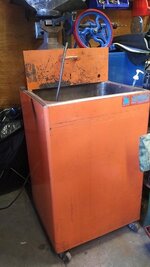
Just got 15 gallons of Crown PSC 1000 solvent for my parts washer; set me back $150, so I'd like for it to last for a while. Parts cleaner is the type pictured below.

I see parts washer filter bags listed for about $60 each - https://www.amazon.com/dp/B084VS7KV6/?tag=atomicindus08-20

the idea appeals to me, but that sure seems expensive for what it is. Anyone use anything less expensive that works well?

Thanks

56YR52_AS01.jpg
 
To avoid these ads, REGISTER NOW!

vwpieces

Well-known member
Joined
Apr 28, 2020
Messages
5,925
Location
Hills, PA
I wouldn't bother. That type of parts washer can allow you to keep the pump near the top of the solvent, away from the sediment. May require modification, but will help.
Once the solvent becomes to oily to be useful it's done.
 

txvwnut

Well-known member
Joined
Jan 1, 2015
Messages
7,654
Location
Bedford, Texas
I have the larger Graymills parts washer and it has a mesh screen filter to trap the large chunks. Every once in a while I’ll wrap a rag on a roll around and let the pump. It’ll pull some of the impurities out enough to change the color of the solution. I’ve some guy make up an external pump/filter setup using an automotive type filter and cycle the solution through.
 

tak1313

Well-known member
Joined
Feb 4, 2018
Messages
658
My parts washer is a Sterlite container with some mineral spirits, so this is just an academic question I'm curios about.

A lot of fluid for parts washers these days are water based (I think). Most parts washer filters (dedicated or not) are likely manufactured for old style petroleum based fluid.

Are there filters designed to handle water based fluid (I would assume ones built for oil, such as ones that are essentially oil filters) would just disintegrate in water since the elements are usually paper based?

Like I said, it's just a curiosity since I'm DIY and can't substantiate a stand alone parts washer, but when I was looking at them, the filter elements I saw seem to be made to handle petroleum based fluids.
 
OP
B

bulletpruf

Well-known member
Joined
Nov 28, 2013
Messages
11,130
Location
San Antonio
My parts washer is a Sterlite container with some mineral spirits, so this is just an academic question I'm curios about.

A lot of fluid for parts washers these days are water based (I think). Most parts washer filters (dedicated or not) are likely manufactured for old style petroleum based fluid.

Are there filters designed to handle water based fluid (I would assume ones built for oil, such as ones that are essentially oil filters) would just disintegrate in water since the elements are usually paper based?

Like I said, it's just a curiosity since I'm DIY and can't substantiate a stand alone parts washer, but when I was looking at them, the filter elements I saw seem to be made to handle petroleum based fluids.

I think most folks are using petroleum based fluids in their parts washers. Water based stuff can lead to rust.
 

CS454

Well-known member
Joined
Oct 10, 2014
Messages
668
I think most folks are using petroleum based fluids in their parts washers. Water based stuff can lead to rust.
We have molded plastic parts washers at work filled with a water based bio-cide agent. You can guess how well it works.

Always been a fan of external filters on parts washers, the bags work but external is much nicer to service.
 

dscheidt

Well-known member
Joined
Apr 26, 2017
Messages
2,909
I think most folks are using petroleum based fluids in their parts washers. Water based stuff can lead to rust.
probably most people hanging out here use solvent based stuff. But industrially, lots of aqueous washers are in use. they've got a bunch of advantages (like: they don't catch on fire, don't cause cancer in workers, do not contribute to air or water pollution, operating costs are lower, ...) which outweigh their disadvantages (they don't work as well in simple washers). Good ones, especially high temperature high pressure spray enclosures, actually do work pretty well, but aqueous solutions require more work, either scrubbing, pressure jets, or ultrasonic agitation, and often heat. aqueous solutions that contain corrosion inhibitors exist, and for some applications, these are superior to solvent cleaning. If your parts washer is functionally a bucket you soak stuff in and a toothbrush, solvent works lots better.

there are oil separators, and particulate filters, to keep the solution from being containinated with the oil/grease from parts, and to keep the solution working well longer. It's problably more complicated to do this than a simple oil filter, especially as a diy set up.
 

isb cornbinder

Well-known member
Joined
Nov 3, 2010
Messages
7,073
Location
Pacific South West, BC, Canada
Just got 15 gallons of Crown PSC 1000 solvent for my parts washer; set me back $150, so I'd like for it to last for a while. Parts cleaner is the type pictured below.

I see parts washer filter bags listed for about $60 each - https://www.amazon.com/dp/B084VS7KV6/?tag=atomicindus08-20

the idea appeals to me, but that sure seems expensive for what it is. Anyone use anything less expensive that works well?

Thanks

56YR52_AS01.jpg
I use my old socks. The socks get attached to the drain with a hose clamp. This has worked for me for 35 years. If one sock is not enough filtering, just add a second sock over the first sock.
 

Attachments

  • SOLVENT POWER WASH TANK.jpg
    SOLVENT POWER WASH TANK.jpg
    59.7 KB · Views: 30
To avoid these ads, REGISTER NOW!

dscheidt

Well-known member
Joined
Apr 26, 2017
Messages
2,909
That looks like a winner to me. Has anyone tried this for solvent?
HDPE has mediocre resistance to hydrocarbon solvents. I'd find one made of something else. Mcmaster sells a bunch of socks like this, as well as filter housings if you want to use one where you're pumping fluid.

We used one as the first step of cleaning up a couple hundred gallons of diesel in a rusting farm tank some years ago. gravity flow into a truck bed fuel tank, then pumped through a much finer filters into a new tank. We had a remarkable amount of sludge by the time we were done.
 

larry4406

Well-known member
Joined
Jan 27, 2006
Messages
19,562
Location
Northern Virginia
I seem to recall @zmotorsports using a Zep filter bag years ago with excellent results ….🤔
I tried finding @zmotorsports post about his filter bag, I think this is it


asallwey

Active member
Joined
Jan 15, 2012
Messages
35
Location
N. Virginia
I wouldn't bother. That type of parts washer can allow you to keep the pump near the top of the solvent, away from the sediment. May require modification, but will help.
Once the solvent becomes to oily to be useful it's done.
One suggestion I would make is to decide what you are going to clean. These work best over the long run if you only put parts in that DON'T have encrusted grease, oil, and dirt, scrape that off first. Solvent stays much cleaner which means your parts come out cleaner and the solvent lasts a long time. Filter bags over the drain are good for catching small parts and dirt gobs. Spin-on filters can be effective on relatively clean fluid, but will load up fast if the fluid carries large particles. The micron size is something you need to carefully evaluate, you don't want it to be too fine. If the filter element is cleanable, like a SS grid, that makes it easier. Big filthy items should go in a soaking bucket before your washer. Many shops will have a couple of washer, and which one get used depends on how dirty it is. An auto machinist I knew would just about kick somebody out of his shop if they put something greasy into the washer he kept in his machine room, instead of the general washer.

But if you only use it occasionally, it may not matter. Do your homework on filtering and micron level for your type of potential useage.
 
OP
B

bulletpruf

Well-known member
Joined
Nov 28, 2013
Messages
11,130
Location
San Antonio
One suggestion I would make is to decide what you are going to clean. These work best over the long run if you only put parts in that DON'T have encrusted grease, oil, and dirt, scrape that off first. Solvent stays much cleaner which means your parts come out cleaner and the solvent lasts a long time. Filter bags over the drain are good for catching small parts and dirt gobs. Spin-on filters can be effective on relatively clean fluid, but will load up fast if the fluid carries large particles. The micron size is something you need to carefully evaluate, you don't want it to be too fine. If the filter element is cleanable, like a SS grid, that makes it easier. Big filthy items should go in a soaking bucket before your washer. Many shops will have a couple of washer, and which one get used depends on how dirty it is. An auto machinist I knew would just about kick somebody out of his shop if they put something greasy into the washer he kept in his machine room, instead of the general washer.

But if you only use it occasionally, it may not matter. Do your homework on filtering and micron level for your type of potential useage.

I generally give stuff a pre-cleaning before it goes into the parts washer, mainly to knock off the bulk of the nasty grimy stuff. I haven't used it yet since I put 15 gallons of fresh PSC 1000 in it, but I need to flush out a TH400 torque converter this weekend. Glad I'll be doing that with fresh solvent.
 

SM Racing

Well-known member
Joined
May 3, 2006
Messages
856
Location
Huntsville, AL
On my parts washer, I built, I used a:

below the drain into the 55gal drum. Then below that I have three or four layers of:


Then at the bottom of the barrel I have a couple of magnets, and a little wire rack that sets the pump up off the bottom of the barrel a couple of inches. Using a little Giant submersible pump. I am using mineral spirits as the solvent. Then the line out of the pump goes into a huge hydraulic filter and then on to the spray nozzle in the basin. Works really well. I don't replace the solvent I just top it off every couple of years.

The filter bag catches the big bits, metal shavings, huge hunks of debris, rocks, etc. I change it when it starts being slow to drain. The filter felt below catches anything that slips through the bag. Been running this setup for more than 10 years. Have a new design in mind if I can find a pair of 30gal barrels.
 

MileHighRover

Well-known member
Joined
Mar 13, 2018
Messages
1,127
I don't think anyone understands what the filter bags are for. They're not to filter particulates. They pull oil out of the solvent so it lasts longer. Coffee filters, socks, spin on filters, etc are not going to pull oil from the solvent.
 
OP
B

bulletpruf

Well-known member
Joined
Nov 28, 2013
Messages
11,130
Location
San Antonio
I don't think anyone understands what the filter bags are for. They're not to filter particulates. They pull oil out of the solvent so it lasts longer. Coffee filters, socks, spin on filters, etc are not going to pull oil from the solvent.

Based on the info on Amazon, it appears that they do both. My focus was more on particulates, but I can see the benefits of pulling oil out, too.

From the listing: "Designed to trap and contain particulate matter. Limited amounts of greases and oils are removed from solvent as fluid percolates through the filter medium. Intended for use in a continuous waste-minimizing program, not as a remedy for a badly contaminated system."
 

larry4406

Well-known member
Joined
Jan 27, 2006
Messages
19,562
Location
Northern Virginia
@bulletpruf check out this thread

On my Zep unit, the manual excerpt shows the flow path as sump thru canister type filter then thru the filter bag.
1698401160319.png
 
OP
B

bulletpruf

Well-known member
Joined
Nov 28, 2013
Messages
11,130
Location
San Antonio
@bulletpruf check out this thread

On my Zep unit, the manual excerpt shows the flow path as sump thru canister type filter then thru the filter bag.
1698401160319.png

Excellent thread, @larry4406! Thanks for the link!
 
To avoid these ads, REGISTER NOW!
Top Bottom