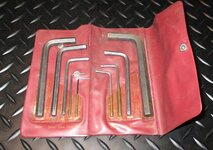
That's about what I'd guessed. They are zinc? Plated, not bare steel or chrome, so I figured after ww2 but before materials were plentiful again.@Graeme it is difficult to date them unless you can find a picture of your set in a dated catalougue. I suspect your set is a similar age to this 1/2" BSW set:
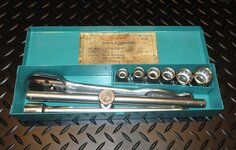
In common with your set:
Box paint finish and King **** branding.
Tapered sockets with straight knurling
No branding on T bar
Press fit ball dents
I guess my set to be late 40s as the sockets are short of steel (post war shortages?) and I know aluminium ratchets were around from the 1950s. If I'm wrong I'd like to be put right.


You are using an out of date browser. It may not display this or other websites correctly.
You should upgrade or use an alternative browser.
You should upgrade or use an alternative browser.
British Tool Manufacturers
- Thread starter Dave455
- Start date

Yes, I would say my set is zinc plated. There is a little bit of chrome on the ratchet. Part of the extension bar looks painted.That's about what I'd guessed. They are zinc? Plated, not bare steel or chrome, so I figured after ww2 but before materials were plentiful again.
I know this is an old post, there is one brand missing. I bought my spanners at Halfords during the early 80s. They sold Gordon branded Gordon. Then Gordon manufactured spanners branded Halfords. Then King **** spanner sets. Probably bought the last set new in 83.Sort of.
Originally, I’m talking 1970’s here, Halfords sold tools, but they were not “Halfords“ branded.
They certainly sold Bedford tools in this era, together with things like Stanley screwdrivers. There was some Halfords branded stuff, but as I recall it was things like grease guns not tools. The names of the tool manufacturers were probably better known than Halfords.
I think the Halfords tools appeared maybe late 70’s / early 80’s, and I think that’s the era Mr Lemons tools date from. Note the packaging says both “Halfords”, and “Gordon”, the latter name still counting for something.
From the late 80’s / early 90’s the tools were just marked “Halfords”, and from pretty much that era were generic Taiwanese. They did stock Facom for a bit, but by the time they had added their mark up they were too costly to sell.
Still have the King **** spanners. A recent eBay purchase:
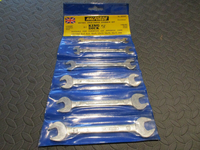
Last edited:
Just now enjoyed reading this thread from start to finish. Interesting King **** is named after the then owners dog.
Decided to take a look and see if I have any British tools that I have not yet posted, King **** TKC 23M. Just a few years old now:

Decided to take a look and see if I have any British tools that I have not yet posted, King **** TKC 23M. Just a few years old now:

Ton ton
Well-known member
I learned something new today. Thank you!Just now enjoyed reading this thread from start to finish. Interesting King **** is named after the then owners dog.
Decided to take a look and see if I have any British tools that I have not yet posted, King **** TKC 23M. Just a few years old now:
King **** metric ring spanners 5.5mm to 36mm. These are a good length giving good leverage. Comfortable to handle too.

Original set bought from Halfods in the early 80s. Been added to with eBay purchases. Difficult to find sizes bought new.
Short reach spanner is a military 13 / 17 mm. I believe it is a special for the forces, never seen them on sale.
Original set bought from Halfods in the early 80s. Been added to with eBay purchases. Difficult to find sizes bought new.
Short reach spanner is a military 13 / 17 mm. I believe it is a special for the forces, never seen them on sale.
It could have been with any government contract where specific tools were sold with certain machines.King **** metric ring spanners 5.5mm to 36mm. These are a good length giving good leverage. Comfortable to handle too.
Original set bought from Halfods in the early 80s. Been added to with eBay purchases. Difficult to find sizes bought new.
Short reach spanner is a military 13 / 17 mm. I believe it is a special for the forces, never seen them on sale.
esben57
Well-known member
Gordon Tools made some Halfords spanners. Photos showing the same design and 'CRO-VAN' which was often on Gordon tools.


Oldtuleguy
Well-known member
- Joined
- Nov 4, 2017
- Messages
- 10,483
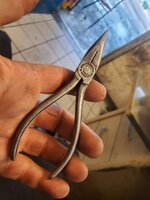

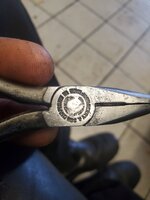
Ratchet.
Well-known member
there were so many small UK makers of pliers, most that are long since defunkt, or at best zombie brands, will go and grab the plumbton(?) linesman pliers i have which are marked "made in warrington", not far from where i currently live, i aught to see if i can find where they were based, and if anything remains of the factory.
I do find it kind of sad that despite the number of tool manufacturers there were in the uk, there isnt the same sort of interest in collecting UK tools, or reserching there history, much that has been already lost to time, as i found when trying to work out some info on Swinborne tools, its presumed connection to Chicago Pnematic and what happened to the company.
On that note i have considered starting a site a bit like alloy artifacts specificly dealing with uk tool manufacturers, but alas got lots of other things to work on right now, maybe in the future though
I do find it kind of sad that despite the number of tool manufacturers there were in the uk, there isnt the same sort of interest in collecting UK tools, or reserching there history, much that has been already lost to time, as i found when trying to work out some info on Swinborne tools, its presumed connection to Chicago Pnematic and what happened to the company.
On that note i have considered starting a site a bit like alloy artifacts specificly dealing with uk tool manufacturers, but alas got lots of other things to work on right now, maybe in the future though
There were a huge number of pliers manufacturers over the years.there were so many small UK makers of pliers, most that are long since defunkt, or at best zombie brands, will go and grab the plumbton(?) linesman pliers i have which are marked "made in warrington", not far from where i currently live, i aught to see if i can find where they were based, and if anything remains of the factory.
I do find it kind of sad that despite the number of tool manufacturers there were in the uk, there isnt the same sort of interest in collecting UK tools, or reserching there history, much that has been already lost to time, as i found when trying to work out some info on Swinborne tools, its presumed connection to Chicago Pnematic and what happened to the company.
On that note i have considered starting a site a bit like alloy artifacts specificly dealing with uk tool manufacturers, but alas got lots of other things to work on right now, maybe in the future though
Even by the early 20th century, some had already gone, and by the late 20th century we primarily had a few big makers such as Elliott Lucas, Wilkinsons etc, but I still come across small firms I know nothing about.
Some of these manufacturers made predominantly one type of tool, such as pincers, or produced for one specific market, such as leather working, so are relatively unknown generally!
It’s a shame so much information has been lost, and is still being lost as former workers retire, or even pass away.
oldpliers1
Well-known member
- Joined
- Jun 30, 2021
- Messages
- 732
Was there a firm called S&S from Sheffield that made pliersthere were so many small UK makers of pliers, most that are long since defunkt, or at best zombie brands, will go and grab the plumbton(?) linesman pliers i have which are marked "made in warrington", not far from where i currently live, i aught to see if i can find where they were based, and if anything remains of the factory.
I do find it kind of sad that despite the number of tool manufacturers there were in the uk, there isnt the same sort of interest in collecting UK tools, or reserching there history, much that has been already lost to time, as i found when trying to work out some info on Swinborne tools, its presumed connection to Chicago Pnematic and what happened to the company.
On that note i have considered starting a site a bit like alloy artifacts specificly dealing with uk tool manufacturers, but alas got lots of other things to work on right now, maybe in the future though
I had a pair of their 8 inch version of the Elliott Lucas combination pliers. They lasted a month before they were stolen a nice tool for a first year boy.
Picked up something unusual on eBay; a 9/32 drive imperial AF King **** socket set:

I have only ever seen 9/32 drive before on BA sized military socket sets. The UJ and ratchet are crowfoot marked military tools that I had sat around waiting to be sold on eBay. The remainder are my new additions, produced for the retail market and in AF sizes. Also fills a gap in my tool box.
I have only ever seen 9/32 drive before on BA sized military socket sets. The UJ and ratchet are crowfoot marked military tools that I had sat around waiting to be sold on eBay. The remainder are my new additions, produced for the retail market and in AF sizes. Also fills a gap in my tool box.
four.cycle
Well-known member
^ wowzers. one rare animal for sure. 
CGarage
Well-known member
There's a big gap in the British market at the moment for some good quality tools that are just a notch cheaper than Snap On. Of course there are European brands, some of which are really nice, but British tastes are far more along American lines - we expect polished chrome and red boxes! If someone imported Wright (for exmple) they'd probably be popular!
Why not Halfords? I have some bits and bobs from them and I quite like it, especially for the money! Have seen it in use in McLaren factory as well!
Halfords are “O.K.” probably about the lowest quality that’s useable, but they are basically generic Taiwanese tools, and they are not particularly cheap. You can get comparable quality for less money, or with a bit of shopping around, much better for comparable money.Why not Halfords? I have some bits and bobs from them and I quite like it, especially for the money! Have seen it in use in McLaren factory as well!
I think for most folks Halfords are the tool equivalent of a local shop in a small village. The latter will charge more than a supermarket for a pint of milk, but you can get it on a Sunday without going far, and that’s worth a small premium!
esben57
Well-known member
I know of SSP. Sheffield Steel Products. Seen SSP pliers that were part of Jaguar (Jag-wire ) toolkits.Was there a firm called S&S from Sheffield that made pliers
I had a pair of their 8 inch version of the Elliott Lucas combination pliers. They lasted a month before they were stolen a nice tool for a first year boy.
Somebody mentioned one of these Britool sets in their comment and it prompted me to get this set out of the attic. It was put there for my son, should he ever develop an interest in maintaining his car. It has been up there a few years:
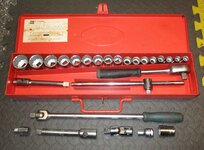
Sockets and ratchet date from very early 1990s. Breaker bar is older. 20mm socket, the one out of the box, is a Facom Britool.
Sockets and ratchet date from very early 1990s. Breaker bar is older. 20mm socket, the one out of the box, is a Facom Britool.
Last edited:
Halfords are “O.K.” probably about the lowest quality that’s useable, but they are basically generic Taiwanese tools, and they are not particularly cheap. You can get comparable quality for less money, or with a bit of shopping around, much better for comparable money.
I think for most folks Halfords are the tool equivalent of a local shop in a small village. The latter will charge more than a supermarket for a pint of milk, but you can get it on a Sunday without going far, and that’s worth a small premium!
It’s a different story with a trade card, the tools are very reasonably priced. Plus if the tool breaks, the minimum wage teenager just swaps it, rather than needing to hope the snap on guy turns up that month and you’ve spent enough with him recently for him to honor the warranty. If you live near a Halfords, it’s a good option for a lot of DIYers. I like their modular trays, they are decent quality and were very cheap on trade.
oldpliers1
Well-known member
- Joined
- Jun 30, 2021
- Messages
- 732
That’s the product thank youI know of SSP. Sheffield Steel Products. Seen SSP pliers that were part of Jaguar (Jag-wire ) toolkits.
esben57
Well-known member





Interesting! Thanks for posting.TW - Williams SUPERSLIM.
Black finish open end spanners bomb proof. Not pretty or deadly accurate, but you could beat seven shades from them
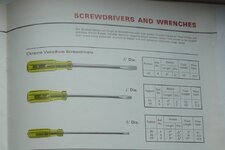
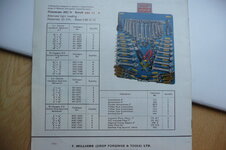
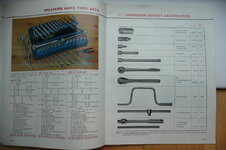
I have a set of Williams Superslim A/F open ended spanners that were bought new, I think in about 1976.
They are chromed, but the finish isn’t as good as those in this catalogue appear to be.
The screwdrivers appear to be re branded Steadfast!
esben57
Well-known member
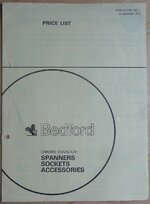

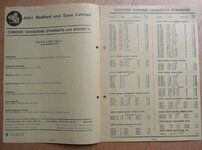


Bedford tools price list. SJ from being bought out by Spear & Jackson, saw makers.
Not so keen on the sockets then. Very good chrome finish but seen many cracked. Britool, King **** much better.
Bedford did make Halfords tools.
Bedford ratchets ( some) may have been made by HAND TOOLS- Dronfield. Identical pattern in some cases.
esben57
Well-known member
Tend to agree Dave. Steadfast, I think, made early Britool and perhaps Gordon drivers.Interesting! Thanks for posting.
I have a set of Williams Superslim A/F open ended spanners that were bought new, I think in about 1976.
They are chromed, but the finish isn’t as good as those in this catalogue appear to be.
The screwdrivers appear to be re branded Steadfast!
Mid 80's I acquired a joblot of new Steadfast from somebody from the Stanley works. Do not know how that came about.
Sold the lot in minutes to my workmates.
Also Stead drivers. Same company ??? always with broad arrow. Same amber grip as Footprint.
A lot of everybody making each others.
I was never convinced about Steadfast making the Gordon and Britool screwdrivers.Tend to agree Dave. Steadfast, I think, made early Britool and perhaps Gordon drivers.
Mid 80's I acquired a joblot of new Steadfast from somebody from the Stanley works. Do not know how that came about.
Sold the lot in minutes to my workmates.
Also Stead drivers. Same company ??? always with broad arrow. Same amber grip as Footprint.
A lot of everybody making each others.
I have examples of all of them, and the Steadfast handles all fall into two distinctive patterns - the ones with the raised flutes (as above) and a vaguely hexagonal pattern, similar to the Stanley drivers of the same era.
The Gordon drivers have a similar, but distinctly different, handle with inset flutes. The yellow cellulose acetate is a distinctly different colour on the Gordons too (lighter yellow), and the blades have a subtly different finish.
Unfortunately, all these tools were produced at different times, so it’s hard to be sure. The Britool drivers seem to be identical to the Gordon however.
The last of the Steadfast drivers (Spear and Jackson branded, but Steadfast patterns, probably produced on Steadfast tooling, and even the same colours of handle) were still available till recently. Only about two years ago I obtained “Instrument” pattern drivers from Zoro - PZ1, PZ2 (both with long blades) and some 1/8” slotted!
Edit - the long bladed PZ2 are still available. The picture is wrong, as is the description, but a Steadfast PX2/10 is a No.2 Pozidriv with a 10 inch blade, and that’s what you get!
The picture is obviously a Steadfast pattern PH2, so close!

esben57
Well-known member





esben57
Well-known member


A James Neill Britool A45 job saver ratchet.


Swinborne set.
esben57
Well-known member


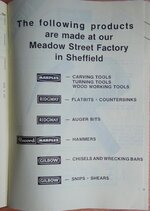
All Sheffield made.
esben57
Well-known member
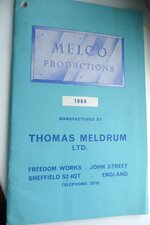


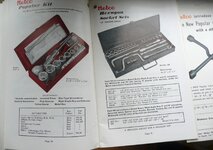
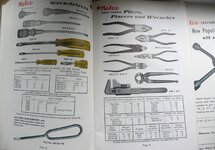

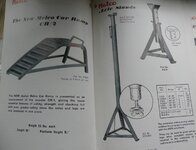


Melco may still be making tools.
esben57
Well-known member
BIB wire cutters/strippers.
JPI ignition set.
Terry's Tempered flat plate spanners. BA also AF and BSW
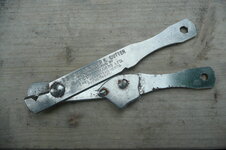


JPI ignition set.
Terry's Tempered flat plate spanners. BA also AF and BSW
Last edited:
CGarage
Well-known member
Good description here of all of the lingo:
BA
BSF
BSW
AF
Etc
BA
BSF
BSW
AF
Etc
Convert,compare all Imperial tool,nut,bolt and spanner sizes to metric.
Convert Whitworth,BSF,BA,AF sizes to metric.Wrench,socket,nut and bolt sizes explained.
www.baconsdozen.co.uk
Hopefully it’s not too different!Good description here of all of the lingo:
BA
BSF
BSW
AF
Etc
Convert,compare all Imperial tool,nut,bolt and spanner sizes to metric.
Convert Whitworth,BSF,BA,AF sizes to metric.Wrench,socket,nut and bolt sizes explained.www.baconsdozen.co.uk
BSW = British Standard Whitworth aka “Whitworth”. Coarse threads optimised for iron. Similar to UNC / ANC.
BSF = British Standard Fine. Same threadform as BSW but finer so optimised for steel. Similar to UNF / ANF.
BA = British Association. Small sized threads optimised for instrument work. Similar role to UNC / UNF “numbered” series, but the low numbers are the biggest.
AF (or A/F) = Across Flats. A designation for a wrench using the American (SAE) or Unified system, where the size shown is the size “Across Flats” rather than the thread size.
The website linked is useful to a degree, but there are some errors / omissions.
I’ve never found these charts showing metric equivalents of BS sizes any use whatsoever. Most metric sizes don’t quite fit, or are simply too big. Use the correct size.
The BSW / BSF sizes shown are correct as regards pre war fasteners, but post war the BSF sizes were used for both BSF and BSW (and 2/4 BA were substituted for the smallest sizes).
When the U.K. adopted the Unified system, the “numbered” sizes were never adopted, so BA sizes are found much later on British equipment, and in fact are still used in some areas.
BA sizes are actually metric threads. O BA is 6mm (x 1mm pitch) and each subsequent size is 90% of the previous. This is actually far more sensible than sizing in fixed increments, where, say 1mm, might not be enough of a jump in larger sizes, and too much in the smaller.
I’m quite happy using ISO metric fasteners as substitutes for Imperial sizes (either BS or Unified). 1/4, 5/16 and 3/8 can be switched for 6,8 and 10mm quite easily. However, I find the ISO metric very cumbersome in the smaller sizes so generally still use BA. The screws are better quality too.
CGarage
Well-known member
Hopefully it’s not too different!
BSW = British Standard Whitworth aka “Whitworth”. Coarse threads optimised for iron. Similar to UNC / ANC.
BSF = British Standard Fine. Same threadform as BSW but finer so optimised for steel. Similar to UNF / ANF.
BA = British Association. Small sized threads optimised for instrument work. Similar role to UNC / UNF “numbered” series, but the low numbers are the biggest.
AF (or A/F) = Across Flats. A designation for a wrench using the American (SAE) or Unified system, where the size shown is the size “Across Flats” rather than the thread size.
The website linked is useful to a degree, but there are some errors / omissions.
I’ve never found these charts showing metric equivalents of BS sizes any use whatsoever. Most metric sizes don’t quite fit, or are simply too big. Use the correct size.
The BSW / BSF sizes shown are correct as regards pre war fasteners, but post war the BSF sizes were used for both BSF and BSW (and 2/4 BA were substituted for the smallest sizes).
When the U.K. adopted the Unified system, the “numbered” sizes were never adopted, so BA sizes are found much later on British equipment, and in fact are still used in some areas.
BA sizes are actually metric threads. O BA is 6mm (x 1mm pitch) and each subsequent size is 90% of the previous. This is actually far more sensible than sizing in fixed increments, where, say 1mm, might not be enough of a jump in larger sizes, and too much in the smaller.
I’m quite happy using ISO metric fasteners as substitutes for Imperial sizes (either BS or Unified). 1/4, 5/16 and 3/8 can be switched for 6,8 and 10mm quite easily. However, I find the ISO metric very cumbersome in the smaller sizes so generally still use BA. The screws are better quality too.
You are one of our most valuable members!!! Excellent info, as always!!!
You are, as ever, too kind!You are one of our most valuable members!!! Excellent info, as always!!!
In the early days, I learnt about bolts, threads and wrenches from my Grandfather (there was no metric then, BA excepted, so that’s my weak area) and use these older threads regularly working on classic machine tools.
If anybody is confused, I advise the following book. It’s a good read. Really…!
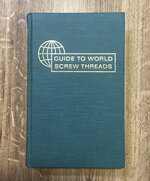
You don't see many of these:


1/2" drive ratchet with unusual reversing mechanism marked Bedfords Sheffield. Probably dates from the 60s? Not as robust as King ****, and not as refined as a Swinborne or Britool, but it is a very usable tool.
1/2" drive ratchet with unusual reversing mechanism marked Bedfords Sheffield. Probably dates from the 60s? Not as robust as King ****, and not as refined as a Swinborne or Britool, but it is a very usable tool.