To avoid these ads, REGISTER NOW!

Smart Meters…

u3b3rg33k

Well-known member
Joined
Dec 18, 2017
Messages
4,049
I find the smart meter hate moderately hilarious. if you're the only one on the leg without a smart meter, they can figure out your real time usage by subtracting it from whoever else is on your distribution leg. congratulations, you effectively have one.

sure, it's got a motorized switch inside to disconnect it. no, it's not intended to be used to turn on/off bob every 5 minutes to mess with bob.

as the number of customers with manual read meters goes down, the cost to read them goes up. if that's not being paid for 100% by the opt-out customers, congratulations, you've got a subsidy for the sticks in the mud, raising rates for everyone else.

if anything as a customer, I want MORE visibility into my usage, not less. I wish they had a remote display that showed me real time data. that'd be great! if you go out and look, you can usually figure out what each display is, there's usually TOU buckets, KW demand info, total kWh, etc. easier to read out real numbers than try to time out a spinning disk.
 
To avoid these ads, REGISTER NOW!

zendriver

Well-known member
Joined
Dec 10, 2014
Messages
30,154
Location
Indiana
Ironically, one of the best ways to ensure you have what you need in the future, is to manage what you already have available.

True of most anything

The tinfoil hat is nothing new. When the REA came around, there were plenty who were brainwashed into believing the lightbulbs would explode and burn down your house and barn
 

SlappyWhite

Well-known member
Joined
Oct 3, 2012
Messages
1,819
Location
Upper Canada
Some phone companies offer rotary/pulse dial support for an extra charge today...

Ironically when DTMF came out support was at an extra charge for DTMF.

(It all makes sense from a technology perspective just not logically to laypeople.)
 

cvairwerks

Well-known member
Joined
Aug 12, 2016
Messages
7,256
Location
Within hearing distance of Texas Motor Speedway
The tinfoil hat is nothing new. When the REA came around, there were plenty who were brainwashed into believing the lightbulbs would explode and burn down your house and barn
When the REA came around, they were still installing tube and bare or cotton covered wiring as well. Both were highly susceptible to inadvertent damage and were high fire risk for those that didn't know better. Most were just glad to have power in any form without running generators.
 

Copymutt

Well-known member
Joined
Sep 3, 2016
Messages
3,407
Location
Colorado
Around here we had a precursor to the smart meter! A smart meter reader! He would stop on the road & read all visible meters with binoculars from his truck & move on👍🏻
 

duneslider

Well-known member
Joined
Jan 20, 2013
Messages
2,268
Location
Riverton, Utah
I didn't realize smart meters were such a concern. My dad worked for the power company doing load research. We had one on our house in like the 90's. They had to be read by plugging a cable into them and pulling the data. Eventually, they moved up in tech to where the meter reader would just have to drive around the neighborhood and the computer in the truck would pull the data. At one point my dad could call home and tell us someone forgot to unplug a curling iron. Back in the day, he would bring home printed sheets (long stacks of dot matrix printed paper) that showed the power consumption at different times of the day, it was fun to look at and guess what we were doing based on the consumption rates. You could tell when the kids left for school and when we got home, when dinner prep started, etc.

I think the natural gas meters have been smart meters for at least 25 years here, even the water meters are I think. I haven't seen a meter reader in ages.
 

wyliesdiesels

Well-known member
Joined
Aug 14, 2012
Messages
20,073
Location
Modesto, CA
I think the natural gas meters have been smart meters for at least 25 years here, even the water meters are I think. I haven't seen a meter reader in ages.
Yes but they do not provide the same usage info that an electric smart meter provides. All they can do is provide daily usage. They cannot provide minute to minute usage, interval usage or demand usage…
 

zendriver

Well-known member
Joined
Dec 10, 2014
Messages
30,154
Location
Indiana
When the REA came around, they were still installing tube and bare or cotton covered wiring as well. Both were highly susceptible to inadvertent damage and were high fire risk for those that didn't know better. Most were just glad to have power in any form without running generators.
Generators? :confused: This was the 1930s.

Farm lighting was by kerosene lantern and mechanical power was by hand, horse, primitive tractor or small engine, running on some rendition of fossil fuel

Would not be surprised if they’re still farm houses that have that wire yet today
 

cvairwerks

Well-known member
Joined
Aug 12, 2016
Messages
7,256
Location
Within hearing distance of Texas Motor Speedway
Generators? :confused: This was the 1930s.

Farm lighting was by kerosene lantern and mechanical power was by hand, horse, primitive tractor or small engine, running on some rendition of fossil fuel

A hit-n-miss was used to drive lots of stuff including generator heads.... Some were dc and others were ac. Still, whether the portion that actulally produced the electricity had an engine or was water driven, it's still a generator. Current bastardation of the definition is anthing that is a direct coupled, ICE powered, stand alone unit capable of producing electricity.
 

paranoid56

Well-known member
Joined
Dec 18, 2008
Messages
1,596
Location
San Diego, Ca
we didnt have a choice but to get a smart meter when we did solar. but i 100% signed up for HVAC controlling for a cheaper rate lol. being in San Diego, we never use heat, and i have a mini split thats not hooked up to the main thermostat lol.
 

ArcReactorKC

Well-known member
Joined
Jun 1, 2019
Messages
2,237
Location
Out in the county NE of KCMO
I find the smart meter hate moderately hilarious. if you're the only one on the leg without a smart meter, they can figure out your real time usage by subtracting it from whoever else is on your distribution leg. congratulations, you effectively have one.

sure, it's got a motorized switch inside to disconnect it. no, it's not intended to be used to turn on/off bob every 5 minutes to mess with bob.

as the number of customers with manual read meters goes down, the cost to read them goes up. if that's not being paid for 100% by the opt-out customers, congratulations, you've got a subsidy for the sticks in the mud, raising rates for everyone else.

if anything as a customer, I want MORE visibility into my usage, not less. I wish they had a remote display that showed me real time data. that'd be great! if you go out and look, you can usually figure out what each display is, there's usually TOU buckets, KW demand info, total kWh, etc. easier to read out real numbers than try to time out a spinning disk.
To the beginning of your post. I'll say the same thing I've always said.
The end goal of smart meter implementation was and is, and always will be to increase margins for the utility.

Now that my complaint is over.


I used to use AI on the edge with an ESP32 to report to my home assistant configuration. I can see current demand in as close to real time as the meter will display. https://github.com/jomjol/AI-on-the-edge-device


I now use my own CT's and PT's to determine all of my billable variables. This is the info I use to moderate our demand charges and schedule things like the water heater, 3d printers, clothes dryer, etc. to NOT run when the server demand is high and we are on the verge of high demand charges, this is weighted as well during "peak" usage times to try and keep our electricity rates down.
 

ArcReactorKC

Well-known member
Joined
Jun 1, 2019
Messages
2,237
Location
Out in the county NE of KCMO
we didnt have a choice but to get a smart meter when we did solar. but i 100% signed up for HVAC controlling for a cheaper rate lol. being in San Diego, we never use heat, and i have a mini split thats not hooked up to the main thermostat lol.
I couldn't imagine letting the utility manage our HVAC. But then again we are in the midwest where 80f temperature swings are not unheard of. Heat in the morning AC in the afternoon is common.

My father in law let evergy install a nest thermostat in his house. I'm not sure the algorithm they use but his hvac usage actually went up causing a bill increase not the decrease they promised. Because the thermostat was "free" with his program sign up it ended up costing him a few hundred bucks just to go back to the original smart thermostat I had installed for him with geofencing.
 

dcg9381

Well-known member
Joined
Jun 20, 2018
Messages
11,919
Location
Austin, TX
To the beginning of your post. I'll say the same thing I've always said.
The end goal of smart meter implementation was and is, and always will be to increase margins for the utility.
Well, sure.. I mean that makes sense to me. But like any business, they're going to get margin somewhere and if they can't "optimize" to the margin, they'll get it on the other end with a price increase to consumers. I'm in a co-op, so what's better for the business is technically better for me as a member... I'll ignore the prior lavish spending by the board on trips to vegas.

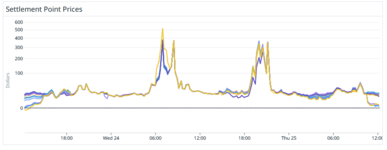
It's remarkable to me how much the wholesale power market swings here in TX...I think being able to predict and optimize likely can result in some real advantages... Now just think how cool it would be if we could store this power during "low price" settlement points and distribute it when the market is demanding much higher prices... But on a regional level.

1714065594433.png
 

AA/FC

Well-known member
Joined
Dec 9, 2010
Messages
2,080
I couldn't imagine letting the utility manage our HVAC. But then again we are in the midwest where 80f temperature swings are not unheard of. Heat in the morning AC in the afternoon is common.

My father in law let evergy install a nest thermostat in his house. I'm not sure the algorithm they use but his hvac usage actually went up causing a bill increase not the decrease they promised. Because the thermostat was "free" with his program sign up it ended up costing him a few hundred bucks just to go back to the original smart thermostat I had installed for him with geofencing.

I would have a similar problem at my old poorly insulated house....

My central A/C unit can maintain inside house temperature at whatever I set the thermostat at..... but if I turn the A/C off (or let it turn off by raising the set temp) during a warm summer day, and the inside house temp rises even one degree, I will never get that degree back until outside temps cool off during the overnight hours.

My A/C cannot LOWER my inside house temp, it only has enough cooling power to MAINTAIN any given temp. I have to be very careful how I run the A/C in my house or I can get caught with my pants down. Not a chance in hell will I let someone at the power company (or their computer algorithm) decide when MY air conditioning should be turned on/off. No thanks....
 

LopezBart

Well-known member
Joined
Oct 13, 2023
Messages
2,564
Location
Lopez Island, WA
I couldn't imagine letting the utility manage our HVAC. But then again we are in the midwest where 80f temperature swings are not unheard of. Heat in the morning AC in the afternoon is common.
If you have the space, heating some water during the hot day would help keep things comfortable and night/morning.... and so would better insulation.
 

ArcReactorKC

Well-known member
Joined
Jun 1, 2019
Messages
2,237
Location
Out in the county NE of KCMO
If you have the space, heating some water during the hot day would help keep things comfortable and night/morning.... and so would better insulation.
Heat isn't an issue really in this house. Elsewhere on GJ I referenced that we use heat from the server room throughout the house, as well as the outdoor air mixing to alleviate the AC running on days it's 60 and sunny.
 

reader2580

Well-known member
Joined
Dec 31, 2014
Messages
14,571
Location
Minneapolis, MN
My electricity is provided by a cooperative that doesn't have a profit motive. Yet, they too have gone to smart meters. They were still using fully analog meters before the change. They save by eliminating meter readers and being better able to pinpoint outage locations.

The cooperative I am with has only raised rates in one year out of the previous seven years. They have managed to hold rates steady in the face of massive inflation the past few years. They raised rates less than 4% in 2023 and no rate increase in 2024. I believe the previous rate increase before that was 2018.
 

reader2580

Well-known member
Joined
Dec 31, 2014
Messages
14,571
Location
Minneapolis, MN
I know the state is pushing utilities to go to TOU and smart meters make that much easier. TOU rates **** because the peak rates are during the time when households use the most electricity. It isn't like I am going to wait until 8 pm to start cooking dinner. If I start laundry at 8 pm I won't be done with just one load before I go to bed at 9:15 pm. I suppose I could do laundry only on weekends, but that requires more planning. My dishwasher has a delay start at least. Air conditioning is the worst. I don't want to shut off my A/C during the time I am actually home and at a time when it is still quite warm. I know from experience on a warm day if the utility precools my house for 90 minutes and kills the A/C from 4 pm to 7 pm that it will be 78 degrees at 7 pm. (I keep the A/C at 74 degrees normally.)

I have solar, but the peak usage period is also at a time when solar production is dropping like a rock in the summer, and no production at all during the winter during that time.
 

u3b3rg33k

Well-known member
Joined
Dec 18, 2017
Messages
4,049
why you'd have the utility killing your AC for THREE HOURS is beyond me. most demand response windows targeted at homeowners I'm aware of are 15-30 min tops. my place would go up way more than 4F in 3 hours on a 95F+ day without the AC on, but I find the sun drives most of my AC demand, so the solar knocks it off the bill, regardless of which TOU bucket it's in.

I don't find cooking uses that much energy (kWh). boiling a pot of water or running the oven is just not a big kWh driver, vs water heating or running the dryer.

it sounds like you'd benefit from a house battery to time shift some of your solar. Tesla's VPP seems to pay out BIG money in the markets they're currently operating in when they sell during DR events.

Well, sure.. I mean that makes sense to me. But like any business, they're going to get margin somewhere and if they can't "optimize" to the margin, they'll get it on the other end with a price increase to consumers. I'm in a co-op, so what's better for the business is technically better for me as a member... I'll ignore the prior lavish spending by the board on trips to vegas.

It's remarkable to me how much the wholesale power market swings here in TX...I think being able to predict and optimize likely can result in some real advantages... Now just think how cool it would be if we could store this power during "low price" settlement points and distribute it when the market is demanding much higher prices... But on a regional level.

1714065594433.png
that's part of the issue with flat rate billing. residential tier one here is an "average" of peak and off-peak power. is that fair to anyone? to small users it's probably just easier accounting, but a lot of the time people are paying 50% more than they need to.

there' another side effect though. I think it incentivizes bad behavior. Say you know that certain hours are "peak" and it costs more to run big stuff (like your dryer) during that time. but you're on the flat rate so "it doesn't cost ME any extra, **** it time to turn it all on!" well if lots of people do that, it ends up costing EVERYONE more, driving up the base rate.

with analog meters, it used to be that you could get a second "cheap" meter for off-peak water heaters, but they just put a timer on it so it was off outside of certain hours. then if the power went out the clock was wrong and had to be re-set. or you have a meter that can log different time periods, but that doesn't scale well, and it's not very flexible, and then the customer needs a timer that they ALSO have to maintain.

smart meters and appliances that buffer energy (like water heaters, or the "new" thermal storage wax/brick systems), allow everyone to benefit from accurate billing, and being able to load shift to cheaper times benefits both the end user and the grid, and thus other customers.

is that just more margin for the utility? there may be some in there for them, but I don't think it's a pure profit play. that's not the system we have, it isn't that simple.
 

dcg9381

Well-known member
Joined
Jun 20, 2018
Messages
11,919
Location
Austin, TX
I have solar, but the peak usage period is also at a time when solar production is dropping like a rock in the summer, and no production at all during the winter during that time.
IF you move to TOU rates and there are big swings, but you have solar, it starts (perhaps) to make sense to look at installing battery systems. Many of them can be programmed to "charge low TOU" and "discharge high TOU". But it's a math problem to see how long it takes to pay back.

Our co-op killed the economics of net metering, which put many people who had installed permanently upside-down on their installs. The only way to get that money back is to use battery systems that capture rather than sell back to the utility and have the batteries discharge, trying to keep most of the power at home...
 
To avoid these ads, REGISTER NOW!

reader2580

Well-known member
Joined
Dec 31, 2014
Messages
14,571
Location
Minneapolis, MN
Our co-op killed the economics of net metering, which put many people who had installed permanently upside-down on their installs. The only way to get that money back is to use battery systems that capture rather than sell back to the utility and have the batteries discharge, trying to keep most of the power at home...
The state of Minnesota requires net metering for solar at this point. There is also state law that requires no fossil fuel for electricity by 2040 so I figure net metering is probably safe until my solar is paid off. I did DIY for the most part. I never would have done it if I paid someone.
 

u3b3rg33k

Well-known member
Joined
Dec 18, 2017
Messages
4,049
IF you move to TOU rates and there are big swings, but you have solar, it starts (perhaps) to make sense to look at installing battery systems. Many of them can be programmed to "charge low TOU" and "discharge high TOU". But it's a math problem to see how long it takes to pay back.

Our co-op killed the economics of net metering, which put many people who had installed permanently upside-down on their installs. The only way to get that money back is to use battery systems that capture rather than sell back to the utility and have the batteries discharge, trying to keep most of the power at home...
my utility does monthly net metering, with any overage being sold at "avoided cost rates" which are... very generous for the utility. it'd be like if I was buying gas retail and charging you $0.99/gal to fill your tank.
 

4 FN 27

ALLIANCE MEMBER
Joined
Oct 19, 2015
Messages
4,635
Location
Minnesnowta
Sorry no link. My Mother in law still gets the paper delivered to her driveway, sometimes street, front yard or in the bushes. :)

St Paul Pioneer Press, Monday April 24. Tried to look at it on their FB page but they either didn't put the article on the page or they took it down.

The only reason for Smart Meters:

IMG_5932.JPG
 

Copymutt

Well-known member
Joined
Sep 3, 2016
Messages
3,407
Location
Colorado
Anyone have info on residential battery storage which would augment TOU? Think banking it during cheap hrs. so no peak charges.🤔
 

dcg9381

Well-known member
Joined
Jun 20, 2018
Messages
11,919
Location
Austin, TX
my utility does monthly net metering, with any overage being sold at "avoided cost rates" which are... very generous for the utility. it'd be like if I was buying gas retail and charging you $0.99/gal to fill your tank.
Avoided cost rate sounds perfect. It also sounds completely fair (I'm sure it's highly dynamic). I'd suggest this to the board of my utility, but they had some highly-biased study done that I, as an engineer and solar installer can't begin to understand. The conclusion that board came to was that solar installs cost non-solar owners money and if adoption continued (we are at under 2% now) we'd soon have problems like California.

We'll ignore the fact that California's adoption is mandated and is well into double digits. I pay a lot more attention to annual voting now.

The state of Minnesota requires net metering for solar at this point. There is also state law that requires no fossil fuel for electricity by 2040 so I figure net metering is probably safe until my solar is paid off. I did DIY for the most part. I never would have done it if I paid someone.

Sounds like a legislative pipe dream without massive cost increases. I'm "pro-renewables" but this is "financially infeasible" as far as I know. Other countries with much high adoption of renewables have essentially reached "saturation" of wind and solar - you need other power that can be brought online without being dependent on the weather.
 

ArcReactorKC

Well-known member
Joined
Jun 1, 2019
Messages
2,237
Location
Out in the county NE of KCMO
Anyone have info on residential battery storage which would augment TOU? Think banking it during cheap hrs. so no peak charges.🤔
Return on investment would be quite long I imagine.
I did the math for us to run more solar and maybe even some wind power. With our almost $1k/mo bill the return still isn't there.
 

dcg9381

Well-known member
Joined
Jun 20, 2018
Messages
11,919
Location
Austin, TX
Return on investment would be quite long I imagine.
I did the math for us to run more solar and maybe even some wind power. With our almost $1k/mo bill the return still isn't there.
Given that ROI on "installed" solar is often in the 10+ year range on a good day, I'd expect the same on battery systems - IE, a really long time. But if you've got high use during high TOU maybe it might work. Given the math is going to be more difficult than with solar. My concern would be that battery lifetime might not be within the payback time period.

$1k power bill... Ouch....
 

reader2580

Well-known member
Joined
Dec 31, 2014
Messages
14,571
Location
Minneapolis, MN
why you'd have the utility killing your AC for THREE HOURS is beyond me. most demand response windows targeted at homeowners I'm aware of are 15-30 min tops. my place would go up way more than 4F in 3 hours on a 95F+ day without the AC on, but I find the sun drives most of my AC demand, so the solar knocks it off the bill, regardless of which TOU bucket it's in.
They technically aren't shutting off A/C for three hours. This uses a smart thermostat to control things. For my house it is effectively shutting off the A/C for three hours. I keep my A/C at 74 degrees when I am at home.

What happens is the co-op will change your thermostat to two degrees below your current set point 90 minutes before the peak period to pre-cool the house. This usually starts at 2:30 pm for a 4 pm to 7 pm peak period. At 4 pm your thermostat will be set to four degrees above your set point point until 7 pm. At 7 pm it goes back to normal. You can opt out and change your temperature setting, but you lose your $10 credit for the month.

My house is pretty energy efficient. (I air sealed the attic and installed new windows and doors in 2014.) My house will usually be right at 78 degrees by 7 pm, but it won't get quite warm enough to kick on the A/C. I have talked to others who are on this program and their A/C will kick on about once per hour during the three hour peak period as they hit the higher temperature set point faster.

If the co-op starts abusing the system I can just take my thermostat off WI-FI so they no longer have access.
 

reader2580

Well-known member
Joined
Dec 31, 2014
Messages
14,571
Location
Minneapolis, MN
Given that ROI on "installed" solar is often in the 10+ year range on a good day, I'd expect the same on battery systems - IE, a really long time. But if you've got high use during high TOU maybe it might work. Given the math is going to be more difficult than with solar. My concern would be that battery lifetime might not be within the payback time period.
Many storage batteries have a ten year warranty. Some will limit the warranty to ten years, or a certain number of charge cycles, whichever comes first. I have a couple of solar storage batteries in my motorhome that have a ten year warranty, but the vendor says to expect a 20 year lifetime. I am skeptical on the 20 year lifetime.
 

ArcReactorKC

Well-known member
Joined
Jun 1, 2019
Messages
2,237
Location
Out in the county NE of KCMO
$1k/month electric bill 😳😬!

We vary from around $180-$350 depending on season.
Our entire business is run from the house so that includes the servers and the 3d printers. Our use case is more commercial than residential realistically but we don't need three phase and I really don't want to rent commercial space.

In 2025 we will be moving home base to *probably* South Dakota and when that happens we may rent a commercial office space for everything. It definitely won't be cheaper but I am expecting full time employees on site at that point. Currently the only employees I have are remote/drivers
 

Copymutt

Well-known member
Joined
Sep 3, 2016
Messages
3,407
Location
Colorado
Return on investment would be quite long I imagine.
I did the math for us to run more solar and maybe even some wind power. With our almost $1k/mo bill the return still isn't there.
Anyone have info on residential battery storage which would augment TOU? Think banking it during cheap hrs. so no peak charges.🤔
Totally agree on the lack of acceptable payback. There are numerous ways to store energy though.
I’ve watched a few videos of mechanical weight storage from Europe. Life span is acceptable, but it takes up some real estate. Another possibility is weight storage down the hole! Instead of massive tonnage above ground a well or shaft is used to contain the weight mechanism. Wonder if a small scale hydro pump up into a weight chamber during cheap rate would pay back. This is done on several reservoirs in the west on a huge scale. The first advantage I see is the cost and installation of water weight @ 8# a gallon has to be cheaper than the heavy weights & cost of equipment install required for set up. Need some engineering studies.
 

u3b3rg33k

Well-known member
Joined
Dec 18, 2017
Messages
4,049
Anyone have info on residential battery storage which would augment TOU? Think banking it during cheap hrs. so no peak charges.🤔
I think the powerwall system will let you do arbitrage.
Totally agree on the lack of acceptable payback. There are numerous ways to store energy though.
I’ve watched a few videos of mechanical weight storage from Europe. Life span is acceptable, but it takes up some real estate. Another possibility is weight storage down the hole! Instead of massive tonnage above ground a well or shaft is used to contain the weight mechanism. Wonder if a small scale hydro pump up into a weight chamber during cheap rate would pay back. This is done on several reservoirs in the west on a huge scale. The first advantage I see is the cost and installation of water weight @ 8# a gallon has to be cheaper than the heavy weights & cost of equipment install required for set up. Need some engineering studies.
I don't think the setups for home energy use that aren't LFP will pencil out if the grid is available.

Numbers I've seen for large scale hydro are 70-80% efficiency. so if you're going to move it up and down, 70% of 70% is 49% efficiency. best case.
small stuff has higher losses.

LFP puts you in the 90%s.

if you're geologically lucky and have a property with large ponds/lakes separated by hundreds of feet in height, maybe it's worthwhile. if you've got a few acres or less, just go LFP, and save yourself some trouble.

if you need to store thermal energy on the cheap, there's UL listed thermal brick systems that are DIRT cheap per kWh.
 

Chukster

Well-known member
Joined
Jan 25, 2012
Messages
2,598
Location
Cary, NC
They are supposed to show up once a year for an actual reading, but they never bothered. That has become an issue when houses in my area sell and POCO shows up for the first reading with the new owner. There was a house in my area that the previous owner had fudged the readings for years and had an outstanding balance of over 7K. It was on the local news and for some reason the POCO settled with the previous owner for half the owed amount. I thought that was wrong, they should have had to pay every penny owed back.
I'm going to guess that physical audits end up falling way down the list of priorities, like so many other things. Managerial oversight, yeah, we'll do that next week, yadda yadda.

Can you tell I have a dim view of managers in general?
 

Chukster

Well-known member
Joined
Jan 25, 2012
Messages
2,598
Location
Cary, NC
My electricity is provided by a cooperative that doesn't have a profit motive. Yet, they too have gone to smart meters. They were still using fully analog meters before the change. They save by eliminating meter readers and being better able to pinpoint outage locations.

The cooperative I am with has only raised rates in one year out of the previous seven years. They have managed to hold rates steady in the face of massive inflation the past few years. They raised rates less than 4% in 2023 and no rate increase in 2024. I believe the previous rate increase before that was 2018.

That's a pretty good record there.

Just because they don't have a profit motive doesn't mean they don't want to increase their margins, save costs, etc.

And the technology to better pinpoint outages and other events vastly improves recovery times. We've lost power twice in the last 2 years, and within probably 1/2 hour POCO's outage website had been updated to show our neighborhood and which houses had reported without power.

Altho trucks & lineman still had to show up and get trees off lines, bring in new poles, etc.

Yes, both events were for trees falling on lines. First one was 5 houses down the street which took out one pole and pulled the lines way back 6 or 7 houses up the street! Next one was just next door to us, fell all the way across the street and into another pole. 100+ year old oak trees make a big thud when they hit the ground!

All this beats what we had in 1996 with Hurricane Fran. Our neighborhood was without power for 7-1/2 days, because POCO back then didn't have really good records of where lines really were. Other places near us lost power for even longer.
 

reader2580

Well-known member
Joined
Dec 31, 2014
Messages
14,571
Location
Minneapolis, MN
That's a pretty good record there.

Just because they don't have a profit motive doesn't mean they don't want to increase their margins, save costs, etc.
Sure, they want to save money too, but they aren't doing it to make more profit like a investor owned utility. The cost savings have been used to keep rates from going up. I believe the cooperative installed smart meters before Xcel Energy did which is surprising to me.
 
To avoid these ads, REGISTER NOW!
Top Bottom