To avoid these ads, REGISTER NOW!

Bending Tubing - Need Advice

paulsomlo

Well-known member
Joined
Jul 16, 2013
Messages
3,898
Location
Northern Colorado
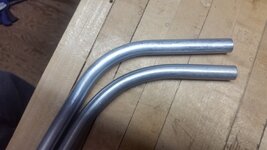
I'd like the straight piece in the picture below to resemble the bent piece. I'm working with 1/2" OD aluminum tubing, 0.065" wall. I turned a bending form on the lathe that matches the tube's radius and has the desired bend radius (2.5")

At what point do I restrain the tube, how do I know where the midpoint of my bend will end up, and how close to the bend do I need to hold the free end of the tube when I bend it?

IMG_20240918_193623247.jpg
 
To avoid these ads, REGISTER NOW!
OP
P

paulsomlo

Well-known member
Joined
Jul 16, 2013
Messages
3,898
Location
Northern Colorado

danielbuck

Well-known member
Joined
Apr 15, 2014
Messages
924
I would look at some commercially available benders (JD2, Rogue, and so on), you can probably understand alot by looking at how they are built. Most benders that I have used hold the tube pretty tight to the die. As far as the midpoint of the bend, I think you should make some reference marks on the die, so that you always start from the same spot, and then once you do a few test bends you can mark mid points on the die, and do some measurements before and after bending the tubes. Even with commercially available benders, it's best to do some test bends to figure this stuff out.
 

LXCam

ALLIANCE MEMBER
Joined
Apr 23, 2013
Messages
19,163
Location
AZ
Well you have half the tool made. You might as well finish it out. You need to model your stop and and follow something like this. You don’t need to do anything fancy but you do need to be able to force the tube into your mandrel and maintain the outside radius or it’ll flatten on you.

The next step getting your center point is to bend an absolute 90. Hash mark your start and end points and then you can find your center.

The other thing you might have an issue with is what grade aluminum you bough. If it’s 6061 it might end up cracking on you at that radius. You can try annealing it but I prefer to use 5052.

And if you’re interested, I might have done some tubing in my life a couple times: https://www.garagejournal.com/forum/threads/my-15-sema-project.309020/

IMG_8830.png
 
OP
P

paulsomlo

Well-known member
Joined
Jul 16, 2013
Messages
3,898
Location
Northern Colorado
Well you have half the tool made. You might as well finish it out. You need to model your stop and and follow something like this. You don’t need to do anything fancy but you do need to be able to force the tube into your mandrel and maintain the outside radius or it’ll flatten on you.

The next step getting your center point is to bend an absolute 90. Hash mark your start and end points and then you can find your center.

The other thing you might have an issue with is what grade aluminum you bough. If it’s 6061 it might end up cracking on you at that radius. You can try annealing it but I prefer to use 5052.

And if you’re interested, I might have done some tubing in my life a couple times: https://www.garagejournal.com/forum/threads/my-15-sema-project.309020/
The tubing is 6063; I can see this is a non-exact science - I'll have to finish the bending apparatus and hopefully, display the results here. Enjoyed your photos!
 
OP
P

paulsomlo

Well-known member
Joined
Jul 16, 2013
Messages
3,898
Location
Northern Colorado
I just measured the OD of the sample; predictably, it's about 0.012" larger in it's width where the bend is, and undersize in the other dimension. I know this is due to the tube flattening; is that an unavoidable consequence of bending? And if so, does that mean that the form needs to be slightly oversized to allow for it?
 

TurnipTruck

Well-known member
Joined
Aug 28, 2005
Messages
1,577
Location
Southcentral Alaska
Starting at the “reference mark” and assuming a 90 degree bend, line up the destination axis with the far side of your bend shoe (assuming it’s half tube depth) and clamp at the red mark. Some benders use rollers, some use long shoes with rollers or a pivot behind to prevent kinking. The tubing generally gains a diameter in length on subsequent bends.
IMG_0763.jpeg
I have bent several hundred miles of tube up to 2”. It’s incredibly hard to describe when two minutes in person would do it.

I just measured the OD of the sample; predictably, it's about 0.012" larger in it's width where the bend is, and undersize in the other dimension. I know this is due to the tube flattening; is that an unavoidable consequence of bending? And if so, does that mean that the form needs to be slightly oversized to allow for it?
Mandrel bending will maintain your tolerance, but that involves a bender with an internal ball following the bender shoe/roller thing.
 

danielbuck

Well-known member
Joined
Apr 15, 2014
Messages
924
I just measured the OD of the sample; predictably, it's about 0.012" larger in it's width where the bend is, and undersize in the other dimension. I know this is due to the tube flattening; is that an unavoidable consequence of bending? And if so, does that mean that the form needs to be slightly oversized to allow for it?
You could try filling the tube up with tightly packed sand before bending it, that may help. But without some sort of internal support (mandrel bending), you will probably always have a slight bit of tube flattening, even on precisely machined dies and followers. it's just the nature of bending.

You could also try making the shape of the die slightly oval instead of round, but you will always have some sort of deformation.
 

DAVE94LIGHTNING

Well-known member
Joined
May 24, 2024
Messages
198
I'd like the straight piece in the picture below to resemble the bent piece. I'm working with 1/2" OD aluminum tubing, 0.065" wall. I turned a bending form on the lathe that matches the tube's radius and has the desired bend radius (2.5")

At what point do I restrain the tube, how do I know where the midpoint of my bend will end up, and how close to the bend do I need to hold the free end of the tube when I bend it?

IMG_20240918_193623247.jpg
I just want to say nice Die!... I've bent a lot of aluminum tubing and I use a little heat at the bend to help. Go slow and you will need a follower machined to the same dimensions to prevent the flattening. Look up the " affordable bender' that will give you an idea of the simplest design...you just mount yours horizontally.
 
OP
P

paulsomlo

Well-known member
Joined
Jul 16, 2013
Messages
3,898
Location
Northern Colorado
I just want to say nice Die!... I've bent a lot of aluminum tubing and I use a little heat at the bend to help. Go slow and you will need a follower machined to the same dimensions to prevent the flattening. Look up the " affordable bender' that will give you an idea of the simplest design...you just mount yours horizontally.
I looked up the "Affordable Bender" - very reasonably priced for what it is. I'll make up a follow roller out of Delrin and see how it works.

The die was not easy - I used a form tool on the lathe and it really wanted to chatter.
 

no704

Well-known member
Joined
Apr 27, 2016
Messages
5,224
Trick I recently learned. When bending small diameter tubes (I was bending 5/16) pack it with table salt! It will work, is cheap, and will wash out with water as opposed to sand. Not sure that helps the OP but a handy tip to have in your box of tricks.
 

Yankeefarmer

Well-known member
Joined
Jul 25, 2011
Messages
1,190
Location
Connecticut
I recently bent some 1/2” copper and 3/8” aluminum tubing using an Imperial bender that looks exactly like the one pictured in post #7. The bender came with an instruction sheet that specified a distance from the reference mark to the center line of the resulting bend. It took a few minutes to figure it out, but all my bends came out just as I had hoped.
 

cannuck

Well-known member
Joined
Nov 30, 2021
Messages
4,647
Location
Rural SK
To begin with, we need the OP to post his dimensional tolerance for bend radius and tube diameter.

2.5" is a fairly large radius for the tubing being used, and the die already made should serve well for the first component of his bender (assuming it is 180 degree cut and the 2.5+ springback is tolerable).

First decision to make is mandrel or no mandrel....HUGE difference in complexity of tool and cross sectional area of tube.

Second decision is based on first: roll the tube around the center die or pull the tube into the center die. If to be mandrel bends, it will be pulling. If open die can go either way. I have done a lot of bends up to 2" using a rolling outer die and if wall thickness sufficient (thicker wall material WAY easier to bend successfully than thin wall - and 0.065 x 1/2" 6063 is right around where I would put the split between thick and thin wall (I have done thousands of 1" x 0.090 up to 0.125 6061 square 1" with round corners and there is quite a difference over that range). Rolling outer dies work better as radius goes up and best if 1:1 over inner die radius. "Pull" types - either open die of mandrel bend) use a straight die with a 180 degree groove for the tube long enough to accommodate the whole bend (often 180 degree) that bears against a fixed out roller that holds the sliding die against the rotating inner die. The start end is just grabbed by a simple hook or if mandrel bend you will need a clamping block to have enough power to pull over the (LUBRICATED) mandrel. I prefer double tapered "torpedos" over balls as much less force should be needed to hold tube wall shape - but I have never actually built a mandrel bender, so take with grain of salt.
 
OP
P

paulsomlo

Well-known member
Joined
Jul 16, 2013
Messages
3,898
Location
Northern Colorado
To begin with, we need the OP to post his dimensional tolerance for bend radius and tube diameter.

2.5" is a fairly large radius for the tubing being used, and the die already made should serve well for the first component of his bender (assuming it is 180 degree cut and the 2.5+ springback is tolerable).

First decision to make is mandrel or no mandrel....HUGE difference in complexity of tool and cross sectional area of tube.

Second decision is based on first: roll the tube around the center die or pull the tube into the center die. If to be mandrel bends, it will be pulling. If open die can go either way. I have done a lot of bends up to 2" using a rolling outer die and if wall thickness sufficient (thicker wall material WAY easier to bend successfully than thin wall - and 0.065 x 1/2" 6063 is right around where I would put the split between thick and thin wall (I have done thousands of 1" x 0.090 up to 0.125 6061 square 1" with round corners and there is quite a difference over that range). Rolling outer dies work better as radius goes up and best if 1:1 over inner die radius. "Pull" types - either open die of mandrel bend) use a straight die with a 180 degree groove for the tube long enough to accommodate the whole bend (often 180 degree) that bears against a fixed out roller that holds the sliding die against the rotating inner die. The start end is just grabbed by a simple hook or if mandrel bend you will need a clamping block to have enough power to pull over the (LUBRICATED) mandrel. I prefer double tapered "torpedos" over balls as much less force should be needed to hold tube wall shape - but I have never actually built a mandrel bender, so take with grain of salt.
Well, I don't actually have a number for the bend radius tolerance - I'll just eyeball the bend and try to get it as close as possible to the original. What's more important, is consistency between parts. Regarding the tube diameter tolerance, it's spec'd at plus/minus 0.020". I've machined a follow roller from nylon, to the same radius as the die.

Your comment about "180 degree cut" - not sure I understand; does that mean the depth of the die is such that half the diameter of the tubing is buried in the die?
 

cannuck

Well-known member
Joined
Nov 30, 2021
Messages
4,647
Location
Rural SK
it's spec'd at plus/minus 0.020". I've machined a follow roller from nylon, to the same radius as the die.

Your comment about "180 degree cut" - not sure I understand; does that mean the depth of the die is such that half the diameter of the tubing is buried in the die?
Yes, you want your 2 dies - be they round leading or straight trailing - to each be half of the tube OD. Not sure nylon6 or 6sa? is strong enough to constrain the tubing from fattening on bend axis - strongly recommend steel in largest dia you can do (i.e. same as inner die - that I assume is you fixed die).
 
OP
P

paulsomlo

Well-known member
Joined
Jul 16, 2013
Messages
3,898
Location
Northern Colorado
Yes, you want your 2 dies - be they round leading or straight trailing - to each be half of the tube OD. Not sure nylon6 or 6sa? is strong enough to constrain the tubing from fattening on bend axis - strongly recommend steel in largest dia you can do (i.e. same as inner die - that I assume is you fixed die).
I'll try the nylon one first, since it's already done - I can always make another one out of steel or aluminum. Yes, the inner die is my fixed die; what influence does the OD of the moving die have on things?
 
To avoid these ads, REGISTER NOW!

LXCam

ALLIANCE MEMBER
Joined
Apr 23, 2013
Messages
19,163
Location
AZ
yea the only good part about is it’s fairly close to level, adding the sill gasket should hide the little roughness in it, ill probobly just patch the deep holes in the curb with whatever are local hardware store has witch i think is sakrete top and bond , than drill and bolt my sill plate on stright and block the little bit of overhang on the inside with some scrap wood, than just stick frame the wall instead of trying to stand the wall
It keeps the circumference concentric because it does not drag on the tubing which can pull and deform it.
 

Kenstone1

Well-known member
Joined
Oct 2, 2015
Messages
734
Put the already bent tube on that roller, mark the roller where the bend begins and ends.
Put the straight tube on the roller, mark the tube where the bend starts, roll the straight tube around the roller until is perpendicular to the bend end mark on the roller.
The distance between the marks on the straight tube is the length needed to make the bend, half of it is the midpoint of the bend.
jmo,
.
 
OP
P

paulsomlo

Well-known member
Joined
Jul 16, 2013
Messages
3,898
Location
Northern Colorado
If you use a follow roller design for your tubing bender you need two rollers.

ridgid.jpg

In the pic above you can see the two pins where the rollers are. One roller will just kink the tubing.
I did think about that, then I saw this - a very expensive bender for large radius bends. Maybe the double rollers are necessary given the smaller bend radius.
probend-2.jpg
 

Firebrick43

Well-known member
Joined
May 12, 2015
Messages
14,112
Location
West central Indiana
Rollers may lead to kinking the workpiece as they produce point contact. Professional benders, like my JD-2. do not use rollers. Second photo shows my first bending job.
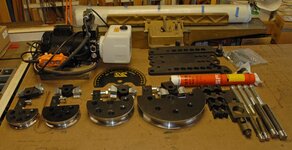
I have multiple roller tubing benders, and some shoe benders for small hydraulic tubing 3/4 and smaller and a jd2 model 32 for larger stuff

While the rollers make the same quality bend without kinks that my shoe benders do, they require significantly less effort to operate due to the reduced friction.

I had a bender with its second axle stake a little lacking. On the Taylor Dunn cart ride out to a machine the axle/roller fell out in my tool bag and the first bend I made was really jacked up. Once I realized that the worker wasn’t in place I reassembled and restaked the axle and continued on without issue.

I did think about that, then I saw this - a very expensive bender for large radius bends. Maybe the double rollers are necessary given the smaller bend radius.
probend-2.jpg
Do you know the brand/model? The pic doesn’t really show enough of the shoe, maybe the front edge is made like a traditional pressure die?

The geometry is also odd for most hand benders. Usually the lever link pivots and the rear following roller are all directly inline on the same radio while bending is taking place. That one for some reason has the roller setting forward of that line?
 

cannuck

Well-known member
Joined
Nov 30, 2021
Messages
4,647
Location
Rural SK
I'll try the nylon one first, since it's already done - I can always make another one out of steel or aluminum. Yes, the inner die is my fixed die; what influence does the OD of the moving die have on things?
The force needed to pull the tube around the inner die will dent the tube inversely in proportion to diameter. There are actually some roller benders that use a straight die that is moved ahead as needed to prevent this denting, but if you can tolerate the deformation of a large round die you should be allright. My bender has a second point of articulation to clamp the rolling die tight to the fixed die, but due to that geometry it limits my rolling die diameter - but I can (make that could, haven't been in production for some time) get by with that bit of deformation.

BTW: I was at our local NAPA/Traction store yesterday and they had a roll or 1/2" Al tube with what looked like 0.064" wall, but they did not know the alloy. It was WAY out of round so I suspect fairly soft. I assume you 6063 stuff is pretty rigid and round?

(on edit) I should have mentioned from a comment somewhere back about what causes tube oval deformation. The rolling die can put a dent in the tube, but it is the tension on the outer part of the bend that pulls the OD flat - as without a mandrel there is nothing to support it to prevent that flattening.
 
Last edited:
OP
P

paulsomlo

Well-known member
Joined
Jul 16, 2013
Messages
3,898
Location
Northern Colorado
Do you know the brand/model? The pic doesn’t really show enough of the shoe, maybe the front edge is made like a traditional pressure die?

The geometry is also odd for most hand benders. Usually the lever link pivots and the rear following roller are all directly inline on the same radio while bending is taking place. That one for some reason has the roller setting forward of that line?
Here's a link to their website: https://probendindustries.com/#!/about
 
OP
P

paulsomlo

Well-known member
Joined
Jul 16, 2013
Messages
3,898
Location
Northern Colorado
The force needed to pull the tube around the inner die will dent the tube inversely in proportion to diameter. There are actually some roller benders that use a straight die that is moved ahead as needed to prevent this denting, but if you can tolerate the deformation of a large round die you should be allright. My bender has a second point of articulation to clamp the rolling die tight to the fixed die, but due to that geometry it limits my rolling die diameter - but I can (make that could, haven't been in production for some time) get by with that bit of deformation.

BTW: I was at our local NAPA/Traction store yesterday and they had a roll or 1/2" Al tube with what looked like 0.064" wall, but they did not know the alloy. It was WAY out of round so I suspect fairly soft. I assume you 6063 stuff is pretty rigid and round?

(on edit) I should have mentioned from a comment somewhere back about what causes tube oval deformation. The rolling die can put a dent in the tube, but it is the tension on the outer part of the bend that pulls the OD flat - as without a mandrel there is nothing to support it to prevent that flattening.
Yes, the 6063 is quite rigid and round. You bring up good points, both you and @Firebrick43, regarding the geometry of the rollers, the links, where the rollers contact the tube, etc.. My first thought was to have no link and just have the lever arm pivot from the center of the fixed die and have the rolling die attached to the lever arm, but I don't know if this is even viable from the standpoint of inserting/removing the tubing and the tubing's OD tolerance. If I use a link, I'm not sure where to position the rolling die
 
OP
P

paulsomlo

Well-known member
Joined
Jul 16, 2013
Messages
3,898
Location
Northern Colorado
That is a "clamping" rolling die similar to what my much larger bender does. You can see how very small the rolling element is - and that would scare me about denting at load point. If there is any way you could get access to one for a test bend would be worth doing.
I would have ordered one of these, since the bend radius was exactly what I needed, but I was quoted $1060.00. There's not much choice in large radius benders for 1/2" tubing - most are of the plumbing variety and 1/2" tube w/1.5" bend radius seems to be standard. I can stand some deformation - the original I'm trying to copy has it's width deformed to about 0.012" over the unbent portion.
 

Firebrick43

Well-known member
Joined
May 12, 2015
Messages
14,112
Location
West central Indiana
Interesting? I have never seen that geometry. All benders I have used have the roller or plain shoe contact inline with the center of the die? I am unsure what to suggest. They certainly have a nice looking product. Maybe with the larger radius the second roller isn't as important as long as its more forward of the bend point as it is with smaller radius bends?


I do think that you won't be disappointed if you do use two rollers, one of the red line and a second more forward like the ridgid bender pic I showed above.


x9x6yq3p.png
 

cannuck

Well-known member
Joined
Nov 30, 2021
Messages
4,647
Location
Rural SK
I do think that you won't be disappointed if you do use two rollers, one of the red line and a second more forward like the ridgid bender pic I showed above.
That tool does NOT have 2 rollers. The center (large) roller is the fixed die. the bolt on the red line is a pivot point for the lever/handle. The ONLY roller is the one and only roller - and coming from someone who designed, built and used the same thing (but MUCH larger) - that roller is too small. Not sure what the "45, R and L" stand for (45 degrees, Right, Left I assume). OP Paul could easily build a similar bender with much larger rolling element.
 

Firebrick43

Well-known member
Joined
May 12, 2015
Messages
14,112
Location
West central Indiana
That tool does NOT have 2 rollers. The center (large) roller is the fixed die. the bolt on the red line is a pivot point for the lever/handle. The ONLY roller is the one and only roller - and coming from someone who designed, built and used the same thing (but MUCH larger) - that roller is too small. Not sure what the "45, R and L" stand for (45 degrees, Right, Left I assume). OP Paul could easily build a similar bender with much larger rolling element.
Thanks Mr Obvious. First time caller, long time listener.

I have only pointed it out twice that it does not have two rollers? I don’t know where you see that I said it did?

I was saying if he was to build his own bender he would not go wrong to use two rollers instead of one
 

cannuck

Well-known member
Joined
Nov 30, 2021
Messages
4,647
Location
Rural SK
Thanks Mr Obvious. First time caller, long time listener.

I have only pointed it out twice that it does not have two rollers? I don’t know where you see that I said it did?

I was saying if he was to build his own bender he would not go wrong to use two rollers instead of one
Sorry about that, posting on run with house full of grandkids. Missed your highlighted text but worth noting having two rollers would accomplish very little. I think I see what you are suggesting (that following roller might contain or re-shape distortion from leading roller) but not sure it would be needed. If it did work the mandrel people would be out of business.
 
OP
P

paulsomlo

Well-known member
Joined
Jul 16, 2013
Messages
3,898
Location
Northern Colorado
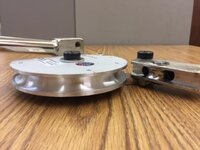
I finally got back to this, here's what I ended up with - I decided to use a single roller, directly inline with the pivot point, and no articulating joint. Everything was fabricated so as to fit the 1/2" tubing very closely. Since I used non-standard thicknesses for the fixed die and the roller, I had to make my own shoulder bolts. I've got the "stop" fixed in place with a clamp, in case it needs moved. One thing that surprised me, was how much force it took - I did have to put a cheater on the aluminum bar and the vise really had to be tightened up to keep the fixed die from rotating. And the shoulder bolt that I made for the roller, bent where it threaded into the aluminum arm (1/4"-20 thread was apparently too small). The original part that I'm trying to replicate is the lower one - the bend is more gradual, smoother; I'm wondering if my bend radius is too small? The copy (upper one) look like it stretched quite a bit; the overall length of the tube gained 1/4". The results are good, but I'd like to get closer to the original - suggestions?
20241023_002523.jpg20241023_002501.jpg20241023_002757.jpg20241023_003813.jpg
 

cannuck

Well-known member
Joined
Nov 30, 2021
Messages
4,647
Location
Rural SK
You didn't measure radius accurately from your master part. The die does have to be slightly smaller (due to spring back) but in your case, you are a LONG way off. You need to measure your newly bent piece very carefully to get a value for spring back then select a new die radius that allows for it. How have you been measuring up to this point?

Also: you have wildly underestimated the need for rigidity. It is not only important for...um...more personal reasons, but worshipped in metal forming and machining. I would like to see your forming (rolling) die a lot larger and the arm holding it and both axles CONSIDERABLY larger. On my rolling bender (same concept as yours) I use a bottom arm and removable top arm so the forming die axle is loaded in shear, not bending. I also use a point of articulation near the main central axle so the force on the moving arms clamps the rolling die tightly to the fixed die.

You are on the right track, just not far enough down it.
 

DAVE94LIGHTNING

Well-known member
Joined
May 24, 2024
Messages
198
I finally got back to this, here's what I ended up with - I decided to use a single roller, directly inline with the pivot point, and no articulating joint. Everything was fabricated so as to fit the 1/2" tubing very closely. Since I used non-standard thicknesses for the fixed die and the roller, I had to make my own shoulder bolts. I've got the "stop" fixed in place with a clamp, in case it needs moved. One thing that surprised me, was how much force it took - I did have to put a cheater on the aluminum bar and the vise really had to be tightened up to keep the fixed die from rotating. And the shoulder bolt that I made for the roller, bent where it threaded into the aluminum arm (1/4"-20 thread was apparently too small). The original part that I'm trying to replicate is the lower one - the bend is more gradual, smoother; I'm wondering if my bend radius is too small? The copy (upper one) look like it stretched quite a bit; the overall length of the tube gained 1/4". The results are good, but I'd like to get closer to the original - suggestions?
20241023_002523.jpg20241023_002501.jpg20241023_002757.jpg20241023_003813.jpg
To keep the die from rotating you can machine two holes across from each other for locating dowels that will prevent it from rotating in the vise. One dowel above the vise jaws and one below.
 
OP
P

paulsomlo

Well-known member
Joined
Jul 16, 2013
Messages
3,898
Location
Northern Colorado
You didn't measure radius accurately from your master part. The die does have to be slightly smaller (due to spring back) but in your case, you are a LONG way off. You need to measure your newly bent piece very carefully to get a value for spring back then select a new die radius that allows for it. How have you been measuring up to this point?

Also: you have wildly underestimated the need for rigidity. It is not only important for...um...more personal reasons, but worshipped in metal forming and machining. I would like to see your forming (rolling) die a lot larger and the arm holding it and both axles CONSIDERABLY larger. On my rolling bender (same concept as yours) I use a bottom arm and removable top arm so the forming die axle is loaded in shear, not bending. I also use a point of articulation near the main central axle so the force on the moving arms clamps the rolling die tightly to the fixed die.

You are on the right track, just not far enough down it.
I traced the original bend onto a piece of paper, both inside and outside radius, then extrapolated in between and used a compass and ruler - but yes, it does look like I'm off quite a bit.

And yes, I did have some doubts about the size of the arm and the axles during construction - but, it's my 1st go 'round as far as bending; can you post a picture of your rolling bender?
 

cannuck

Well-known member
Joined
Nov 30, 2021
Messages
4,647
Location
Rural SK
And yes, I did have some doubts about the size of the arm and the axles during construction - but, it's my 1st go 'round as far as bending; can you post a picture of your rolling bender?
I will have to make a sketch as the arms, handle (that couples the arms) and rolling dies are stored SOMEWHERE at the farm. Shop was sort of storage dump for many years since I had a space in city to work from big enough for semi and trailers. When I retired from that I had to build a 1500 sq.ft. storage shelter to take the excess out of my 1,000 sf shop. Things got burried!
 
To avoid these ads, REGISTER NOW!
Top Bottom