To avoid these ads, REGISTER NOW!

Hex Keys - The Whole Story

Dave455

Well-known member
Joined
Mar 19, 2013
Messages
5,806
Location
Sussex, England
It’s a rainy day here in the U.K. so I decided to write a post I’ve been meaning to write for a while, and write about hex keys.

Now, I know this isn’t the most exciting of topics to some (flip to the next thread if that’s the case) but over the years it’s become apparent that most of the big manufacturers products all offer something different, and there might be a few guys here who can use what I’ve learnt.

Full disclosure here - in my past I’ve worked extensively with machine tools. One of the members here wrote that hex keys are to a machinist what wrenches are to a mechanic. That is so true, and I’ve done that.

I’ve also worked in the defence industry, and that’s an environment which sorts the “wheat from the chaff”. If you’ve got to assemble a hundred widgets with 4 small button head screws, each torqued to a high value, and no way to access with anything other than a ball head hex key, you soon find out what works and what doesn’t.

The early days - British and German

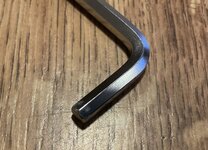
Growing up, I never had my own hex keys, I just used Dad’s. I don’t think he was bothered about the manufacturer, certainly not the way he would have been about a wrench or screwdriver.

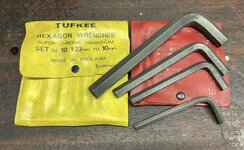
I notice though, that they were all British made, and to the relevant British Standard. That’s important, and was even more so then. Some people will tell you that you’re a “country of origin snob” if you’re bothered about this, and anything can be made to the same standard anywhere. Well, that’s not the case now, and certainly wasn’t then. But If it was British made, it was going to be acceptable.
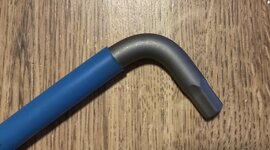
IMG_1810.jpeg

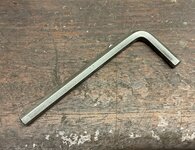
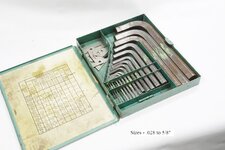
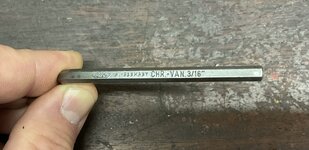
Many of Dad’s hex keys were “Unbrako”. I only realise now, after the passage of many years, how good these tools were. Even heavily used ones show little wear. I still acquire these if I see them used, and have a drawer full of miscellaneous sizes. Sadly, back then even long series were rare, and ball hex unknown, so I seldom find these.
IMG_1811.jpegIMG_1812.jpeg

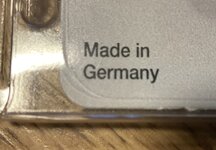
When I came to buy some hex keys for myself, my first need was some small keys to leave by my machines. I bought some “CK” (Carl Kammerling) which is actually a British brand, although many if their tools are made in Germany. The same principle applies. I don’t even know the actual maker of these, but “Made in W.Germany” was all I needed to know.

And I was right. These little keys have had the finish worn off through use, yet still the tips remain good. Quite an advert. I’d have bought a few more sets if I’d known…!
IMG_1813.jpegIMG_1814.jpeg

There’s much more to follow - but bear with me and I’ll break it up into bite size posts.

I know you’re desperate to tell me about your favourite maker, but bear with me and I’ll probably get to them!
 
To avoid these ads, REGISTER NOW!

RoninB4

Well-known member
Joined
Jul 22, 2020
Messages
3,555
Location
Under My House
-There's a few existing threads on this topic already but the Euro perspective, especially on pre-1990 hex keys might be interesting. I also liked the Unbrako (US) brand until I went to work for Eklind.
 

dutchgray

Well-known member
Joined
Sep 28, 2014
Messages
6,467
Location
Dorset. England.
I know old stock Unbrako screws and bolts are highly coveted by those old enough to have used them when they were available, miles better quality than most of what you can get now.
I have some Unbrako hey keys, I to buy used ones when I find them, they are very good quality.

I think my favourite currently available standard length black oxide finish hex key are the French made Facom ones, they can be found quite cheaply and are also decent quality.
 
OP
D

Dave455

Well-known member
Joined
Mar 19, 2013
Messages
5,806
Location
Sussex, England
Growing up - American and Swiss

Bondhus and Eklind


I had been aware for some years of Bondhus. Their “ball hex” drivers were well known from the outset, and a local shop had a big display of them.

Over the years I acquired a good deal of Bondhus, and came to value it’s quality. Although this post is about regular hex keys, I should mention that I’ve found the Bondhus T handle hex keys to be about the best overall. I like the drivers too, but the handles on the smaller sizes are ridiculously small.
IMG_1815.jpeg

So, needing some long hex keys, ideally ball tipped, I set out to get some Bondhus, but found some Eklind on a deal so tried them.

That was a good purchase. Those Eklind sets have lived in my main box ( in fact survived two changes of box ) for decades and have withstood a lot of use. I think the Bondhus would have done so too.
IMG_1816.jpegIMG_1817.jpeg

It’s perhaps a little unfair of me to discuss Bondhus and Eklind in the same paragraph, since I know they are competitors, but from my side of the pond the products are very similar.

They are both incredibly well designed, both very well made, both from very good materials, and both with good quality control. I also have to say that both represent incredibly good value.

Even in the U.K. these tools are priced comparably to tools sourced much closer to home, so there’s really little excuse not to own these.
If you live in the U.S. - there’s no excuse whatsoever!

Bondhus / Eklind are best for value, good for overall quality.

I slightly prefer Bondhus for T Handles, and Eklind for regular keys, but that’s just a slight preference!

P.B. Baumann / PB Swiss.

About that time, I bought a set of ball hex drivers, used, from a local shop. They were from the, then unknown, manufacturer - P.B.Baumann.

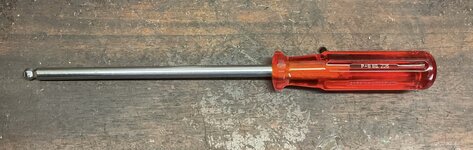
These drivers were typically Swiss (something about the style and finish you get to recognise) and obviously of the highest quality, but I only realised how good with use. I used these drivers an awful lot, and they just didn’t show any wear, I couldn’t believe it.
IMG_1819.jpegIMG_1820.jpeg

I eventually found their U.K. importer and started buying their regular hex keys. The difference in quality between these and anything else was considerable. They were stronger, better fitting, better finished, and seemed almost not to wear.

I’d use one key of my own for assembly work in preference to the boxes of mid grade keys I was supplied and I was never let down.

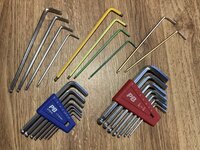
I’ve heard people on this forum describe PB Swiss as a “boutique brand”, obviously thinking that their selling point is their coloured keys, or suchlike.

To do so is to totally misunderstand the product. For a start, they’re not a “brand” they’re a manufacturer - a distinction lost on many.

Their selling point is their quality - evident on close examination, or prolonged use, but they are much more.

Max Baumann, the “big cheese” at PB, told me that they carried out extensive research to find what their customers wanted.

One of the things their customers didn’t want was bent keys - so a PB key will deform elastically to it’s limit, and spring back to it’s original shape. Bent beyond that, it will break, but it won’t deform!

PB keys are also designed to flex by a comparable amount when they reach the limiting torque for a typical fastener. When you get used to using them in assembly you find this is true, and I can assemble 4mm x 0.7 cap screws with a PB hex key just as accurately (probably more so) than some monkey with a torque screwdriver.

Their biggest strength though, is their ability to withstand high repetitive loads. I once had an assembly task that involved inserting button head screws. That had to be torqued up quite tight, but couldn’t be accessed by a regular driver, it had to be a ball tip.

We were eating through Wera bits at a shocking rate, and Wiha drivers did little better. We switched to PB and completed the job (hundreds of units) with no further breakages. They are that good.
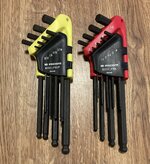
IMG_1821.jpegIMG_1818.jpegIMG_1822.jpegIMG_1823.jpegIMG_1824.jpeg

So, PB Swiss are best for overall quality (and finish) but also very good for the quality of their fit, and the selection available.

They offer short or long keys, standard or ball ended, and I think were the first to offer both the coloured keys, and the short / 100 degree offset.

Somebody will no doubt point out that in some numpty’s hex key test they didn’t take any more of an overload than the next best. Well, firstly they’re not designed to, and secondly, I couldn’t care less - that’s not how I use my tools.
 

General Geoff

Well-known member
Joined
Jan 12, 2013
Messages
3,873
Location
Allentown, Pennsylvania
So, PB Swiss are best for overall quality (and finish) but also very good for the quality of their fit, and the selection available.
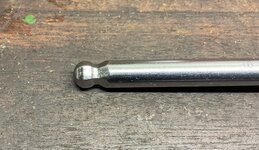
I use PB Swiss knurled L keys every day professionally, and while they are the best ones I've used in general, I do have one pet peeve: the ball will break off of the 1.5mm key specifically, with very little torque applied. Had this happen several times when snugging down small set screws.
20230404_162010.jpg

The taper between ball and shaft (lol) is just a little too narrow I think.

Aside from the 1.5's ball end, the rest have held up to years of daily use with no discernible wear.
 
OP
D

Dave455

Well-known member
Joined
Mar 19, 2013
Messages
5,806
Location
Sussex, England
Wiha and Wera

I hadn’t historically bought any Wiha, despite my favoured supplier keeping Wiha, and offering them at favourable prices.

Nothing against them, but when you’ve got a bench full of Bondhus and Eklind, and a PB Swiss collection second only to the importer, you just don’t have the need. Or do you…?

I came to realise, working with a lot of hex screws, that the tool you need depends on the size. Small sizes are best dealt with by the “flag” style of key. Medium with screwdriver style handles, and large ones with T handles, or even bit sockets.

Each of these tools becomes unsuitable when used outside it’s ideal size range however. Only the original “L” shaped hex key works from the smallest to the largest sizes encountered.

With this in mind, as Torx became more common I wanted some Torx “L” keys, and was slightly disappointed to discover that PB Swiss offered only a limited range, and didn’t include the sizes I sometimes used.

I bought some Wiha, and was pleasantly surprised by the quality, especially from a manufacturer I always thought of as “mid range”.

Nice tools, very sturdy, and I think were one of the first to offer “ball tips” on Torx.
IMG_1837.jpeg

I subsequently bought a lot of Wiha for my company, which was all good.

Note however, that the Wiha I bought was
IMG_1826.jpeg

and as of just recently, they are not.

Sadly, the Polish made keys are not the same quality. They’re not as durable, not as well finished, and I don’t believe the few keys I’ve seen are even made from the same materials. These may be teething troubles, but I suspect it’s more a result of a deliberate decisions by Wiha.

The solution - see above, or see below!

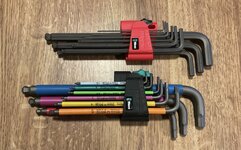
I’d also been monitoring Wera. Their outsourcing, primarily to the Czech Republic, was handled much better, and right from the start all the Czech made tools used first class steel.

I started seeing their hex keys more and more, and acquired a few despite not really needing more hex keys.

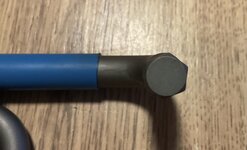
I was pleasantly surprised. Firstly, their (at the time) unique profile isn’t a gimmick - it really does work (though not quite the way Wera say in their advertising).

I got my first set of these for use on screws with damaged heads, but found that the profile works so well it actually avoids damage if you have to deal with soft screws. I really can’t recommend these too highly.

Other things I like

- The quality of the steel and the overall hardness of the tools.

- The fact that, on any but the most inexpensive tools, you actually get an oversized round shank key - something you pay a lot more for from PB Swiss. This gives the tools a very substantial feel. A lot of “heft”

- The variety on offer, particularly the selection in Torx and Stainless steel.

- The subtle variations - for example, the steel Torx keys feature a ball tip, the stainless a straight one. Subtle, but needed, and shows thought about details.

- The price. This side of the pond these are mid price tools. Even if they were not, I’d own at least some.
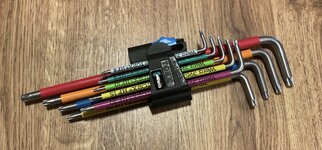
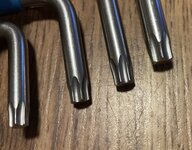
IMG_1828.jpegIMG_1829.jpegIMG_1830.jpegIMG_1831.jpegIMG_1832.jpeg

So, I think Wera are the absolute best for use on damaged screws, and for stainless tools. I think they’re best for Torx too.

They’re good for their selection on offer, durability, and availability.
 
Last edited:
OP
D

Dave455

Well-known member
Joined
Mar 19, 2013
Messages
5,806
Location
Sussex, England
France and Japan

The question that now arises of course, is which of the above is the best fit?

The answer, surprisingly, is none of them. The very best fitting are Facom.

I was told this years ago by an old bloke I worked with. I must admit, that I assumed that Facom was the first good quality hex key he had used, and they were simply good, compared to average.

I also, back then, didn’t know much about Facom, and assumed that their hex keys would be outsourced like most German companies do, and wouldn’t be any better.

A good decade later another mechanic friend told me the same thing about Facom. He was a bike enthusiast - Japanese bike specialist, loads of Japanese tools, yet he insisted on Facom hex keys for seized screws.

He couldn’t be right? Surely not compared to PB Swiss.

I took a few new hex screws, some long hex keys, and measured the “slack” as best I could. The PB are good. Better than most. Waaay ahead of the “generic“ keys, especially when used. But, the Facom, by a tiny frac, appear better.

I cannot tell you why. There is no measurable difference in size. Maybe the corners are a frac sharper, maybe the metal a frac harder, but as far as my unscientific experiments can determine, the fit is tighter. And yes, it shocked me too!

Facom are not flashy - most of their keys are blacked. They’re not pricey either (not here), and they’re not even promoted heavily.

But they are made in France. They’re not outsourced, they’re made in house. And they’re used by a lot of folks who have all the options available.

I don’t know if the same keys are available under other SBD brands. USAG keys are French made so I suspect them to be the same.
IMG_1836.jpeg

So, Facom are the best fit. They’re good on general quality too.

My bike mechanic friend had an awful lot of Vessel. Mostly screwdrivers. If you’re working on 70’s vintage Japanese bikes you really need these for the fit on JIS screws. He had a lot of Vessel hex keys too, which caught my attention.

The striking thing about Vessel, is the variety available. Most manufacturers offer short and long. From Vessel I have seen short, standard length, long and even extra long (one of the few manufacturers to offer these) - and useful for some applications on Japanese bikes I understand.

They’re also quite durable. They don’t have anything like the standard of finish of the PB Swiss, but if you’re changing the brake pads on your BMW rather than assembling some satellite, that doesn’t matter!

I quite like ‘em.
IMG_1835.jpeg

Vessel are best for their variety, and good for durability - particularly the plating.

I’m tempted to end my hex key write up there, but there are rumours of another, as yet untested (by myself) manufacturer…

One that produces hex keys of comparable quality to PB Swiss, comparable fit to Facom, comparable variety to Wera or Vessel (but sadly not comparable price to Bondhus).

I speak of the legend that is … Asahi!

I have only seen these, never used them, but from a first inspection their quality seems incredible.

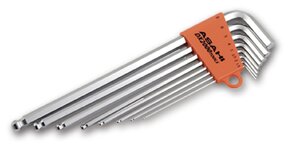
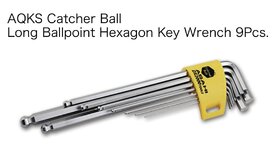
Some of their features, such as their “catcher ball” retainers, are unique. Their short offset “Daxkey” are also impressive, and the version with offset ends unique.

I may need to investigate these, but I really don’t need more hex keys…!
IMG_1840.jpegIMG_1841.jpegIMG_1842.jpeg
 
Last edited:
OP
D

Dave455

Well-known member
Joined
Mar 19, 2013
Messages
5,806
Location
Sussex, England
I use PB Swiss knurled L keys every day professionally, and while they are the best ones I've used in general, I do have one pet peeve: the ball will break off of the 1.5mm key specifically, with very little torque applied. Had this happen several times when snugging down small set screws.
20230404_162010.jpg

The taper between ball and shaft (lol) is just a little too narrow I think.

Aside from the 1.5's ball end, the rest have held up to years of daily use with no discernible wear.
The 1.5mm are particularly difficult.

All my breakage problems were with 2.5 and they were bad enough

With PB you are sacrificing some strength in order to be able to use the keys at the same angles as the other sizes

If that’s not essential it might be worth trying something from another maker who offers slightly more material for a reduced angle.

I might also consider contacting PB. They generally welcome feedback.
Funny thing but I am a hex key hoarder, and I thought unbrako was American made company?


They were originally, but I think became multi national. They produced both screws and hex keys in the U.K. as well as the U.S. The quality of both seems comparable.
 
OP
D

Dave455

Well-known member
Joined
Mar 19, 2013
Messages
5,806
Location
Sussex, England
I know old stock Unbrako screws and bolts are highly coveted by those old enough to have used them when they were available, miles better quality than most of what you can get now.
I have some Unbrako hey keys, I to buy used ones when I find them, they are very good quality.

Yes, they were.

I used to specify them all the time, although historically a lot of other manufacturers were equally good.

By the 90’s it was Unbrako by preference.

I had the good fortune to buy the entire stock of cap and grub screws from an engineering company that was closing down. About 80% are Unbrako.

I sometime find covetous eyes glancing at my stash when I have visitors…
I think my favourite currently available standard length black oxide finish hex key are the French made Facom ones, they can be found quite cheaply and are also decent quality.
See above…!

It’s worth picking up the long ones too.
 
Last edited:

dutchgray

Well-known member
Joined
Sep 28, 2014
Messages
6,467
Location
Dorset. England.
I have a set extra extra long from "Eight" another Japanese option, they seem good but they haven't had anywhere near enough use yet to really know, I mostly use standard length for assembly and the normal long for disassembly when needed.
 
OP
D

Dave455

Well-known member
Joined
Mar 19, 2013
Messages
5,806
Location
Sussex, England
-There's a few existing threads on this topic already but the Euro perspective, especially on pre-1990 hex keys might be interesting. I also liked the Unbrako (US) brand until I went to work for Eklind.
Yes, but I thought I’d share my experiences.

They’re slightly different to others.

Pre 1990 there really were not many options for hex keys this side of the pond. Short or long was about it.

But cap screws and hex head grub screws were only really found on machine tools, and in relatively specialised areas such as firearms and aircraft. In all those cases access had been carefully considered.

I’m not now sure which came first, whether the availability of ball hex tools allowed motor manufacturers to use fasteners that previously could never have been accessed, or whether the tools proliferated because they had to!

I even had to install an oven which couldn’t be fastened in place without a ball tip Torx!

We all appreciate your input on any hex key related topic!
 
Last edited:
OP
D

Dave455

Well-known member
Joined
Mar 19, 2013
Messages
5,806
Location
Sussex, England
I have a set extra extra long from "Eight" another Japanese option, they seem good but they haven't had anywhere near enough use yet to really know, I mostly use standard length for assembly and the normal long for disassembly when needed.
I’m aware of ”Eight” but know nothing about them.

I’d try a set. But Asahi are probably on the list first.
 

KnurledNut

Well-known member
Joined
Jan 28, 2011
Messages
8,130
Location
n/a
While the key quality is most important to getting the job done, lets not forget the storage. Most holders from the top brands are lackluster and some even aggravating in form and function.
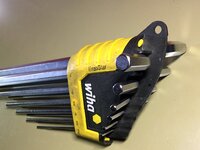
If you have never seen or used the Wiha Ergostar holder, all the keys fan out with the twist of just one, same for closing, and retention is just right.
Why more manufacturers don't put more thought into this detail is beyond me.
54574140985_f987740346_b_d.jpg
 
OP
D

Dave455

Well-known member
Joined
Mar 19, 2013
Messages
5,806
Location
Sussex, England
Without checking I have Hex keys or T handles or Flag drivers from Beta, Belzer, Bondhus, Elkind, Facom, Felo, Eight, Proto, PB Swiss, Wera, Wiha, Unbrako, Vessel.

I have many more sets than I really need.
Sounds like I’m not alone then…

I’ve got a fairly outrageous collection too.

Trouble is, once you start noticing the differences you develop a need for different makes for different purposes.

My partner is very tolerant. I don’t question the price of horse feed, she doesn’t question the need for tools, or cars, or vehicles generally, or aeroplanes, or….
 

dutchgray

Well-known member
Joined
Sep 28, 2014
Messages
6,467
Location
Dorset. England.
Yes, they were.

I used to specify them all the time, although historically a lot of other manufacturers were equally good.

By the 90’s it was Unbrako by preference.

I had the good fortune to buy the entire stock of cap and grub screws from an engineering company that was closing down. Sbout 80% are Unbako

I sometime find covetous eyes glancing at my stash when I have visitors…

See above…!

It’s worth picking up the long ones too.
I was picking up a Bridgeport mill head riser block this week and the seller, a retired engineer had a large stash of Unbrako fastners, which he had kept when he sold up his business, I was quite envious myself as I just have a few boxes myself.

I do have a good stash of old GKN wood screws, in steel, brass, various platings etc, very useful to have around for repairs to old stuff but not a lot of use on new work.
 
OP
D

Dave455

Well-known member
Joined
Mar 19, 2013
Messages
5,806
Location
Sussex, England
While the key quality is most important to getting the job done, lets not forget the storage. Most holders from the top brands are lackluster and some even aggravating in form and function.
If you have never seen or used the Wiha Ergostar holder, all the keys fan out with the twist of just one, same for closing, and retention is just right.
Why more manufacturers don't put more thought into this detail is beyond me.
54574140985_f987740346_b_d.jpg
That’s a very good point, and yes, I was tempted to mention that the Wiha came with the very best holders.

Most of mine come with the plain holders, but the ErgoStar are brilliant.

I’m keeping an eye open for some old stock, but already most retailers realise that the German made tools are worth a premium.

On a bench I tend to store hex keys in a block of wood. The drill index style holders also work well in this environment. For mobile use most of the holders are not bad, but not great either. Anything is better than a vinyl wallet!
 
Last edited:
OP
D

Dave455

Well-known member
Joined
Mar 19, 2013
Messages
5,806
Location
Sussex, England
I was picking up a Bridgeport mill head riser block this week and the seller, a retired engineer had a large stash of Unbrako fastners, which he had kept when he sold up his business, I was quite envious myself as I just have a few boxes myself.

I do have a good stash of old GKN wood screws, in steel, brass, various platings etc, very useful to have around for repairs to old stuff but not a lot of use on new work.
I’ve got probably a “sizeable bookcase“ of entirely Unbrako. About 70% are BSW / BSF sizes, so incredibly useful to me now.

The non Unbrako all seems to be from the same era however, and seems comparable quality. A lot of Holo-Krome and GKN, and a lot of Swedish stuff. The latter is superb.

Yes, I have a lot of Netttlefolds screws - all pretty much irreplaceable now. I had to substitute modern screws in some wooden boxes I was making to an old pattern, and they’re just not the same, but I couldn’t find the quantities of the sizes I needed.

I was told that the Nettlefolds machines are all lying idle. I wouldn’t be surprised.

Some of the modern screws are not too bad, but it’s a different look. I find the regular Spax to be very over rated. Locally I can get Timco and Reisser and I’m happy with both.
 

American Locomotive

Well-known member
Joined
Jan 8, 2017
Messages
10,957
Location
Rhode Island
I use PB Swiss knurled L keys every day professionally, and while they are the best ones I've used in general, I do have one pet peeve: the ball will break off of the 1.5mm key specifically, with very little torque applied. Had this happen several times when snugging down small set screws.
20230404_162010.jpg

The taper between ball and shaft (lol) is just a little too narrow I think.

Aside from the 1.5's ball end, the rest have held up to years of daily use with no discernible wear.
The Wera hex bit sockets have the same problem. They have the ball, which works great for holding fasteners, but the smaller sizes (I want to say maybe <6mm?) will shear off around the rated torque of a grade 12.9 cap screw. The larger sizes were fine. We used to have a few extras of the smaller ones because they broke so often.

It's a shame too, because the hex-plus bits were the best we found for not stripping out the fasteners. The Wera hex keys on the other hand didn't have the ball detent, and were fine. We straight up abused those things with all kinds of cheaters or pipes without issue. Great tools.
 
To avoid these ads, REGISTER NOW!

Steve_P

Well-known member
Joined
Sep 15, 2010
Messages
5,185
While the key quality is most important to getting the job done, lets not forget the storage. Most holders from the top brands are lackluster and some even aggravating in form and function.
If you have never seen or used the Wiha Ergostar holder, all the keys fan out with the twist of just one, same for closing, and retention is just right.
Why more manufacturers don't put more thought into this detail is beyond me.
54574140985_f987740346_b_d.jpg


Yes, this. I have Allen, Ekland, Bondhus..... and they are all just fine. I'm sure all are within a few percent of each other and any other brand. But the typical old school holder is a total PITA to use. I didn't need another set of hex keys, but when I saw the Wiha holder design 10+ years ago, I went all in on them. What I have is the early sliding design of the Wiha holder, replaced by the above, but it's an absolute pleasure to use. No rotating 4 keys out of the way to get the one you need. Nope. Two seconds and done. Sure, these are first world problems, but that's what this forum is all about. These also have the holding spring function on the ball end for the larger sizes.


Wiha_hex_keys.jpg
 

KnurledNut

Well-known member
Joined
Jan 28, 2011
Messages
8,130
Location
n/a
Yes, this. I have Allen, Ekland, Bondhus..... and they are all just fine. I'm sure all are within a few percent of each other and any other brand. But the typical old school holder is a total PITA to use. I didn't need another set of hex keys, but when I saw the Wiha holder design 10+ years ago, I went all in on them. What I have is the early sliding design of the Wiha holder, replaced by the above, but it's an absolute pleasure to use. No rotating 4 keys out of the way to get the one you need. Nope. Two seconds and done. Sure, these are first world problems, but that's what this forum is all about. These also have the holding spring function on the ball end for the larger sizes.


Wiha_hex_keys.jpg
Those German-made Magic Ring keys are well crafted!
54574442603_f4e6b18fc3_b_d.jpg

Another showing retention:
54573351222_cc636bd8b0_b.jpg

Also of interest, the large 950 series Wera (17mm shown) are made completely different than the smaller Wera keys. Lacking hex plus and having a high polish finish versus the satin finish of most others like the 950L (12mm shown).
 
Last edited:

KnurledNut

Well-known member
Joined
Jan 28, 2011
Messages
8,130
Location
n/a
Not sure if they make them or rebrand them, but Tone fitment and finish is good:
54574460893_cda4357eff_b_d.jpg
 

dutchgray

Well-known member
Joined
Sep 28, 2014
Messages
6,467
Location
Dorset. England.
I’ve got probably a “sizeable bookcase“ of entirely Unbrako. About 70% are BSW / BSF sizes, so incredibly useful to me now.

The non Unbrako all seems to be from the same era however, and seems comparable quality. A lot of Holo-Krome and GKN, and a lot of Swedish stuff. The latter is superb.

Yes, I have a lot of Netttlefolds screws - all pretty much irreplaceable now. I had to substitute modern screws in some wooden boxes I was making to an old pattern, and they’re just not the same, but I couldn’t find the quantities of the sizes I needed.

I was told that the Nettlefolds machines are all lying idle. I wouldn’t be surprised.

Some of the modern screws are not too bad, but it’s a different look. I find the regular Spax to be very over rated. Locally I can get Timco and Reisser and I’m happy with both.
Modern screws are faster and work well, many are a bit hard and prone to snapping if used in anything that sees movement, like furniture.
If you need anything specific for a project drop me a PM and I can look to see if I have any, I have a lot of full boxes.

I need quite a bit of BSW/ BSF for my machine tools but usually have to make do with imported as you often can't get anything else when you need them.
 

RoninB4

Well-known member
Joined
Jul 22, 2020
Messages
3,555
Location
Under My House
-A nice write-up comparing different brands and the opinion of the end user. I've been using hex keys every day on the job since 1977 on industrial, military, and consumer goods but that doesn't make me an expert either. While I won't attempt to comment in depth on Euro or Asian brands I do have a few thoughts after reading the write-up:

1) Fitment can depend upon the brand of fastener. The socket opening in set screws and socket head cap screws are not all equal in the different brands, even the hex opening in different cap/head configurations can be different. Yes there are manufacturing tolerances but I've noticed a fitment difference between fastener brands for the same size fastener while working on the same mold/die/machine. I have a few different theories for why this is so but, to me, the "why" is less important than just adapting to what does/doesn't fit. Everybody has different preferences for work methodology, that's ok too. When I encounter a poor fitment for any of the 4 brands of hex keys I use with a fastener I'll replace the fastener when possible. Fastener heads/sockets have limited duty cycles too with repeated install/uninstall and should be considered perishable tooling just like the hex keys.

2) Deform or break? That can largely depend upon the steel and the heat treating process. I've written/typed about this in past threads when I was involved in this decision to lower the hardness (Rc) for the hex keys at Eklind. Deform or break is a personal preference IMO and I don't regard one as being superior to another as there are pros/cons to each. I will admit some disappointment to lowering the hardness at Eklind but there was a specific reason (lawsuit/liability) to the decision. This did spark my preference for Unbrako.

3) Did the ball driver come first or the need for it? Here in the US the only maker of ball drivers was Bondhus by the patent they held for the process of making it. A ball shape was (here in the US) too generic a shape to patent so the process was. Just before the patent ran out a number of industrial supply houses urged Howard Eklind to get in the game due to pricing habits from Bondhus being the only maker of ball drivers in the US. When Eklind developed a different/superior process (with a German machine tool maker) it opened the market for several other makers from Europe and Asia. I witnessed this while on assignment in Germany. Did the tool or the need come first? Here it was always considered a bad design if there wasn't direct access to a fastener that was part of regular maintenance. With the widespread use of CAD programs in the design stage there was really no excuse for hindering access to a fastener. When I was designing machinery I made a habit of creating a model of the wrench needed to check for access and swing. Sometimes it still happens but I mostly consider it a failure of departmental communication or poor design when it happens.

4) The relative strength of a ball driver is a function of the ball shape, neck profile, the steel used, and the heat treating. There are pros/cons for each that determine the outcome. Exploring the limits of any design can yield predictable results.

5) Strictly a personal opinion: The surface finish/coating of a perishable tool like a hex key is money that could have either lowered the price or been put into a functional aspect of the tool. Some people like hex keys to be shiny (chrome) or colored for easy reference and that's fine too, we all have different priorities. I avoid coatings on hex keys, drills, end mills, and other cutters when possible.
 

MushCreek

Well-known member
Joined
Jan 14, 2015
Messages
9,774
Location
Upstate South Carolina
I'll stick with Wera Hex-Plus. After many years of (ab)using them on a daily basis, they hold up. We routinely tightened and loosened them with a cheater pipe, and they just work.
 
OP
D

Dave455

Well-known member
Joined
Mar 19, 2013
Messages
5,806
Location
Sussex, England
I kept waiting for you to name the best or the worst brand.
Well, the point is, there is really no “best” but rather different makers offer the best in different areas.

To pick out the bones,

PB Swiss are the overall best, best finished, and wear the best.

Bondhus / Eklind are best value.

Wera are the best for damaged screws, and if you want stainless.

Facom are the best fit.

Vessel are the best for variety of lengths.

Hunt down older (German made) Wiha, or British / U.S. made Unbrako where you can.

But note that some, as yet untried (Asahi etc), may turn out to be better than any of the above…

So the conclusion is, in best Garage Journal tradition, you need many different options…!
 
OP
D

Dave455

Well-known member
Joined
Mar 19, 2013
Messages
5,806
Location
Sussex, England
The Wera hex bit sockets have the same problem. They have the ball, which works great for holding fasteners, but the smaller sizes (I want to say maybe <6mm?) will shear off around the rated torque of a grade 12.9 cap screw. The larger sizes were fine. We used to have a few extras of the smaller ones because they broke so often.

It's a shame too, because the hex-plus bits were the best we found for not stripping out the fasteners. The Wera hex keys on the other hand didn't have the ball detent, and were fine. We straight up abused those things with all kinds of cheaters or pipes without issue. Great tools.
Asahi put their retaining ball on the ball end of their hex keys

It’s obviously more difficult to do, but one end of the tool is then free from any weakness.

I have quite a few hex bit sockets (in fact that’s probably another whole thread) but am careful with my Wera ones for that reason.
 
OP
D

Dave455

Well-known member
Joined
Mar 19, 2013
Messages
5,806
Location
Sussex, England
-A nice write-up comparing different brands and the opinion of the end user. I've been using hex keys every day on the job since 1977 on industrial, military, and consumer goods but that doesn't make me an expert either. While I won't attempt to comment in depth on Euro or Asian brands I do have a few thoughts after reading the write-up:

1) Fitment can depend upon the brand of fastener. The socket opening in set screws and socket head cap screws are not all equal in the different brands, even the hex opening in different cap/head configurations can be different. Yes there are manufacturing tolerances but I've noticed a fitment difference between fastener brands for the same size fastener while working on the same mold/die/machine. I have a few different theories for why this is so but, to me, the "why" is less important than just adapting to what does/doesn't fit. Everybody has different preferences for work methodology, that's ok too. When I encounter a poor fitment for any of the 4 brands of hex keys I use with a fastener I'll replace the fastener when possible. Fastener heads/sockets have limited duty cycles too with repeated install/uninstall and should be considered perishable tooling just like the hex keys.

2) Deform or break? That can largely depend upon the steel and the heat treating process. I've written/typed about this in past threads when I was involved in this decision to lower the hardness (Rc) for the hex keys at Eklind. Deform or break is a personal preference IMO and I don't regard one as being superior to another as there are pros/cons to each. I will admit some disappointment to lowering the hardness at Eklind but there was a specific reason (lawsuit/liability) to the decision. This did spark my preference for Unbrako.

3) Did the ball driver come first or the need for it? Here in the US the only maker of ball drivers was Bondhus by the patent they held for the process of making it. A ball shape was (here in the US) too generic a shape to patent so the process was. Just before the patent ran out a number of industrial supply houses urged Howard Eklind to get in the game due to pricing habits from Bondhus being the only maker of ball drivers in the US. When Eklind developed a different/superior process (with a German machine tool maker) it opened the market for several other makers from Europe and Asia. I witnessed this while on assignment in Germany. Did the tool or the need come first? Here it was always considered a bad design if there wasn't direct access to a fastener that was part of regular maintenance. With the widespread use of CAD programs in the design stage there was really no excuse for hindering access to a fastener. When I was designing machinery I made a habit of creating a model of the wrench needed to check for access and swing. Sometimes it still happens but I mostly consider it a failure of departmental communication or poor design when it happens.

4) The relative strength of a ball driver is a function of the ball shape, neck profile, the steel used, and the heat treating. There are pros/cons for each that determine the outcome. Exploring the limits of any design can yield predictable results.

5) Strictly a personal opinion: The surface finish/coating of a perishable tool like a hex key is money that could have either lowered the price or been put into a functional aspect of the tool. Some people like hex keys to be shiny (chrome) or colored for easy reference and that's fine too, we all have different priorities. I avoid coatings on hex keys, drills, end mills, and other cutters when possible.
All top info as usual!

Yes, there’s a lot of variation among fasteners. I work on a lot of older machines, and the fasteners on those are often the very best.

Modern ones can be a bit “hit or miss”. I’ve bought cap screws (and not the cheapest) that wouldn't even fit the pre machined counterbores.

I find that I seldom have access problems on machine tools, or tooling. Vehicles are a different matter.

Sometimes I need something specialised, maybe a ball hex or a short bit in a bit driver, to save me having to remove a lot of parts before getting to the one I need.

Sometimes, an extra short, ball tipped, universal, bit socket is the only tool that fits and you wonder what on earth the designer was thinking…!

I once encountered a Fiat that had a couple of fasteners torqued up, then a panel glued over the top, so maybe some things are just not intended to be serviceable. In this case, that was most of the vehicle…
 
OP
D

Dave455

Well-known member
Joined
Mar 19, 2013
Messages
5,806
Location
Sussex, England
Modern screws are faster and work well, many are a bit hard and prone to snapping if used in anything that sees movement, like furniture.
If you need anything specific for a project drop me a PM and I can look to see if I have any, I have a lot of full boxes.

That’s appreciated!

Generally, with anything new, I just put new screws on. If you’re careful you can get them to look o.k.

I’ve had a couple of applications where I needed to duplicate an original screw, but they were so specialised I’ve pretty much given up!
I need quite a bit of BSW/ BSF for my machine tools but usually have to make do with imported as you often can't get anything else when you need them.
Feel free to drop me a PM too.

I’ve got stuff sorted by thread form and size, so it doesn’t generally take me long to check, certainly as regards cap screws and grub screws.
 

RoninB4

Well-known member
Joined
Jul 22, 2020
Messages
3,555
Location
Under My House
I once encountered a Fiat that had a couple of fasteners torqued up, then a panel glued over the top, so maybe some things are just not intended to be serviceable. In this case, that was most of the vehicle…
-Must have been that "finished" look that came from the Design Studio department. When in doubt put a panel over it. I've similar experiences with domestic/imported vehicles (2 and 4 wheel) that add a whole new perspective to the task at hand. Thank you for your write-up and the ensuing discussion that followed.
 

MushCreek

Well-known member
Joined
Jan 14, 2015
Messages
9,774
Location
Upstate South Carolina
I try to never torque down screws with the ball end. I use it to run the screw in quickly, but not so much for high torque tightening and loosening. I have a set of plain-end hex keys for those cases where the short arm won't reach.
 

YesIHaveAHammer

Well-known member
Joined
Jun 1, 2025
Messages
825
Great wisdom in this thread.

I came to realise, working with a lot of hex screws, that the tool you need depends on the size. Small sizes are best dealt with by the “flag” style of key. Medium with screwdriver style handles, and large ones with T handles, or even bit sockets.

Each of these tools becomes unsuitable when used outside it’s ideal size range however. Only the original “L” shaped hex key works from the smallest to the largest sizes encountered.

I chose a set of T-shaped P-handles with straight long ends (Unior 193HX) a couple of years ago, to complement a set of plain L keys with ball long ends.

In 2mm this general form of driver is unnecessary, but for me not worth deviating from a matching set. In 8mm I'd rather have an L key with a comfort handle due to the torque required for pedals and there being plenty of clearance to spin, but again not worth deviating given the frequency of that task for me. In the 2.5-6mm range, they work well - I appreciate the straight long end when spinning in/out bolts made of soft material or possibly stiff due to threadlock.
 
Last edited:

cannuck

Well-known member
Joined
Nov 30, 2021
Messages
4,624
Location
Rural SK
I have mostly Bondhus for ball end, but my pet peeve is hex socket bits. I have suffered with reasonable service with a few brands, but when faced with really silly overtorque for stuck fasteners, my go to is Proto. I have 5/8 UNC SHCS punch clamping bolts in my press brake and they get horribly stuck. I have had 2 x 200 lb adult males applying max force on the 2 sides of a 3/4 tee handle with cheaters. The 1/2 x 1/2 Proto socket held up while breaking 3/4 x 1/2 impact adapter and on another bending the T bar handles No other tool I have found can do that. My biggest disappointment is that nobody seems to make a 3/4 drive 1/2 in bit
 
OP
D

Dave455

Well-known member
Joined
Mar 19, 2013
Messages
5,806
Location
Sussex, England
My biggest disappointment is that nobody seems to make a 3/4 drive 1/2 in bit
Always difficult.

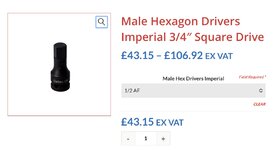
When you get to 3/4 drive less manufacturers offer bit sockets, the European ones tend to offer them in metric only, and the U.S. ones tend to view 1/2 inch as a bit small for 3/4 drive.

But panic not - there’s an island between the U.S. and Europe that makes all sorts of obscure things - Deltec in the U.K. offer these.

Reasonably priced too!
IMG_1843.jpeg
 
To avoid these ads, REGISTER NOW!
Top Bottom