To avoid these ads, REGISTER NOW!

Whole Home Surge KA level?

Cruzan80

Well-known member
Joined
Jul 22, 2015
Messages
4,304
Location
Denver, CO
I was talking with my wife about adding one of these as I clean out and re-space breakers (we had electric baseboard previously, so lots of unused breakers now and the baseboards also caused a ton of tandems to be installed to make things fit). Plan is to eliminate as many tandems as possible. Look at my options, there is an Eaton (matches panel type/breakers) that does 18kA that is a "drop-in" 2-space breaker (with a neutral wire) for about $80, or I see they make standalones in NEMA 4 enclosures that have up to 200kA+ of surge protection, but are a $400+ plus in cost.

How much is good enough vs overkill? Right now, we have most of the home electronics on surge protectors or UPS, and I haven't had an issue with losing anything. In Colorado, overhead power lines to the house due to land (we have about 8.5 acres). So lightning would theoretically have to either come up the grounding wire (very tired when I wrote this part, ignore please), or hit a pole? If I go this route, I will probably only keep UPS on the computers/NAS to avoid outages. If it matters (not sure why it would), it is an outdoor panel and this would be going in the main panel, not a subpanel (there is a subpanel off of the main downstream).

Or is this one of those where I put in the 18kA, and if it fries in the next few years, splurge for a higher capacity one? We are running 5G home internet, so no phone/Ethernet from outside to worry about either. It is all self-contained. The line from the main to the sub is buried in conduit.

I understand generally how these work, in that the higher capacity ones have more room to take surges over time, vs worrying about really being a huge number all at once. Current plan is to source from a known supplier (Electrical supply and HD for the "drop-in" are within $2 of each other, Amazon is up to 50% lower, which is a red flag to me for something like this).

The other part of this is that from what I can tell, downstream equipment size doesn't really matter for sizing these (regarding how large the service overall is, or how many larger (30A+ 240V) breakers are downstream). Can someone trustworthy confirm?

Lastly, I know the relative merits/quality of different panel manufacturers. This is what I have installed, and it isn't worth the money for me to swap the entire panel for what it does. I haven't had any issues, so please only recommend things that fit this, or are universal (example: telling me that SQ makes a 25kA drop-in version for cheaper isn't helpful in this case).
 
Last edited:
To avoid these ads, REGISTER NOW!

kbuhagiar

Well-known member
Joined
Dec 27, 2005
Messages
1,759
Location
Escondido, CA
I was talking with my wife about adding one of these as I clean out and re-space breakers (we had electric baseboard previously, so lots of unused breakers now and the baseboards also caused a ton of tandems to be installed to make things fit). Plan is to eliminate as many tandems as possible.
Just curious, is there anything inherently wrong with tandem breakers?
Or any advantage to conventional breakers vs. tandems?
 
OP
C

Cruzan80

Well-known member
Joined
Jul 22, 2015
Messages
4,304
Location
Denver, CO
For me, it is also about trying to clear out a mess of old abandoned wiring. If I take that wiring out, I am either going to be left with orphaned breakers (from the baseboard heating), open spaces in the dead-front (from the breakers I take out), or I can swap them over to non-tandems to make sure the deadfront is fully occupied. So I don't know if there is a "need" to get rid of tandems from a safety perspective (as long as the panel is rated correctly for them, correct breakers used, etc), but rather for a cleaner look as part of other work I am doing. I am not an expert, so if one of our electricians knows better, please correct me.

And the reason I am taking out the wiring is because the deadfront can almost not close due to the bundles of wiring back there (a decent percentage of which is now abandoned). So I will be clearing it out, re-labeling wires to help if I need to do further work, routing wires cleaner, etc.
 

DrinkMan

Well-known member
Joined
Sep 13, 2020
Messages
1,252
Location
Georgia, USA
FWIW: I don't remember what capacity we had an electrician install (external standalone) but the logic we used was simple - in a previous house, a power surge wiped out a garage door opener (one of those roving code not-cheap ones). And a neighbor lost a refrigerator. Neither our refrigerator nor our garage door openers had dedicated surge protectors. So, we decided to spend the bucks up front on a good surge protector rather than deal with having those appliances die. At our previous house, after the storm that wiped out our opener and our neighbors refrigerator we bought some appliance surge protectors. But this house has 4 openers and 3 refrigerators and I like having the whole house protected. Too many devices have sensitive electronics these days.
 
OP
C

Cruzan80

Well-known member
Joined
Jul 22, 2015
Messages
4,304
Location
Denver, CO
Thanks @DrinkMan, from what I have seen the standalones start at about 50-100kA, and can go up from there. Not saying they don't make ones that are around the same 18kA as the "drop-in" option for mine, just for name-brands it seems like they start with a higher capacity (and price tag).

My thinking is the same as yours, just trying to find the correct balance/level of protection.
 

mm08822

Well-known member
Joined
Jan 13, 2012
Messages
6,052
Location
NJ
Just curious, is there anything inherently wrong with tandem breakers?
Or any advantage to conventional breakers vs. tandems?
Circuits that are highly loaded (near the cb over-current rating) may occasionally trip due to their proximity with other similarly loaded cbs. That means lots of conditions are needed to generate enough heat to cause a premature trip. (Rare!)

It is not a common issue and I would not change them out just because.

Only other thing is the handles are 1/2 the size of full size. Personal dexterity may be an issue with this, but a minor inconvenience.

I buy full size cbs when there are no other constraints affecting number of open cb positions in the panel needed.

Likewise, I have put existing circuits on tandems to make room for additional cbs. I will try to combine "low load/usage" circuits if/when obvious.
 

mm08822

Well-known member
Joined
Jan 13, 2012
Messages
6,052
Location
NJ
Thanks @DrinkMan, from what I have seen the standalones start at about 50-100kA, and can go up from there. Not saying they don't make ones that are around the same 18kA as the "drop-in" option for mine, just for name-brands it seems like they start with a higher capacity (and price tag).

My thinking is the same as yours, just trying to find the correct balance/level of protection.
The drop-in style is good for a flush panel installation. Try to locate it as close to the main cb/incoming feed as possible. Purchase with the highest Joule rating as possible.

Same for the externally mounted type except additionally trim the connecting leads.

Joule rating is where the smoke and mirrors start. No one knows what energy level the next lightning strikes will provide. However, a higher rating seems logical that it will absorb more energy at the time of a hit and your load will see less of it. It could also have more internal headroom to remain functional for the next hit.
Buy as large as you can afford balanced against what you are protecting.

Also, keep using localized surge protection, for example, Isobar power straps.

Make sure your incoming phone and cable lines are properly protected, too.
 

mm08822

Well-known member
Joined
Jan 13, 2012
Messages
6,052
Location
NJ
I was talking with my wife about adding one of these as I clean out and re-space breakers (we had electric baseboard previously, so lots of unused breakers now and the baseboards also caused a ton of tandems to be installed to make things fit). Plan is to eliminate as many tandems as possible. Look at my options, there is an Eaton (matches panel type/breakers) that does 18kA that is a "drop-in" 2-space breaker (with a neutral wire) for about $80, or I see they make standalones in NEMA 4 enclosures that have up to 200kA+ of surge protection, but are a $400+ plus in cost.

How much is good enough vs overkill? Right now, we have most of the home electronics on surge protectors or UPS, and I haven't had an issue with losing anything. In Colorado, overhead power lines to the house due to land (we have about 8.5 acres). So lightning would theoretically have to either come up the grounding wire, or hit a pole? If I go this route, I will probably only keep UPS on the computers/NAS to avoid outages. If it matters (not sure why it would), it is an outdoor panel and this would be going in the main panel, not a subpanel (there is a subpanel off of the main downstream).

Or is this one of those where I put in the 18kA, and if it fries in the next few years, splurge for a higher capacity one? We are running 5G home internet, so no phone/Ethernet from outside to worry about either. It is all self-contained. The line from the main to the sub is buried in conduit.

I understand generally how these work, in that the higher capacity ones have more room to take surges over time, vs worrying about really being a huge number all at once. Current plan is to source from a known supplier (Electrical supply and HD for the "drop-in" are within $2 of each other, Amazon is up to 50% lower, which is a red flag to me for something like this).

The other part of this is that from what I can tell, downstream equipment size doesn't really matter for sizing these (regarding how large the service overall is, or how many larger (30A+ 240V) breakers are downstream). Can someone trustworthy confirm?

Lastly, I know the relative merits/quality of different panel manufacturers. This is what I have installed, and it isn't worth the money for me to swap the entire panel for what it does. I haven't had any issues, so please only recommend things that fit this, or are universal (example: telling me that SQ makes a 25kA drop-in version for cheaper isn't helpful in this case).
Leave the tandems alone. They aren't hurting anything. The 2p30s can remain as spares until you need the space for a new purpose.

Clean up the panel if needed. Maybe re-order cb positions if you must.

Not every heater circuit cable must be torn out. They make for new circuits w/o having to run new cable. Can easily connect 12/14 ga onto the #10 and continue on with new wiring.
 

dave*99

Well-known member
Joined
May 5, 2009
Messages
4,281
Location
Coastal NJ
I am either going to be left with orphaned breakers (from the baseboard heating), open spaces in the dead-front (from the breakers I take out),
There are brand specific covers should you need them. I'd leave unused breakers in the panel instead of open holes.

1754403227741.png
 

Attachments

  • 1754402412041.png
    1754402412041.png
    294.5 KB · Views: 7
Last edited:
OP
C

Cruzan80

Well-known member
Joined
Jul 22, 2015
Messages
4,304
Location
Denver, CO
What grounding wire are you referring to?
My tired-ness. Thinking again, what I wrote made no sense.

Edit post coffee: For some reason, I was thinking that I needed to be worried if somehow the lighting hit the top of the grounding rod, and would flow back up into the house. Completely ignoring the part where A) It would take the easiest path, which wouldn't include the house and B) there is only one wire from the panel to the grounding rod, so it couldn't complete the loop if it went "up" to the panel, as there wouldn't be a way "down).
 
Last edited:
OP
C

Cruzan80

Well-known member
Joined
Jul 22, 2015
Messages
4,304
Location
Denver, CO
Glad to see, in true GJ fashion, we have headed out on a tangent from the original question. Going to try and respond to as many as I can, apologies if I miss you. TL: DR I know I don't have to do anything with tandems safety-wise, there are options to leave them or fill empty spaces, but may end up swapping for a "cleaner" panel, and easier for my wife to handle.

@wyliesdiesels , I edited my response above to you after coffee. Please ignore that part of the OP, wasn't thinking clearly (and struck it from the OP, so as not to confuse others later).

The drop-in style is good for a flush panel installation. Try to locate it as close to the main cb/incoming feed as possible. Purchase with the highest Joule rating as possible.
As far as I can tell, there are only two possible options for a flush install (vs a universal installed behind the dead-front). Both have the same level of protection, one is for legacy installs with a neutral pigtail and the other is for PON panels.
Joule rating is where the smoke and mirrors start. No one knows what energy level the next lightning strikes will provide. However, a higher rating seems logical that it will absorb more energy at the time of a hit and your load will see less of it. It could also have more internal headroom to remain functional for the next hit.
Buy as large as you can afford balanced against what you are protecting.
Thanks. This is kind of the heart of the question for now. I am thinking if I have been fine for 7+ yrs here, that starting with a 18kA drop in version will be a good start (and if it dies quickly, to upgrade afterwards). Trying not to overbuy, just on the off-chance.

Not every heater circuit cable must be torn out. They make for new circuits w/o having to run new cable. Can easily connect 12/14 ga onto the #10 and continue on with new wiring.
I see what you are saying, and maybe I worded things wrong to start. The plan is to cut most of the wiring close to the entrance to the breaker box (so if required, I could still tie into it). Not pull the cable out of the wall, but leave as much room in the box as I can. The other end in the house for all of these have had j-boxes installed, and solid covers to close them off. However, there is a very very low possibility I would need to reuse these, as most of them have outlets and such already installed very close to the old heaters.

Clean up the panel if needed. Maybe re-order cb positions if you must.
Is there any real reason to only re-order CB positions if I must (besides labor cost, which in this case is free aka. me)?

There are brand specific covers should you need them. I'd leave unused breakers in the panel instead of open holes.
^^^This. Just mark the unused breakers 'VACANT' and leave them switched off.

Thanks, didn't realize the covers were brand specific vs generic (probably would have realized when I shopped for them). If it was the shop, I would happily leave unused breakers, but partially want to make "cleaner" and easier to tell what is going on for my wife. I understand there is not a safety issue here, but rather an appearance one.
 

mm08822

Well-known member
Joined
Jan 13, 2012
Messages
6,052
Location
NJ
Glad to see, in true GJ fashion, we have headed out on a tangent from the original question. Going to try and respond to as many as I can, apologies if I miss you. TL: DR I know I don't have to do anything with tandems safety-wise, there are options to leave them or fill empty spaces, but may end up swapping for a "cleaner" panel, and easier for my wife to handle.

@wyliesdiesels , I edited my response above to you after coffee. Please ignore that part of the OP, wasn't thinking clearly (and struck it from the OP, so as not to confuse others later).


As far as I can tell, there are only two possible options for a flush install (vs a universal installed behind the dead-front). Both have the same level of protection, one is for legacy installs with a neutral pigtail and the other is for PON panels.

Thanks. This is kind of the heart of the question for now. I am thinking if I have been fine for 7+ yrs here, that starting with a 18kA drop in version will be a good start (and if it dies quickly, to upgrade afterwards). Trying not to overbuy, just on the off-chance.


I see what you are saying, and maybe I worded things wrong to start. The plan is to cut most of the wiring close to the entrance to the breaker box (so if required, I could still tie into it). Not pull the cable out of the wall, but leave as much room in the box as I can. The other end in the house for all of these have had j-boxes installed, and solid covers to close them off. However, there is a very very low possibility I would need to reuse these, as most of them have outlets and such already installed very close to the old heaters.


Is there any real reason to only re-order CB positions if I must (besides labor cost, which in this case is free aka. me)?


Thanks, didn't realize the covers were brand specific vs generic (probably would have realized when I shopped for them). If it was the shop, I would happily leave unused breakers, but partially want to make "cleaner" and easier to tell what is going on for my wife. I understand there is not a safety issue here, but rather an appearance one.
I meant flush panel enclosure install vs surface mount install.
There are external SPs that install through a ko in the side wall.
PON style might be better but that's only a choice if your panel is of that design.

Don't trim the wires back so only nubs exist. If you do, some day, somebody will curse you out and you will hear them no matter where you are.
Take a pic with the cover off and post.

Re-ordering cbs if you wish, not my suggestion or any need to. I would rather the legend be correct.
Mark the unused cbs as spare. That should be self explanatory and further supports an accurate legend.
 
OP
C

Cruzan80

Well-known member
Joined
Jul 22, 2015
Messages
4,304
Location
Denver, CO
If I re-order, I will print and replace the legend to match.

I will try and find a pic with the cover off, so people can see what I am dealing with.
 

dave*99

Well-known member
Joined
May 5, 2009
Messages
4,281
Location
Coastal NJ
I put 25kA plug on types into some panels. To my knowledge, there have been no issues. Years ago I helped several people recover from nearby lighting strikes. Garage door openers always seemed to go first. This was before whole house SPDs were common.

When I did my house, I spoke to the manager of distribution engineering at my POCO. We have overhead distribution and I'm near the coast. In case anyone cares.

He recommended I go bigger. So I used the Square D HEPD 80. Connected to a 2 pole breaker. They sell an optional flush mount kit and trim for it should you need it. I've had it for 5 years. No issues to date.

1754409881836.png
 
OP
C

Cruzan80

Well-known member
Joined
Jul 22, 2015
Messages
4,304
Location
Denver, CO
Thanks, Dave. Those numbers and experience of protection are what I was hoping to hear. Does the SqD a "universal" SP (the wires attach to a breaker that matches the panel)? It appears so from here.

Did the manager at the POCO give any specific reason to go bigger, or simply the same idea of "It will last longer, bigger reservoir, etc"?
 

rlitman

Well-known member
Joined
Oct 18, 2010
Messages
24,662
Location
Long Island
...Edit post coffee: For some reason, I was thinking that I needed to be worried if somehow the lighting hit the top of the grounding rod, and would flow back up into the house. Completely ignoring the part where A) It would take the easiest path, which wouldn't include the house and B) there is only one wire from the panel to the grounding rod, so it couldn't complete the loop if it went "up" to the panel, as there wouldn't be a way "down).
Unfortunately, that's neither how current nor lightning work.

If, for some reason you were to get a direct lightning strike on the top of the ground rod, the current would most certainly travel up your ground wire to your neutral bus. That's because the resistance of the rod to the ground is probably greater than 50 ohms, while the resistance of your neutral back to the grid is only a fraction of an ohm. And anyway, current follows ALL paths, not just the path of least resistance. It just follows them all with proportionality to their resistance, so the least resistant path will get the bulk of the current, but when 1% of a lightning strike current is still plenty of power to fry things, it doesn't really matter.

For the purposes of your original question, the best protection you can get is always an SPD that plugs directly into the panel bus. Every inch of wire away from that makes things worse. A foot of wire on a universal SPD can let by hundreds of volts before the SPD has the chance to react. That's because the voltage on the panel bus rises those hundreds of volts WHILE the surge slowly travels up those wires to the protective device.

Don't worry about kA values. A higher kA rating may indeed be necessary in a larger panel (such as a commercial environment), but in a plug-in type SPD, you can rest assured that the manufacturer spec'd out "enough" for your needs. More than that does not offer "more" protection, even if it may be longer lasting. Longer lasting doesn't eliminate failure. You still need to regularly check the status lights to be sure it's still working (I'd also give it a feel and see if it's unusually warm, and listen for unusual buzzing, because dark status lights aren't always the first sign of failure)
 
OP
C

Cruzan80

Well-known member
Joined
Jul 22, 2015
Messages
4,304
Location
Denver, CO
I get that it travels all paths, but how would it complete a circuit to flow "up" to the panel? Would it try and travel out thru the meter to "complete" a circuit?

I also didn't mention the part where lightning hitting the few inches of rod exposed vs the 30+' high house, a tree, power pole, etc would be statistically almost nil from an elevation standpoint.

Thanks for the reassurance that the "standard" drop in level is sufficient. That was my thought, and the local Electric supply said he sells 10:1 of these vs a higher stand-alone.
 

dave*99

Well-known member
Joined
May 5, 2009
Messages
4,281
Location
Coastal NJ
Thanks, Dave. Those numbers and experience of protection are what I was hoping to hear. Does the SqD a "universal" SP (the wires attach to a breaker that matches the panel)? It appears so from here.

Did the manager at the POCO give any specific reason to go bigger, or simply the same idea of "It will last longer, bigger reservoir, etc"?
Yes it connects to a 20 or 30A 2 pole breaker matching the panel.

The engineer was not specific on how he arrived at the value.

Here is a prior thread on this topic.

 
To avoid these ads, REGISTER NOW!

dave*99

Well-known member
Joined
May 5, 2009
Messages
4,281
Location
Coastal NJ
Unfortunately, that's neither how current nor lightning work.

If, for some reason you were to get a direct lightning strike on the top of the ground rod, the current would most certainly travel up your ground wire to your neutral bus. That's because the resistance of the rod to the ground is probably greater than 50 ohms, while the resistance of your neutral back to the grid is only a fraction of an ohm. And anyway, current follows ALL paths, not just the path of least resistance. It just follows them all with proportionality to their resistance, so the least resistant path will get the bulk of the current, but when 1% of a lightning strike current is still plenty of power to fry things, it doesn't really matter.

For the purposes of your original question, the best protection you can get is always an SPD that plugs directly into the panel bus. Every inch of wire away from that makes things worse. A foot of wire on a universal SPD can let by hundreds of volts before the SPD has the chance to react. That's because the voltage on the panel bus rises those hundreds of volts WHILE the surge slowly travels up those wires to the protective device.

Don't worry about kA values. A higher kA rating may indeed be necessary in a larger panel (such as a commercial environment), but in a plug-in type SPD, you can rest assured that the manufacturer spec'd out "enough" for your needs. More than that does not offer "more" protection, even if it may be longer lasting. Longer lasting doesn't eliminate failure. You still need to regularly check the status lights to be sure it's still working (I'd also give it a feel and see if it's unusually warm, and listen for unusual buzzing, because dark status lights aren't always the first sign of failure)

I would add that this phenomenon is due to lightning strikes containing high frequency energy. Significantly greater levels of high frequency energy will travel on low inductance paths. Locating the protection in the right place (as you stated) is important.

But just as the leads on a pigtailed SPD add inductance and slow the response of the SPD - the branch circuit wires have the same effect. The high frequency energy sees significant inductance on its way to your television etc.
 

larry4406

Well-known member
Joined
Jan 27, 2006
Messages
19,562
Location
Northern Virginia
I am not a sparky so flame me now for wading into this....

I read thru the attached IEEE guide (2005, so 20 years old.....) to try to educate myself before I went on my surge protection journey.

Section 2.2.2 talks about Surge Current kA ratings (pdf Page 27, document page 18).
1754420717580.png

My 200A main panel is a Cutler Hammer CH. I recently installed a CHN250SUR which is a combination surge protector and breaker. It is a 2-pole 240V50A breaker and I installed in space 1/3 adjacent the main breaker. It also feeds the range. It has a surge current capacity rating of 36 kA per phase so low-mid range of the Residential (20-70 kA) recommendation of the IEEE guide. But its directly connected to the bus with a short lead to the ground bar which I understand is best.

About 3 weeks back my pumped septic controls were smoked. Second time in 3 years - this time just the floats were fried ($680), last time the entire digital controller and ultrasonic level sensor fried ($4k). So this time I installed a Square D HEPD80 on my 4-wire feed exterior septic sub-panel attached to the house which has a 80 kA rating (high lightning range) and this is connected to a 2-pole 20A breaker (instructions say 30A max, but no min.....). I connected it to spaces 1/3 which is as close to the main lugs as I can get it.

At my outdoor heat pump unit, I installed an Intermatic AG3000 with a 20kA rating directly connected to L1, L2, and G on the line side of the disconnect using proper wire nuts and not double tapping. This is at the bottom (low) end of the recommended residential range per the IEEE guide.

I still need to do the basement sub-panel and the detached barn sub-panel.

There are also other competing ratings to be compared but my head started to swirl when I dove into those (MCOV, VPR, SCCR, etc).
 

Attachments

  • IEEE_Guide.pdf
    1 MB · Views: 4

dave*99

Well-known member
Joined
May 5, 2009
Messages
4,281
Location
Coastal NJ
I am not a sparky so flame me now for wading into this....

I read thru the attached IEEE guide (2005, so 20 years old.....) to try to educate myself before I went on my surge protection journey.

Section 2.2.2 talks about Surge Current kA ratings (pdf Page 27, document page 18).
1754420717580.png

My 200A main panel is a Cutler Hammer CH. I recently installed a CHN250SUR which is a combination surge protector and breaker. It is a 2-pole 240V50A breaker and I installed in space 1/3 adjacent the main breaker. It also feeds the range. It has a surge current capacity rating of 36 kA per phase so low-mid range of the Residential (20-70 kA) recommendation of the IEEE guide. But its directly connected to the bus with a short lead to the ground bar which I understand is best.

About 3 weeks back my pumped septic controls were smoked. Second time in 3 years - this time just the floats were fried ($680), last time the entire digital controller and ultrasonic level sensor fried ($4k). So this time I installed a Square D HEPD80 on my 4-wire feed exterior septic sub-panel attached to the house which has a 80 kA rating (high lightning range) and this is connected to a 2-pole 20A breaker (instructions say 30A max, but no min.....). I connected it to spaces 1/3 which is as close to the main lugs as I can get it.

At my outdoor heat pump unit, I installed an Intermatic AG3000 with a 20kA rating directly connected to L1, L2, and G on the line side of the disconnect using proper wire nuts and not double tapping. This is at the bottom (low) end of the recommended residential range per the IEEE guide.

I still need to do the basement sub-panel and the detached barn sub-panel.

There are also other competing ratings to be compared but my head started to swirl when I dove into those (MCOV, VPR, SCCR, etc).

Wow, turns out I know one of the authors for many years. He lives in Florida (lots of lightning) I could ask his opinion - or look at:

Page 19 states:

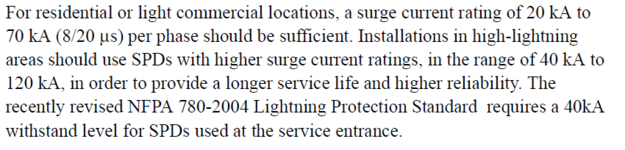
"The authors recommend a minimum surge current rating of 20 kA to 70 kA (8/20 µs) per phase for SPDs to be used in residential or light commercial service in low or moderate lightning areas. For houses in lightning-prone areas, or with severe exposure, higher surge current ratings in the range of 40 kA to 120 kA should be specified."
 

mm08822

Well-known member
Joined
Jan 13, 2012
Messages
6,052
Location
NJ
I am not a sparky so flame me now for wading into this....

I read thru the attached IEEE guide (2005, so 20 years old.....) to try to educate myself before I went on my surge protection journey.

Section 2.2.2 talks about Surge Current kA ratings (pdf Page 27, document page 18).
1754420717580.png

My 200A main panel is a Cutler Hammer CH. I recently installed a CHN250SUR which is a combination surge protector and breaker. It is a 2-pole 240V50A breaker and I installed in space 1/3 adjacent the main breaker. It also feeds the range. It has a surge current capacity rating of 36 kA per phase so low-mid range of the Residential (20-70 kA) recommendation of the IEEE guide. But its directly connected to the bus with a short lead to the ground bar which I understand is best.

About 3 weeks back my pumped septic controls were smoked. Second time in 3 years - this time just the floats were fried ($680), last time the entire digital controller and ultrasonic level sensor fried ($4k). So this time I installed a Square D HEPD80 on my 4-wire feed exterior septic sub-panel attached to the house which has a 80 kA rating (high lightning range) and this is connected to a 2-pole 20A breaker (instructions say 30A max, but no min.....). I connected it to spaces 1/3 which is as close to the main lugs as I can get it.

At my outdoor heat pump unit, I installed an Intermatic AG3000 with a 20kA rating directly connected to L1, L2, and G on the line side of the disconnect using proper wire nuts and not double tapping. This is at the bottom (low) end of the recommended residential range per the IEEE guide.

I still need to do the basement sub-panel and the detached barn sub-panel.

There are also other competing ratings to be compared but my head started to swirl when I dove into those (MCOV, VPR, SCCR, etc).
There will never be an absolute guard all, short of chemically creating your own at the point of use, but each stage of protection reduces risk.

No 2 lighting strikes will be the same, so while a lot has been learned by the R&D groups, there will always be something new to be concerned with, hence evolving technology, requirements.
 

larry4406

Well-known member
Joined
Jan 27, 2006
Messages
19,562
Location
Northern Virginia
There will never be an absolute guard all, short of chemically creating your own at the point of use, but each stage of protection reduces risk.

No 2 lighting strikes will be the same, so while a lot has been learned by the R&D groups, there will always be something new to be concerned with, hence evolving technology, requirements.
That is why I emphasized how stale that document is/was.

But, it is the only one that provided a simpleton's read on the subject (I am a rusty ME that almost double majored in EE).

I wish there were an updated guide in simple terms, but that is all I found.
 

mm08822

Well-known member
Joined
Jan 13, 2012
Messages
6,052
Location
NJ
That is why I emphasized how stale that document is/was.

But, it is the only one that provided a simpleton's read on the subject (I am a rusty ME that almost double majored in EE).

I wish there were an updated guide in simple terms, but that is all I found.
Maybe IEEE Green Book. Happy reading 📚 😊
 

dave*99

Well-known member
Joined
May 5, 2009
Messages
4,281
Location
Coastal NJ
That is why I emphasized how stale that document is/was.

But, it is the only one that provided a simpleton's read on the subject (I am a rusty ME that almost double majored in EE).

I wish there were an updated guide in simple terms, but that is all I found.

It's an old guide for sure. But lighting hasn't changed much since it was written. My house is still fed from a 3 wire secondary distribution system with a multi-grounded neutral.

I do have tons more sensitive electronics in my house now. Any one of a number of sensitive pieces of equipment cost more than my SPD.
Some literature states you can get by with as little as 10 kA SPD on the bus in your panel. And longevity may be lower than that of a larger device.

All in - between the advice of the IEEE guide and the local POCO in agreement, I'm good with the 80 kA I have and some local surge protection at the receptacles and I/O ports of the expensive electronics.
 
OP
C

Cruzan80

Well-known member
Joined
Jul 22, 2015
Messages
4,304
Location
Denver, CO
So it sounds like the recommendations vary as well (I had seen as low as 10kA as a reasonable starting point for residential). At this point, anything would be better than the existing (nothing), and if I install, I should leave any existing surge power strips in place. If I go with a "universal", it sounds like something in the double digit range (sub 100kA) would be sufficient.

As an aside, I had completely forgotten that we added a mini-split system last year, and that zapped quite a bit of space that I was going to use for replacing tandems. So most/all tandems are staying (still need to get a pic with the dead-front off to show what I am dealing with wire-wise).
 

dave*99

Well-known member
Joined
May 5, 2009
Messages
4,281
Location
Coastal NJ
why did you call it a multi-grounded neutral?
The most common distribution in the US uses a multigrounded neutral. Primary and secondary neutrals are tied together and a down ground runs down the pole to earth.


This is from Google:

A multigrounded neutral in the National Electrical Safety Code (NESC) (NESC) is a neutral conductor in a three-phase, four-wire electrical system that is intentionally connected to ground at multiple points along the circuit, typically at each transformer and at additional locations such as along the line. This practice is common in the United States and is designed to provide a low-impedance path for fault currents to return to the source, allowing protective devices to quickly isolate faults.

@wyliesdiesels I know you are in California - help me with my weak understanding of CA rules, but I believe primary and secondary neutrals are NOT usually tied together. I also believe CA follows their own construction code (perhaps GO95 ?), not the NESC. I think there are lots of phase to phase connected transformers in CA where we have phase to neutral here - again I'm not very knowledgeable on CA standards.
 

wyliesdiesels

Well-known member
Joined
Aug 14, 2012
Messages
20,072
Location
Modesto, CA
The most common distribution in the US uses a multigrounded neutral. Primary and secondary neutrals are tied together and a down ground runs down the pole to earth.


This is from Google:

A multigrounded neutral in the National Electrical Safety Code (NESC) (NESC) is a neutral conductor in a three-phase, four-wire electrical system that is intentionally connected to ground at multiple points along the circuit, typically at each transformer and at additional locations such as along the line. This practice is common in the United States and is designed to provide a low-impedance path for fault currents to return to the source, allowing protective devices to quickly isolate faults.

@wyliesdiesels I know you are in California - help me with my weak understanding of CA rules, but I believe primary and secondary neutrals are NOT usually tied together. I also believe CA follows their own construction code (perhaps GO95 ?), not the NESC. I think there are lots of phase to phase connected transformers in CA where we have phase to neutral here - again I'm not very knowledgeable on CA standards.
entirely dependent on the PoCo and system voltage

My PoCo doesnt have any systems where the secondary neutral is tied to the primary

Profits Gone Elsewhere on the other hand does in some setups including where theyre using pole pigs rated for primary phase to neutral voltage vs primary phase to primary phase voltage

the reason i asked you that question is because people usually dont call it that. the multi-ground has no bearing on your service
 

dave*99

Well-known member
Joined
May 5, 2009
Messages
4,281
Location
Coastal NJ
entirely dependent on the PoCo and system voltage

My PoCo doesnt have any systems where the secondary neutral is tied to the primary

Profits Gone Elsewhere on the other hand does in some setups including where theyre using pole pigs rated for primary phase to neutral voltage vs primary phase to primary phase voltage

the reason i asked you that question is because people usually dont call it that. the multi-ground has no bearing on your service
So what do people call it?
 

larry4406

Well-known member
Joined
Jan 27, 2006
Messages
19,562
Location
Northern Virginia
I went a bit overboard and had a Siemens FS140 house surge protector installed. It's rated for 140,000 Amps.
1754494243303.jpeg
I was planning on installing the Siemans FS140 First Surge but they are scarce as hen's teeth now and the ones that are available are sky high pricing. Also, my panel is flush mount so the Siemans would need the optional flush kit.

Siemans has a more common one now with a similar name FSPD140 at a lower price point with lower specs as well. As I recall, the VPR rating is worse.
 

dave*99

Well-known member
Joined
May 5, 2009
Messages
4,281
Location
Coastal NJ
we just call it split phase service...
Are there a lot of separate down grounds for primary neutrals and secondary neutrals in your area? My understanding is CA is the only place where multigrounded neutrals are not the usual configuration.
 

aggie113

Well-known member
Joined
Jul 22, 2015
Messages
477
Location
San Antonio, TX
I was planning on installing the Siemans FS140 First Surge but they are scarce as hen's teeth now and the ones that are available are sky high pricing. Also, my panel is flush mount so the Siemans would need the optional flush kit.

Siemans has a more common one now with a similar name FSPD140 at a lower price point with lower specs as well. As I recall, the VPR rating is worse.
Yeah, they seemed to have finally phased it out. The FSPD is almost as good, but shorter leads may make for a harder install. Don't know if it has any flush mount kit options either. My main box is out at the poll where my meter is so just sticking out the bottom (professionally).
 
To avoid these ads, REGISTER NOW!
Top Bottom