KwikFab
Well-known member
Next thing you know you’ll be buying a planer and a jointer and a cnc router.
Give it 3-4 years and I should be running a CNC mill
Wood working is an absolute no-go for me though for many reasons.


Next thing you know you’ll be buying a planer and a jointer and a cnc router.
Just remember, wood is a lot lighter to handle than steel/metal.Give it 3-4 years and I should be running a CNC mill
Wood working is an absolute no-go for me though for many reasons.
You don't need a full enclosure. If you can just make a small divider wall with foam on one side to place in front of it, it'll divert a lot of the noise up into the rafters. Make the divider wall movable for when you need to get to stuff back there. it'd probably need to be ~6' tall to be effective. But it looks like you have a lot of stuff on those shelves, so it might just be in the way all the time.A couple of weeks ago, I built a You Tube intake air muffler for our ridiculously loud vintage DeVilBliss 5 hp recip compressor.
It did nothing to reduce the noise, as per my OSHA-approved sound pressure meter. Between 85 and 90 dB at my desk, regardless.
So today I tried another approach. Folks replied to my thread about the muffler build with some suggestions to:
1) Relocate the intake outside.
B) Use a long section of hose between the comp and the intake filter.
iii) Build an insulated enclosure for the comp. Now, this just ain't happening due to where the comp is used to living.
So, a long hose leading to an outside intake. That I can do.
I have most of the parts I need around the shop: Some 1" plumbing fittings, a bunch of 1 1/4" tubing (hose) and a 1" wall flange from the muffler build.
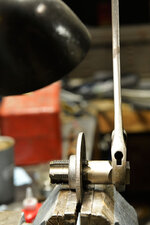
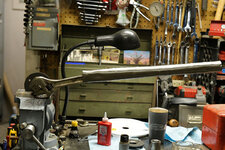
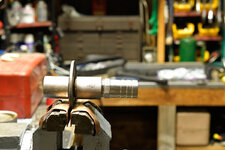
Problem is, I need the wall flange to be a pass-through so I can mount the intake filter to the wall outside. This means re-tapping it all the way through:
Big tap require big wrench.
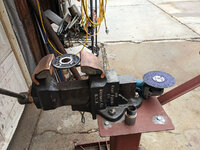
Now the flange is too thick for a close ******, so grind the boss off (yes, tapping it would have been much easier after grinding it down--but that would be thinkin' ahead):
Gawds, I love those 3M Cubitron II disks!
That's the ticket!
Shoot a heavy coat of black gloss on, and get it into the curing oven.
While that's happening (and after the weekly office meeting), I bored a 1 1/2" hole through the wall with a hole saw.
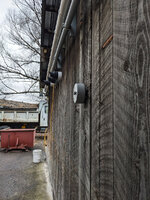
I mounted the intake well away from and lower than the Rinnai water heater exhausts so I don't pick up a bunch of CO. I also moved the outer coupler to the inside of the wall as the filter housing was sticking out too far in a forklift zone and the hose barb on the inside wasn't sticking out far enough.
Now, I'd ordered two 1 1/4 barb X 1" MNPT fittings to attach the hose to my fittings. Of course, what I got from The Jungle were two 1 " barb X 1" MNPT. Fortunately, it's a low-suction applications so this will work:
Finished:
It seems a little quieter to me, but best get out the meter and check. Nope. Still 85-89 dB at my desk. Maybe a dB or so of reduction, but I guess it's just a damned noisy old compressor.
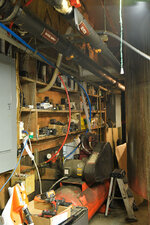
You can see why an insulated enclose ain't practical there. I guess I'll live with it. At least the comp isn't sucking out what warm air I can muster in the shop anymore.
the headlights!What is adjustable on that vehicle other than front and rear toe?
I disassembled and greased a 3/8 rachet ONCE. Then took it back apart and used oil. Much, much better.The Central Maryland Ratchet Whisperer strikes again in the dark of night.
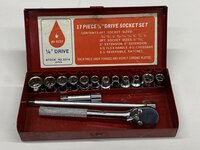
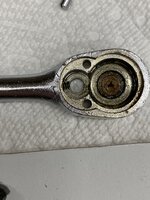
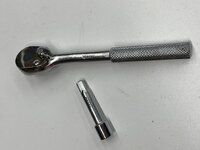
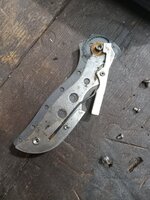
I found myself reaching for a 1/4" ratchet in the basement workshop earlier today, and the one I was reaching for wasn't... there. Hunting for it while I had one hand ******* with the workpiece, I ran across this little set that I had sorta inherited a while ago:
It got the job done, but, my oh my, what an awful excuse for a ratchet it was. I shoulda spelled that "ratshit."
Fast forward to later in the day, and curiosity got the better of me, so I performed essentially the same surgical procedure on this one as I'd recently done to a trio of miniature bit ratchets with quite a bit of success.
Degunked, spring shortened quite a bit, a light swipe with SuperLube, and reassembled. Somewhat to my surprise, it's as if it is now a different tool. The anvil will always be a sloppy-loose amusement, and the tool will never be a quality item. I'd never try to lean on it hard, either. But, I'd estimate that the back-drag is now somewhere in the 10-20% range of what it had been, and the ratcheting is much smoother than it had been.
Now I'm pondering which of the coupla dozen other ratchets that are resting around here might be candidates for a similar hot-rodding...
Just remember, wood is a lot lighter to handle than steel/metal.


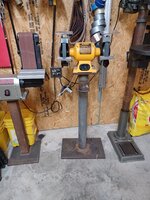
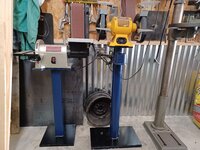
How do you like the BuckTools disk/belt sander? There is a 1HP unit on FBM near me.Cleaned, flung, put away. Blew out the dust and stray leaves with the leaf blower. Bolted the belt sander and bench grinder back on their newly painted stands.
Before:
After:
It does well for my use, which is light sanding of metal - cleaning up corners and rough edges, and sharpening mower blades. But I really would like something a little stronger. This one is 3/4 HP with a 8" disk. The 1 HP unit would be better.How do you like the BuckTools disk/belt sander? There is a 1HP unit on FBM near me.
What size disk is your machine.
Thanks






Yea, you drop one of those screws you're spending the next 10-20 mins crawling on the floor. Don't ask how I know... lolLots of opportunity for parts to go MIA for that one!
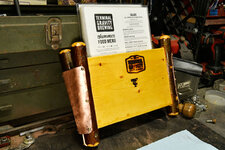
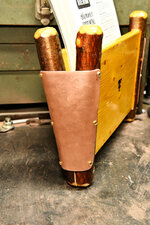
I’ve had that exact same shinifier for ages- it’s awesome as a buffer.For once, no brushfires to put out so I can get on with my menu holder project. PTB want it to look rustic and handmade. It will be.
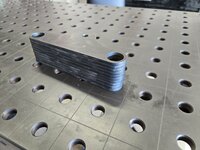
I want to make some end pieces from copper, so first thing is to make some 2" pipe into sheets.
Gotta get it good and hot, so the Coleman rosebud (500) comes down from the shelf:
I forget just how many BTUs that thing produces, but it's soon shirt-sleeves weather in the shop.
Hot enough to get started:
If I turned the lights off, that would be dull red. Perfectly annealed, and I'll be striking while the copper is hot. I used a couple of pair of linesman's pliers to open them up--soft as butter--then rough-flattened on the bench plate.
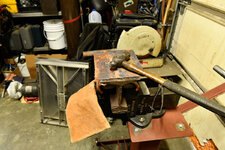
PTB want rustic, so I gave 'em a good working over on my vise anvil with a 2 lb ball-peen.
I used the face, not the ball.
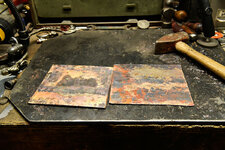
Then a final flattening between a heavy plate and my bench plate:
Set those outside to cool.
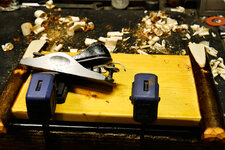
Now to put a bevel on the sticks of the old flights:
Finally an excuse to use my Stanley No. 9 1/2!
About there:
There's probably a right way to put bevels on those sticks with a block plane, but, damnit, Jim, I'm a pipefitter, not a cabinet maker!
Not too bad for an old Beer Hippie.
Now for the copper work.
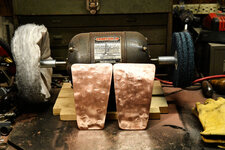
I marked the end pieces directly from the menu holder, then cut them out with a cut-off disk on an angle grinder. I cleaned up the edges with a flap disk in another angle grinder held in my useless POS Asian Roughneck vise.
Then gave 'em a goodly shinifying using blending disks on my new-to-me shinfier:
Fitting, drilling, more fitting, screwing and:
My mandrel for making the ends:
I don't know how the hammer marks ended up disappearing from the copper ends. I decided to put them back, so I spent a few minutes beating the hell out of the ends with the ball end of a 12 oz ball peen.
I need to make some hangers--tomorrow--and get it hung once the PTB decide where they want it.

The big "buffer" shakes like a dog... you know the rest. I don't know which part of the kludge it is. I'll figure it out. Plenty of power, 'though.I’ve had that exact same shinifier for ages- it’s awesome as a buffer.
I admire your industry for “creating” copper sheet from copper tube. Too bad you’re so far away, I’d be happy to give you some. It’s only 0.040” thick though.




You've found the key. . . Just get started!Resumed putting things back together after tearing up the front of the garage to install the aforementioned shelf for the ol’ pile of copper sheets. I put a second one up to hold the shorter 4’ sheets. The rest of that shelf was perfect for a stack of veneer that has been looking for a home. I don’t think I’ll be incorporating any of that into a project any time soon, but at least it will be out of the way until then.
Cleaning that corner of the front part of the garage revealed a number of surprises, like a bundle of base shoe that I had primed and sanded a long time ago. Yep, I have a plan for that soon. Also discovered (or rather, rediscovered) a 5 gallon bucket 3/4 full of 304 stainless hardware- brackets, 3/8 bolts, nuts, washers, lag screws - all good stuff reclaimed from a deck and pergola I removed when I put an addition on the house. I’ll use a lot of that for the new front porch next year.
Then I started creating a pile of power tools to give away. Don’t worry - they are all the oldest of the many multiples I’ve got. I’m tired of tripping over them in the woodshop. My overarching goal is to bring order back to the woodshop after neglecting it for a long, long time. Or rather a long, long, long time. This will take months. Maybe years, but you’ve got to start somewhere.
My post was meant to be sarcastic, your position on woodworking is clear.lol When I was younger I thought I wanted to be a woodworker, but fabricating came more natural. Or maybe it was just more useful for my interests.Wood working is an absolute no-go for me though for many reasons.
My post was meant to be sarcastic, your position on woodworking is clear.lol When I was younger I thought I wanted to be a woodworker, but fabricating came more natural. Or maybe it was just more useful for my interests.
My favorite knife made too many trips through the dishwasher
Like really, who wants to play with sand paper and 2 by 4s when you can melt metal together!

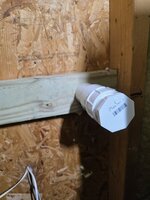

I might have to “reverse engineer” that ideaAdded air to outside. Probably my most shade tree execution to date. The compressor is on the opposite side. This is the garage's rear. Stick the hose through and go. Faster and cheaper than fittings. Zero corrosion concerns and it's large enough to pass other things if needed. And only I see it. The hole saw size made for a perfect friction fit. No additional support required. FWI a laser level allowed DNO centering of the pipe through the siding.
Came in handy for running a roofing gun away from the house and yesterday blowing water out of the supply lines running out to my wife's garden.
I had that attitude about 50 years back, but I got over it. but my kind of fabrication, especially back then, could not be considered "cleaner' than wood working. Building race cars by hand was messy work and lots of grinding wheels and such...
I can see with your CNC table it being a lot more controlled and clean.
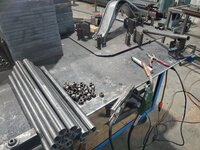
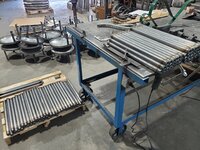
Oooh my friend I need to show you all the pics of manual labor because my boss was the cheapest guy in the world
We had a small foundry and you'd be shocked to see where he collected most of his aluminum for the casting of our benches
Everything from those dollar store mops (with aluminum handles, found in the trash) to soda cans, discarded pipe, and more!
And let me tell you, welding on dirty cast aluminum is the worst lol but I still loved it cause I got to learn a lot and really put my time in before I spoiled myself

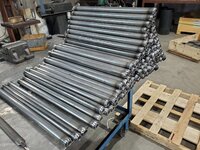
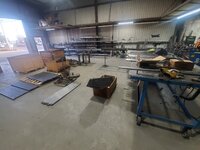
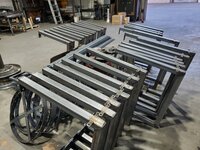
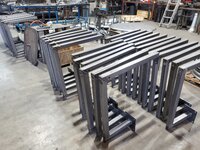
I once knew an old rancher who would save beer and soda cans to sand-cast things. I clearly recall the brake handle of his tractor which he made that way.Oooh my friend I need to show you all the pics of manual labor because my boss was the cheapest guy in the world
We had a small foundry and you'd be shocked to see where he collected most of his aluminum for the casting of our benches
Everything from those dollar store mops (with aluminum handles, found in the trash) to soda cans, discarded pipe, and more!
And let me tell you, welding on dirty cast aluminum is the worst lol but I still loved it cause I got to learn a lot and really put my time in before I spoiled myself
I once knew an old rancher who would save beer and soda cans to sand-cast things. I clearly recall the brake handle of his tractor which he made that way.
That's a LOT of beer cans!
My HS metal shop did a few can drives for casting projects. I was never involved with those.
 :
: