To avoid these ads, REGISTER NOW!

Between 265 & 485 SQ/FT Building a 16x22 Gambrel Workshop

Workspaces sized between 265 and 485 squarefeet.
OP
O

old_smokey

Well-known member
Joined
May 16, 2018
Messages
410
Location
Manitoba
It’s been two weeks since my last post. I’ve been working a ton, but it doesn’t look like I’ve made a ton of progress — mostly because insulating the ceiling turned into a much bigger job than expected.

My goal over the past two weeks was to get the shop insulated and ready for heat before the cold really sets in. But, of course, I overcomplicated things.

The main time sink was building custom rafter baffles. I looked at store-bought ones but they were so flimsy. I was sure they’d collapse under the pressure of installing Rockwool batts, closing off my ventilation gap — a big problem with a cathedral ceiling. I decided to make my own. How hard could it be!

I decided I needed my baffles to do a couple things -
  1. Maintain a consistent 1.5” vent gap from soffit to ridge cap
  2. Be rigid enough to hold their shape against compressed insulation (I’m using R28 Rockwool, which is 7.25” thick. But with baffles, I only had 6.75” of rafter space, so I need to compress them just a touch).
  3. Be airtight to prevent wind-washing. This is to maximize the insulation performance. Cold air blowing through the batts via the ventilation channel is like wearing a winter jacket with the zipper open.
  4. Be vapour-open so any moisture that finds its way into the rafters can make its way through the baffles and dry via the vent space.
  5. Be cheap
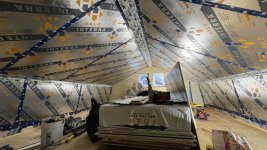
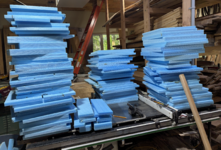
My solution was to use reclaimed XPS rigid foam. I found it at the dump by our family cabin — possibly old dock floats. So the price was right! It was old enough that it didn’t seem waterlogged, just dirty. My dad has a homemade hot-wire cutter in his shop. We used that to slice the blocks into 1” thick panels. They cleaned up really nicely. While I worked on other things in my shop, my Dad cut panels to size and added a tongue-and-groove joint to the edges. This made the joint between panels nice and tight. A touch of spray foam later would make them fully air-tight.

Screenshot 2025-11-13 at 10.26.39 AM.png

I used leftover foam scraps to establish a 1.5" vent gap. These were just glued to the underside of the roof deck.

IMG_9838.JPEG

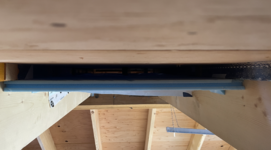
Here you can see me looking up the vent channel. I also needed to add a thin strip of foam along the centre of most rafter bays, so the baffles are supported at both edges and in the middle. The XPS was very brittle, but this added support kept it from snapping during installation.
Screenshot 2025-11-13 at 10.31.18 AM.png

At the base of the rafter bays, there is a 2x6 bottom plate covered with 2" scrap XPS, fit tightly and glued in place, and later sealed to the rafters and the baffles with spray foam. You can see the first pieces going in here, along with some vent spacers.

IMG_9839.JPEG

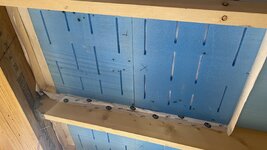
1” XPS is about 1.1 perms. So it’s vapour open, but only a little bit. To increase the drying capacity, I had the idea to add ventilation slots to the upper panels. These were made on a router table. However, this means they aren’t air-tight anymore.

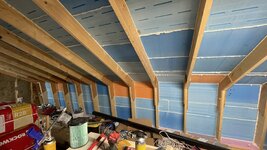
To solve that, I wrapped the vented baffles in leftover Tyvek before installing. The Tyvek was secured tightly along the rafters and the ridge beam with wood cleats, then sealed with spray foam. I held the upper foam baffle back 3” from the ridge beam as well, extending only the house wrap, giving the top of the rafter bays a perm rating of around 50 — very vapour-open while staying airtight and rigid.
IMG_9827.JPEG


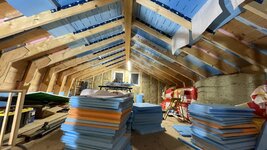
This all took ages to finish. Every piece had to be custom-fit because the rafters aren’t perfectly spaced and some have a slight twist. I'm not sure I would do it this way again!
IMG_9869.JPEG
IMG_9897.JPEG

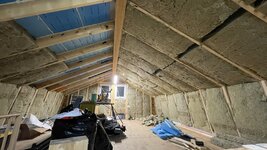
It took about a week to finish the baffles and another couple of days for the Rockwool. I bought six bags from Marketplace, all of which seemed just a smidge undersized. They kept falling out of the ceiling, so I had to hold them in place by stapling strings across. Very irritating.
IMG_9903.JPEG

But the difference is immediate — the shop is noticeably warmer and quieter, even without the heat turned on. I was in a T-shirt while working inside, even though it was below freezing outside. Most importantly, despite this feeling like possibly the most absurd thing I've done in some time, I'm confident I’ve got a robust roof assembly that should stay warm and dry for years.

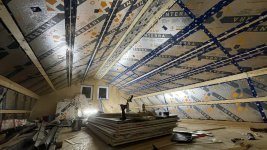
The last step will be to add two layers of 1” foil-faced EPS under the rafters, taped and offset, followed by 3/4” plywood strapping and drywall. The foam will be detailed as my air and vapour barrier. Between the EPS, Rockwool, and 1” XPS baffles, I will have a total roof R-value of around R41-42, above code for cathedral ceilings in my area. And no thermal bridging at the rafters. The gable walls will get the same plywood as downstairs.

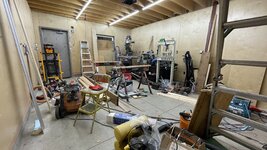
In other news, I finished the main-floor plywood last night, which went pretty smoothly. I still need to finish screwing it down, add cover plates, and do window trim and door thresholds, but it’s nearly wrapped up.
IMG_9916.JPEG


T-minus 10 days until move-in. Let’s go!
 
Last edited:
To avoid these ads, REGISTER NOW!
OP
O

old_smokey

Well-known member
Joined
May 16, 2018
Messages
410
Location
Manitoba
Just a quick update on the past week's work. I installed a smart/variable vapour retarder on the gable walls (Certainteed Membrain, the same as the main floor), sealing it to the framing with acoustical sealant. I am so over using that sealant at this point, as I keep getting it all over myself. And of course, one tube decided to explode in my M12 caulking gun, which took a good hour or two to clean up! A strange thing about the Membrain material as well, is that it destroys razor blades. I can only make a few slices in it before the blades stop cutting. Pretty interesting material.


IMG_9934.JPEG

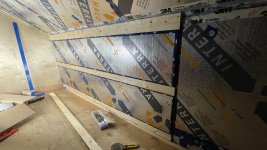
Anyway, getting a tight air and vapour seal in the ceiling is important. I'm trying to go slow and pay attention to the details here. Under the rafters, I'm nailing in two layers of foil-faced GPS foam for added insulation and a thermal break. It is also my vapour and air barrier. I've just put sheets against the gable walls for now, enabling me to tape the plastic sheeting to the foam, which then clears me to install plywood wall panels.

IMG_9936.JPEG

A happy discovery was that I could cut two corner pieces from a single sheet. So I've managed to have two full sheets left over, plus a third I got as a 'just in case' extra. Between the three full sheets and all my offcuts, I have a lot of nice plywood left over to give cabinetmaking a try later in the year.

I've been cutting the sheets to size downstairs, then hauling them up a ladder to install. A bit awkward in here, but making due. I'm very happy to have tall ceilings finally!

IMG_9939.JPEG

I finished installing the last plywood wall panel last night. Tomorrow I'll be renting a trailer and moving all my tools and stuff back inside. This is honestly a bit premature, as the whole shop is very much a construction zone, but snow and cold weather arrive on Tuesday. I don't want to move my gear in sloppy snow and track that into the shop, and I don't want to leave all my tools and materials in an unheated garage either. So it is what it is. The chaos will be temporary.

IMG_9944 (1).JPEG
IMG_9943.JPEG

On Sunday, my goal is to finish installing the 1" rigid foam, tape all the seams and the ridge beam, then turn the heat on. If it goes quickly, I'll start hanging drywall. I'm going with 5/8 4x8 sheets, hung vertically, so I'll have a lot of joints, but they'll all be along the long edge. I don't think I can squeak a 10 or 12' long sheet up here without damaging it, which is too bad. That would have saved me a lot of taping.

I've actually been running the heater for maybe 30 minutes before starting to work for the evening. A nice discovery has been that after just a short burst of heat, the shop is still warm inside the following morning. Excellent!
 

badmatt

Well-known member
Joined
Dec 27, 2018
Messages
147
Location
America's hat.
You're progressing quite quickly in the build. Looks great!

I'm also weary of the weather stated for Tuesday. hopefully it doesn't hit like a sledgehammer.

Edit:
I owe you for those light panels from Jenco: Back Lit Panel SS-BPL24-72-Tx(**)-2x4 LED Panel Light 3K/4K/6K Is how it shows up on the Invoice.

If you need a reference number for an Invoice Ill PM you mine.
 
Last edited:
OP
O

old_smokey

Well-known member
Joined
May 16, 2018
Messages
410
Location
Manitoba
Big weekend progress!

I took Friday off from working in the shop. Saturday was the big move-in day. I was up bright and early, picking up 18 sheets of 5/8 drywall and three sheets of 3/4 plywood for the ceiling. I'm going to cut the plywood into 3" strapping, fasten it over a layer of rigid foam, and hang my drywall from that. I started the day loading the drywall into the second story, which wasn't too bad as I still had a DIY panel hoist from sheathing the roof.

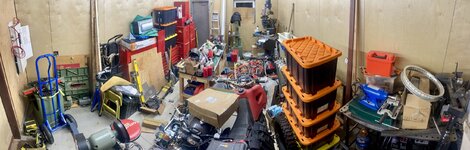
Next up was moving. I don't have many photos from this, just the aftermath, and oh boy. Is it ever a disaster lol.

There is no rhyme or reason here, just piled all my stuff into the shop, and will deal with it later. The good news is that it all fits, and I can envision a final layout that will leave a lot of room open for working. I'm planning on building one of those classic Garage Journal "Steevo" benches around my tool cabinets, and ditching the old workbench currently sitting in the middle of the room. That will be one of the first projects in the shop, I expect.

IMG_9972.JPEG

I also brought my cabinet saw home for the first time, after buying it over a year ago. It's an old Canadian-made General 350, whichy I'll be restoring and building a rolling base for soon. I'll share that project here too.

IMG_9970.JPEG

I'm not going to even think about this stuff until the drywall is done upstairs, though. When it's done, I can move a lot of this upstairs to make room to work.

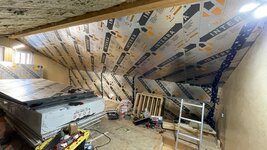
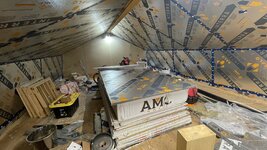
Sunday was spent working on the upstairs rigid foam. I mentioned before, I think, that this foam is my air and vapour barrier, as well as a thermal break. It needs to be detailed before turning the heat on. So I got to work.

IMG_9964.JPEG

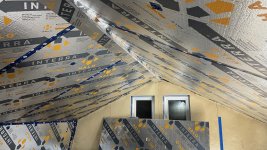
I used my track saw to cut bevels that match the roof angles. Along the bottom plate, I first tried embedding the foam in a bead of foam-safe acoustical sealant. But it didn't create a reliable seal, and made a huge mess. So I changed my approach. I applied a bead of sealant, then cut an 8-foot-long, 6-inch-wide strip of vapour barrier/poly. I embedded the poly in the sealant and left the rest of the plastic sheet lying out of the way on the floor. Then I installed the foam to the rafters with cap nails, and afterward I folded the poly flap up onto the face of the foam and taped it. This was much more forgiving to the minor inconsistencies with my framing and foam cuts.
IMG_9966.JPEG

At the ridge, I had better luck embedding the foam in a bead of sealant. I also applied a bead of spray foam afterward for insurance. This is just a temporary solution, though, as I plan to wrap the beam in foam and use 3M 8067 to tape over the entire beam area, giving me a nice, air-tight finish at this tricky area. My plan for finishing this area is to wrap the insulated beam in hardwood and **** the drywall against it. I'm thinking about integrating a t-track into the faux-hardwood beam as well, for integrated LED strip lighting.

IMG_9969.JPEG

And there you have it - joints are all taped, edges are sealed. You can see the poly flap I talked about pretty clearly here. At this point, I was working in a t-shirt, which felt pretty funny as I was hustling to get the heat turned on.

IMG_9973.JPEG

This week, I'll focus on getting the 3" strapping up, filling in the gaps between straps with 3/4" foam (shown above in the big AMC plastic wrap), and aim to hang my drywall on the weekend.

I'm thinking it probably makes sense to do the beam wrap before mud and tape, so I can finish the drywall against it with a tear-off bead. That might need to be the next priority.

At least now that the heat is on, I feel like the pressure is off and a weight is lifted. Still a ton of work to do, but I can do it at a slower pace and have a bit more fun with it.
 
OP
O

old_smokey

Well-known member
Joined
May 16, 2018
Messages
410
Location
Manitoba
Hit another milestone last night. Drywall is hung!

Picking up from my last update, the next steps were to install 3/4" strapping and fill the spaces between with more rigid foam. I ripped a bunch of 2-7/8" strips from plywood, so that with the kerf, I ended up with 16 strips per sheet. Exactly enough to cover the whole ceiling.

In hindsight, I probably wouldn't do it this way again. I would have just covered the entire underside of the rafters in 2" foam, then strapping, then drywall. But I was trying to save every bit of headroom I could. Doing it this way gave me an extra inch, but it was so much work.

First up, I wrapped the beam in a layer of 1" foam, then wrapped it in 3M 8067 for a continuous air and vapour barrier.

IMG_9975.JPEG
IMG_9996.JPEG

Next, I started putting in the strapping. Bottom first, then the top pitch.

IMG_9998.JPEG
IMG_0009.JPEG

In order to seal around the edges of each inset foam panel, I had to tape all the edges with blue tuck tape. That was a huge pain given how super sticky it is. But I eventually came up with a method that worked pretty well. It likely wasn't strictly necessary given I had a taped 1" layer behind it, but I didn't want to risk humid air creeping around the edges and behind the 3/4" foam, and possibly condensing between the two layers of foam and creating a moisture issue.

I had some leftover tape in the end, so I covered the seams of all the strapping too. Just a bit of extra insurance.

IMG_0011.JPEG

Next up was hanging drywall. I'm using 5/8 sheets, and boy. They are heavy! I think I've worn out my help at this point, so I was on solo duty. It took a while to figure out how to wrangle these panels up. In the end, these telescoping posts with swivel feet absolutely saved the day. I'd squat down, pull a panel onto my shoulders, stand up and push the sheet against the ceiling, then grab a post and wedge it between the drywall and floor. That was enough to hold it in place, maneuver it into its final position, and fasten it to the strapping.

IMG_0018.JPEG
IMG_0020.JPEG
IMG_0028.JPEG

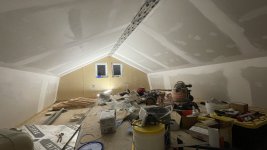
It took me two evenings to do the drywall. Way less time than insulating. Overall I think it turned out pretty nicely. In a few spots, the drywall looked a bit wavy during installation, as the strapping must have pulled in tight to the foam and recessed slightly. But it looks like it's settling into place after adding a pile of screws. I think it will finish pretty well.

Now I have a lot of mud and tape work, but honestly, I don't mind that work. I'll pre-fill the gaps with setting-type mud tonight, and probably do my first mud and tape on the weekend. Once that's done and primed, I'll start focusing on the main level again.
 

DJL1967

Well-known member
Joined
Dec 13, 2016
Messages
97
Location
Northern Ontario
Wow! Great work and hello from Thunder Bay.
Not sure if I missed it but have you completed the stairs to access the second floor?
 
OP
O

old_smokey

Well-known member
Joined
May 16, 2018
Messages
410
Location
Manitoba
Thanks everyone!

@DJL1967 I haven't built any stairs yet. That's something I'll be starting sooner than later, I hope. The plan (at the moment) is to build a ship's ladder staircase. That would allow it to be removable if I want to hoist something significant up through the access hole. I have dreams of welding up an elevator system to lift a motorcycle up here. I have a bunch of plans sketched out, but haven't landed on anything concrete yet. That is the goal, though. A ship's ladder would be much more stable than the ladder I'm using now. Plus a ladder just feels so un-finished.
 
OP
O

old_smokey

Well-known member
Joined
May 16, 2018
Messages
410
Location
Manitoba
Just a small update for the time being, while some bigger projects get underway.

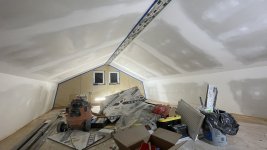
I've spent the past 1.5 weeks mudding and taping the loft area. I said I didn't mind this work, but I take that back ha ha. That was a lot of work to get it looking good. Mostly, because I'm bad at taping.

IMG_0041.JPEG

But the important this is that the final results are good. In the past, I've always used that Dust Control compound in an effort to reduce the mess. I'm not sure if it really helps. This time I followed a more traditional approach. I prefilled any gaps with Durabond 90, then taped with All-Purpose, a fill coat with All-Purpose again, and then a finish coat with a Lite Finish compound.

IMG_0052.JPEG

I found a few mistakes after, and went back for a second pass with the finish compound. This stuff was so much easier to sand than the Dust Control mud. I got a much nicer end result than I've ever had before. But it was extremely dusty.

IMG_0081.JPEG
IMG_0080.JPEG

Last night I did my first coat of primer. It immediately feels less dusty up here, and so much closer to finished. I need to figure out what to do with the beam still. I'll wrap it in something and integrate some LED strip lighting, but that'll be a later project. Right now I just want this space clean.

IMG_0087.JPEG

I'll put a few more coats of paint on yet, then a ton of vacuuming and cleaning.

In much more exciting news, I've started on two other shop projects. The radiant heat system and a new workbench. Those will both get dedicated posts.

The workbench will be something special. Much like my plywood wall deal, after getting nearly a dozen quotes, I found a great price on a huge piece of 10Ga stainless, laser cut with the edges bent on a brake, for a bench top that wraps around a 1.5" MDF core. I need to pick up some steel for the base yet, and wire up a welding circuit. More to come soon!

Thanks for following along!
 

zanyad

ALLIANCE MEMBER
Joined
Apr 26, 2018
Messages
2,777
Location
NE Ohio
The attic is coming along nicely.
In much more exciting news, I've started on two other shop projects. The radiant heat system and a new workbench. Those will both get dedicated posts.
Looking forward to further updates on these, too!
 
OP
O

old_smokey

Well-known member
Joined
May 16, 2018
Messages
410
Location
Manitoba
Been a month, and I think I’m overdue for an update.

I left off after applying a few coats of paint on the upstairs ceiling. I wasn’t quite satisfied with the outcome, which says more about my painting skills than anything. So I kept applying coats until I ran out of paint. By the last coat, I finally got my technique down and achieved a smooth, flat finish without major flaws. In the end, it took two coats of primer and four coats of paint!

On to more exciting topics.

IMG_0101.JPEG

With winter in full swing, I decided it's time to get the hydronic floor heating system running. First off, big shout-out to @crashmtb for pointing me to a local supplier for all this stuff. I saved a good amount of money buying locally.

I decided to assemble the boiler system using 3/4” copper, as I’m not the biggest fan of threaded connections. The first challenge was fitting everything into a tight, confined space. I have 26" of space between the corner of my wall and an electrical outlet. I went to a local metal supplier and picked up a 2x4’ sheet of tread plate to use as a mounting surface. With it lying on my workbench, I started roughing out the layout.

IMG_0217.JPEG

Anyone with any plumbing experience should be able to spot my embarrassing mistake without too much searching here. More on that later.

IMG_0244.JPEG
IMG_0258.JPEG

Everything just fit on the treadplate. I faced some challenges with sweating fittings near threaded connections. The boiler, manifold, and micro air separator had threaded fittings. I used Teflon tape and pipe dope on some brass adapters, then soldered the copper into them. In hindsight, I should have soldered everything first, then threaded the ends in place. My concern was burning off the thread sealant. But with a dripping rag wrapped around the threads, I managed to assemble everything on the bench. With a few strategically placed unions and fittings, I can take the system apart in sections. This should make it easier to mount on the wall and also service or replace parts down the road.

IMG_0264.JPEG


I bolted the boiler to the treadplate, then screwed the treadplate to the wall. Now I could start assembling the sections. Once everything was in place, I began filling the system with a 50/50 glycol mix. It didn’t take long for glycol to start pouring on my head.


IMG_0274.JPEG

Remember the embarrassing mistake I mentioned earlier? Spot it? I put the pressure relief valve in backwards. There is even a directional arrow cast into the fitting! Luckily, it was quick and easy to flip it around. No harm, no foul.

I was using a cheap drill pump to fill the system. I started by filling and purging each loop individually, then isolating the PEX and filling the boiler loop. The drill pump wasn’t great, and I wasn’t confident it had the power to expel all the air from the system. So I grabbed a 3/4-hp jet pump I use to water my garden from rain barrels. After making up a couple of hose fittings, I was able to really push glycol through the system. I purged a huge amount of additional air from each loop and the boiler that the drill pump couldn’t remove.

IMG_0279.JPEG

I let the pump run for an extra ten minutes after seeing the last bubbles purged out. I grabbed a shutoff valve to close the return side and build pressure. Whelp... pressure built a lot faster than I expected, surpassing my 30psi pressure relief valve, and I ended up getting another shower of glycol rain down on me. This time, with a lot more force!

It probably would have been quite funny to see. Thankfully, it wasn't hot. But again... just a mess, no harm done. I re-purged the system, and this time carefully controlled the shutoff valves to build 12 psi in the system, then shut off the supply and return valves without introducing air.

Now filled, I activated my circulator pump and ran it for three days to remove any tiny bubbles I might have missed. I’m happy to report that after three days, there has been no drop in pressure and no leaks. Win!

IMG_0316.JPEG

I was now ready to fire up the system. This hasn’t been entirely straightforward. I’m using a Sinope smart thermostat. It requires a common wire, which the boiler lacks. This boiler operates when two contacts close via continuity. T1 and T2. Jumping them together fires up the boiler. Breaking continuity shuts it off.

Most smart thermostats require three wires: R, W, and C. I can tap into the boiler’s transformer to get my third wire, but the instructions clearly state not to do that. But after speaking with another local guy with the same boiler, he produced a wiring diagram from the manufacturer, showing it was okay to do so in this application.

So I gave it a go, but I was getting erratic pulsing on the 24vac control board and t-stat. That suggests to me the transformer doesn’t have enough output to power the onboard controls and my thermostat. Probably why the instructions said not to do this. I’m not sure why it worked for the other guy, but my guess is he was maybe using a thermostat with a battery.

I’ve gone ahead and am trying some alternative approaches - I have a spare 24VAC transformer, which I’m running as a standalone 24V power supply for the t-stat. At first, I thought this would be enough to solve the issues and let me connect the thermostat directly to T1/T2, but I found I could either not fire up the boiler or it was always on, and I couldn't shut it off. So my third and hopefully final attempt is to connect the thermostat R and W wires to a 24VAC relay coil, and the other relay contacts connect to the boiler T1/T2 terminals. This way, I don’t mess with the boiler control board at all, and simply create continuity between the terminals.

I’ve got it roughed in place for testing, and it seems to work. The floor was 7.5C when I started the boiler. It is rising about 0.5 °C every 20-30 minutes, so I should have a warm floor by morning! This is a 3kw boiler, for the record. If everything keeps working well, I'll clean up all this wiring, mount the thermostat on a bracket near the boiler, add a power consumption monitor, and disconnect the fill pump.

That’s it for now. Astute readers will notice some other new additions to the shop lurking in the photos - namely, a new huge 3/16" stainless steel workbench top. That project is for another update, though. More to come soon!

IMG_0145.JPEG
 
Last edited:
OP
O

old_smokey

Well-known member
Joined
May 16, 2018
Messages
410
Location
Manitoba
Quick update - Here is some data on how the floor has warmed up.

Shop hyd floor initial warm-up. 3KW boiler. Floor sensor. Stat set to 28C.png

It took 1.5 days to bring the slab from 7C/44F to 28C/82F. Based on what I've read, it seems that around 28-32C/82-90F is the hottest you should go with a slab before getting uncomfortable. I don't have any intention of keeping the shop this warm, but I was curious if my little baby 3KW boiler could even get the floor that hot.

Last year, I used LoopCAD to design the hydronic system. It was all very new to me, so I was leery of making an expensive mistake. The loop spacing and building design suggested that a 3 kW boiler was right on the cusp of being able to handle the load. So I cranked the boiler wide open and watched the data come in.

The temp climbed steadily at first. About 1 degree Celsius per hour. But once it reached about 18C/65F, it slowed. And by 24C/75F, it slowed more again. I was concerned the boiler might be slightly undersized for the task.

But when I woke up this morning, the weather was -18C/-1F outside, the slab was 28C/82F, and the inside air was 20C/68F. Success!

Something interesting to me was watching the supply and return water temps change as the slab warmed up. At first, the supply water was only leaving the boiler at around 80F/20C. As the slab got warmer, those temps started to rise to 88F/31C, returning at 72F/22C.

My understanding is that it's ideal to have a delta T of around 10F or so, which is what my LoopCAD plans assumed. The design said that with a 100F supply and a delta T of 10F, I should be able to heat my space to about 70F on the coldest day. But I couldn't get the boiler to supply 100F water at the start. And my delta was larger, 16F. Nervous times. Hard to be patient. As the slab warmed up, though, so did the supply/return temps, and my delta reduced. By this morning, the supply temp was exactly 100F, the return was 90F, and the slab and air temps were right on target. It looks like the system worked as planned!

At 0.09587/KwH, and a 3KW boiler, this would be pricy to leave running full blast 24/7. About $200 a month. So, the next thing to watch is how much electricity the system consumes to maintain temperature, vs a preliminary warm-up.

Anyway, I am pretty pleased with this all. For now, I've dropped the slab temp down to 15C/60F, which is more than enough to keep the chill out of my feet. I can quickly increase the air temperature as needed with the ceiling fan heater when I'm working.

That's it for now!
 
OP
O

old_smokey

Well-known member
Joined
May 16, 2018
Messages
410
Location
Manitoba
Probably due for a shop update by now. Here's a snapshot of what I've been chipping away at in the shop.

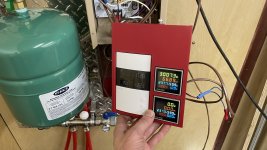
To finish off the radiant heat system, I needed to make a mount for the thermostat. While I was at it, I figured I'd add in some KwH meters for both the boiler and my ceiling fan heater. I like knowing how much of my electricity bill goes to heating the shop. Plus I was curious how it would compare to my old, small but leaky shop.

I bent up an aluminum sheet for a housing. This gave me space to mount a relay for the thermostat, plus space for the meters. The front face is 3D printed (thanks Dad!). Took a few tries to get it right, and I still have a little tweaking needed, but it's pretty darn slick I have to say.

IMG_0450.JPEG

IMG_0451.JPEG


I've settled on a floor temp of 13C. This leaves the inside temperature around 10C or so, which is slightly cool at first, but very comfortable once working. This is averaging around $1.50 a day in radiant heating costs. So $45. That is about the same cost I had in my old shop when heating it to 5C. And it's been COLD out lately. Like, really cold.

IMG_0544.PNG

I still need to fasten the boiler wiring to the walls and tidy up a few small things, but I'm close enough now to call this project done-ish.

IMG_0459.JPEG

Moving on to the project at hand, I've started working on my workbench. This is exciting! You may have noticed a stainless plate sitting on my tool boxes earlier. This was a splurge purchase, though not as much as I expected. I used to have a .120" hot rolled steel sheet for a workbench. it was great, but too small. So I planned to get the same thing again, but 10' wide. I called over ten suppliers for pricing on hot rolled, pickled & oiled, and stainless options. The prices were all over the place. For the same spec, hot rolled ranged from $300 to $700. Stainless was $700 to $1,500. It truly pays to shop around.

In the end, I got a great price for 3/16 stainless, including laser cutting and bending. Ready in two days. All in, it cost me less than the high-end mild steel quotes.

IMG_0145.JPEG

This thing feels NICE. With nothing under it, the surface is already so solid. The bends make such an impact on rigidity. I've designed it so I can fit 1.5" of MDF under, for sound deadening and extra strength. It is a massive work surface compared to what I'm used to. Sitting down in front of it felt like a huge milestone.

2CAA8E20148C_1766610068.JPEG

Clearly, my next priority has got to be organizing. The shop is an absolute mess, and I hate it. So it's time to start welding.

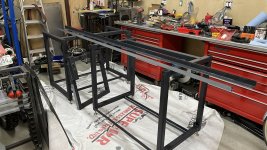
I'll be making a "Steevo" style bench. Basically, a welded frame for my tool cabinets to nest in, with the stainless top. I'll be using adjustable feet as my floor isn't 100% flat. And I'll be making it somewhat modular - each half of the frame will be independent. Then, some full-width angle bolting them together. This will make it possible to move into place, easier to make, easier to move.

IMG_0219.JPEG

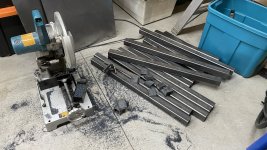
I picked up some tube steel from a local supplier. They messed up and sent me home with heavier gauge than I asked for. Which is fine. It cost me no extra. But now the base is made of 3/16", 2" square tubing. It is going to be so heavy lol. My Makita dry cut saw made quick work of it though.

IMG_0539.JPEG

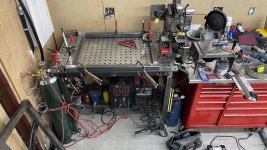
I tacked it together on my home-made welding table, finishing the sides first, then adding in the angle and bracing. The first one turned out almost perfect, and the second one is bang on. I'm getting better and managing warping and distortion. This is all TIG welded, because I don't have the space cleared for MIG yet. 185 amps, wide open. I'm out of practice, but I think it turned out good enough for a workbench.

IMG_0546.JPEG
IMG_0607.JPEG

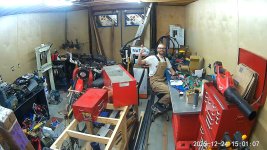
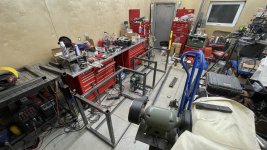
This photo makes me laugh. I wanted a 10' wide bench because I was tired of running out of room. It took no time at all for it to be completely covered with junk. I'll need to start designing some shelving and cabinets next.

That's it for now. There is a bit more welding in my future this week, then some machining. I've been doing a lot of work on the mill and lathe so I can make parts for the adjustable feet, but that's for the next update.
 
Last edited:
To avoid these ads, REGISTER NOW!
OP
O

old_smokey

Well-known member
Joined
May 16, 2018
Messages
410
Location
Manitoba
Time to pick up on the workbench project.

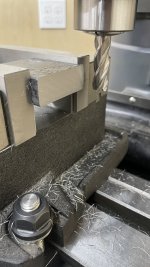
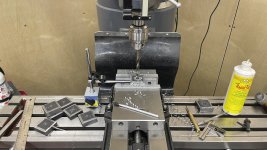
I needed a way to mount levelling feet in the square tube. I could have just welded in a plug, but I decided to use this as an opportunity to practice on the mill. Starting with some 3/4" stock, I cut some plugs roughly to length on my dry-cut saw, then faced each side with an endmill. The first task was just to get all the pieces identical in size. Seeing chips fly off for the first time was exciting!

IMG_0638.JPEG

My next step was to machine a shoulder into the top, so it would lock into the square tubing like a lego block. I used a magnetic indicator base as a make-shift stop block, so I could quickly drill and tap the centres. I lowered the spindle speed way down and power tapped them all. That was so nice compared to hand tapping.


IMG_0656.JPEG
IMG_0657.JPEG

The last step was the trickiest... since square tubing has a radiused corner, I needed a way to match the plugs. I could have used a belt grinder and done it by hand, but the point was to learn basic machining skills. So I setup a rotary table, and after a lot of fussing and a few mistakes, I figured out a way to match the profile exactly. The hardest thing was just clamping the parts securely.

IMG_0661.JPEG

A quick test fit looked promising

IMG_0682.JPEG

And then I welded it all out.

IMG_0687.JPEG

Pretty pleased with how that turned out. Now it was time to fit a piece of angle across the front, paint and assemble.

IMG_0692.JPEG

I ran a string across the front piece of angle here, to verify everything was bang on before painting. Good thing I did, because I discovered that the right-side box was actually a parallelogram. It was out by 1/2"! I had to cut it apart and reweld it... more than once. It just kept ending up not square.

IMG_0698.JPEG

Even with all these clamps and braces, it wouldn't finish square. I finally discovered the reason... one of the pieces of square tubing was bent. This is leftover from moving the mill out of the basement, and I guess it got bent in the process! Lesson learned.

To be continued in the next post as I've hit my photo max.
 
OP
O

old_smokey

Well-known member
Joined
May 16, 2018
Messages
410
Location
Manitoba
Part 2 -

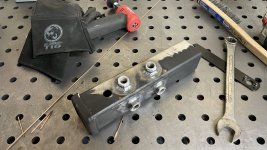
After getting the base figured out, I decided to add a 2" hitch receiver to the frame. My thinking is that it would be nice to make a few accessory mounts. Maybe a vise mount, porta-band table, bicycle work stand, etc. I'm not really sure yet, but given the weight of the bench, it could be useful to have a universal mount on it. Plus I don't want to drill through the top!

IMG_0712.JPEG

I welded in four 3/4 nuts as well, so I can take up the slop. In hindsight, I'm not sure why I didn't put the second set of nuts right at the back of the tube. Oh well.

IMG_0713.JPEG

I welded it to the centre 'leaf' of the table with a couple of stitch welds. The holes on the face of this tube is for bolting the three sections together.

IMG_0729.JPEG

A bit of primer.....

IMG_0732.JPEG

Then two coats of paint...

IMG_0740.JPEG

And voila!

The table was pretty close to flat. I used the levelling feet to get it dialled in. Getting the boxes into the frame was pretty simple. I took all the drawers out, then lifted them in place by hand. The left box snagged a weld at the back corner, but a quick zip with a carbide burr in the die grinder gave me the needed clearance. Once the boxes were in, I bolted the front angle in place.

Or at least I tried. I forgot that the boxes have locks, which interfered with the angle. No matter though, I have a mill!

A few minutes later and...

IMG_0744.JPEG

This little machining task is where I learned the importance of locking your quill. I didn't realize an endmill would pull the quill down because of its helical cutting flutes. It's very obvious in hindsight. A painful lesson.

IMG_0743.JPEG

Once bolted together, this frame does not flex at all. While adjusting the levelling feet, I had to be careful, as I could easily have a box suspended by accident, resting on only one or two feet.

Under the 3/16 stainless top, I put two 3/4" MDF sheets, screwed together. That gives the top a very flat, dense base. The steel is folded around the MDF, with a very tight fit, so I don't need to worry about gluing it to the MDF or anything. The MDF is screwed from the underside, through the front angle iron, to keep it from moving. Though the top weighs around 250lbs I think, so it's not going anywhere :)

IMG_0746.JPEG

IMG_0757.JPEG

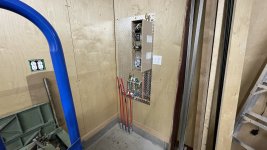
After that, it was a quick clean-up and time to have a look. The shop is starting to take shape now. There is still a lot to do - make and install window and door trim, build shelves for upstairs, build a permanent ladder/stairs, get the lathe running, finish some electrical stuff, build a walkway around the shop to the driveway, etc. So there is a lot more to come.
 
Last edited:
OP
O

old_smokey

Well-known member
Joined
May 16, 2018
Messages
410
Location
Manitoba
I've been spending a lot of time working on my lathe over the past two weeks. Truth be told, I hadn't really looked at it closely when I bought it, other than looking for any signs of wear on the ways. Now that I had some time to dedicate to the machine, I saw some obvious signs of neglect. Belts shot, dark oil, grime everywhere, sigh...

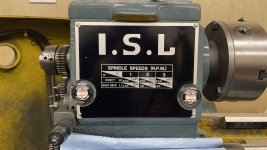
This lathe has two sight glasses at the front for the spindle bearings. These also double as the oil drain. For some reason, my front site glass oil was black as night. I drained it, and not much oil came out. You can just make it out in the photo below.

IMG_0506.JPEG

When I drained the oil, it didn't appear to have any metallic junk in it, just very worn-out oil. My best guess is that maybe some kind of automotive oil, or other incompatible oil, was used in here, turning it black quickly. Though it's curious that the rear bearing oil was much lighter. Anyway, it took a lot of flushing to get it to come out clean. I used a pneumatic brake bleeder tool to fish a rubber hose through the oil drain hole and **** out the junk. I managed to break the sight glass in the process, but thankfully, they're easy to source on Amazon.

IMG_0620.JPEG

Hey, that looks a lot better!

Next up were the belts. The lathe uses two belts - the first between the motor and rear step pulley, and a second to the spindle. They appeared to be the originals and were in absolutely awful condition. The spindle belt looked like it might snap at any moment.

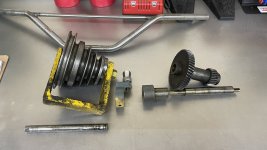
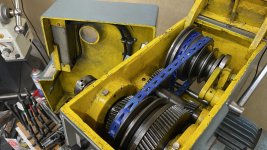
The belts shed debris everywhere as they break down, mixing with oil and grime into a thick, black paste. Replacing the motor belt is simple, but the spindle belt is captive and requires pulling the spindle out of the headstock to replace. That's not something I wanted to do unless absolutely necessary. So I picked up some link belts at a local supplier. They were ungodly expensive, but should run nice and quiet, plus I didn't have to pull the spindle and risk damaging the expensive spindle bearings. After cutting the belts off, I decided to pull the rear cone pulley and back-gear out to make it easier to clean up the nasty belt debris. This turned out to be a smart call, as one of the bearings in the step pulley was shot. Everything else was in good shape.

IMG_0787.JPEG

IMG_0778.JPEG

IMG_0885.JPEG

With new belts and bearings fitted, it was time to wire up the motor. This was an odd, head-scratching moment. The motor was configured for running on 240V. But when I moved it out of the seller's basement, it was wired to a 120V circuit. The guy must have been running it on half the rated voltage, which technically works, but would pull a lot of amps and run really hot. Not great for motor life at all. And it would have something like a quarter the horsepower it should. I struggle to believe it was run this way, but that's how it was configured...

So, after double-checking the motor wiring, I bought some new SOOW cable to replace the old, stiff cable between the switch and motor, and a new lead from DigiKey for the powercord. I hooked it up to a 240C receptacle, fired it up, and the motor sprang to life. I measured 7.5A with a clamp meter - exactly what the motor should be drawing at this voltage. The belts were nice and quiet, and the spindle sounds smooth. So far so good.

Next up was aligning the headstock to the bed. This is a fairly simple, though tedious, procedure. I started by mounting a dial indicator to my carriage. Then chucked up a 10" piece of precision-ground rod, and ran the carriage back and forth to measure if the rod was parallel with the bed. This isn't exact as it doesn't account for runout in the chuck, but it got me close.

Next, I mounted a 1.5" aluminum rod into my 4-jaw chuck, about 10" long, indicated it in, and then started making light passes, measuring the thickness after at each end. If the tail end was thinner, that means the headstock is tilted toward the tool. If the tail end tapers to a larger diameter, the head is tilted away.

IMG_0887.JPEG

Astute readers will notice a 3-jaw chuck above. This was from after I finished aligning the headstock. I apparently was too engrossed with the task to think of taking any photos.

It took a few hours of fiddling, but I've got the lathe setup now so I can make an 8" long cut that stays within 0.0005" without a tailstock. With 8" of material sticking out, I was struggling with some chatter at the far end of the rod during the test cuts. It's important not to use a tailstock support for this test, as it can throw the reading out and hide misalignment. Once I felt I had chased my tail as far as I could, I aligned my tailstock, added a live centre, and did a second test cut. This eliminated my chatter, give me a very good surface finish, and reduced my taper down to 0.0003". Happy days!

I've got an absolutely enormous amount to learn about machining. Heck, I probably didn't even dial the lathe in correctly and don't know it yet. But this felt like a small win for me - to be able to get a decent surface finish, and what seems like a good amount of precision from an import lathe from 1980, I'll take it.

IMG_0888.JPEG

Next up, I think I'll shift away from metalworking and turn my focus back to the shop itself - I still haven't made any trim for inside. This weekend I'll start pulling out some red oak from the lumber stash and start milling it to size. Cheers everyone
 

Denwood

Well-known member
Joined
Sep 22, 2014
Messages
4,191
Location
Thunder Bay, Ontario, Canada
Just dropped in to check your thread! I'm in the same size shop, 16x24 so can relate to the challenges of a smaller space. You did an insane amount of work on the insulation side, including your ceiling. That will pay off in Manitoba.

The quality of this build is pretty much top notch..kudos!
 
OP
O

old_smokey

Well-known member
Joined
May 16, 2018
Messages
410
Location
Manitoba
Just dropped in to check your thread! I'm in the same size shop, 16x24 so can relate to the challenges of a smaller space. You did an insane amount of work on the insulation side, including your ceiling. That will pay off in Manitoba.

The quality of this build is pretty much top notch..kudos!
Thanks so much! I've really been enjoying spending time in the shop, in a t-shirt, while it's freezing cold out. Feels like such a luxury ha
 
OP
O

old_smokey

Well-known member
Joined
May 16, 2018
Messages
410
Location
Manitoba
I started working on window trim this week.
If you remember a few posts back, when I was putting up the wall plywood panelling, I used some red oak for baseboards. I thought that looked pretty nice, so I wanted to match the trim to it. Trouble is, I wasn't sure I had enough on hand. And if I did, I wasn't sure I wanted to use it for shop trim anyway.

I went over to my Dad's shop and looked at the stash of material. There was a pile of oak flooring on the rack that we had snagged out of someone's garbage last thanksgiving. The nails were already punched out with a pneumatic nail remover tool. The wheels started turning...

IMG_0890.JPEG

I decided to laminate a bunch of it together and see how it would work for trim. It will be a bit of a patchwork quilt look, but I don't mind that for the shop at all. Probably wouldn't do this for my house, but still... worth a go I think.

The first step was to remove the bevelled groove on one side and the tongue on the other.

IMG_0893.JPEG

I flattened the groove-bevel on the jointer first, then moved to the table saw to cut off the tongue and create two parallel faces. From there, I ran the boards on-edge through a thickness planer, which probably wasn't necessary, but helped make sure the faces were nice and flat for gluing.

IMG_0891.JPEG


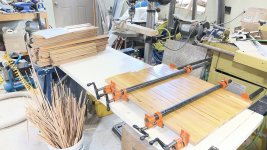
Now it was time to glue. I made a trim cut-list beforehand, for jambs and casing. I tried to find material that was close to the finished length to avoid waste. Then everything got glued up and clamped in a big sandwich. I had to make four of these in total.

IMG_0896.JPEG
IMG_0897.JPEG

Here you can see a bucket full of tongue cut-offs. Makes for great firewood kindling!

Once dried, I cut each piece of trim to width on the table saw and labelled them.
IMG_0898.JPEG

The pieces didn't come out dead flat, which was expected, so the next job was to make 'em flat. I did the backside on the jointer first, then ran them through the thickness planer again.

IMG_0904.JPEGIMG_0902.JPEG

This was after the first pass. The material started off as 3/4" thick flooring. You can see where the low spots are. But that's fine - I usually make casing around 1/2" thick, maybe 5/8" at most, so there was a lot of extra material I was able to take off when flattening. 3/4" jambs would be nice, but my windows have integrated casing channels that accept 3/4" or 1/2" jambs. So I'll skim them down to 1/2". Just a few more passes through the jointer and...

IMG_0905.JPEG

That's looking pretty nice.

IMG_0907.JPEG

Done for the day. I made about 100 feet of casing in about six hours or so. This will finish all my windows, including the ones in my doors. The big doors will get something else for the door frame trim.

Next, I need to cut them to the final length, get my mitre saw dialled in and cut all the mitres, sand everything, biscuit-joint the mitres, stain everything, and pre-assemble the trim. That will be sometime next week, I hope.
 
Last edited:
OP
O

old_smokey

Well-known member
Joined
May 16, 2018
Messages
410
Location
Manitoba
A bit of a side-quest update today.

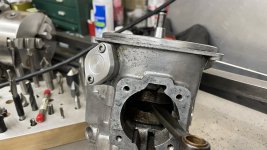
A friend of mine is helping his neighbour fix up an old two-stroke scooter or something. The engine was creating zero vacuum through the intake. Pulling the alternator cover revealed an open hole into the crankcase, where an oil injection pump drive should have been. I guess it broke, the owner decided to run pre-mix, and pulled it out, leaving the case open to the atmosphere. No good, for all manner of reasons!

There is an overseas company that makes a blockoff plug for this, but they’re out of stock and pretty expensive. I offered to try making one. Seemed like a good project to learn on, with a fair number of lathe and mill operations.

Screenshot 2026-03-31 at 4.43.29 PM.png

I started with a chunk of 6061 and turned it down to size for the plug. I didn’t have any inside micrometers or t-gauges, so I just made shallow passes until I could test fit it while still in the lathe. You can see how the smaller diameter enters a hole in the casting. The plan was to machine an o-ring groove to block it off.

IMG_1011.JPEG
IMG_1059.JPEG
Once the diameter was a slip-fit, and parted to length, I turned the end cap to the right OD.

IMG_1060.JPEG

You can see the shape of the existing DIY cap the owner made. It was useful for marking out the target shape. My plan was to mill two pairs of parallel faces, but I realized the casting isn’t actually symmetrical. So my best bet was to mark out the shape and do some very manual machining.

IMG_1066.JPEG

I used a pointer in the mill to verify my cutting path matched the scribe marks, then cut out the shape with a two-flute 5/16 end mill. This was my first time milling aluminum. What fun!

IMG_1068.JPEG

Here the plug is roughed out and test fit. The holes were perfectly aligned, to my great surprise. I left the cap thick so I could try cutting out the shape fairly shallow first, before going full depth, in case I made mistakes. In the end that wasn’t needed and I cut it all in one go.

IMG_1072.JPEG

Here is a final test fit, after counter-boring the holes and adding a little decorative recess in the centre, just for some flair. I think it looks pretty great! A bit of hand deburring and scotchbrite buffing and it was done.

IMG_1081.JPEG

All in all, took me about four hours to make. Buddy was very happy, and I got to learn a few new things. Plus keep the leftover 6061.

IMG_1083.JPEG

With the weather warming up, I’ve removed the rigid foam panels over the windows. it’s so nice to have warm light pouring into the shop while I’m working.

IMG_1093.JPEG

Till next time!
 
OP
O

old_smokey

Well-known member
Joined
May 16, 2018
Messages
410
Location
Manitoba
Happy one-year anniversary of the demolition of my old shop! So much has happened since then, it's a bit crazy to think about.

Time for a quick update. I've been working on a ton of different projects in and on the shop, but none of them are finished. This seems to be a constant struggle for me. Working on too many things at once, and none of them get done in a timely manner lol. Oh well, it's all for fun anyway.

I've got two projects I want to share some progress on.

The first is a cabinet saw restoration. I got a really great deal on an old, Canadian-made General 350R cabinet saw about a year ago. These saws are built like tanks. It's over 400lbs and has the heaviest, thickest cast iron trunnions I've ever seen on a saw.

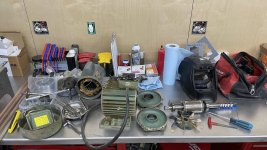
The saw was no longer in use as something was up with the switch wiring. It looked like there was either a dead short, some mice got in there, or I don't know what. But the wiring from the switch to the motor was all torn up. I didn't really care, though, as I had a spare 3-phase 3hp motor from another General cabinet saw at home, coincidentally.

IMG_7938 (1).JPEG

I brought it home and started working on getting it setup. I'm not exactly excited about doing any dusty woodworking in my shop now that I have a lathe and a mill, but sometimes you just gotta use a table saw. Dust collection will be something on my mind in the future. Anyhow, I've got a couple of house and shop projects coming up that need a table saw, and I've already got this machine taking up space, so may as well get it going.

A nice thing about General tablesaws compared to Delta Unisaws is that the motor mounting plate is universal. Almost any TEFC motor of the appropriate size will bolt up to it. So that was no issue. I just needed to make sure the 3-phase motor ran and was in good shape.

IMG_0348.JPEG

The motor was due for new bearings, so I disassembled it, blew out a few decades of super-fine sawdust, pressed on some new bearings and was ready for testing.

Since I don't have 3-phase power, I needed a way to convert to single phase. I found a used, unopened VFD on marketplace that fit the bill. But there were a few issues to sort out first.

While reading through the VFD manual, I came across a warning about not powering up a VFD if it has sat unused for more than six months. I guess the VFD uses aluminum electrolyitic capacitors, and these capacitors use aluminum oxide as the dielectric. Over time, if not in use, this layer of oxide breaks down and eventually disappears. If you power up the device, it will basically createa a dead short and they’ll blow up, damaging or destorying the VFD.

To avoid this, there is a process called ‘reforming’ a capacitor. It’s pretty simple, just apply DC voltage, starting at a low current for a set period of time, then increase to a higher voltage, progressively in steps, until you’re applying the full rated voltage of the capacitors. The longer they’ve sat, the longer you apply voltage for.

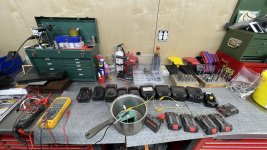
I found a stamp on the VFD stating it was manufactured two years ago. I found a reforming chart from the capacitor manufacturer, and determined I needed to apply the rated voltage for several hours. The only problem was…. they were rated at 400V DC. Where do I get 400V DC?

IMG_0972.JPEG

To answer that question, I present to you the latest offering from Milwaukee - the M400 series. Also known as every M18 battery I own, plus my Dad’s Stihl, Makita and Bosch batteries, all wired in series, to give us 400V DC. Then through a resistor to give the recommended current. The capacitors are in the kitchen pot in case they rupture. Safety first, after all.

I’m happy to say that the capacitors reformed without issue, and I was able to fire up the VFD without any unwanted surprises. Happy days!

From here, I wired up the motor and tweaked a few parameters. Didn’t take long to get it running smoothly. I set the carrier frequency to 16K so I can’t hear it so much. One of the perks of playing with engines, tools, and loud music all my life.

Another pesky issue was controlling the motor. I really like the original on/off switch from the saw. It feels very art deco or something. Since the VFD will accept low voltage controls, I pulled out the old mag switch internals, 3d printed a little stand-off, and put in some low voltage switches. Now I can retain the orignal saw controls and mount the VFD far away from the dusty saw. Pretty sweet!

IMG_0921.JPEG
IMG_0976.JPEG
IMG_0979.JPEG

Next up is putting this all together. I have new belts, arbor bearings, fence, router table and extension wing. The only problem is that it’s all stuffed in the corner of the shop, with my motorcycles in the way.

This has become a recurring problem to be honest. My shop just isn’t big enough (already lol), but it would be so much more useful if I didn’t have motorcycles taking up 25% of the floor space. It would be really, really handy if I could somehow part them upstairs.

Hmm.

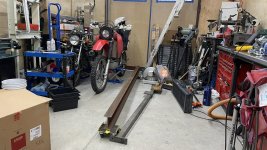
I’m not sure how it happened, but a few days after having that though, this followed me home.

IMG_1196.JPEG

So this is the current project on deck. I’m basically building a gantry crane upstairs, with a rolling cable hoist, so I can lift bikes up through the ceiling opening, then roll along the i-beam and drop them on the floor. I don’t have a good way of anchoring the i-beam to the roof ridge beam, so I will be building a steel truss/bracing to support the i-beam from below, anchoring it to the floor framing. This makes it possible to build in pieces, carry upstairs, and assemble. Or also dis-assemble and remove, if I wanted.

IMG_1206.JPEG

The beam is an S6x12.5, 11 feet long. I selected the beam after running through a bunch of load and deflection calculations, and also comparing those results against commercially available gantry crane specs. My heaviest motorcycle is 475lbs, but I probably won’t even use it for that. I'm hoping to sell it ASAP. My main bike is the XR650R, and it's just 300lbs, so this has an enormous margin of safety built in. It should actually be safe for lifting up to 1-ton.

A side benefit is that I can also back my truck through the double doors, and the hoist will be perfectly positioned to lift heavy items out of the truck bed, at which point I can drive out, and lower the carge to the shop floor.

That's it for now. I'm busy finalizing the crane design and will get to cutting and welding next week, I hope. I want to get this crane sorted out sooner rather than later, as the weather is getting warm and it's nearly time to turn my focus to building a paver-stone walkway around the shop.
 

larry4406

Well-known member
Joined
Jan 27, 2006
Messages
19,259
Location
Northern Virginia
Very cool project! Glad you can save the saw. Clever micro-switch solution as well.

Couple months back I read a thread where guy stores his motorcycles upstairs. I think he is in New England region with a timber frame type structure. He may have used a platform for his bikes...
 
OP
O

old_smokey

Well-known member
Joined
May 16, 2018
Messages
410
Location
Manitoba
Very cool project! Glad you can save the saw. Clever micro-switch solution as well.

Couple months back I read a thread where guy stores his motorcycles upstairs. I think he is in New England region with a timber frame type structure. He may have used a platform for his bikes...
I may have seen that actually! I've got a list of a good dozen different ways people have parked bikes on a second level, ha. Some are basically full-blown freight elevators. I would love to have a platform as that would be so much more versatile, but it's much more complicated, heavy, and expensive. I also had a hard time working through how to build it with safety in mind. So I'm keeping it simple for now. Who knows, maybe this is just version 1.0.
 

slim_grim

Well-known member
Joined
Oct 19, 2014
Messages
231
Location
Central NC
Awesome stuff! There's a 100% chance that I'd have blown those capacitors and been left scratching my head what happened...

Stoked to see this crane come together.
 

devvar

Member
Joined
Sep 19, 2023
Messages
24
Location
Connecticut
While reading through the VFD manual, I came across a warning about not powering up a VFD if it has sat unused for more than six months.
Good on you for reading the manual, you have a rare talent!

I have blown up a VFD because of this issue, it made a lot of sparks, a lot of smoke, and then nothing else. Thankfully it was a relatively small drive, maybe 2hp, so replacement wasn't too expensive (on the company dime as well). I read the manual after plugging it in and letting all the smoke out, should have read it before...

Excellent work you are doing both in and on that shop!
 

larry4406

Well-known member
Joined
Jan 27, 2006
Messages
19,259
Location
Northern Virginia
Wow!

So does the deterioration start as soon as the VFD is put in a box for sale?

The box would need to be labeled with a packing date to know how stale it was.
 
OP
O

old_smokey

Well-known member
Joined
May 16, 2018
Messages
410
Location
Manitoba
Wow!

So does the deterioration start as soon as the VFD is put in a box for sale?

The box would need to be labeled with a packing date to know how stale it was.
I believe so, yes! I found the manufacturing date printed on the main circuit board, of all places. I don't remember seeing it printed on the box somewhere, but I'll have another look...
 
To avoid these ads, REGISTER NOW!
Top Bottom