Hernán,
Patents (Utility and Design) and Trademarks are two different kinds of intellectual property granted, issued, or awarded here in the US. Patents are for unique things, Trademarks are for unique symbols and/or terms.
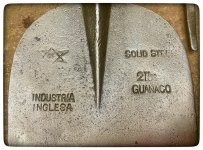
One tidbit I pulled out of the record in the USPTO Trademark Status and Document Retrieval system (google 'TSDR' and you'll find it, very useful research tool) for Dunn's 'Guanaco' TM (13,346), linked
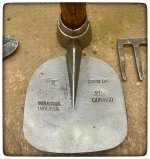
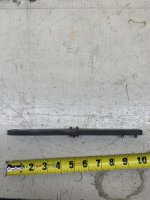
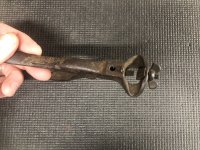
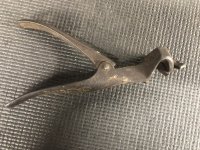
here, is that he was a "subject of the Queen of England" (i.e., British citizen) residing in New York. That means almost certainly an import/export agent. I don't know how much that helps answer your questions about the markings on this particular tool.
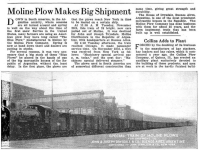
Linked
here in Google Books is an article from a 1924 issue of the
Farm Machinery and Hardware trade mag, connecting him, indirectly, to a big plow deal in Argentina. See the caption to the photo. I'm not exactly sure in this context what "consigned" means when the manufacturer was in Moline, Illinois, and Dunn was not the distributor, either.
Another clue from a 1912 American Exporter directory
here...

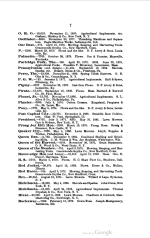
The Star of David "WE" trademark is very likely the manufacturer's or foundry's trademark. John Dunn was not the manufacturer. I don't know how you would identify it other than paging through directories of Trademark Digests like the one you excerpted. There are thousands of them.
Hello...
Honestly, I'm amazed and grateful.
I knew nothing about this, and now I understand much better the origin and how this hoe must have arrived in Argentina.
In 1810 (I'm not going to talk about politics, just history), Argentina established what is known as the First National Government (First Governing Junta), known in Argentina as the "May Revolution." But it wasn't an independent country, in fact. Argentina declared its independence in 1816.
However, a century later, in 1910, the so-called "Centennial" of the May Revolution was celebrated very extensively (according to what I read).
Then, from 1880 onward, Argentina adopted a distinctly agro-export-oriented economic profile. By 1910, this model was very well established.
It is then that the news about the export of agricultural implements to Argentina makes sense.
My father, who is still alive, was born in 1933. I was born in 1971. And my grandfather, Alcides, passed away, as far as I understand, a year or two before I was born. Since my grandmother, his wife, was born in 1905 and my father in 1933 (he wasn't my grandmother's first child), I suppose this hoe must have come into my grandfather's possession sometime between the 1920s and 1930s. It's clearly not a tool my father would have bought, but rather my grandfather, who, moreover, worked on the railroads in Argentina when they were managed by "the British" (as we always say here when referring to the period before the nationalization of the railroads). Perhaps, during that time, he bought several tools of English origin that I own today.
Argentina, as you know, had almost no industry at that time, and that's why many old tools in Argentina were of French, English, and German origin, primarily (although, of course... also from the US, but to a lesser extent).
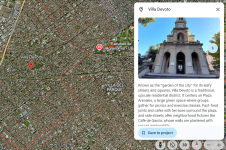
Then, the house where I live, in Villa Devoto (a neighborhood in Buenos Aires), was bought by my grandfather (a railway worker at the time, as I mentioned) for 80 pesos (every time I think about it, I can't believe it... a simple railway worker, with four children—his fifth would be born a few years later—buys a house in the first planned neighborhood of Buenos Aires, which is Villa Devoto), in 1938/9 (my father told me he was 5 or 6 years old when he came to live here). I tell you this because on the back wall of this house my grandfather bought, there's a kind of ring where horses used to be *******... When digging in my garden, I found several horseshoes and bridles.
It seems, then, that 100 years ago, this was a simple stable or something similar.
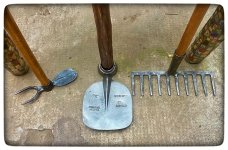
The hoe and various farming tools I have must have been bought by my grandfather, as I mentioned, for his vegetable garden. It used to be very common for people to plant tomatoes, lettuce, and other things on even the smallest piece of land, and also keep chickens and other poultry (in fact, I knew my grandmother, and in this house where I live, when I was a child, we still raised chickens; although there was no longer a vegetable garden, as it had been replaced by a brick patio).
I'm telling you this because it makes me very happy that you generously and without any need to, found out all this.
I send you my regards and thanks again for your generosity and for the detailed information you provided.