To avoid these ads, REGISTER NOW!

More Whatzits--Can we make this the official Whatzit thread?

kaymccampbell

Well-known member
Joined
Feb 27, 2015
Messages
29,518
Location
Upstate New York
Looks suspiciously like a shop smith accessory. Kay would probably know if it is or not.

@kaymccampbell
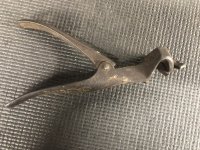
Not Shopsmith. That little key engages something that a Shopsmith doesn't have. It would crush the tube.
It does look a bit like a riggers clamp or some weird steady rest. I know I've crossed something like its path somewhere in the past, but damned if I can remember. It's designed to clamp to the ways of something.
 
To avoid these ads, REGISTER NOW!

Zrxrunner

Well-known member
Joined
Jan 14, 2018
Messages
522
Location
Eastern Iowa
Hard to link to something else at the sale I got it from too. Tractor parts/salvage/scrap/hoarder sale in small town south of me. There was a little of everything selling that day and they had this clamp on its own sale lot.
 

Porkis

Active member
Joined
Oct 9, 2022
Messages
26
Location
Utah
IMG_5942.jpeg
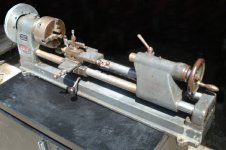
Hours and hours of looking and nothing. Cannot find the manufacturer of this chuck. Is that an H and an S? I know it’s not a Horton & Sons. I’m scared it’s going to be some lame trash brand that is good for nothing more than keeping paper from blowing away.
 

RTM

Well-known member
Joined
May 13, 2019
Messages
13,158
Location
SF Bay Area
IMG_5942.jpeg
Hours and hours of looking and nothing. Cannot find the manufacturer of this chuck. Is that an H and an S? I know it’s not a Horton & Sons. I’m scared it’s going to be some lame trash brand that is good for nothing more than keeping paper from blowing away.
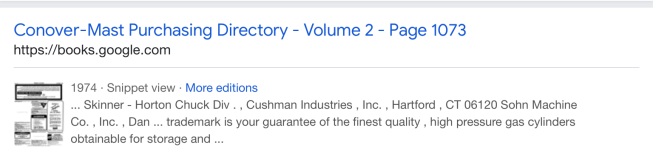
Does anyone know what the Skinner Horton logo might be? They came together in 1960 when Skinner bought Horton. Does that look like a 1960s+ chuck?

1769754736574.png


Sometime before 1974 they were acquired by Cushman.

1769754838353.png
 

RTM

Well-known member
Joined
May 13, 2019
Messages
13,158
Location
SF Bay Area
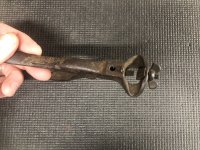
Found this at an ES, guy had lots of plumbing stuff, was not a car guy. Some Woodworking tools, saws, adze, no idea what I missed.
Solid metal, rotationally symetrical except for the groove (flat spot) at the front bottom. The ears seem to be a roll pin. Forgot to take it to my tool sale today. Showed the pic to the Whatzit guy, no clue, but thought he saw gradations on the flat spot. No gradations, just machining marks, and what might be some set screw marks.

Size 8 hand for reference, no soda can or banana for scale.

PXL_20260131_013652659-X2.jpg
 

pcrov

Well-known member
Joined
Feb 27, 2023
Messages
377
Location
Ontario, CA
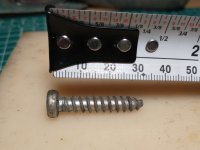
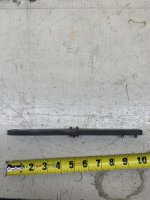
So today I was sifting through a drawer of mixed screws, throwing away the slotted (per my civic duty, ) and came across this.

It's about yay long:

IMG_20260203_195703817.jpg

Now my questions begin here:

IMG_20260203_195809667.jpg

IMG_20260203_195742900.jpg

Either this has never been used or it's been used way too much. No real in-between I can figure. It had no partners in shape and size.

I'm pretty sure it's a double entendre, but what would one call this?
 

hbp1971

Member
Joined
Mar 14, 2025
Messages
13
Hello. Since I noticed this thread was active, I wanted to try and identify the brand of two tools I'm looking for, as I'm unable (at least for now) to determine if one of them has a brand and what the other brand is.

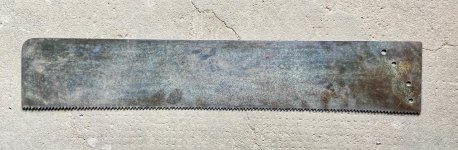
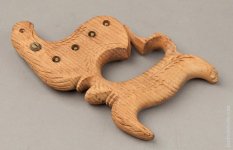
One of these tools is a handsaw. As you can see in the photos, it's incomplete (it's missing the handle and its screws). However, I found it in my father's workshop as you see it in the first photo, with ONE screw and a nut, and attached to the saw blade are two "accessories" (I don't know what to call them). I honestly don't know if these accessories belonged to this saw or another saw, or if they actually belong to a similar saw or some other tool.

So, looking at the handsaw closely, I realize it's not a very common handsaw.

The blade resembles a tenon saw, but it doesn't have the usual tenon that those saws have. On the other hand, the blade is rectangular, like that of a tenon saw, but unlike them (aside from lacking a tang), the saw's tip ends in a curve, not a right angle.

Where the handle should be, there are four screws that are somewhat aligned (at least they are aligned in a curved line, not perfectly straight), and if you look closely, you can see the mark left by the handle (when it had one).

Based on this mark left by the handle, I rule out that it's a Disston saw (Disston saw handles don't have that shape). Furthermore, in general, the saws I've seen (modern and, especially, antique) have two or three screws to attach the handle; Sometimes there are 5 screws, but from what I've seen, almost none have 4 screws, and even fewer have four screws aligned... and even fewer have four screws aligned in that way (when there are 4 screws, they're usually aligned straight and perpendicular to the saw's teeth).

I'm looking through all 4084 results (273 pages... I'm on page 50) that the word "saw" returned on a website selling antique tools... NOTHING, so far.

I'm inclined to search by the shape of the handle and the location of the screws, but so far I haven't found anything even remotely similar (I searched on Google Images, Yandex, etc.... NOTHING).

Then, another "mystery"...

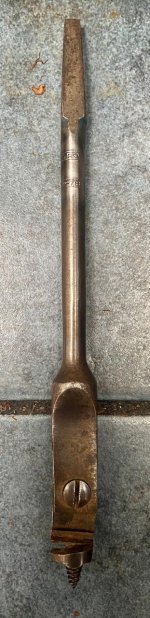
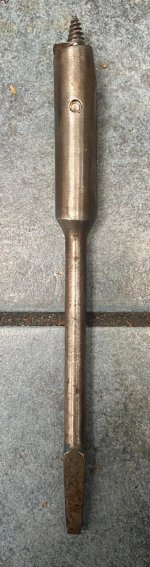
I have what is clearly an expansion drill bit. It's missing the blade and the screw to attach it. The "curious" thing about this expansion wick is that it DOES have a brand, as you can see in one of the photos (although the first letter of the brand isn't visible): CORO (it seems to be the brand) and, further down, 22-78 (which I assume must be, in millimeters, the expansion range of this drill bit).

Searching by photo, by brand, or even cropping the photo to narrow the image search, didn't yield any acceptable results, or at least none that helped me identify this brand (which clearly exists, I understand... it's not just a simple "sticker" but a brand—now that I think about it... could it be a MODEL of a well-known brand?—engraved on the metal).

Finally, I'd like to know if it's possible to make blades for these expansion wicks, because I don't know if it's possible, somehow, to get a blade that would be useful for this particular drill bit.

Anyway... If anyone can guide me, I would be very grateful. Greetings from Argentina.
SERRUCHO.jpegSERRUCHO II.jpegSERRUCHO III.jpegACCESORIO SERRUCHO.jpeg.

Mecha de expansión Coro 22-78 - I.jpegMecha de expansión Coro 22-78 - II.jpegMecha de expansión Coro 22-78 - III.jpegMecha de expansión Coro 22-78 - IV.jpeg
 
Last edited:

Provincial

Well-known member
Joined
Sep 21, 2011
Messages
6,869
Location
Near Salem, OR
Found this at an ES, guy had lots of plumbing stuff, was not a car guy. Some Woodworking tools, saws, adze, no idea what I missed.
Solid metal, rotationally symetrical except for the groove (flat spot) at the front bottom. The ears seem to be a roll pin. Forgot to take it to my tool sale today. Showed the pic to the Whatzit guy, no clue, but thought he saw gradations on the flat spot. No gradations, just machining marks, and what might be some set screw marks.

Size 8 hand for reference, no soda can or banana for scale.

PXL_20260131_013652659-X2.jpg
The machining marks indicate that the flat was cut with the side of an end mill. Combined with the black oxide coating, my guess is a limited production specialty tool. The one set-screw mark might indicate that it has been mounted in an end mill holder for a milling machine. Perhaps an arbor for a fixture or alignment device.
 

RTM

Well-known member
Joined
May 13, 2019
Messages
13,158
Location
SF Bay Area
One of these tools is a handsaw. As you can see in the photos, it's incomplete (it's missing the handle and its screws). However, I found it in my father's workshop as you see it in the first photo, with ONE screw and a nut, and attached to the saw blade are two "accessories" (I don't know what to call them). I honestly don't know if these accessories belonged to this saw or another saw, or if they actually belong to a similar saw or some other tool.
That looks like a miter box back saw blade, missing the the “back”, the folded metal bit that keeps it ridgid. Not sure the size, but mine is 5” tall, until it hits the back, then 26” long.

You can see one top right here. These big ones were typically not made by every saw maker here, like the smaller ones (<18”), so you may be able to reduce your search to the big makers. Disston, Atkins, Simonds, Pennsylvania may be ones to check. All my mitre box sized back saws are Disston or Warranted Superior. Thought I had a huge Atkins, but don’t see it on my inventory.

DSC08760-X2.jpg

The accessories don’t typically go on that style saw. Those are side plates for the handle, and since the hole patterns don’t match, almost assuredly don’t. I can’t find an image of mine right now, will dig more later.

No clue on your drill bit. Here they are thick on the ground. I wouldn’t work to look for the blade, I’d just grab another one. Assume that’s not true in Argentina.
 
Last edited:

hbp1971

Member
Joined
Mar 14, 2025
Messages
13
That looks like a miter box back saw blade, missing the the “back”, the folded metal bit that keeps it ridgid. Not sure the size, but mine is 5” tall, until it hits the back, then 26” long.

You can see one top right here. These big ones were typically not made by every saw maker here, like the smaller ones (<18”), so you may be able to reduce your search to the big makers. Disston, Atkins, Simonds, Pennsylvania may be ones to check. All my mitre box sized back saws are Disston or Warranted Superior. Thought I had a huge Atkins, but don’t see it on my inventory.

DSC08760-X2.jpg

The accessories don’t typically go on that style saw. Those are side plates for the handle, and since the hole patterns don’t match, almost assuredly don’t. I can’t find an image of mine right now, will dig more later.

No clue on your drill bit. Here they are thick on the ground. I wouldn’t work to look for the blade, I’d just grab another one. Assume that’s not true in Argentina.
First of all, thank you very much for your reply. I finally managed to see all 4,084 search results on that website selling antique tools. There were 273 pages, with 15 results per page. Obviously, I didn't look at them one by one, but rather focused on the saw handles. I couldn't find any with the screw configuration (or at least, a handle similar to the one my saw blade must have had, judging by the marks it left on the saw blade). The last screw is very close to the saw teeth, and from the mark left by the handle, it seems to have been only a few millimeters above those teeth. Well... I haven't found any screw (in the results I looked at) in that specific location. What's more... Regarding tenon saws, from what I've observed (tell me if I'm wrong), the handles are usually positioned quite far from the blade teeth, on the spine of the blade... That is to say: from the middle of the blade upwards, towards the spine. I have seen that on some Atkins saws (a few) and some Sandvik saws (few, but more numerous than Atkins), the handle usually comes within a few centimeters of the blade teeth; but never like on the one I have, with the handle almost touching the blade teeth.


I agree with you that those accessories don't belong to my saw blade in any way (even though they were attached by ONE screw). The curious thing is that this screw (it's not in the photo... that is: what's in the photo isn't the screw head, but the other part) is EXACTLY THE SAME as the screws I saw for sale (on that same website I mentioned where I looked at those 4000+ results) for a Disston handle (I've included two photos of that handle). That would lead me to think it's a Disston... However, I've seen on the Disstonian Institute website that there isn't a single handle even remotely similar to the one my saw supposedly had. Disston saw handles are very distinctive, very recognizable. The mark on my saw blade doesn't seem to indicate that it was the shape of a Disston handle.

As for the expansion drill bit, you're right... In Argentina, expansion drill bits are already difficult to find. Of this type... Not even used... They sell something that's the same concept and almost the same shape, but in sets, and they're called spade bits. They serve the same function, but instead of a bit with that millimeter adjustment like an expanding bit, there are several bits (cheaper, less material, etc.) of different sizes. I won't even mention finding someone who would bother to make a blade for that bit... Anyway...

I'm going to keep looking at Simonds and Pennsylvania saws to see if I can find something similar.

My intention was/is to make a handle as similar as possible to the original handle. But, to do that, I would need to find a saw that's the same or at least similar (something I haven't managed to do so far). It happened to me with an M. Harry P. Will pliers, made in Germany... I spent weeks trying to identify the brand by the shape of the pliers and what little I could see of the name engraved on them... Finally, I found a photo in an online sale and was able to identify my pliers.

Thank you so much again for taking the time to take the photos and send them.

Greetings from Argentina.

DISSTON - I.jpegDISSTON - II.jpeg
 

RTM

Well-known member
Joined
May 13, 2019
Messages
13,158
Location
SF Bay Area
My intention was/is to make a handle as similar as possible to the original handle. But, to do that, I would need to find a saw that's the same or at least similar (something I haven't managed to do so far).
Oh, don't be boring. This is your saw blade, make it your handle too. Design it to fit YOUR hand, and your way of working. All you need to match is the attachment holes. Everything else can be freeform


Regarding the bottom hole being close to the toothline, lots of love and sharpening can do that. This was a hint at me poking for size. In the Disston world, the big saws came in 4, 5, and 6" depths, and then the length was sorta fixed. Don't forget to add an inch for the back. If the get too short, they no longer fit in some boxes.

The miter box saws shown here may help, can't read on phone.


Still poking on the handle shape to match.
 

four.cycle

Well-known member
Joined
Oct 19, 2015
Messages
28,878
Location
Tacoma, Washington
To avoid these ads, REGISTER NOW!

hbp1971

Member
Joined
Mar 14, 2025
Messages
13
Oh, don't be boring. This is your saw blade, make it your handle too. Design it to fit YOUR hand, and your way of working. All you need to match is the attachment holes. Everything else can be freeform
Without a doubt, I'm going to do that. What I initially thought was to try to reconstruct (if you can call it that) the "original" handle (well... what I assume was the "original" handle that left those marks), and for that, nothing better than finding a photo or drawing somewhere of a similar saw. But, for now, I haven't managed it... And believe me, I've tried...

In the International Tool Catalog Library, I entered "saw" in the "search metadata" field and it returned 297 results... That is: 297 catalogs. I suppose the system searched and found the word "saw" in those catalogs. But... Ugh... 297 catalogs... I armed myself with patience and reviewed, ONE BY ONE, ALL the catalogs that appeared in that search and EACH AND EVERY page of each catalog, and I must say that I haven't found ANYTHING even remotely similar.

To begin with, the handles... NONE with that shape on any type of saw. I've seen ONE with a similar (but not identical) shape offered as a handle (without actually being part of a saw). And a few others (two or three at most) that could be said to slightly resemble the handle my saw should have had.

Then, the fixing holes... their number (4), their alignment (aligned one behind the other forming a slightly curved line), and their specific location (the last hole is almost directly over the saw's teeth). The holes on NONE of the saws I saw matched those parameters.

And well... The blade... NONE with that shape (the rounded tip on my saw). I suppose the rounded tip of my saw's blade indicates (I think... I'm not sure) that the tang or spine of the backsaw was located there, along the spine of my saw's blade.

So, WITHOUT HESITATION (before this "obsession" with finding a saw identical or similar to mine, I had already planned to make a handle for it), I'll follow your suggestion.

Perhaps the brand of my saw might have been on the missing handle... The thing is, I want to make a handle for it, and I'm asking you... Should I put a tang on my saw, like tenon saws do? I haven't seen, so far, any tenon saw that... DIDN'T have a tang... Hehehe... Nor, I must say, have I seen any saw with a rectangular blade that WASN'T a tenon saw.

Finally, it may be that my saw was simply a handmade piece and not a saw manufactured by a company that makes/sells saws.

Best regards, and I hope you have a great weekend.
 

RTM

Well-known member
Joined
May 13, 2019
Messages
13,158
Location
SF Bay Area
RT … what’s the story of that skinny hammer at the top of the picture?
If looking for me, and this post's first picture

That is a tack hammer with a splayed out puller in the bottom of the handle.

@Lugz posted a pic of a nice Stanley recently. Mine looks a lot like it, except for the nice part. I have a pic somewhere. Handle was painted red n yellow for owner ID (lots of tools from that sale were). splayed puller, been kicking around the garage for years.
 

hbp1971

Member
Joined
Mar 14, 2025
Messages
13
Hello...

I hope someone can answer this little question I have.

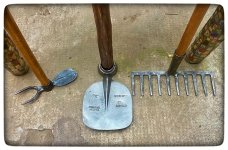
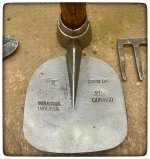
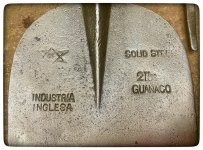
This is a hoe that I believe belonged to my grandfather Alcides (my father Jorge's father), who passed away before I was born, 54 years ago (that's my age, of course). There are several of his tools in my father's workshop. Not all of them, though, because, according to my father, his brothers surreptitiously "appropriated" them. However, some survived, which my father was able to salvage and keeps as a treasure (I, too, must admit, do the same with my father's and grandfather's tools, and generally with everything that belonged to my ancestors).

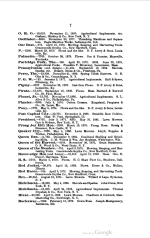
This hoe (or mattock, as we also call it in Argentina) has obvious marks, as you can see. What I was able to find out is that John Dunn, in New York, patented three trademarks in 1886 (this is recorded in the 1893 Digest of Trade Marks... I've included some screenshots so you can see): Guanaco (Agricultural Implements, one patent in 1886), Excelsior (Shovels and Spades, two patents in 1875 and 1886), and Richibucto (Shovels and Spades, one patent in 1886).

The logos, as you can see in one of the screenshots, have NOTHING to do with the Star of David on the left. Inside that Star of David, there are two letters that I believe are "WE" (they could be WF... but I'm more inclined to think it's WE... I seem to see, although somewhat blurry, the last horizontal line of the letter "E"). And what surprises me even more is this: "INDUSTRIA INGLESA" in... SPANISH. In other words... Normally, when products from England arrive in Argentina (I remember my beloved Matchbox cars, Made in England), they arrive with those three words: Made in England. I have NEVER, but NEVER, seen anything similar on an English product... Although not from the United States either... I mean: why in Spanish?

Then... This hoe doesn't come from the United States, as one would expect, since the trademark was registered there?

So, it's not clear to me where this hoe REALLY is from (whether England or the United States); why the text is in Spanish, and what the Star of David with two initials has to do with it (could it be the name of the person who forged the hoe? The "inventor" of that hoe?). Furthermore, it only says "Guanaco" and there's no Guanaco logo... Is it, then, a "Guanaco" product manufactured in the USA, or is it an "English Industry" product manufactured in England under license granted by John Dunn to someone who manufactured it in England?

I apologize for being so inquisitive, but I like to know the history of the tools I own and, through them, also learn a bit about my family history.

I send my greetings to everyone and hope you have a great weekend.
 

Attachments

  • ZAPA - II.jpeg
    ZAPA - II.jpeg
    255.8 KB · Views: 35
  • ZAPA - III.jpeg
    ZAPA - III.jpeg
    389.1 KB · Views: 36
  • ZAPA - IV.jpeg
    ZAPA - IV.jpeg
    388.9 KB · Views: 30
  • John Dunn (Guanaco, Excelsior y Richibucto) - I.png
    John Dunn (Guanaco, Excelsior y Richibucto) - I.png
    182.1 KB · Views: 26
  • John Dunn (Guanaco, Excelsior y Richibucto) - II.png
    John Dunn (Guanaco, Excelsior y Richibucto) - II.png
    184.4 KB · Views: 18
  • John Dunn (Guanaco, Excelsior y Richibucto) - III.png
    John Dunn (Guanaco, Excelsior y Richibucto) - III.png
    182.9 KB · Views: 11
  • John Dunn (Guanaco, Excelsior y Richibucto) - IV.png
    John Dunn (Guanaco, Excelsior y Richibucto) - IV.png
    138.3 KB · Views: 10
  • John Dunn (Guanaco, Excelsior y Richibucto) - V.png
    John Dunn (Guanaco, Excelsior y Richibucto) - V.png
    186.8 KB · Views: 15

RTM

Well-known member
Joined
May 13, 2019
Messages
13,158
Location
SF Bay Area
Furthermore, it only says "Guanaco" and there's no Guanaco logo... Is it, then, a "Guanaco" product manufactured in the USA, or is it an "English Industry" product manufactured in England under license granted by John Dunn to someone who manufactured it in England?
I checked the DAT for Dunn, in NY, and the only one was not John.

Could be that John Dunn was an importer / exporter, and not a maker, which could explain the convoluted path you are seeing. Maybe poke directories for him in that era, see what his job was.

Gotta check another older catalog on Hoe shapes.

This listing looks interesting, has NY, Guamaco and Hoe on the same page, but it’s a paper insulator, if my translation is to be believed


Private Lugnutz

Well-known member
Joined
Mar 30, 2012
Messages
30,574
Location
The Authentic Jersey Shore
John Dunn, in New York, patented three trademarks in 1886 (this is recorded in the 1893 Digest of Trade Marks... I've included some screenshots so you can see): Guanaco (Agricultural Implements, one patent in 1886),
Hernán,

Patents (Utility and Design) and Trademarks are two different kinds of intellectual property granted, issued, or awarded here in the US. Patents are for unique things, Trademarks are for unique symbols and/or terms.

One tidbit I pulled out of the record in the USPTO Trademark Status and Document Retrieval system (google 'TSDR' and you'll find it, very useful research tool) for Dunn's 'Guanaco' TM (13,346), linked here, is that he was a "subject of the Queen of England" (i.e., British citizen) residing in New York. That means almost certainly an import/export agent. I don't know how much that helps answer your questions about the markings on this particular tool.

Linked here in Google Books is an article from a 1924 issue of the Farm Machinery and Hardware trade mag, connecting him, indirectly, to a big plow deal in Argentina. See the caption to the photo. I'm not exactly sure in this context what "consigned" means when the manufacturer was in Moline, Illinois, and Dunn was not the distributor, either.
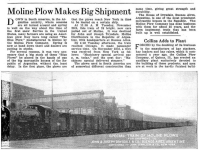
1771561844684.png

Another clue from a 1912 American Exporter directory here...

1771563097345.png

The logos, as you can see in one of the screenshots, have NOTHING to do with the Star of David on the left.
The Star of David "WE" trademark is very likely the manufacturer's or foundry's trademark. John Dunn was not the manufacturer. I don't know how you would identify it other than paging through directories of Trademark Digests like the one you excerpted. There are thousands of them.
 

Old tool guy

Well-known member
Joined
Apr 13, 2023
Messages
3,268
I’m thinking this means he was the shipper and handled the customs paperwork, loading on the ships, bribes on the receiving end etc, and the plows were his until delivered to the end user.
 

hbp1971

Member
Joined
Mar 14, 2025
Messages
13
Hernán,

Patents (Utility and Design) and Trademarks are two different kinds of intellectual property granted, issued, or awarded here in the US. Patents are for unique things, Trademarks are for unique symbols and/or terms.

One tidbit I pulled out of the record in the USPTO Trademark Status and Document Retrieval system (google 'TSDR' and you'll find it, very useful research tool) for Dunn's 'Guanaco' TM (13,346), linked here, is that he was a "subject of the Queen of England" (i.e., British citizen) residing in New York. That means almost certainly an import/export agent. I don't know how much that helps answer your questions about the markings on this particular tool.

Linked here in Google Books is an article from a 1924 issue of the Farm Machinery and Hardware trade mag, connecting him, indirectly, to a big plow deal in Argentina. See the caption to the photo. I'm not exactly sure in this context what "consigned" means when the manufacturer was in Moline, Illinois, and Dunn was not the distributor, either.

1771561844684.png

Another clue from a 1912 American Exporter directory here...

1771563097345.png


The Star of David "WE" trademark is very likely the manufacturer's or foundry's trademark. John Dunn was not the manufacturer. I don't know how you would identify it other than paging through directories of Trademark Digests like the one you excerpted. There are thousands of them.
Hello...

Honestly, I'm amazed and grateful.

I knew nothing about this, and now I understand much better the origin and how this hoe must have arrived in Argentina.

In 1810 (I'm not going to talk about politics, just history), Argentina established what is known as the First National Government (First Governing Junta), known in Argentina as the "May Revolution." But it wasn't an independent country, in fact. Argentina declared its independence in 1816.

However, a century later, in 1910, the so-called "Centennial" of the May Revolution was celebrated very extensively (according to what I read).

Then, from 1880 onward, Argentina adopted a distinctly agro-export-oriented economic profile. By 1910, this model was very well established.

It is then that the news about the export of agricultural implements to Argentina makes sense.

My father, who is still alive, was born in 1933. I was born in 1971. And my grandfather, Alcides, passed away, as far as I understand, a year or two before I was born. Since my grandmother, his wife, was born in 1905 and my father in 1933 (he wasn't my grandmother's first child), I suppose this hoe must have come into my grandfather's possession sometime between the 1920s and 1930s. It's clearly not a tool my father would have bought, but rather my grandfather, who, moreover, worked on the railroads in Argentina when they were managed by "the British" (as we always say here when referring to the period before the nationalization of the railroads). Perhaps, during that time, he bought several tools of English origin that I own today.

Argentina, as you know, had almost no industry at that time, and that's why many old tools in Argentina were of French, English, and German origin, primarily (although, of course... also from the US, but to a lesser extent).

Then, the house where I live, in Villa Devoto (a neighborhood in Buenos Aires), was bought by my grandfather (a railway worker at the time, as I mentioned) for 80 pesos (every time I think about it, I can't believe it... a simple railway worker, with four children—his fifth would be born a few years later—buys a house in the first planned neighborhood of Buenos Aires, which is Villa Devoto), in 1938/9 (my father told me he was 5 or 6 years old when he came to live here). I tell you this because on the back wall of this house my grandfather bought, there's a kind of ring where horses used to be *******... When digging in my garden, I found several horseshoes and bridles.

It seems, then, that 100 years ago, this was a simple stable or something similar.

The hoe and various farming tools I have must have been bought by my grandfather, as I mentioned, for his vegetable garden. It used to be very common for people to plant tomatoes, lettuce, and other things on even the smallest piece of land, and also keep chickens and other poultry (in fact, I knew my grandmother, and in this house where I live, when I was a child, we still raised chickens; although there was no longer a vegetable garden, as it had been replaced by a brick patio).

I'm telling you this because it makes me very happy that you generously and without any need to, found out all this.

I send you my regards and thanks again for your generosity and for the detailed information you provided.
 

Private Lugnutz

Well-known member
Joined
Mar 30, 2012
Messages
30,574
Location
The Authentic Jersey Shore
thanks again for your generosity and for the detailed information you provided.
You're welcome. It's an interesting tool with an even more interesting history, about which I would have known nothing without seeing it.
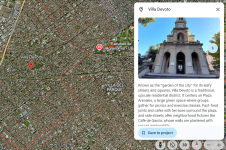
Villa Devoto (a neighborhood in Buenos Aires),
I Google Earthed it.

1771677370998.png

It was interesting to zoom in and scan around and very easy to visualize it 100 years ago with your descriptions in mind.

The way that part of the city was planned around the park (Plaza Arenales), with the streets and walkways radiating geometrically from the very center of the park, is sooo European.

About 30 years ago, during a phase of my career in which I was supporting Army, DEA, and State Department operations I won't discuss, I travelled extensively in Central and South America, mainly in the northern part of the continent, back and forth between US embassies (always located in cities) and 2- to 3-days excursions into the countryside. One of the things that stuck with me about Bogota (other than the scheduled brown outs, twice a day!) was how European it looked and felt, from colonial to Neoclassical to Belle Époque.

But also how quickly, abruptly and starkly the terrain went from urban to agrarian and then wilderness. As opposed to here in the US, with cities giving way to suburbs, suburbs giving way to larger and smaller towns, separated by rural and wooded areas, and eventually to open country with nothing but farmland and hills and woods with fewer and fewer and smaller and smaller towns in between.

I've never been to Buenos Aires, but I am of course aware of its reputation as the ne plus ultra example.
I knew my grandmother, and in this house where I live, when I was a child, we still raised chickens;
I'm older than you and I grew up in a small town in Carbon County, Pennsylvania, and as the name suggests, it was surrounded by mines, mills, and other heavy industry. Today it's known as a sleepy upper middle class commuter town with picaresque houses where nobody would raise chickens. But when I was a boy...
I was deathly afraid of our grandparents' rooster when I was a kid. It was mean as sin and visibly enjoyed terrorizing us. On its last day on God's green earth it was chasing my brother, made him fall and rip his face up real bad near his eye on a broken crate. Our grandma came flying out the back door muttering curses in the mother tongue of "the old country" with a cleaver, trapped it, sat on it, and dispatched it to eternal Gallus gallus domesticus damnation. That was the last rooster they ever had.
:)
 

hbp1971

Member
Joined
Mar 14, 2025
Messages
13
So you live in your grandfathers house?
Yes, that's right.

Despite my age, I've unfortunately never been able to obtain the resources to buy a property (and I don't think I will be able to now or in the future).

This house was bought, as I said, by my grandfather. Later, he bought the lot next door. Both lots have a standard size: 8 meters by 20 meters... More precisely, something like 10 varas wide by—I think—25 varas deep. In the past, due to Spanish influence, the vara was used as a unit of length. Hence the "strange" length of the frontage of 8.66 meters, which is equal to 10 varas of 0.866 meters each. This is what Wikipedia says about it, and of course, it's correct:

"In Argentina, the 'Castilian vara of the Province of Buenos Aires' (0.866 m), the 'Castilian vara of Rosario' (0.862 m), the 'Castilian' (0.848 m), and the 'Santa Fe' vara (0.836 m) were used. In the City of Buenos Aires, many urban lots were subdivided into parcels with a 10-vara frontage, and therefore the lot frontage is 8.66 m. This doesn't happen in other more modern cities or those with a more recent layout, where most lots typically have a 10-meter frontage."

My father built his workshop on that lot next to his parents' house. Later, we lived there for many years until we moved across the street to another lot that my father was able to buy. There he built his new house; our new house (and that's where my father and mother live today). My grandmother passed away and left this house "in probate" (it's not a will, strictly speaking, but an inheritance process that occurs after a person's death... the assets are divided equally among the heirs), which still hasn't been resolved. In other words, the inheritance hasn't been settled yet, even after almost 40 years. My father and my mother, who have paid the taxes and maintenance on this house for almost 55 years, are initiating a lawsuit to transfer the title to my mother's name (his siblings, my father's siblings, have sued their own brother... family resentment against my father). Until that process is resolved, I live in this property, paying my parents rent (which isn't a large amount... it's a help I appreciate from them).

I would have liked to buy this house (where I grew up for much of my childhood), which, of course, is currently impossible. Of course, I would also have loved to live in my own place.

I try, as much as possible, to maintain the place as best I can, and as for my father's workshop, as I mentioned in another thread, two years ago I started cleaning, preserving, and/or restoring all his hand and power tools. I'm almost finished (more than 800 tools... fewer than 10 left). And that restoration/preservation of my father's tools is what led me to this place, The Garage Journal.

I'm glad to have found this place where I can get accurate and well-documented information and, moreover, where I'm treated with respect and kindness (something I, at least, especially appreciate).
 
Last edited:
To avoid these ads, REGISTER NOW!
Top Bottom