To avoid these ads, REGISTER NOW!

Wiring a switch-How best to run my romex?

Model A Fan

Well-known member
Joined
Dec 1, 2011
Messages
1,223
Location
NW Washington
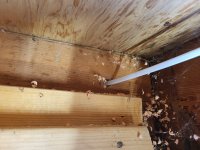
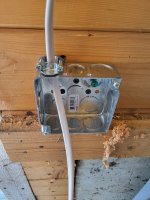
I'm wiring in a switch and I'm wondering if I can run two lines of romex under the same staples and through the same hole in the metal box or if I have to separate the incoming and outgoing lines.

I'm doing new lighting based off a switch for some LEDs and doubling up would be tidier but I also want to remain compliant. My other thought was run the romex I to a box above, run THHN down some conduit to the switch and then the THHN goes back up the conduit to the lighting. All I'd have to do is put everything in a junction box up top and run the ground and black wire down and back up the conduit where the neutral, hot, and ground would then proceed to the first outlets.

This is all with 14AWG for lights and a 15A breaker. It will only power outlets into which LED shop lights would be plugged.

Thank you!
20260405_135950.jpg20260405_142018.jpg20260405_140006.jpg20260405_135944.jpg
 
To avoid these ads, REGISTER NOW!

BillK

Well-known member
Joined
Aug 24, 2006
Messages
9,368
Location
Beautiful Southern Maryland
It takes about 30 seconds to punch out another hole in the box and be done with it. To be honest with you I think that is "neater" than putting 2 cables in one clamp which might not even be allowed.
 

PCustoms

Well-known member
Joined
Jul 23, 2011
Messages
23,574
Location
VT
I'd at least run a conduit chase, as that doesn't appear to be a protected location and you can't have exposed NM-B like that.

I forget the rules, but 2 runs of 14/3 will easily fit in 3/4. May be able to go 1/2.

Also your hole looks a little low on that joist
 
Last edited:

dave*99

Well-known member
Joined
May 5, 2009
Messages
4,289
Location
Coastal NJ
All I'd have to do is put everything in a junction box up top and run the ground and black wire down and back up the conduit where the neutral, hot, and ground would then proceed to the first outlets.
This implies you would not have a neutral in the switch box. You should include one in that conduit. It would allow you to use a smart switch if you ever needed to.

I suspect my post will trigger a long code discussion about exceptions where you may skip the neutral since there is conduit etc., but suffice it to say the added neutral will be compliant.
 

cgrutt

Well-known member
Joined
Mar 4, 2016
Messages
8,384
This implies you would not have a neutral in the switch box. You should include one in that conduit. It would allow you to use a smart switch if you ever needed to.

I suspect my post will trigger a long code discussion about exceptions where you may skip the neutral since there is conduit etc., but suffice it to say the added neutral will be compliant.
If he ran NM instead wouldn't it be the same result (i.e., no neutral at the switch)?
 

dave*99

Well-known member
Joined
May 5, 2009
Messages
4,289
Location
Coastal NJ
If he ran NM instead wouldn't it be the same result (i.e., no neutral at the switch)?
When he mentioned NM, he was talking 2 cables, hence a neutral would be in the switch box.

I'm wiring in a switch and I'm wondering if I can run two lines of romex under the same staples and through the same hole in the metal box or if I have to separate the incoming and outgoing lines.
 

purplezr2

Well-known member
Joined
Jun 1, 2010
Messages
5,300
Location
Central MN
If he ran NM instead wouldn't it be the same result (i.e., no neutral at the switch)?


The old way of running a single line of 14-2 NM to the outlet is no longer up to code, code requires you to have a neutral at the switch. In this case he could run 14-3/12-3 depending on need and have two conductors, neutral, and ground. This assume power is supplied to the switched device. If power is run to the switch, then you can run regular 14-2 to the device.
 

cgrutt

Well-known member
Joined
Mar 4, 2016
Messages
8,384
When he mentioned NM, he was talking 2 cables, hence a neutral would be in the switch box.
I read that as being at a junction box before the switch. Why would you use a single 4x4 box at a switch? Anyway, single NM run to switch is pretty common. The white conductor is marked black and used as a hot.

ETA didn't see code changed before posting.
 

cgrutt

Well-known member
Joined
Mar 4, 2016
Messages
8,384
The old way of running a single line of 14-2 NM to the outlet is no longer up to code, code requires you to have a neutral at the switch. In this case he could run 14-3/12-3 depending on need and have two conductors, neutral, and ground. This assume power is supplied to the switched device. If power is run to the switch, then you can run regular 14-2 to the device.
Thanks did not know it changed.
 

cgrutt

Well-known member
Joined
Mar 4, 2016
Messages
8,384
Just circling back to the code requirements. Seems as if neutral would not be required in this case at the switch box because the switch will be wired to outlets (i.e., "where switch controlls a receptical load"). Also, there appears to be second exemption if OP runs conduit to the switch and the conduit (i.e., "raceway") is large enough to accommodate a neutral (i.e., "grounded conductor") if one was needed at a later date. Is this correct? Relevant code is at 404.2 c I believe.
 

dave*99

Well-known member
Joined
May 5, 2009
Messages
4,289
Location
Coastal NJ
Since the lights will be plugged into a receptacle, assuming this is a garage, GFCI protection will be needed.
 

T444e

Well-known member
Joined
Feb 25, 2016
Messages
456
Why would you use a single 4x4 box at a switch?
I'm just a hack that works on my own stuff, but I always use a 4 square box with mud ring. I like the extra room and allows the ability for a change down the road. Maybe it's because I've been bit by 3x2 boxes when wanting to install dimmer switches and not comfortable trying to stuff it in the box.
 

cgrutt

Well-known member
Joined
Mar 4, 2016
Messages
8,384
I'm just a hack that works on my own stuff, but I always use a 4 square box with mud ring. I like the extra room and allows the ability for a change down the road. Maybe it's because I've been bit by 3x2 boxes when wanting to install dimmer switches and not comfortable trying to stuff it in the box.
That may be the case but I still read OP as a junction box up top feeding separate line to switch below. Not an electrician but don't believe switch box requires neutral in configuration described in OP.
 

dave*99

Well-known member
Joined
May 5, 2009
Messages
4,289
Location
Coastal NJ
That may be the case but I still read OP as a junction box up top feeding separate line to switch below. Not an electrician but don't believe switch box requires neutral in configuration described in OP.
Code considerations aside, I’d put a neutral in the final switch box. And the switch box might be a good place to locate the GFCI for the receptacles connected to the switch.
 
Last edited:
OP
M

Model A Fan

Well-known member
Joined
Dec 1, 2011
Messages
1,223
Location
NW Washington
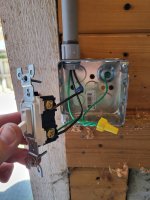
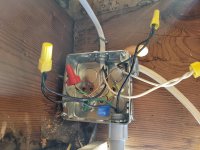
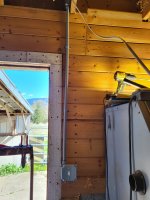
Well, I decided to not go the cheesy route and I just ran THHN down some conduit from a junction box. You'll see in the pics the black wire with blue tape marking it. That is the hot line in from the Romex down the conduit to the top screw on the switch. The wire without tape is the return to the "downstream" romex leading to the outlets.

I'm coming in off a 50A sub-panel, and the romex is powered by a 15A breaker. This is strictly for lighting in boxes in the ceiling.

The previous owner put up ¾" pine tongue and groove and did OSB to the whole ceiling. In a very "puzzly" fashion...I'm halfway tempted to yank it and use a nicer plywood painted white.

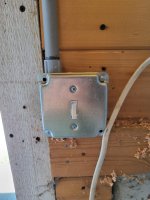
I have the 4x4 box for the switch because I overestimated the amount of wiring that would be in the box. All that's there is the black THHN and three grounds (one running from the romex into switch box, one to ground the box, one to pigtail from the switch to the bundle [please see pic]). I bought a metal face plate for the singular switch as well.

What is the talk of needing a neutral in the box? What purpose does it accomplish? What would I connect it to? I literally got internet for my house a week ago. I don't ever envision having "smart switches" for my barn. I'll be doing a GFCI for the first outlet of this run of outlets. It will power four 5500 lumen LED light fixtures.

I also redrilled my hole through the noise a little higher.20260407_134950.jpg20260407_140003.jpg20260407_135939.jpg20260407_135953.jpg20260407_140319.jpg20260407_140410.jpg
 

cgrutt

Well-known member
Joined
Mar 4, 2016
Messages
8,384
Not an electrician but believe you are fine the way it is wired. The unused neutral in the switch box is a code requirement. Believe the concern is if you or any future owner ever decided to install a smart device or dimmer, they don't want it wired to the ground. However, in your installation believe you are compliant due to one or more exemptions the first being you have it installed with conduit and a neutral can easily be added to that circuit in future if needed and (possibly) second exemption if downstream boxes are switched outlets (which it sounds like they are) adding a smart device or dimmer to that circuit is not likely. In any event, this is a relatively recent requirement (since 2010) in past a separate neutral would not have been needed. I misunderstood where that box was in your original post its fine being 4x4 with the switch plate but could have been done with a standard single gang as well. Nice job.
 
To avoid these ads, REGISTER NOW!

Codyboy

Well-known member
Joined
Jan 31, 2019
Messages
1,727
Location
S.E. TEXAS
Looks like the switch is a self grounding type.
Is there still the need to run the ground pigtail to the switch?
 

cgrutt

Well-known member
Joined
Mar 4, 2016
Messages
8,384
Looks like the switch is a self grounding type.
Is there still the need to run the ground pigtail to the switch?
Yes because ground is immediately detached when its being serviced (if pigtail is not attached).
 

Codyboy

Well-known member
Joined
Jan 31, 2019
Messages
1,727
Location
S.E. TEXAS
Yes because ground is immediately detached when its being serviced (if pigtail is not attached).
When servicing, the breaker is most likely off and no need for a ground.
If its as you say, what is the point of self grounding devices?
 

cgrutt

Well-known member
Joined
Mar 4, 2016
Messages
8,384
When servicing, the breaker is most likely off and no need for a ground.
If its as you say, what is the point of self grounding devices?
Have at it believe standard practice is to attach ground to the device. Most enclosures today are plastic and many metal boxes are not actually grounded unless installer attaches ground to the box. In this case there's plastic conduit it could also have been NM cable. Many people service devices without shutting off the breaker. If you don't want to attach ground don't makes no difference to me.
 

dscheidt

Well-known member
Joined
Apr 26, 2017
Messages
2,910
Have at it believe standard practice is to attach ground to the device. Most enclosures today are plastic and many metal boxes are not actually grounded unless installer attaches ground to the box. In this case there's plastic conduit it could also have been NM cable. Many people service devices without shutting off the breaker. If you don't want to attach ground don't makes no difference to me.
not grounding the box is a much bigger problem than not grounding the device.
self grounding devices are allowed in exposed metal boxes, if the covers have recessed corners, the box is properly bonded, and the device is attached to the cover with locking nuts. Nothing wrong with putting the ground on the device, other than it takes time and wire, but I'd probably do it here, because wire is already there. In a metallic conduit system, there's not usually a ground wire (because it will never carry fault current, the conduit is so much lower impedance, there's no reason to run it unless you're worried about the mechanical integrity of the conduit. If you're worried about that, you probably have other problems....) so no one attaches a bonding wire to the device.
 
OP
M

Model A Fan

Well-known member
Joined
Dec 1, 2011
Messages
1,223
Location
NW Washington
Not an electrician but believe you are fine the way it is wired. The unused neutral in the switch box is a code requirement. Believe the concern is if you or any future owner ever decided to install a smart device or dimmer, they don't want it wired to the ground. However, in your installation believe you are compliant due to one or more exemptions the first being you have it installed with conduit and a neutral can easily be added to that circuit in future if needed and (possibly) second exemption if downstream boxes are switched outlets (which it sounds like they are) adding a smart device or dimmer to that circuit is not likely. In any event, this is a relatively recent requirement (since 2010) in past a separate neutral would not have been needed. I misunderstood where that box was in your original post its fine being 4x4 with the switch plate but could have been done with a standard single gang as well. Nice job.
Thank you for the reassurance. I don't plan on running smart anything in my barn, so I figure if the need ever arose, I could just run one strand through the conduit.
The crooked PVC is a nice touch 😂
The door is installed crooked, not the conduit 😅 just kidding, i fixed it! I saw it after I got done last night and was not going to mess with it but now I did since it was so noticeable.

20260408_130841.jpg
Mountain as backdrop looks awesome!!!
Thanks, it is a great view!

20260408_130624.jpg
Will this GFCI be easily reached? Meaning without a ladder etc?

This staple is deep into the insulation

1775649879264.png
I will need a ladder for this GFCI outlet. I checked and its not digging in, but I appreciate the pointing out. I pulled that staple and put a non-bent one in.

20260408_130234.jpg20260408_130340.jpg

Looks like the switch is a self grounding type.
Is there still the need to run the ground pigtail to the switch?
I just ground everything...I figure its safer to ground the box and switch than to not do it. Perhaps its overboard, but it is not much extra work and near zero cost.
 

dave*99

Well-known member
Joined
May 5, 2009
Messages
4,289
Location
Coastal NJ
I will need a ladder for this GFCI outlet. I checked and its not digging in, but I appreciate the pointing out. I pulled that staple and put a non-bent one in.
That's not good and easily avoidable. Put a dead front GFCI in the switch box and you will have access. Add a neutral to and from the GFCI inside the conduit.

1775681235338.png
 

PCustoms

Well-known member
Joined
Jul 23, 2011
Messages
23,574
Location
VT
That's not good and easily avoidable. Put a dead front GFCI in the switch box and you will have access. Add a neutral to and from the GFCI inside the conduit.

1775681235338.png

Meh

I left mine in the ceiling.

If the outlet isn't easily accessible, why should it require a GFCI?
 

Codyboy

Well-known member
Joined
Jan 31, 2019
Messages
1,727
Location
S.E. TEXAS
That's not good and easily avoidable. Put a dead front GFCI in the switch box and you will have access. Add a neutral to and from the GFCI inside the conduit.

1775681235338.png
Or at least get some benefit out of it as op already has a 4x4 box.
They mame steel covers also. Couldn't find a pic.
 

Attachments

  • Screenshot_20260408_160210_Chrome.jpg
    Screenshot_20260408_160210_Chrome.jpg
    349 KB · Views: 10

dscheidt

Well-known member
Joined
Apr 26, 2017
Messages
2,910
Meh

I left mine in the ceiling.

If the outlet isn't easily accessible, why should it require a GFCI?
because you can get electrocuted while you're on a ladder? Because whatever is plugged into the outlet might be accessible or might energize something that is?
 

dave*99

Well-known member
Joined
May 5, 2009
Messages
4,289
Location
Coastal NJ
Or at least get some benefit out of it as op already has a 4x4 box.
They mame steel covers also. Couldn't find a pic.
That makes for a convenient place to plug something in. Less convenient when it trips the GFCI and all the lights go out.
 
OP
M

Model A Fan

Well-known member
Joined
Dec 1, 2011
Messages
1,223
Location
NW Washington
That makes for a convenient place to plug something in. Less convenient when it trips the GFCI and all the lights go out.
I understand the thought process behind putting a GFCI next to the switch, but I don't care for the plug right next to switches, as when you walk in and lift the switch, you may invariably knock whatever is plugged in out. Not a big deal, but I have a bunch of switches that just aren't in well lit areas and I often have to fumble for them (garage is like this for the garage door button). One smooth face plate with one switch is perfect for this application. I'll be plugging 4-6 Braun brand shop lights into the ceiling outlets, so nothing that will be plugged in and out very much.

I'll be running 12AWG for outlets for equipment for the workspace. I have a big Skat Blast sand blaster and have already wired in my 220v 80gal air compressor with a 5hp motor. Its a real brute. Here's the thread with pics: Big Brown Beast and Skat Blast Cabinet

I truly do enjoy the wiring/electrical work. It is methodical and it clicks with my brain. I'm slow compared to a pro, but it only costs me materials as I work on it about 4-6hrs/week. It took forever to get my compressor wired in (got it done two weeks ago) as I have other more pressing projects to work on. I redid my garage with outlets in half the garage, ran new lighting and wire, stripped out all the old **** (extension cords spliced into Romex; 14/3 used when 14/2 should have been used, upgraded the panel and amperage for it, ran new sub-panel on other end of the garage. Its been fun, but my ultimate project is the restoration of a WWII Jeep. All these little side quest projects are in an effort to be able to work on it. Now I have my welder able to do 220v operating, air compressor for the sand blaster is wired in, now its time to get light and power to the workspace and start working on the Jeep! I've taken the engine down to a bare block and its now engine and body work.
 

dave*99

Well-known member
Joined
May 5, 2009
Messages
4,289
Location
Coastal NJ
I understand the thought process behind putting a GFCI next to the switch, but I don't care for the plug right next to switches, as when you walk in and lift the switch, you may invariably knock whatever is plugged in out.
I agree. That’s why I suggested a dead front GFCI. The test and reset buttons are recessed. It has the GFCI functionality but does not have a receptacle. See photo in post 30. The alternative is a GFCI breaker in the panel.
 

Codyboy

Well-known member
Joined
Jan 31, 2019
Messages
1,727
Location
S.E. TEXAS
Well whet
That makes for a convenient place to plug something in. Less convenient when it trips the GFCI and all the lights go out.
Well whether the gfci is on the ceiling or right there by the switch, if it trips , the lights are still going out.
Just because its there makes it convenient, it doesn't have to be used . Or at least with a permanent fixture plugged in it.
 

dave*99

Well-known member
Joined
May 5, 2009
Messages
4,289
Location
Coastal NJ
Well whet

Well whether the gfci is on the ceiling or right there by the switch, if it trips , the lights are still going out.
Just because its there makes it convenient, it doesn't have to be used . Or at least with a permanent fixture plugged in it.
I’m not a fan of putting anything other than lights on a lighting circuit. Especially in a workspace.
 

Codyboy

Well-known member
Joined
Jan 31, 2019
Messages
1,727
Location
S.E. TEXAS
I’m not a fan of putting anything other than lights on a lighting circuit. Especially in a workspace.
I thought this was for ceiling mounted receptacles to plug lights into?
A DF gfci would work , but are you going to use that by tripping it each time you want to turn off the lights?
Gfci doesn't have to be in same box as switch but why not?
Doubtful a cord is going to be fumbled and unplugged reachring for a switch.
But it could be located in a different box altogether above or below.

Or better yet just don't even worry about stupid gfci that feeds inaccessible receptacles in the ceiling.
Mine doesn't have gfci for those outlets.

Ha. Hell nothing in my shop has a gfci except for the bathroom and sink.

Near a water source. Yeah thats cool. No issues.

A receptacle in the shop is no different than a receptacle in the living room or bedroom.
 
To avoid these ads, REGISTER NOW!
Top Bottom