
You are using an out of date browser. It may not display this or other websites correctly.
You should upgrade or use an alternative browser.
You should upgrade or use an alternative browser.
Vise Info Thread
- Thread starter FMC1959
- Start date


CRSINMICH
Well-known member

NOTE: The swivel pin is tapered AND threaded.
KMScott
Well-known member


CRSINMICH
Well-known member
I didn't find any information on No.101 vises but in 1909 Rock Island offered a No.1 that had the same size jaws. Notice that they also offered versions with swivel jaws (but not in the No.1, No.2, or No.3 sizes). By 1920 Rock Island only offered non-swivel versions.


KMScott
Well-known member


Outlawmws
Well-known member
That one is pretty cool Dr. Scott!
KMScott
Well-known member
I agree, it’s in incredible shape.That one is pretty cool Dr. Scott!
CRSINMICH
Well-known member


KMScott
Well-known member


jreb10
Well-known member
I spotted this Hollands 23 in an online auction too far away for me to think about acquiring it. But I did notice that its Vise Info Spreadsheet entry links to photos that show an example without the swivel base. So here are two photos of a Hollands 23 with its swivel base.


CRSINMICH
Well-known member


KMScott
Well-known member


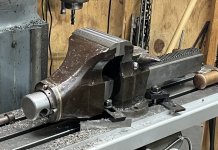
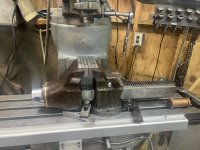
Beerhippie
Well-known member
Damn! Nice work!Funny how it goes. Fitting a set of jaws on a Bonney #160 (5-1/2” jaws) as I write. Jaws are similar to Parker’s. Just thought I’d share.
Outlawmws
Well-known member
Fitting a set of jaws on a Bonney #160 (5-1/2” jaws) as I write. Jaws are similar to Parker’s
I agree looks great!
I'd think Bonney contract with Parker. I don't think of Bonney as a vise Mfg.
CRSINMICH
Well-known member
Outlaw: I was a bit puzzled that you didn't think of Bonney Vise and Tool as vise makers. I was so focused on the vise part of their operation that I completely forgot that in 1921 there was a name change and a manufacturing change. Thanks for the second hand reminder.

Outlawmws
Well-known member
Outlaw: I was a bit puzzled that you didn't think of Bonney Vise and Tool as vise makers.
Just always been seeing their wrenches and such and never really paid much attention to their ads and full company name.
Also, why would they duplicate that iconic Parker jaw mount?
micahd1997
Well-known member
- Joined
- Apr 27, 2022
- Messages
- 271


CRSINMICH
Well-known member
I have found no information about that except that Bonney's Rapid Transit ads don't clearly show Parker style jaws until 1891 - well after Parker started. Also that seems to be the only Bonney vise that did. Does anyone else know anything about that?Also, why would they duplicate that iconic Parker jaw mount?
KMScott
Well-known member


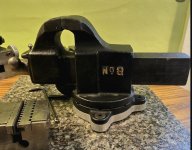
CRSINMICH
Well-known member
Two Hollands catalog excerpts for Models 8 through 70. Two different styles of swivel bottoms but somehow all the specs are the same including prices.

CRSINMICH
Well-known member
I just posted this on the main vise thread. It might be helpful to have the information on The Vise Information thread too.
Parker 954/104 Eclipse Machinists' vises
(Including a swivel conversion kit)

Parker 954/104 Eclipse Machinists' vises
(Including a swivel conversion kit)
SkyPuncher
Well-known member
- Joined
- Dec 22, 2014
- Messages
- 242
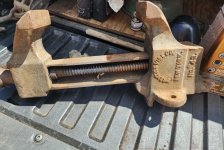
Here is one I did not see on the list. Samson 5214, 5 inch jaws and weighing in at 102 pounds.
I would guess made by Rock Island? Although the "meatball" is different and pretty large. No date on the slide, but it appears to have an OK

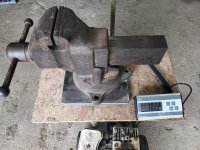

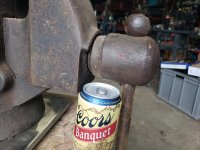

I would guess made by Rock Island? Although the "meatball" is different and pretty large. No date on the slide, but it appears to have an OK
KMScott
Well-known member
Thanks Sky. If you close the vise and take a measurement of the square slide‘s length then I’ll have the max opening to record. Here is a 5” Rock Island jaw drawing to see if it is the same as your jaws. Thanks for the great pics and your lucky to own this vise.
Attachments

micahd1997
Well-known member
- Joined
- Apr 27, 2022
- Messages
- 271
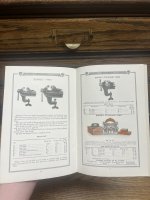
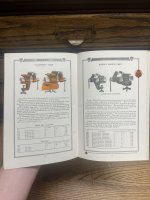
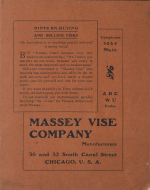
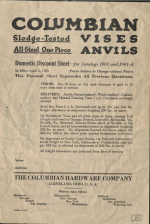
Excited to share THREE new catalogs and a price list. My favorite is the 1901 Massey catalog - the first known example, to the best of my knowledge. The others are later Columbian Hardware Co catalogs/price list. All can be found here on Internet Archive: https://archive.org/details/@micah_darwin


KMScott
Well-known member
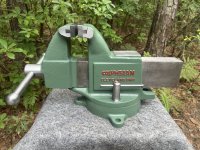
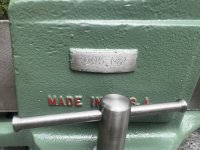
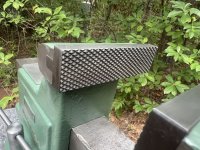
Columbian 605-M2. 5” jaws that opens to 8” and weights 70 lbs.
Just finished restoring this one for a vise collector on the island. New jaws, handle’s and Bronze wear washer.
Just finished restoring this one for a vise collector on the island. New jaws, handle’s and Bronze wear washer.
Attachments
-
 IMG_8934.jpeg985.8 KB · Views: 13
 -
 IMG_8939.jpeg1.1 MB · Views: 12
 -
 IMG_8935.jpeg887.4 KB · Views: 11
 -
 IMG_8937.jpeg726.3 KB · Views: 10
 -
 IMG_8940.jpeg676.2 KB · Views: 10
 -
 IMG_8941.jpeg899.2 KB · Views: 10
 -
 IMG_8944.jpeg901.1 KB · Views: 8
 -
 IMG_8945.jpeg913.7 KB · Views: 9
 -
 IMG_8938.jpeg511.4 KB · Views: 9
 -
 IMG_8943.jpeg752.3 KB · Views: 12
four.cycle
Well-known member
WOW! Excellent! Thank you!

KMScott
Well-known member


SkyPuncher
Well-known member
- Joined
- Dec 22, 2014
- Messages
- 242
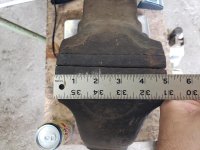
KMScott, the measurement for the Samson of the exposed slide when jaws are shut is 8 inches. The measurements of the jaws you provided are almost spot on if not for some wear and tear.
twagler
Well-known member
Mystery Vise (unknown manufacturer). 3-3/4” jaws that opens to 8-1/4"” and weights 73 lbs. Swivel base, with center below the bench swivel release. Plain iron jaws, no replaceable steel jaws, no cast-in-place steel jaws.
I have this posted over on the big vise thread where I had asked for help identifying it prior to purchasing. I ended up buying it, but the manufacturer and model number is still a complete mystery since there are no markings on the vise body. I'll post a few additional pics here, now that I've cleaned it up a bit, hoping that there might be some key identifying features that someone recognizes.
As-found condition: (very rusty, badly pitted on the right side, must have been left lying in the mud for many years to get this bad. Sold at auction from a homestead property in very rural countryside near Ottawa Ontario Canada.

Condition after cleaning and electrolysis: The jaw towers have a bit of a bevel cut to them. Screw retained by a front collar plate. Both of these features remind me of Parker, but it isn't a Parker since all of their vises were very well marked.

Markings: The only markings whatsoever are found on the main nut (made of bronze, same as the collar) and on the base plate for the swivel mount. Dual-marked as 4 and 4-1/2, so I'm assuming that these items were shared by the Model 4 vise and the Model 4-1/2 vise made by this manufacturer (whoever it was). The base plate is of the less common type for below the bench swivel vises, in that its hold down bolts are exposed on the periphery rather than being hidden under the vise body which was a much more common style.

Plain iron jaws: This is the first vise I've ever owned that doesn't have additional hardened steel replaceable jaws or hardened steel cast-in-place jaw inserts. Not sure if that is the sign of an older vise, or just a cheaply made vise. It definitely rules out Parker as a manufacturer since even in their oldest catalogs, their vises all had steel jaws. On the other hand, the plain iron jaws seem to have held up reasonably well in service. I think this vise might be what manufacturers used to advertise as "semi-steel". This vise is extremely heavy for its size (73 lbs for only a 3-3/4" jaw), and I think steel is denser than cast iron. The casting quality of this vise is also extremely poor, with some bad voids and lumpy surfaces on all pieces, which apparently is another characteristic of semi-steel compared to cast iron. in that it poured poorly and often didn't fill the mould perfectly.

Square, plain styling: I've ruled out many possible manufacturers because the styling of the stationary on this vise is very squared off with nary a flying buttress (Parker) or front edge rounded protrusion (Reed) to be seen.


Odd main nut design: Rather than the typical dovetail shape for holding the main nut in place, this bronze main nut is square bottomed, except for two short square wings at the rear only that fit into matching square undercuts. This was a bad design, since the two wings broke off of the main nut, and now the nut is very loose. (I'll have to figure out a way to fix it if I want to make this vise a user). Another odd feature is an internal tower that sits in front of the nut to take the force when clamping tightly.
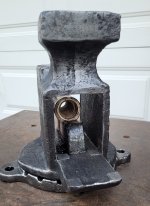

Thanks for looking. Hoping that someone might recognize a manufacturer for this vise, although I'm guessing it might just have been an unmarked vise made by a local foundry back-in-the-day.
Thanks, Tom
I have this posted over on the big vise thread where I had asked for help identifying it prior to purchasing. I ended up buying it, but the manufacturer and model number is still a complete mystery since there are no markings on the vise body. I'll post a few additional pics here, now that I've cleaned it up a bit, hoping that there might be some key identifying features that someone recognizes.
As-found condition: (very rusty, badly pitted on the right side, must have been left lying in the mud for many years to get this bad. Sold at auction from a homestead property in very rural countryside near Ottawa Ontario Canada.
Condition after cleaning and electrolysis: The jaw towers have a bit of a bevel cut to them. Screw retained by a front collar plate. Both of these features remind me of Parker, but it isn't a Parker since all of their vises were very well marked.
Markings: The only markings whatsoever are found on the main nut (made of bronze, same as the collar) and on the base plate for the swivel mount. Dual-marked as 4 and 4-1/2, so I'm assuming that these items were shared by the Model 4 vise and the Model 4-1/2 vise made by this manufacturer (whoever it was). The base plate is of the less common type for below the bench swivel vises, in that its hold down bolts are exposed on the periphery rather than being hidden under the vise body which was a much more common style.
Plain iron jaws: This is the first vise I've ever owned that doesn't have additional hardened steel replaceable jaws or hardened steel cast-in-place jaw inserts. Not sure if that is the sign of an older vise, or just a cheaply made vise. It definitely rules out Parker as a manufacturer since even in their oldest catalogs, their vises all had steel jaws. On the other hand, the plain iron jaws seem to have held up reasonably well in service. I think this vise might be what manufacturers used to advertise as "semi-steel". This vise is extremely heavy for its size (73 lbs for only a 3-3/4" jaw), and I think steel is denser than cast iron. The casting quality of this vise is also extremely poor, with some bad voids and lumpy surfaces on all pieces, which apparently is another characteristic of semi-steel compared to cast iron. in that it poured poorly and often didn't fill the mould perfectly.
Square, plain styling: I've ruled out many possible manufacturers because the styling of the stationary on this vise is very squared off with nary a flying buttress (Parker) or front edge rounded protrusion (Reed) to be seen.
Odd main nut design: Rather than the typical dovetail shape for holding the main nut in place, this bronze main nut is square bottomed, except for two short square wings at the rear only that fit into matching square undercuts. This was a bad design, since the two wings broke off of the main nut, and now the nut is very loose. (I'll have to figure out a way to fix it if I want to make this vise a user). Another odd feature is an internal tower that sits in front of the nut to take the force when clamping tightly.
Thanks for looking. Hoping that someone might recognize a manufacturer for this vise, although I'm guessing it might just have been an unmarked vise made by a local foundry back-in-the-day.
Thanks, Tom
The pitting on it is incredible, it looks like it spent years at the bottom of the sea. If it was mine, I would keep it as a user, just to respect all that it has been through. Nice find.Mystery Vise (unknown manufacturer). 3-3/4” jaws that opens to 8-1/4"” and weights 73 lbs. Swivel base, with center below the bench swivel release. Plain iron jaws, no replaceable steel jaws, no cast-in-place steel jaws.
I have this posted over on the big vise thread where I had asked for help identifying it prior to purchasing. I ended up buying it, but the manufacturer and model number is still a complete mystery since there are no markings on the vise body. I'll post a few additional pics here, now that I've cleaned it up a bit, hoping that there might be some key identifying features that someone recognizes.
As-found condition: (very rusty, badly pitted on the right side, must have been left lying in the mud for many years to get this bad. Sold at auction from a homestead property in very rural countryside near Ottawa Ontario Canada.
Condition after cleaning and electrolysis: The jaw towers have a bit of a bevel cut to them. Screw retained by a front collar plate. Both of these features remind me of Parker, but it isn't a Parker since all of their vises were very well marked.
Markings: The only markings whatsoever are found on the main nut (made of bronze, same as the collar) and on the base plate for the swivel mount. Dual-marked as 4 and 4-1/2, so I'm assuming that these items were shared by the Model 4 vise and the Model 4-1/2 vise made by this manufacturer (whoever it was). The base plate is of the less common type for below the bench swivel vises, in that its hold down bolts are exposed on the periphery rather than being hidden under the vise body which was a much more common style.
Plain iron jaws: This is the first vise I've ever owned that doesn't have additional hardened steel replaceable jaws or hardened steel cast-in-place jaw inserts. Not sure if that is the sign of an older vise, or just a cheaply made vise. It definitely rules out Parker as a manufacturer since even in their oldest catalogs, their vises all had steel jaws. On the other hand, the plain iron jaws seem to have held up reasonably well in service. I think this vise might be what manufacturers used to advertise as "semi-steel". This vise is extremely heavy for its size (73 lbs for only a 3-3/4" jaw), and I think steel is denser than cast iron. The casting quality of this vise is also extremely poor, with some bad voids and lumpy surfaces on all pieces, which apparently is another characteristic of semi-steel compared to cast iron. in that it poured poorly and often didn't fill the mould perfectly.
Square, plain styling: I've ruled out many possible manufacturers because the styling of the stationary on this vise is very squared off with nary a flying buttress (Parker) or front edge rounded protrusion (Reed) to be seen.
Odd main nut design: Rather than the typical dovetail shape for holding the main nut in place, this bronze main nut is square bottomed, except for two short square wings at the rear only that fit into matching square undercuts. This was a bad design, since the two wings broke off of the main nut, and now the nut is very loose. (I'll have to figure out a way to fix it if I want to make this vise a user). Another odd feature is an internal tower that sits in front of the nut to take the force when clamping tightly.
Thanks for looking. Hoping that someone might recognize a manufacturer for this vise, although I'm guessing it might just have been an unmarked vise made by a local foundry back-in-the-day.
Thanks, Tom
I agree!The pitting on it is incredible, it looks like it spent years at the bottom of the sea. If it was mine, I would keep it as a user, just to respect all that it has been through. Nice find.
four.cycle
Well-known member
^ It's definitely got some character.
gearhead1960
ALLIANCE MEMBER
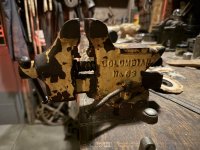
I just finished rehabbing my Craftsman 5242.
This will provide another reference pic for the spreadsheet.
Jaws: 3 1/2 niches wide
Capacity: 2 inches before the slide is no longer completely outside the vise body
Weight: 20 pounds
@Shiftless Just recently acquired one of these, seen here, and would like to restore like yours. What paint did you use to repaint and how much did you do in prep? Interested in your procedure...TIA
KMScott
Well-known member
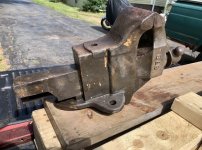
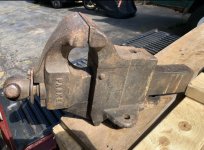
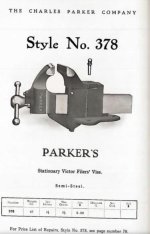
Charles Parker 378 Swivel Jaw. 4-1/4” jaws that opens to 5-1/2” and weights 42 lbs.
Attachments



gearhead1960
ALLIANCE MEMBER

CRSINMICH
Well-known member
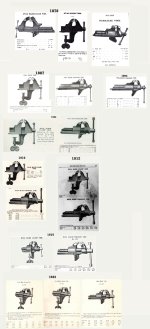
There's been a discussion about Millers Falls oval slide vises on the main vise thread. I posted this there but thought it should be here too.
Last edited:
CRSINMICH
Well-known member
In addition to Clinchers, Perfects, and Lightning Grips The Massey Vise Company also made milling machine/planer vises including an oddity they called a "divided vise".
(The illustration in the lower right was for a different milling machine vise but the "beveled jaws" were common to both styles)

KMScott
Well-known member
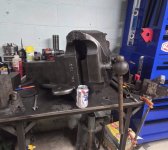
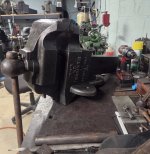
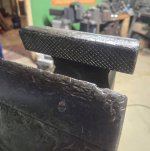
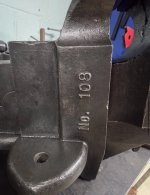
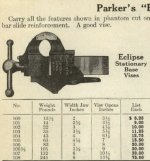
Charles Parker 108. 8” jaws that opens to 13-1/2” and weights 245 lbs.
Attachments


CRSINMICH
Well-known member
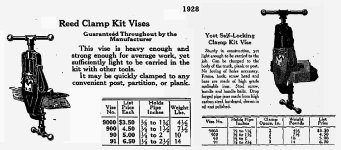
An unsuspected REED - YOST connection. Both of these snippets were from 1928. The specs are identical including prices.
Last edited:
neophyte
Well-known member
Yost was originally located in Meadville PA.
An unsuspected REED - YOST connection. Both of these snippets were from 1928. The specs are identical including prices.
Does anyone know what was going on?
Reed is located in Erie PA.
Presumably, they may have made products for each other.
