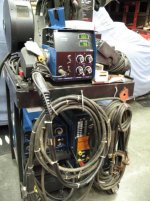
I may as well add in my two cents. I'm an electrical engineer, so I know a bit about electricity, less so about welding. First off, as others said, gas MIG is the way to go here. TIG is really only "necessary" if you are doing thin (cosmetic) panels or aluminum -- and its a heck of a lot harder to get good results. As for what welder to get...
The two big US companies are Miller and Lincoln. Miller has a lower-end brand called Hobart, and Lincoln has a lower-end brand called Century. Any of these brands are adequate. With my albeit limited experience I'd prefer Miller/Hobart over Lincoln/Century, but you'll be getting a decent machine with any of these. Miller tends to be the most expensive, Lincoln and Hobart are about the same price. Century is the cheapest.
If you have to get a 120V welder, a 140 amp unit (such as the one you pointed out, or the Hobart Handler 140 or Millermatic 140) are good choices (just make sure it includes a gas regulator and solenoid). That said, I made the mistake of thinking: "Gee, I'd rather get a 120V machine cause it'll be portable, what if I go some place that doesn't have 240V). Bad thinking. None of these units are particularly portable. They probably weigh 70+ pounds, then there's a cart, and a big tank of gas. Rolling it around on the garage floor isn't a big deal, but you don't want to have to take this somewhere. As an aside, a decent cart is practically a necessity and will not come with the unit.
The 240V units can put out more amperage, have higher duty cycles (minutes you can use it in a 10 minute period) and draw less amperage from the wall. The lower wall amperage is important. These MIG units pull a lot of current, especially, when starting (much more than they are rated for, or the breaker will be rated for). When you are using the MIG for a while, things start heating up, and the heating up is proportional to the square of the current. The resistance of the wire goes up with temperature, and the voltage drop in the wiring increases with both the resistance and the current. At 240V, this drop is at least half as much, possibly a quarter as much, and you are half as sensitive to the voltage drop. In other words, if you want to run full power on a 120V welder, you better hope you have good, short, 12 gauge wiring (if you are using an extension cord it should be 10 gauge and as short as possible) or things wont work well. With the 240V machines, you are typically running 10 gauge or less wiring in the wall and you're running half the current, so you're much better off (at a bare minimum 8x better off, and quite possibly more than that). Couple that with the higher output amperage range, and higher duty cycle, and its worth it.
As for how hard it is to wire a receptacle? Wiring a 240V circuit isn't much harder or different than a 120V circuit, except you are using a different receptacle (and I would recommend 8 or 10 gauge wire). The only reason its tougher is you are using lower gauge wiring so the wire is a little thicker and stiffer. Assuming you are using 10/2 or 8/2, black and white are now both hot (and connected to the two poles of the breaker), and bare copper is still ground, there is no neutral. If you have a 10/3 or 8/3, black and red are hot, and white is neutral, but this is not necessary for most welding machines. You can probably use the dryer receptacle, but you may need to custom build an extension cord (which probably wouldn't be a bad idea anyway, because the power cable is pretty short on most of these units).