To avoid these ads, REGISTER NOW!

Tig welder for a total newbie.

To avoid these ads, REGISTER NOW!

BADSIX

Well-known member
Joined
Nov 30, 2010
Messages
895
Location
oregon coast
just looked at your link, welding that plate with a mig is going to be easy and strong. be sure to put a bolt in that hole to keep weld splater from maybe getting on the threads. if you have someone do it they should know that to overhead weld you'll need to turn up the wire speed and all will go fine.:)
 

mad57

Well-known member
Joined
Jan 30, 2009
Messages
1,698
http://houston.craigslist.org/tls/2337887912.html

Anyone know if that is any good. I would have to get him to take like $400 or so for it. You can get new ones for like $500 or so.

Always go to ebay first and see what current one comparable are going for than check the completed listing for the same one lower right hand side of the page current ones are on ,and see what one comparable sold for.
 

BADSIX

Well-known member
Joined
Nov 30, 2010
Messages
895
Location
oregon coast
i wouldn't pay more than the 400.00. you can get new in the box on ebay to yor door for about 480-490. also if your not in a hurry try to find one that has the varible temp. the 140 has set adjustments for your heat on heavier metal this is not a problem. but for sheetmetal work it is its eather to hot or to cold, you can't dial it inbetween. if your an experianced welder this may not be a problem as you can regulate this by how far the wire is sticking out. this machine would do your job just fine though :)
 
OP
B

bolecailey

Well-known member
Joined
Dec 20, 2008
Messages
54
Location
Houston
Any reccomendations on which welder to go with, I don't mind spending anything up to a $1000, less is better but I would like to get something that will do anything I want it to. I have $200 in amazon gift cards and cyberweld sells everything on there. Our garage does not have 220 but the panel is in the garage and the dryer connection is maybe 20 ft away, is getting 220 in the garage something I can do myself?
 

hpmaxim

New member
Joined
Apr 24, 2011
Messages
1
I may as well add in my two cents. I'm an electrical engineer, so I know a bit about electricity, less so about welding. First off, as others said, gas MIG is the way to go here. TIG is really only "necessary" if you are doing thin (cosmetic) panels or aluminum -- and its a heck of a lot harder to get good results. As for what welder to get...

The two big US companies are Miller and Lincoln. Miller has a lower-end brand called Hobart, and Lincoln has a lower-end brand called Century. Any of these brands are adequate. With my albeit limited experience I'd prefer Miller/Hobart over Lincoln/Century, but you'll be getting a decent machine with any of these. Miller tends to be the most expensive, Lincoln and Hobart are about the same price. Century is the cheapest.

If you have to get a 120V welder, a 140 amp unit (such as the one you pointed out, or the Hobart Handler 140 or Millermatic 140) are good choices (just make sure it includes a gas regulator and solenoid). That said, I made the mistake of thinking: "Gee, I'd rather get a 120V machine cause it'll be portable, what if I go some place that doesn't have 240V). Bad thinking. None of these units are particularly portable. They probably weigh 70+ pounds, then there's a cart, and a big tank of gas. Rolling it around on the garage floor isn't a big deal, but you don't want to have to take this somewhere. As an aside, a decent cart is practically a necessity and will not come with the unit.

The 240V units can put out more amperage, have higher duty cycles (minutes you can use it in a 10 minute period) and draw less amperage from the wall. The lower wall amperage is important. These MIG units pull a lot of current, especially, when starting (much more than they are rated for, or the breaker will be rated for). When you are using the MIG for a while, things start heating up, and the heating up is proportional to the square of the current. The resistance of the wire goes up with temperature, and the voltage drop in the wiring increases with both the resistance and the current. At 240V, this drop is at least half as much, possibly a quarter as much, and you are half as sensitive to the voltage drop. In other words, if you want to run full power on a 120V welder, you better hope you have good, short, 12 gauge wiring (if you are using an extension cord it should be 10 gauge and as short as possible) or things wont work well. With the 240V machines, you are typically running 10 gauge or less wiring in the wall and you're running half the current, so you're much better off (at a bare minimum 8x better off, and quite possibly more than that). Couple that with the higher output amperage range, and higher duty cycle, and its worth it.

As for how hard it is to wire a receptacle? Wiring a 240V circuit isn't much harder or different than a 120V circuit, except you are using a different receptacle (and I would recommend 8 or 10 gauge wire). The only reason its tougher is you are using lower gauge wiring so the wire is a little thicker and stiffer. Assuming you are using 10/2 or 8/2, black and white are now both hot (and connected to the two poles of the breaker), and bare copper is still ground, there is no neutral. If you have a 10/3 or 8/3, black and red are hot, and white is neutral, but this is not necessary for most welding machines. You can probably use the dryer receptacle, but you may need to custom build an extension cord (which probably wouldn't be a bad idea anyway, because the power cable is pretty short on most of these units).
 

kf4zht

Well-known member
Joined
Mar 20, 2008
Messages
712
Location
Calhoun, GA
LOL, I have not made up my mind, I am just trying to do it right and I don't know enough to know what I need to use or who's advice to trust. It is easier to believe people you have known for a while and seen quality work from than a stranger on the internet. That being said, an overwhelming number of you are saying mig is fine but I have seen it plenty of times when a consensus of forum members is flat out wrong. I will talk to my welder friend and see what he says, I am even calling a family friend on monday who does body work and chassis repair to see what his opinion is. I appreciate the advice and will look into mig and gas shielded mig as well as renting a tig. I still am wondering why most shops that do this seem to use a tig. Is it just because it is cleaner and easier to make quality welds? I still have not seen any explanations here as to why mig is fine to use or why it isn't fine. I understand why you would not want to stick it.

Where can I find a mig that is capable of gas shielding, the only ones I have seen don't seem to cost less than a tig.

I would more ask the guys that TIG is why it is "required". There is not a whole lot that cannot be mig'd but can be tig'd. Tig does produce a typically better looking weld, not necessarily stronger. Also most of the good tig welds are done at a table, finding guys that can tig overhead is a much more limited pool.

Judging by the pricing it sounds like the guys that do it are trying to make bank, and convincing everyone that they cannot afford to/learn to do it on their own helps sell it.
 

braxx

Well-known member
Joined
Mar 30, 2011
Messages
136
Location
Dearborn Heights, Michigan
I have a Miller XMT 304 CC/CV Inverter machine- does DC stick/mig and Tig. It's called a muti-purpose industrial machine.

That is only the power supply. You need an add on to make it a MIG unit. The way the unit sits it will not MIG.

My reference was about ONE machine being able to MIG and Stick. Those are rare.
 

justanengineer

Well-known member
Joined
Apr 5, 2011
Messages
7,722
Location
Motor City
BMWs have tissue paper metal frames (I have one and have reinforced everything). Save you money and have it done professionally by someone who has experience welding BMWs.

This is the only piece of advice I would take out of this thread. Learning to weld on a vehicle could easily result in deadly consequences for yourself or others. Ever seen a chunk of steel fall off a vehicle and go through a windshield? I have and its not pretty.

Regarding the whole debate over the MIG/Stick combination - the majority of the larger MIG machines that I have ever seen in industry are simply Stick power sources with wire feeders added...ie MIG/STICK

If I had to do the repair I would use TIG. TIG is fairly easy to get a quality (penetration and not surface) weld with because you can control the arc and puddle, and contrary to popular (uneducated) opinion, MIG is not due to lack of control. TIG also has the advantage of not having a huge heat affected zone. If you have any hand-eye coordination, I think you will find that TIG is actually easier to learn to get a good quality weld with.
 

brownbagg

Well-known member
Joined
Mar 20, 2006
Messages
5,208
holbart is really not a low end company, they was a well establish welding compant which was bought out by miller parent company. Miller and Holbart are both great welders.
 

pgreen

Well-known member
Joined
Jun 3, 2006
Messages
181
Location
Venus, TX
I agree, that link was MIG. However, I will say I would personally TIG weld it. MIG will do fine, with someone that KNOWS HOW TO MIG WELD THIN STEEL. If you are learning on this car, you should not waste your time.

MIG has it's downsides. It is easy to make a nice looking weld with zero penetration. It is also easy to make a big "pile" of a weld that will undercut on the edges and cause a stress riser. This will cause your newly welded part to crack right next to the welds. Welding thin sheet metal with anything is significantly different than thick stuff. Takes a whole different approach. Then add to it that it is an out of position (upside down) weld area, and you just added an additional pain in the *** for someone that doesn't know what they are doing.

I have both MIG and TIG in my race shop. I rarely use the MIG. However, MIG can do body panels, and is the most often used welder for body panels.

I would also bet that the $1500 is not just the welding, but the prep too. If the floor has carpet anywhere near that area in the interior, that had better come out. Melted carpet stinks. A car fire stinks even more.

Oh, and the car isn't TIG welded from the factory. Isn't MIG welded either. Most automotive factories resistance/spot weld damn near everything. It is fast, repeatable, and if the panels are designed correctly, a great way to hold everything in place. The round spots in the before (cracked) pictures are this type of weld. No good for this kind of repair though.
 

sberry

Banned
Joined
Jun 18, 2005
Messages
35,747
Location
Brethren, Michigan
The advice is all over the place here, one real useful thought out post is this.
I may as well add in my two cents. I'm an electrical engineer, so I know a bit about electricity, less so about welding. First off, as others said, gas MIG is the way to go here. TIG is really only "necessary" if you are doing thin (cosmetic) panels or aluminum -- and its a heck of a lot harder to get good results. As for what welder to get...

The two big US companies are Miller and Lincoln. Miller has a lower-end brand called Hobart, and Lincoln has a lower-end brand called Century. Any of these brands are adequate. With my albeit limited experience I'd prefer Miller/Hobart over Lincoln/Century, but you'll be getting a decent machine with any of these. Miller tends to be the most expensive, Lincoln and Hobart are about the same price. Century is the cheapest.

If you have to get a 120V welder, a 140 amp unit (such as the one you pointed out, or the Hobart Handler 140 or Millermatic 140) are good choices (just make sure it includes a gas regulator and solenoid). That said, I made the mistake of thinking: "Gee, I'd rather get a 120V machine cause it'll be portable, what if I go some place that doesn't have 240V). Bad thinking. None of these units are particularly portable. They probably weigh 70+ pounds, then there's a cart, and a big tank of gas. Rolling it around on the garage floor isn't a big deal, but you don't want to have to take this somewhere. As an aside, a decent cart is practically a necessity and will not come with the unit.

The 240V units can put out more amperage, have higher duty cycles (minutes you can use it in a 10 minute period) and draw less amperage from the wall. The lower wall amperage is important. These MIG units pull a lot of current, especially, when starting (much more than they are rated for, or the breaker will be rated for). When you are using the MIG for a while, things start heating up, and the heating up is proportional to the square of the current. The resistance of the wire goes up with temperature, and the voltage drop in the wiring increases with both the resistance and the current. At 240V, this drop is at least half as much, possibly a quarter as much, and you are half as sensitive to the voltage drop. In other words, if you want to run full power on a 120V welder, you better hope you have good, short, 12 gauge wiring (if you are using an extension cord it should be 10 gauge and as short as possible) or things wont work well. With the 240V machines, you are typically running 10 gauge or less wiring in the wall and you're running half the current, so you're much better off (at a bare minimum 8x better off, and quite possibly more than that). Couple that with the higher output amperage range, and higher duty cycle, and its worth it.

As for how hard it is to wire a receptacle? Wiring a 240V circuit isn't much harder or different than a 120V circuit, except you are using a different receptacle (and I would recommend 8 or 10 gauge wire). The only reason its tougher is you are using lower gauge wiring so the wire is a little thicker and stiffer. Assuming you are using 10/2 or 8/2, black and white are now both hot (and connected to the two poles of the breaker), and bare copper is still ground, there is no neutral. If you have a 10/3 or 8/3, black and red are hot, and white is neutral, but this is not necessary for most welding machines. You can probably use the dryer receptacle, but you may need to custom build an extension cord (which probably wouldn't be a bad idea anyway, because the power cable is pretty short on most of these units).
The MIG is the tool for steel car repairs, anyone using tig has too much time and money for this work.
 

sberry

Banned
Joined
Jun 18, 2005
Messages
35,747
Location
Brethren, Michigan
Thanks, but I know all about it and I have their kit. I won't save any money by paying someone $1000 to $1500 when I can buy a tig and have someone I know weld it up. I also know it is done right when I do things myself.
Good luck with that, you may be more caerefyul or critical also but doesnt mean anythying is done right because you did it yourself.
 

Professur

Well-known member
Joined
Apr 7, 2010
Messages
3,911
Location
Mo-Ray-Al, K-bec, Ka-Na-Da
If you've a friend who's a skilled welder ... why even get involved. Let HIM do the footwork. Renting a welder for a day is a lot cheaper than buying, particularly when you claim no skill yourself. If he's skilled, he knows what he's skilled at, and he'll know what to rent.

The welding on most vehicles today is neither tig nor mig, but Resistance welding, with no filler at all. As such, it's not pertinent to the discussion at all. Some damn nice examples of welding in the photos here.

The Henrob torch uses a different technique than a regular O/A ... and as such, I've heard good and bad about it. Those who like it ... LOVE it ... those who don't ... hate it with a vengeance. From that, I take it that the torch is good, but some people just aren't flexible where technique is concerned. The technique for TIG is also similar to these two, but not quite. If you know one, you should be able to learn all three ... but none are the MIG hot glue point and shoot. The hardest to learn IMO is stick ... it's like learning to write by only moving your shoulder (yes, i can, thank you for asking).
 

c39er

Well-known member
Joined
Mar 23, 2008
Messages
1,663
Location
Seattle, Washington
That is only the power supply. You need an add on to make it a MIG unit. The way the unit sits it will not MIG.

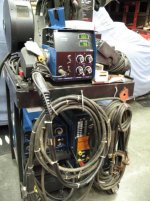
This is my actual XMT unit with a 60 series Dual Schedule feeder and a Bernard water cooler for the tig. I use it for all 3 types of welding-No AC tig though. A Miller Thunderbolt is next to it.
 

Attachments

  • welding machines 012.jpg
    welding machines 012.jpg
    57.1 KB · Views: 22

srmofo

Well-known member
Joined
Oct 15, 2009
Messages
6,161
Location
SW ohio
Has anyone ever glued the reinforcement panels on? I dont think its agood solution for your repair, but it might be a way to prevent the problem in the first place.

My buddy is a bmw bodyman and he has told me about the strength of their glues. I know the newer ones are mostly glued together.
 
To avoid these ads, REGISTER NOW!

Jackfre

Well-known member
Joined
Dec 26, 2010
Messages
4,411
Location
N CA
I made a living as a tig/stick welder. Now for all my automotive needs I use mig. Tig is definitely where it's at for high quality pretty welding. I've restored a couple old BMW's and mig is more than adequate for what you need to do. It is also just a lot easier to do. If you want to really work at tig then go for it, but you will have some heavy lifti g to do practice wise.

I'd suggest the bracing from Turner Motorsports. Just welding up the apparent metal that has all ready cracked will only move the cracks around and you will be back in there sooner than you want. A friend of mine went through this. Point is, do it once, do it right and use mig. I have a bigger mig but frequently use a Miller 135 in 110v. Nice machine for an automotive hobbyist. To make the job easier and absorb a bit of heat ( you will need to), i get a piece of 1 1/2" x3" copper pipe. Pound it flat and hold it tight against the back of the weld. It will make you much better. As well, I've had really good results with POR 15 for paint after the weld. Don't skimp on the prep with por or it will roll off in a sheet. I know that for sure!
 

Ozwelder

Well-known member
Joined
Feb 6, 2010
Messages
180
Location
Mackay, Queensland.Australia
TIG likes a super clean environment whereas MIG will work in less than ideal conditions..

Sorry but that statement is grossly incorrect.Mig like tig,will not tolerate rust,dirt,paint ,grease and oil on surafces to be welded.

The result of doing so will be porosity in the deoposited weld. In addittion mig being a mechanical feed is subject to another layer of potential problems if not maintained carefully before and during the welding process.

I should know, having used them as a tradesman, trade colledge instructor and x ray qualified welder and examiner for 35 years.
Having said that,I agree that the choice of mig is better than the tig in confined areas.

Why was n't an oxy acetylene process considered.Easily hired and will do what the tig will,and is exaclty the same skill level and manipulation.

Ozwelder
 

Professur

Well-known member
Joined
Apr 7, 2010
Messages
3,911
Location
Mo-Ray-Al, K-bec, Ka-Na-Da
Has anyone ever glued the reinforcement panels on? I dont think its agood solution for your repair, but it might be a way to prevent the problem in the first place.

My buddy is a bmw bodyman and he has told me about the strength of their glues. I know the newer ones are mostly glued together.

I've seen tests done with the adhesive. properly prepared clean metal, properly cured .. the metal failed first. but you can't do a **** joint with it, only lap joints. It's strength is that with lap joints, welders do plug welds, giving adhesion for perhaps a quarter inch every 3 inches. the glue covers 100% of the length of the joint. If you've seen and understood the Mythbusters episode trying to pull apart 2 interleaved phone books, you know what kind of power that type of connection brings to the table.
 

skamp

Well-known member
Joined
Jul 20, 2007
Messages
644
Location
Cypress, TX
You know there was a class action lawsuit about this issue. Did you ever get the leter for this?

http://forums.bimmerforums.com/forum/showthread.php?t=1253761

My friend just went through this and was able to get the repair done after the expiration as he requested inspection before the expiration and they apparently did not do the full check. May be worth it to talk to BMW directly and the dealer.

Steve
 
OP
B

bolecailey

Well-known member
Joined
Dec 20, 2008
Messages
54
Location
Houston
Good luck with that, you may be more caerefyul or critical also but doesnt mean anythying is done right because you did it yourself.

LOL, it does when you do it right. I do everything myself on my cars and I do it right.
 
OP
B

bolecailey

Well-known member
Joined
Dec 20, 2008
Messages
54
Location
Houston
You know there was a class action lawsuit about this issue. Did you ever get the leter for this?

http://forums.bimmerforums.com/forum/showthread.php?t=1253761

My friend just went through this and was able to get the repair done after the expiration as he requested inspection before the expiration and they apparently did not do the full check. May be worth it to talk to BMW directly and the dealer.

Steve

Yes, I know about it and they are repairing them still, the problem is that it is a case by case bases and they can be a pain in the *** about trying to wiggle out of it since the lawsuit period is over. They also don't do any reinforcement, they just replace the whole under panel and I don't want to deal with it cracking again as the car will see some track time and they are mo prone to cracking with track use.
 

srmofo

Well-known member
Joined
Oct 15, 2009
Messages
6,161
Location
SW ohio
I've seen tests done with the adhesive. properly prepared clean metal, properly cured .. the metal failed first. but you can't do a **** joint with it, only lap joints. It's strength is that with lap joints, welders do plug welds, giving adhesion for perhaps a quarter inch every 3 inches. the glue covers 100% of the length of the joint. If you've seen and understood the Mythbusters episode trying to pull apart 2 interleaved phone books, you know what kind of power that type of connection brings to the table.

Ive seen the videos. The metal tears and the joint stays intact

Thats why I was thinking it would just be easier to glue the reinforcements on before there is a crack. If its a known problem on track cars, why not take care of it first?
 

cranker

Member
Joined
Oct 1, 2005
Messages
21
Location
IOWA
Just learn how to weld regardless of what machine you buy, before tackling overhead welding on thin metal on a stress point of your car.. That is no place for a cold weld or a bunch of chicken poop. Remember mig is easier to make a "pretty" weld that is not sound.
 

IndyGarage

Well-known member
Joined
Apr 29, 2010
Messages
9,705
Location
Indy
I've had a cheap mig for many years - I don't weld a lot, but do a lot of repairs.

So I thought I would learn to Tig a couple years ago - how hard could it be.

Turns out, really hard. If you're not a really good welder already, plan on spending several months learning to Tig - before you can even be respectable - I like doing it though.

I have a Diversion 165 and it does everything I want it to.
 

Jackfre

Well-known member
Joined
Dec 26, 2010
Messages
4,411
Location
N CA
I just re-read this entire thread this morning. Regardless of which way you go, mig or tig, i agree that for primary stucture on a track car you should have someone who knows what they are doing make this repair. The real purpose of my post is to suggest that you spend some time on Millerwelds.com. There are good instructional videos and guides there.

I have a young fellow mechanic friend who does excellent work and tried my tig and mig machines. He had a hell of a time. He took a several week introductory class at the local voc-tech and he is now doing fine mig work on his race cars. See what local training is available. Welding, like so many things isn't hard particularly. It is just hard to do it well. A basic class will set you up properly. Goodluck with your car and your season!
 
OP
B

bolecailey

Well-known member
Joined
Dec 20, 2008
Messages
54
Location
Houston
Thanks guys. Looks like I am putting off buy anything, woke up this morning to go to work and had a message from my dad saying the family friend who tigs for a living is bringing a whole rig that he is borrowing from work so it should be patched and reinforced by the end of the weekend. I still want to get a welder and learn to weld so I don't have to rely on someone else to do this the next time.
 

Professur

Well-known member
Joined
Apr 7, 2010
Messages
3,911
Location
Mo-Ray-Al, K-bec, Ka-Na-Da
Thanks guys. Looks like I am putting off buy anything, woke up this morning to go to work and had a message from my dad saying the family friend who tigs for a living is bringing a whole rig that he is borrowing from work so it should be patched and reinforced by the end of the weekend. I still want to get a welder and learn to weld so I don't have to rely on someone else to do this the next time.

Perfect. I don't care how good or bad, people always work better with their own tools.
 

houdni

Well-known member
Joined
Feb 22, 2011
Messages
83
i miged my fathers bimmer about a year ago...both sway bar tabs broke off...and bought reinforcement brackets...

2010-03-27180608.jpg
 

Fueler

Well-known member
Joined
Jun 22, 2006
Messages
1,620
Location
Urbana, IL
To the OP. Why are you not talking directly to the person who will be doing the welding?
Have them look it over and see if it is within their capabilities.
That and that alone will dictate your next step.

Aww nuts. Just reviewed when this thread started. Figure it's done or burned up by now.
 
To avoid these ads, REGISTER NOW!
Top Bottom