On to the electronics!!
The electronic circuits in the Sun distributor testers, in my opinion, were very well designed to perform their intended task, that is, measuring how well the distributor was doing its job. The earliest testers from the 1940s through the 1970s are remarkably similar in basic construction, but the design progressed steadily with higher speed capability, upgraded power supplies and components, elimination of the batteries to power the meters with an internal power, etc.
Thomas' 600 tester is in the middle of the evolution, and is well capable of handling most distributors. One of the major change made during the rehab was the elimination of the batteries. As mentioned before in a previous post, the tachometer circuit used a 1.35V mercury battery because it had the desireable characteristic of maintaining a near-constant voltage throughout its useful life. Most owners of these testers, I suspect, use a 1.5V AA battery which is more like 1.6V new, which will give a false high RPM reading. Worse yet, it will slowly go "downhill" from there.
The dwell meter does not have this problem, as it has an internal calibration feature; nonetheless, not having to change batteries is a nice upgrade.
Sun used high quality electronic components for the time. However, some components, notably the capacitors, especially the paper and electrolytic types, are prone to failure over time. So, it is prudent to replace them.
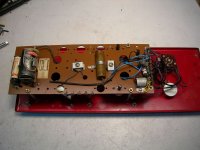
Here are the original circuit boards
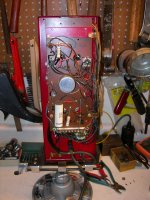
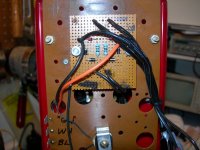
To fix things up, separate AC adapters were used, one for tach, the other for dwell. The adapters were plugged into a power strip and located in the main cabinet (no picture). Two separate regulating circuits were fabricated and mounted:
The capacitors, and any other suspect components were replaced with high quality parts. It is always a good idea to double check component values:

The meters are very well made, and the rule of thumb here is - unless you know exactly what you are doing , leave them alone, don't go looking for trouble. The meters were cleaned up, and a couple of mods were made. First, a small amount of adhesive was applied to reinforce a joint in the armature. Second, a ground strap was added per the picture. This was a design upgrade by Sun and all their later meters have the ground strap. So now Thomas, you have updated meters!
We are almost done. I will get this project wrapped up in one or two more posts.

OK let's get this done!
The specification scroll itself was in very good condition, considering its age, and after some careful cleaning, scotch tape on the paper in spots, and a touch of lube on the scroll shafts, it was brought back to usefulness. I don't have a good close up of the finished product, unfortunately.

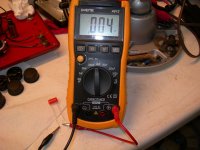
Once the tester was put all back together, the tach, dwell, and condenser circuits & meters were recalibrated per the Sun specifications. A laser non contact tachometer was used to indicate the true speed. A piece of reflective tape was put on the distributor shaft to provide a pickup for the laser. These laser tachs are pretty accurate and reasonably priced. The condenser tester was calibrated using 1% tolerance capacitors at the low, medium, and high range of the meter.
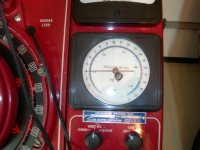
There is not much to do to the vacuum gauge except cleaning it and making sure it has low hysteresis, that is, it reads the same whether increasing or decreasing, and comparing the reading to other known good gauges.
The tester is now ready to go to work. Here is an abbreviated description of a typical test:
The distributor is mounted, and the elevation of the clamp arms is adjusted so that the shaft is not biased against the axial end stops. The condenser is tested first. Then, the dwell meter is calibrated, followed by checking point resistance. If a point tension gage is available, it is used. If all is well, the distributor is run at low speed and the degree ring is set to "0". The mechanical advance is then checked by adjusting the speed and reading the degree ring. It is important to check the advance from both an increasing and decreasing speed, to detect for any binding. All lobes are checked for uniformity.

As the speed increases, the dwelll will eventually decrease when the point tension can no longer maintain the point arm against the cam. When this occurs, additional strobe flashes show up as a "misfire".
The vacuum advance is checked by maintaining a fixed speed, and reading the advance at different vacuum levels. It is important to check in both the increasing and decreasing vacuum direction for the same reason as above.
Notice in this picture the advance weights have swiung outward. Also, you can catch a part of the cleaned up scroll.

Of course, points now are a rarity; however, the tester is still quite able to accomodate the newer distributors. For the Pertronix conversions, all that is needed is a 9V battery across the red and black leads of the Pertronix, and the distributor lead is connected to the black Pertronix lead. For other distributors with magnetic or Hall triggers (HEI, Dura Spark, etc.) a pulse adapter can be used, either purchased or fabricated. A simple pulse adapter can be fabricated with an HEI module and power supply.
Well, I think that just about wraps things up. I thoroughly enjoyed bringing Thomas' tester back to workhorse condition. It's now back in its rightful place a the shop, ready to perform whenever the need arises!
 Then we can see how well it will work on my turbo car.
 )
)