So to continue with new project-lumber rack PART 2.
Many times over the years I have been contacted about a nice Walnut or other hardwood tree that needed to be removed and would I be interested in it in exchange for cleaning up all the associated tree debris afterward? Over the years the amount of lumber I acquired grew faster than I could use. It needs to be stored correctly or it can be damaged. I solved that problem easily enough but stacking it on itself once it has dried becomes cumbersome with a large stack or stacks. Especially if the the boards you want are in the middle of the stack. As most of you must know by now, our future plan is to build our retirement home on the property. Because of that, my present wood shop and lumber storage need to be moved out there. The barn was partially built with that lumber storage in mind. It's humidity controlled and the ceiling fans in it are on 24/7/365 to keep the air from stratifying.
If the building ceiling height will allow it, stacking lumber vertically on end is an ideal way to store it. In the storage area of the barn, I have almost 13' ceilings so that wasn't a restriction.
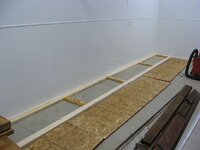
Stacking lumber on end without a vapor barrier beneath it will allow moisture to move through the concrete and then "wick" into the end grain of the wood and that's not a good thing. Even though the barn concrete floor has a vapor barrier I decided to use a wood platform upon which to stack the lumber just to ensure in the future I would never have this problem. Besides it's easy and inexpensive to construct such a platform. In this case I used 3/4" thick
OSB (
Orientated
Strand
Board), 2' wide screwed on 2X4's.

On the wall 2" diameter galvanized pipe flanges were attached starting at 8' above the floor...
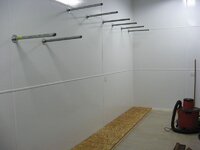
...and then stepping down to 6' above the floor and finally 4' above the floor.
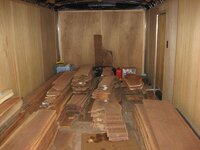
My enclosed car trailer has become very useful over the years...
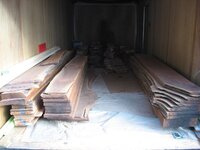
...for moving more than just cars. The lumber seen here has been sealed on the ends with white glue which dries clear. End grain checking is minimal or non existent in some cases. BTW, that Walnut slab on the bottom right is 4" thick, 14" wide and over 11' long. It will become the mantel over the fireplace of our new house. I cut the tree down it came from in 1981 and have been waiting for a worthy project for it. Some of the boards from that same tree were over 23" wide. It was a magnificent tree with no decay anywhere in the trunk. Lighting hit it.

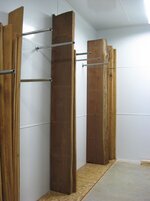
Stacking lumber on end is a much more efficient use of the space and the lumber itself is self supporting without the need for an elaborate, expensive structure. That
OSB is 24" wide and those pipes are 8' above the floor, now note how wide, straight and clear some of those boards are and over 10' long. Imagine the Walnut tree they came from instead of being used for furniture lumber being cut up for firewood and lost forever.

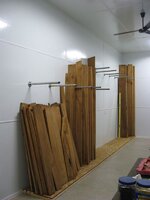
Here I haven't installed the 4' high pipe flanges yet. I was trying to gauge how much wall space to devote to the various heights.
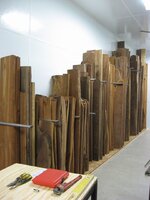
Now you can see the rear pipes at 8', then 6' and finally 4' high. Eventually I wound up with 32 linear feet along the wall and came out 2' from the wall. Ideally I would like to stack the boards without doubling them up from the wall. That way you can choose one by just "flipping" through a single stack between pipes. It turned out that would have used too much linear wall space so I had to double up. Now to get a board next to the wall, I will have to move boards in front of them but only in the section between each pipe.
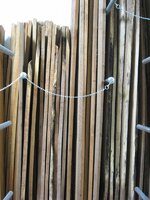
As with the lawn tool rack, the pipes keep the lumber from falling sideways and then I installed pipe caps, eye bolts and chains which keeps the boards from falling away from the wall. Also note this is the end of the 6' high pipe and near the top is the start of the 8' high pipe.
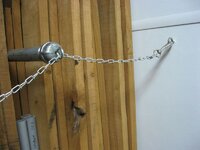
Here's how an eye bolt was installed in the wall to create an end attachment for the chain in the corner. Note how the boards are stacked two deep, one row in front of the row back by the wall. This is Cherry lumber.
There is more to this project which you'll see shortly.
Thomas


 Craig told me he'll find out exactly what size and age it was and let us know.


 Thanks again.


 Matter of fact, Gus was the only truck I looked at that still had it's original engine. All others had been changed, most for V8's of some make or another.


