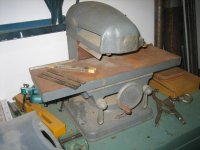
1936-1960 Craftsman Machine Stands/Bases, A Photographic Study
In 1936, Craftsman offered their first machine stand of this era. It was an open legged sheet metal stand, very similar, if not identical, to the open legged Delta stands. It was branded with the Companion logo:
A year later, they introduced a similar stand with enclosed sides, for 1937:
In 1940, Craftsman came out with a new stand design with a definitive art deco flair:
This particular stand was labeled with the 'Companion' brand.
A year later, in 1941, Craftsman declared the release of a 'new' machine stand, identical in appearance to the 1940 Companion stand but this time with the Craftsman label:
In fact, both identical Craftsman and Companion stands were offered in the exact same catalog at the same price point. I suppose they supported the power of choice among their customers.
Craftsman also offered an extended machine base that was built for lathes, available in 2 sizes to accommodate different lathes:
In 1942 the art deco style enclosed machine base stands disappeared completely and never offered again.
One design came close, on a rather unusual machine that appeared in the 1943 catalog only:
This base, however, was not offered as a tool stand accessory. One interesting note is that this tool could be ordered with 2, 3, or 4 drill press heads. From the look of the picture, the cast iron table top would expand out based on the number of drill press heads and the removable machine stand legs would form the ends with the appropriate sized running board connecting the two underneath to maintain rigidity.
The next new stands by Craftsman would not be released until 1951:
These machine stands came in various sizes to suit different machines.
1953 saw a few new stands offered by Craftsman:
A lathe stand:
And a shaper/milling machine stand:
Although not technically a machine tool stand, it is worth mentioning that in 1954 Craftsman offered the following benches:
This was not Craftsman's first foray into work style benches, as they had wood style benches under the Companion name since the 1930s. This particular bench shares more similarities with the machine stands offered at the same time.
1954 also saw the first introduction of the now famous Craftsman 'pedestal' type stands, with stands being offered for table saws, jointers, and the 12" band-saw:
In 1955 Craftsman detailed an entire 'pedestal' base line:
That same year, Craftsman also came out with a new sheet metal legged stand offering, similar to the stands from 1951:
The pedestal stands continued to enjoy popularity, as evidenced in the 1956 catalog:
Unbeknownst to some, Sears actually carried the DeWalt radial arm saw, one of Craftsman's main competitors, in the Craftsman power tool section of the store. They also carried accessories for the 9 and 10 inch saws, including a machine base:
It is not known whether the carrying of DeWalt products was an experiment or trial run for Sears, but it did not last long and one year later there was no trace of any DeWalt products, including the machine base, to be found in the catalogs. It would be easy to presume that with the release of the Accra Arm radial saw around 1958 and the type of press that Craftsman desired for their flagship tool, it would have been unwise to carry the DeWalts.
1959 saw a lot of changes for Craftsman and these changes were also reflected in their machine bases, benches and tool stands:
Accra Arm radial saw base cabinet:
Metal lathe base (integrated):
Grinder bench/stand:
This particular stand has a lot of design elements that we see in later 1980s and 1990s Craftsman stands.
Another tool bench:
More changes were to come in the 1960s for Craftsman. Perhaps that time frame will be covered at a later point. I hope you all have enjoyed this photographic study of the stands and machine bases offered by Craftsman throughout their golden years.
I am sure that the details above will change as new information presents itself. It is a known fact that not every tool and accessory that Craftsman sold ended up in their catalog, so I am expecting it to change, but for now it is a good starting place to detail the history of these accessories. Also, the pictures in various Craftsman catalogs can sometimes be misleading, such as with the tag/nameplate rendering in the artwork. I will also perhaps at a later time add in more information about what years certain bases were removed from catalogs, but I did not want to focus too much on that information because a particular item may have still be available for quite some time after the item no longer appeared in the catalog. All this is leading up to say that the catalogs can be very helpful for information and general dating, but should not be taken as gospel all the time, every time. Only notable discontinuations were referenced, such as the art deco enclosed machine bases, which appeared for 2 years only and then disappeared completely. The following pictures are the only photos I know of that shows one of these bases:


It may be intriguing to speculate on the relative rarity of some of the bases, however many of them have never turned up, so it is hard to say with any type of precision just what the number of bases were relative to the number of tools that were actually manufactured/sold. I suppose we can take that to mean that many of these machine bases are exceedingly rare, given the fact that they were both 1) sheet metal and relatively more susceptible to damage than the tools themselves which leads us to 2) the possible number that were either damaged, destroyed, separated from the tools, rusted out, etc.
If you have any pictures of any of the above machine stands or bases, especially art deco style or any from the 1930s, I would greatly appreciate your submission of such photographs.
Thanks!