It took the better part of the afternoon, up and down the stairs many times, a few small sheetrock drill holes for location references and one big 1" drill hole where I came out close, but not dead on. Long story short, I was able to stay within the house for the wiring, at least for getting a line from the panel up to where the breezeway routes towards the garage. This was the scariest part that had me worried, the final leg shouldn't be a problem.
Thanks for the reassuring words that there is usually always a way to fish wires through studs, had to think really outta the box here, but was able to get her done.
THANKS!

Congratulations! I figured there HAD to be a way.
Just to be clear... Do I gather from the above that you have NOT yet actually run the cable? IOW, you've figured out where to put it, and MAYBE run a pull rope; but he cable itself has yet to be purchased? If so, fine; and see below. But if not, then
EXACTLY what cable did you install, and how much of it?
OK, so now were looking at about 75 ft of 6 / 3 Romex, no conduit, thanks again, from the main panel to a sub panel.
Presuming that you have NOT yet bought/installed the cable, I
again implore you to go heaver than AWG 6. This is a "Now or Never" proposition; and given the various equipment you're talking about --
plus what you may well add in the future (such as that plasma cutter) -- 55 Amps just isn't going to go nearly as far as you might think. Bite the bullet and put in the right stuff NOW, rather than have to re-do it later.
There was a point referenced that more than a 3 hp motor had to be hard wired, so we'll hard wire the compressor and stay with the plug for the welder.
Hard wiring the comp will require a disconnect at the panel vs a plug, correct?
"Required" depends on the specific details of your installation. "Good Idea" is universal.
Looks like NM is rated @ 55 amps, 60 C / 140 F, correct?
Can NM be safely bumped up to 65 amp with 75 C / 167 F breakers?
NO!
This will be a 230 amp panel for a plugged welder and a wired compressor.
There's no such thing as a "230 amp panel", at least not in this context. I presume you mean "240V panel"; but even that belies a misunderstanding. Any appropriate panel you choose can (and SHOULD) support ALL of the branch circuits in the garage, regardless of whether they are 120V or 240V.
Welder pulls 20 amps, the compressor, pulls 22,.........30 amp breaker in both?
I would. I
might even upsize the wiring on those branch circuits, if there is any possibility of your upgrading to significantly bigger/better tools over the next twenty years or so.
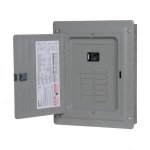
I'm looking at this panel: (generic Home Depot picture doesn't match the description)
125 amp, 8 space, 16 circuit, indoor main lug panel, this'll give me a total of four, 230 breakers, correct?
Correct -- which is why that panel isn't nearly big enough.
As noted above, the subpanel should be sized to support ALL of the branch circuits in the garage, both now AND later. In order to confidently accommodate the "later" part, you should let your imagination run semi-wild. Add up ALL the tools & machines (such as that aforementioned plasma cutter, plus perhaps a drill press, bench grinder, blast cabinet, electric hoist, etc.), infrastructure (electric space heating and/or a dedicated air conditioner, killer lighting, perhaps a dust-collection system, maybe a good stereo system and a beer fridge, etc.) you could possibly imagine ever wanting, and make sure the panel has enough breaker slots to support all of that, and then some -- I'd want
at least 4-6 "spare" slots even after factoring in the foreseeable future; more is better.
The point here is the same as for the upgraded feeder cable: This is a job you want to do
ONCE. Labor is by far the biggest part of the job; it makes no sense to scrimp on the "parts".
That should read 230 v only pane, garage is run for 115 now, all I need this lug panel for is 230 v welder / compressor and two open slots for future use.
Once the sub-panel is in, there is no reason to continue running ANY individual branch circuits back to the main panel. Now granted, this doesn't mean you MUST rip out the existing wiring and re-run it from the sub-panel; but odds are you WILL upgrade/augment those circuits sooner or later. And when that happens, you want to have both the sub-panel slots and the feed capacity to support that.
From the main breaker panel, I want a 60 amp breaker, for the 55 amp 6 / 3 cable to this lug panel,...correct?
No.
The breaker rating MUST NOT exceed that of the wire it is there to protect!
For the 30 amp welder / compressor runs from this lug panel to the receptacles, what size wire can I get away with, the furthest run is maybe 20 ft from the panel,....8 / 3?
Your phrasing here belies a much bigger problem than your technical naivete. Absolutely NO part of this job should be approached with a "get away with it" attitude More than any specific spec or hardware choice, that is THE critical point. You need to take a longer view in general.
If I keep one receptacle run with 6 / 3 then I can run the full 55 amps through this one outlet with a 60 amp breaker,.....correct? (if nothing else is running with it)
I'm not following you on this one at all; and I suspect that either you aren't thinking it through, or fundamentally misunderstand the principles involved.
Quite beyond the breaker-rating issue discussed above, the 6/3 (or 4/3, or 2/3, or whatever) would be used for the sub-panel feeder -- and ONLY the sub-panel feeder. The branch circuits fed from that sub-panel would (pretty much by definition) be significantly smaller, in both current capacity and wiring. If you're going to use up the full capacity of the sub-panel on one outlet, then the sub-panel itself becomes superfluous.

 Yes, aluminum may expand and contract more so than copper but I wouldnt worry about it so much as to check it religiously on a regular basis. I would install it, apply anti ox paste PMI, and torque to spec/PMI. Then maybe a week or 2 later retorque and be done with it!
 But in this situation, 55a is not a standard breaker size, so the OP can go up to a 60a breaker and still be to code. See NEC 240.6(a).....


 If u do, maybe u should read it. Start with 110.14(c)(1)....its on pg 70-36 BTW...