To avoid these ads, REGISTER NOW!

230 to garage

wyliesdiesels

Well-known member
Joined
Aug 14, 2012
Messages
20,049
Location
Modesto, CA
It took the better part of the afternoon, up and down the stairs many times, a few small sheetrock drill holes for location references and one big 1" drill hole where I came out close, but not dead on. Long story short, I was able to stay within the house for the wiring, at least for getting a line from the panel up to where the breezeway routes towards the garage. This was the scariest part that had me worried, the final leg shouldn't be a problem.

Thanks for the reassuring words that there is usually always a way to fish wires through studs, had to think really outta the box here, but was able to get her done.

THANKS! :thumbup:


OK, so now were looking at about 75 ft of 6 / 3 Romex, no conduit, thanks again, from the main panel to a sub panel. There was a point referenced that more than a 3 hp motor had to be hard wired, so we'll hard wire the compressor and stay with the plug for the welder.

Hard wiring the comp will require a disconnect at the panel vs a plug, correct?

Looks like NM is rated @ 55 amps, 60 C / 140 F, correct?

You dont need a disconnect for the compressor as long as the breaker is 'in-sight' of the compressor. Having said that, if your compressor doesnt have an off switch built in and you want to shut it off when not in use, using the breaker as an on-off switch will wear the breaker out. So, a disconnect IS a good idea.

On Aluminum wire keep in mind that your loads may be heavy and will be periodic vs. continuous so there will be thermal expansion and contraction that is greater than with Copper even with the modern alloys. That means you may have to check and adjust your terminations on both ends on a regular basis and you should also use fixtures (like your outlets) that are designed for Aluminum. Please note that I'm not an electrician or electrical engineer but we have been working with a large company who builds a lot of large facilities and have investigated this in detail with their engineers--the conclusion was to use Aluminum for feeder lines only as they see continuous loads. That said, a lot of large projects use all Aluminum wire these days (Southwire has a gallery of projects on their web page). Bottom line, I'd probably use Copper for this application myself for peace of mind.

Whatever path you choose spend some time on manufacturer websites as they are often a wealth of information on applications, installation and maintenance.

The aluminum wire of today is not the same as the 70's. :shocking: Yes, aluminum may expand and contract more so than copper but I wouldnt worry about it so much as to check it religiously on a regular basis. I would install it, apply anti ox paste PMI, and torque to spec/PMI. Then maybe a week or 2 later retorque and be done with it!
 
To avoid these ads, REGISTER NOW!

Charles (in GA)

Well-known member
Joined
Jan 11, 2006
Messages
12,489
Location
50 mi south of Atlanta
You dont need a disconnect for the compressor as long as the breaker is 'in-sight' of the compressor. Having said that, if your compressor doesnt have an off switch built in and you want to shut it off when not in use, using the breaker as an on-off switch will wear the breaker out. So, a disconnect IS a good idea.

In sight from, AND not exceeding 15m/50 ft from breaker/disconnect/switch to the compressor. (50 ft is in the definition of "in sight from" in the electric code.)

Charles
 
OP
4

460Rustang

Well-known member
Joined
Oct 9, 2013
Messages
208
Location
Nawlins
Looks like NM is rated @ 55 amps, 60 C / 140 F, correct?

Can NM be safely bumped up to 65 amp with 75 C / 167 F breakers?

In sight from, AND not exceeding 15m/50 ft from breaker/disconnect/switch to the compressor. (50 ft is in the definition of "in sight from" in the electric code.)

Charles

Good point, "in sight", could have many different opinions without the 50 ft addition.
 
OP
4

460Rustang

Well-known member
Joined
Oct 9, 2013
Messages
208
Location
Nawlins
This will be a 230 amp panel for a plugged welder and a wired compressor.

Welder pulls 20 amps, the compressor, pulls 22,.........30 amp breaker in both?

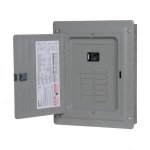
I'm looking at this panel: (generic Home Depot picture doesn't match the description)

125 amp, 8 space, 16 circuit, indoor main lug panel, this'll give me a total of four, 230 breakers, correct?

e441e1c9-a206-47f2-9094-3f6625669005_300.jpg
 
Last edited:

wyliesdiesels

Well-known member
Joined
Aug 14, 2012
Messages
20,049
Location
Modesto, CA
This will be a 230 amp panel for a plugged welder and a wired compressor.

Welder pulls 20 amps, the compressor, pulls 22,.........30 amp breaker in both?

I'm looking at this panel: (generic Home Depot picture doesn't match the description)

125 amp, 8 space, 16 circuit, indoor main lug panel, this'll give me a total of four, 230 breakers, correct?

e441e1c9-a206-47f2-9094-3f6625669005_300.jpg

Not sure what u mean by 230a panel...

Also, is this a detached garage and if so how many circuits do u plan on having? If more than 6, u should get a main breaker panel because u cant have more than 6 breaker handles without a main breaker in the subpanel in a detached structure.

EDIT: What size Hp is the compressor? Wire needs to be 125% of FLC(based on NEC charts)...and breaker should be max 250% of FLC but i usually do about 200%!!
 
Last edited:

RickP

Well-known member
Joined
Jan 15, 2013
Messages
1,554
Location
Annapolis, MD
460Rustang said:
This will be a 230 amp panel for a plugged welder and a wired compressor.

Welder pulls 20 amps, the compressor, pulls 22,.........30 amp breaker in both?

A 30A breaker sounds fine for the welder.

I'd use a 40A breaker for that compressor. The wire can be 8 AWG if you use THHN in conduit. An A/C whip is available for about $11 for the final connection between junction box and compressor.


Posted from Garagejournal.com App for Android
 

pattenp

Well-known member
Joined
Jun 4, 2008
Messages
10,175
Location
Virginia - USA
You stated earlier that your garage is attached so you can use a main lug panel without a main disconnect. A main breaker panel can be used and provides some convenience by having the main breaker to shut off power to all garage circuits without having to flip several breakers. Obviously you can go to the main service panel to shut off all the power to the garage.

This will be a 230 amp panel for a plugged welder and a wired compressor.

Welder pulls 20 amps, the compressor, pulls 22,.........30 amp breaker in both?

I'm looking at this panel: (generic Home Depot picture doesn't match the description)

125 amp, 8 space, 16 circuit, indoor main lug panel, this'll give me a total of four, 230 breakers, correct?

e441e1c9-a206-47f2-9094-3f6625669005_300.jpg
 
OP
4

460Rustang

Well-known member
Joined
Oct 9, 2013
Messages
208
Location
Nawlins
Not sure what u mean by 230a panel...

Also, is this a detached garage and if so how many circuits do u plan on having? If more than 6, u should get a main breaker panel because u cant have more than 6 breaker handles without a main breaker in the subpanel in a detached structure.

What size Hp is the compressor? Wire needs to be 125% of FLC(based on NEC charts)...and breaker should be max 250% of FLC but i usually do about 200%!!

That should read 230 v only pane, garage is run for 115 now, all I need this lug panel for is 230 v welder / compressor and two open slots for future use.

From the main breaker panel, I want a 60 amp breaker, for the 55 amp 6 / 3 cable to this lug panel,...correct?

For the 30 amp welder / compressor runs from this lug panel to the receptacles, what size wire can I get away with, the furthest run is maybe 20 ft from the panel,....8 / 3?

If I keep one receptacle run with 6 / 3 then I can run the full 55 amps through this one outlet with a 60 amp breaker,.....correct? (if nothing else is running with it)


Comp HP is 4.5
 
Last edited:
OP
4

460Rustang

Well-known member
Joined
Oct 9, 2013
Messages
208
Location
Nawlins
A 30A breaker sounds fine for the welder.

I'd use a 40A breaker for that compressor. The wire can be 8 AWG if you use THHN in conduit. An A/C whip is available for about $11 for the final connection between junction box and compressor.

Why a 40 for the comp?
 

2ManyProjects

Well-known member
Joined
Jul 18, 2013
Messages
757
It took the better part of the afternoon, up and down the stairs many times, a few small sheetrock drill holes for location references and one big 1" drill hole where I came out close, but not dead on. Long story short, I was able to stay within the house for the wiring, at least for getting a line from the panel up to where the breezeway routes towards the garage. This was the scariest part that had me worried, the final leg shouldn't be a problem.

Thanks for the reassuring words that there is usually always a way to fish wires through studs, had to think really outta the box here, but was able to get her done.

THANKS! :thumbup:

Congratulations! I figured there HAD to be a way. :thumbup:

Just to be clear... Do I gather from the above that you have NOT yet actually run the cable? IOW, you've figured out where to put it, and MAYBE run a pull rope; but he cable itself has yet to be purchased? If so, fine; and see below. But if not, then EXACTLY what cable did you install, and how much of it?

OK, so now were looking at about 75 ft of 6 / 3 Romex, no conduit, thanks again, from the main panel to a sub panel.

Presuming that you have NOT yet bought/installed the cable, I again implore you to go heaver than AWG 6. This is a "Now or Never" proposition; and given the various equipment you're talking about -- plus what you may well add in the future (such as that plasma cutter) -- 55 Amps just isn't going to go nearly as far as you might think. Bite the bullet and put in the right stuff NOW, rather than have to re-do it later.

There was a point referenced that more than a 3 hp motor had to be hard wired, so we'll hard wire the compressor and stay with the plug for the welder.

Hard wiring the comp will require a disconnect at the panel vs a plug, correct?

"Required" depends on the specific details of your installation. "Good Idea" is universal.

Looks like NM is rated @ 55 amps, 60 C / 140 F, correct?
Can NM be safely bumped up to 65 amp with 75 C / 167 F breakers?

NO!

This will be a 230 amp panel for a plugged welder and a wired compressor.

There's no such thing as a "230 amp panel", at least not in this context. I presume you mean "240V panel"; but even that belies a misunderstanding. Any appropriate panel you choose can (and SHOULD) support ALL of the branch circuits in the garage, regardless of whether they are 120V or 240V.

Welder pulls 20 amps, the compressor, pulls 22,.........30 amp breaker in both?

I would. I might even upsize the wiring on those branch circuits, if there is any possibility of your upgrading to significantly bigger/better tools over the next twenty years or so.

I'm looking at this panel: (generic Home Depot picture doesn't match the description)

125 amp, 8 space, 16 circuit, indoor main lug panel, this'll give me a total of four, 230 breakers, correct?

Correct -- which is why that panel isn't nearly big enough.

As noted above, the subpanel should be sized to support ALL of the branch circuits in the garage, both now AND later. In order to confidently accommodate the "later" part, you should let your imagination run semi-wild. Add up ALL the tools & machines (such as that aforementioned plasma cutter, plus perhaps a drill press, bench grinder, blast cabinet, electric hoist, etc.), infrastructure (electric space heating and/or a dedicated air conditioner, killer lighting, perhaps a dust-collection system, maybe a good stereo system and a beer fridge, etc.) you could possibly imagine ever wanting, and make sure the panel has enough breaker slots to support all of that, and then some -- I'd want at least 4-6 "spare" slots even after factoring in the foreseeable future; more is better.

The point here is the same as for the upgraded feeder cable: This is a job you want to do ONCE. Labor is by far the biggest part of the job; it makes no sense to scrimp on the "parts".

That should read 230 v only pane, garage is run for 115 now, all I need this lug panel for is 230 v welder / compressor and two open slots for future use.


Once the sub-panel is in, there is no reason to continue running ANY individual branch circuits back to the main panel. Now granted, this doesn't mean you MUST rip out the existing wiring and re-run it from the sub-panel; but odds are you WILL upgrade/augment those circuits sooner or later. And when that happens, you want to have both the sub-panel slots and the feed capacity to support that.

From the main breaker panel, I want a 60 amp breaker, for the 55 amp 6 / 3 cable to this lug panel,...correct?

No.

The breaker rating MUST NOT exceed that of the wire it is there to protect!

For the 30 amp welder / compressor runs from this lug panel to the receptacles, what size wire can I get away with, the furthest run is maybe 20 ft from the panel,....8 / 3?

Your phrasing here belies a much bigger problem than your technical naivete. Absolutely NO part of this job should be approached with a "get away with it" attitude More than any specific spec or hardware choice, that is THE critical point. You need to take a longer view in general.

If I keep one receptacle run with 6 / 3 then I can run the full 55 amps through this one outlet with a 60 amp breaker,.....correct? (if nothing else is running with it)

I'm not following you on this one at all; and I suspect that either you aren't thinking it through, or fundamentally misunderstand the principles involved.

Quite beyond the breaker-rating issue discussed above, the 6/3 (or 4/3, or 2/3, or whatever) would be used for the sub-panel feeder -- and ONLY the sub-panel feeder. The branch circuits fed from that sub-panel would (pretty much by definition) be significantly smaller, in both current capacity and wiring. If you're going to use up the full capacity of the sub-panel on one outlet, then the sub-panel itself becomes superfluous.


Kevin C

Well-known member
Joined
Aug 4, 2011
Messages
1,653
Location
Portland OR
Quote:
From the main breaker panel, I want a 60 amp breaker, for the 55 amp 6 / 3 cable to this lug panel,...correct?
No.

The breaker rating MUST NOT exceed that of the wire it is there to protect!

Oh geeze.... The hard part is buying a 55 amp breaker. I keep looking, but I can never find one at Home Depot. Good thing the NEC allows you to round up to the next breaker size. 55 amp rating = 60 amp breaker.
 
Last edited:

RickP

Well-known member
Joined
Jan 15, 2013
Messages
1,554
Location
Annapolis, MD
460Rustang said:
Why a 40 for the comp?

The breaker is sized for the motor, per the NEC tables - wylies said it best:

wyliesdiesels said:
What size Hp is the compressor? Wire needs to be 125% of FLC(based on NEC charts)...and breaker should be max 250% of FLC but i usually do about 200%!!

If the motor is hardwired, then the breaker is allowed to be bigger than normal, to allow for motor startup current. I don't have the NEC tables handy right now, but I recently used them to size wires for my compressor, which is a 5hp. So your 4.5 hp motor should be in good shape if you use the same wire/breaker combo that I did: 8ga THHN and a 40A breaker. That would be up to code for your motor. I think wylies is actually recommending a slightly larger breaker than I'm using.

You might be able to downsize the wire very slightly, but you'd need to do the calcs for your motor size, which isn't standard. If you'd like the details, just search threads for 125% of FLC - several members here really helped me work out the sizing for my motor a couple months ago. (really helpful guys like pattenp and wylies, and others - I was very thankful for the help.)


Posted from Garagejournal.com App for Android
 
To avoid these ads, REGISTER NOW!

wyliesdiesels

Well-known member
Joined
Aug 14, 2012
Messages
20,049
Location
Modesto, CA
That should read 230 v only pane, garage is run for 115 now, all I need this lug panel for is 230 v welder / compressor and two open slots for future use.

From the main breaker panel, I want a 60 amp breaker, for the 55 amp 6 / 3 cable to this lug panel,...correct?

For the 30 amp welder / compressor runs from this lug panel to the receptacles, what size wire can I get away with, the furthest run is maybe 20 ft from the panel,....8 / 3?

If I keep one receptacle run with 6 / 3 then I can run the full 55 amps through this one outlet with a 60 amp breaker,.....correct? (if nothing else is running with it)

Comp HP is 4.5

Since its 4.5hp, I would size the circuit for a 5hp comp. A 5hp motor is listed as 28a FLC which will mean 35a wire- either #8 NM-b or #10 THHN in conduit! Max 70a breaker but 50 would probably work and maybe even a 40a but a 40a breaker may have nuissance trip issues!

Why a 40 for the comp?

Because of in-rush startup currents that motors inherently have! The breaker in a motor circuit DOES NOT protect the wire from overload. Thats the job of the overloads, so breakers in motor circuits ARENT sized based on wire ampacity!

........No.

The breaker rating MUST NOT exceed that of the wire it is there to protect!.........

Didnt read ALL u wrote. Didnt have time...:lol_hitti But in this situation, 55a is not a standard breaker size, so the OP can go up to a 60a breaker and still be to code. See NEC 240.6(a).....
 

2ManyProjects

Well-known member
Joined
Jul 18, 2013
Messages
757
Oh geeze.... The hard part is buying a 55 amp breaker. I keep looking, but I can never find one at Home Depot.

55A breakers DO exist. For example:

http://www.westwayelectricsupply.com/bq2b055l-breaker-55a-2p-120-240v-10k-bq-line-lugs.html

Good thing the NEC allows you to round up to the next breaker size.

With no definitive limit? What if your local Home Despot is out of stock on 60A breakers, but has plenty of 100A ones on the shelf? Seems a rather slippery slope, to me.

55 amp rating = 60 amp breaker.

Perhaps so; but I would place this in the same "get away with it" mentality/category as trying to use the lightest possible wire that might just barely meet code, without considering run length or voltage drop. At the very least, it's too close to the edge for my taste.


wyliesdiesels

Well-known member
Joined
Aug 14, 2012
Messages
20,049
Location
Modesto, CA
55A breakers DO exist. For example:

http://www.westwayelectricsupply.com/bq2b055l-breaker-55a-2p-120-240v-10k-bq-line-lugs.html


With no definitive limit? What if your local Home Despot is out of stock on 60A breakers, but has plenty of 100A ones on the shelf? Seems a rather slippery slope, to me.


Perhaps so; but I would place this in the same "get away with it" mentality/category as trying to use the lightest possible wire that might just barely meet code, without considering run length or voltage drop. At the very least, it's too close to the edge for my taste.


Did u notice thats a specialty breaker with lugs on both sides and a 40* c rating?

Code does allow to upsize the breaker when an ampacity doesnt match a standard size breaker!! U really need a code book 2many!!
 

Kevin C

Well-known member
Joined
Aug 4, 2011
Messages
1,653
Location
Portland OR
With no definitive limit? What if your local Home Despot is out of stock on 60A breakers, but has plenty of 100A ones on the shelf? Seems a rather slippery slope, to me.

The next size up rule is pretty simple, 60 amps is the next size... Based on your interpretation we would need a rule that says when out of stock at Home Depot then go to Lowes. :)

In my experience, the NEC uses very conservative ampacity ratings for wire. In fact, the ratings are to protect the insulation, not the wire. Even then, in my opinion its more insulation aging that they seem to be concerned with, not outright failure. They are shooting for very long wire life.

Check out the ampacity of the wire on your cars charging system.


I just finished a project that uses 18 AWG wire that carries 15.8 amps. Sounds wrong? Its chassis wiring so no NEC, 16 amps is allowable. The project just passed fault testing at a major lab.

Same app... 6 AWG is allowed to carry 101 amps. The fusing current for 6 AWG copper is 668 amps, in the event of a short, the breaker will trip.

The people that write the code actually have a clue.
 
Last edited:
OP
4

460Rustang

Well-known member
Joined
Oct 9, 2013
Messages
208
Location
Nawlins
For a hardwired connection, whats comes outta the wall for the conduit instead of an external mounted junction box,...can anything be somewhat recessed?
 

RickP

Well-known member
Joined
Jan 15, 2013
Messages
1,554
Location
Annapolis, MD
460Rustang said:
For a hardwired connection, whats comes outta the wall for the conduit instead of an external mounted junction box,...can anything be somewhat recessed?

Yes, you can recess the junction box inside the wall. But be prepared for a lot of extra work to do it that way. I recessed one jb for a welder outlet, and I probably won't ever do that again for any future outlets. IMO, the surface mounted boxes look okay, especially if you need to hook conduit up to them.

For your compressor, you'll need to hook some sort of flexible wire or conduit up to the jb, so you'd need to figure out a way to get that to exit the jb. Either through the face plate of the jb, or through a grommet in the wall next to the jb - something like that.

If you use a hardwired disconnect box instead of a jb, it would be pretty easy to surface mount it, and installation of the conduit would be a lot easier. Are you planning to use liquid tite conduit or something else?
 
Last edited:
OP
4

460Rustang

Well-known member
Joined
Oct 9, 2013
Messages
208
Location
Nawlins
Got any pictures, do they have recessed boxes with a faceplate for a conduit attachment vs the plug holes?
 
OP
4

460Rustang

Well-known member
Joined
Oct 9, 2013
Messages
208
Location
Nawlins
Perfect, so the box is recessed, the plate is flush with the drywall and flex conduit can come straight out or 90 out?

THANKS! Whats a box like that called, I kept googling recessed junction box / conduit box and got nothing.
 
Last edited:

RickP

Well-known member
Joined
Jan 15, 2013
Messages
1,554
Location
Annapolis, MD
I just used a standard double gang 4 inch square metal box. I cut the drywall to the exact size of the box, adjacent to a wall stud. The box is attached to the stud with 2 screws, through holes drilled in the side of the box.
 

wyliesdiesels

Well-known member
Joined
Aug 14, 2012
Messages
20,049
Location
Modesto, CA
Been a while since I last accessed the information but less then 100 amp equipment (breakers included) is 65 C. 100 amps and above is 75 C.

When I first saw those temp ratings posted I had to do a double take

First off, 65* c is NOT a temperature rating.

Second, this particular code is often misquoted and misunderstood. It doesnt say ALL circuits 100a or less are to be sized at 60* c rating. It says circuit conductors are required to be sized according to the 60°C column of Table 310.15(b)(6) for equipment rated 100a or less, UNLESS MARKED OTHERWISE.

Do u own a code book? :dunno: If u do, maybe u should read it. Start with 110.14(c)(1)....its on pg 70-36 BTW...
 
To avoid these ads, REGISTER NOW!
Top Bottom