To avoid these ads, REGISTER NOW!

Reed 3C Bench Vise - Full Restoration

p0lar

Well-known member
Joined
Jun 15, 2013
Messages
141
I finally finished the full restoration of my Reed 3C bench vise when the weather broke a few days ago. It's been a long journey, so I figured rather than documenting it in the main vise thread, I'll put it here where I can post more photos of this fantastic breed.

My search for a large vise has been ongoing, and with respect to the Reed, wasn't aimed particularly high as I had my hopes set on a 2C, which the seller promptly sold out from under me at the last minute. I really liked the swivel base with dual locks, dual oiling ports, and the fact that you could adjust both the split ring threaded locking collar and main nut to eliminate end-play in the main screw. I rarely use pipe jaws, but liked the fact that these vises had them, and they were well-designed. I digress.. in a momentary lack of judgement, I turned to eBay and found a dirty Reed 3C sitting there for $350 USD plus shipping. That was never going to fly past the household accountant, so I made an offer of $250 and I'd pick it up and pay cash. To my surprise, the gentleman selling the vise agreed, and let me pre-pay via eBay auction with "free shipping" and pick it up several weeks later. Momentary lapse, indeed, I jumped all over it. Naturally, this vise was 7 hours away, but we were headed to Chicago anyway, so I arranged a detour with the household accountant and went about my business.

The day finally came for the drive to Chicago, but the household accountant was not prepared for what was to come. The seller was not home, so he left it on a brick wall for me to pick up. It was about a 45 minute detour, and I don't think the accountant grasped the size of the vise initially. "That thing is the vise?"

"Yeah, isn't it beautiful!?"

<roll>

Problem #1, it weighs 125 lbs
Problem #2, it was filthy (I had a trash bag just in case, but see Problem #1)
Problem #3, we were driving the M3, and it was already full of luggage

After solving all but two of the problems, we were on our way - the car was noticeably slower on traffic merges. :headscrat

Finally, after getting home from Chicago several days later, the Reed came out and the disassembly began. It was a mess, but there were no problems apart from the usual wear/grime/grit of a 70+ year old vise. My fuel economy decreased, but I was ecstatic.

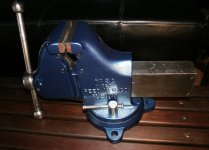
It spent some time degreasing, then many long hours in the blasting cabinet, then many long hours prepping, polishing and painting, and finally arrived at what you see below. The Plomb 1/2" ratchet is attached for the sake of comparison.

The following photos will depict the various parts of the restoration, though I didn't exactly take photos along the way as really they would only be a dirty representation of the cleaned and finished parts. This vise, despite its grime/grit, was in nearly mint shape beneath all the crud.

attachment.php


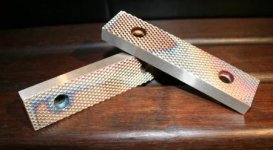
One of the shining pieces of this restoration was not an original piece to the vise, but a piece crafted by one of GJ's finest, Kevin Scott. I cannot overstate enough how fine a job this gentleman and scholar does on his production-quality vise jaws. Seriously, every vise deserves a set of jaws like this. Kevin didn't have a set of Reed 3C jaws from which to produce his, so as soon as he answered my original eMail, without any hesitation or scant second thought, they were in a priority mail box headed to Colorado. Several weeks later, a set arrived back in my mail box.

attachment.php


Whoa. Seriously? Kevin doesn't just make fine tools with firm functionality, this is a work of industrial art. Magnificent does an injustice to the description.

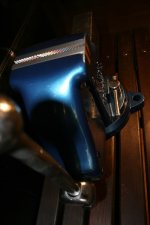
This is a shot showing the oiling port in the middle part of the dynamic arm and also gives some perspective as to how large these vises are. Granted, they're not the biggest things out there, but it absolutely has mass given its size. Any single component isn't bad to handle, but when assembled, it's not fun to lug around.

attachment.php


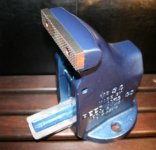
This image shows another angle of the dynamic arm with the jaws affixed. They line up nice and straight when the vise closes and give an idea of the shine/shimmer the paint selection illustrates. This is a General Motors "dark blue metallic". I apologize for the lighting in many of these photos. The flash would fire, but even with the lights on in the room and a separate point-source, they still came out dark. I'll try to get one in the sun.

attachment.php


This is just another profile photo of the vise in its entirety.

attachment.php


P.S. YES, this vise is being put back into service, though I doubt it will ever see as hard a life in my garage/man cave as it previously knew. I lobbied to build a stand in the living room for it, even shooting for something as functional as an anchor to hold an LCD TV. All attempts were met with rejection, but it will take up residence in the house until its paint/hard clear coat has sufficiently cured.
 

Attachments

  • reed_with_ratchet_small.JPG
    reed_with_ratchet_small.JPG
    133.5 KB · Views: 965
  • main_nut_small.jpg
    main_nut_small.jpg
    16.8 KB · Views: 64
  • vise_jaws_small.jpg
    vise_jaws_small.jpg
    20.3 KB · Views: 934
  • profile_2_small.JPG
    profile_2_small.JPG
    120.9 KB · Views: 917
  • profile_small.JPG
    profile_small.JPG
    122.3 KB · Views: 63
  • top_down_small.jpg
    top_down_small.jpg
    52 KB · Views: 914
  • profile_writing_oil_port_small.JPG
    profile_writing_oil_port_small.JPG
    119.8 KB · Views: 929
Last edited:
To avoid these ads, REGISTER NOW!
OP
P

p0lar

Well-known member
Joined
Jun 15, 2013
Messages
141
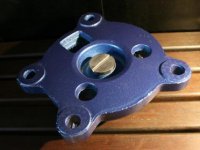
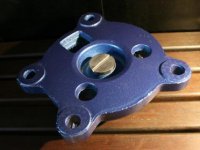
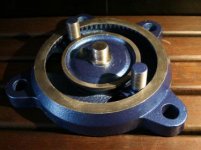
The base was painted on every rough casting surface, then cleared like everything else. I don't expect it to remain perfect, but I do expect it to remain relatively rust-free while in my tenure, which should be for quite some time. I was rather adamant about removing any paint from sliding surfaces so that the vise can operate smoothly with only a light coating of grease.

attachment.php


The swivel base hold-down screw is a rather difficult insertion/extraction depending on what tool is used. Fortunately, mine was not rusted and was still well-greased - excellent for me, but if you're having a problem extracting yours, I used a large drag link socket to loosen mine as I was expecting it to be overly tight. A tiny amount of copper anti-seize absolutely won't hurt when reassembling.

attachment.php


Here's a quick shot of the polished and waxed swivel locks and nuts inserted into the swivel base.

attachment.php


The swivel locks were polished and any rough casting surfaces that made no contact were also coated with paint. This is overkill, seriously, and not necessary. But, why judge a book by its cover when its contents are so masterful? There's more to a good book than a good reed, after all.

attachment.php


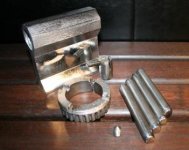
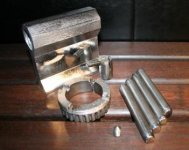
I also polished and waxed the main nut, main nut stop and pipe jaw retention pins. The main nut stop adjusting set screw was oiled and tightened to ~10 lb-ft with just a touch of anti-seize on its threads. The other smaller set screw is for the threaded split-ring locking collar. It also has a minute amount of anti-seize applied.

attachment.php


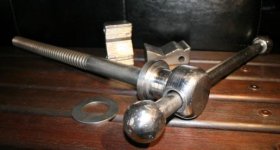
There wasn't much going on with the main screw. I simply cleaned it up and polished/waxed it like the other pieces. Behind the threaded split-ring locking collar I used a high-temp synthetic grease rather than a typical oil as that's a part that won't see service often. The main screw was helped to a dose of anti-seize to operate smoothly, and it is absolutely smooth with extremely little end-play after adjusting the locking collar. The locking collar was tapped tight until rotation slowed or stopped, then backed off approximately 15°. This minimizes the amount of end-play on the main screw without exerting too much tension on the dynamic jaw's body at rest, on the main screw's welds or the threads of the dynamic jaw when loosening.

attachment.php


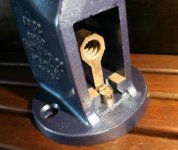
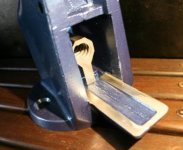
This shot just shows how the main nut is positioned in the rear of the vise with the main nut locking pin inserted and the set screw adjusted.

attachment.php


And lastly, another profile shot, this time of the non-descript left side.

attachment.php
 

Attachments

  • static_profile_left_small.jpg
    static_profile_left_small.jpg
    10.8 KB · Views: 885
  • static_rear_small.jpg
    static_rear_small.jpg
    16.3 KB · Views: 881
  • screw_small.jpg
    screw_small.jpg
    19.8 KB · Views: 880
  • main_nut_small.jpg
    main_nut_small.jpg
    16.8 KB · Views: 878
  • swivel_locks_small.jpg
    swivel_locks_small.jpg
    19.9 KB · Views: 881
  • base_small.jpg
    base_small.jpg
    19.5 KB · Views: 886
  • base_bottom_bolt.jpg
    base_bottom_bolt.jpg
    15.2 KB · Views: 859
Last edited:
OP
P

p0lar

Well-known member
Joined
Jun 15, 2013
Messages
141
attachment.php


attachment.php


attachment.php
 

Attachments

  • static_jaws_small.jpg
    static_jaws_small.jpg
    13 KB · Views: 878
  • static_lettering_smalljpg.jpg
    static_lettering_smalljpg.jpg
    20 KB · Views: 886
  • static_throat_small.jpg
    static_throat_small.jpg
    15.9 KB · Views: 878
  • base_bottom_bolt.jpg
    base_bottom_bolt.jpg
    15.2 KB · Views: 72
  • base_with_lock_bolts_small.jpg
    base_with_lock_bolts_small.jpg
    17.3 KB · Views: 893
Last edited:
OP
P

p0lar

Well-known member
Joined
Jun 15, 2013
Messages
141
And one last post for pre-restoration photos and observations - sorry for the length of this post!
 

KMScott

Well-known member
Joined
Feb 14, 2012
Messages
4,643
Location
Daufuskie Island, South Carolina
p0lar, what a beautiful job. Reeds are sure nice vises. Thanks for the kind words on the jaws. I only need a 2C example to have the four C's covered. Even worked over the nut. I'd be curious to the thread size. I hope you do not mind if I share your pictures. EOC-Jason will enjoy seeing your work.
 

zkling

Well-known member
Joined
Jan 23, 2007
Messages
16,939
Wow, that is very nice. :drool: The smooth curves and metallic blue against the satin finished bare metal is very simple yet elegant. Can we hear a bit more about the vise jaws? I've made some vise jaws but nothing that looked like those. Are they hardened or just heat colored? :beer:
 

drivesitfar

Well-known member
Joined
Oct 23, 2013
Messages
36,046
Location
Pacific Northwest
Wow that is some restoration. I love the story too. did the household account ever get to know what the bills totaled for you to buy an awesome Nick Nack for the living room?

you mentioned a lot of polishing. did you do with a bench buffer or a hand powered one or just elbow grease? compound involved and what may I ask?

did I happen to mention that was a nice restoration?
 
OP
P

p0lar

Well-known member
Joined
Jun 15, 2013
Messages
141
p0lar, what a beautiful job. Reeds are sure nice vises. Thanks for the kind words on the jaws. I only need a 2C example to have the four C's covered. Even worked over the nut. I'd be curious to the thread size. I hope you do not mind if I share your pictures. EOC-Jason will enjoy seeing your work.

Thank you, Mr. Scott! I initially refused the pipe jaws (Modified Wilton C3) and after seeing the vise jaws, it was immediate regret, but the accountant wouldn't have passed that bill. Anyone is more than welcome to use these photos, or any high-resolution ones I may also have, or if they want a specific photo that doesn't require me to dismantle the vise, I'll get that too.

Thanks again for your contribution to the tool's restoration!

Wow, that is very nice. :drool: The smooth curves and metallic blue against the satin finished bare metal is very simple yet elegant. Can we hear a bit more about the vise jaws? I've made some vise jaws but nothing that looked like those. Are they hardened or just heat colored? :beer:

I'll post a photo of the old vise jaws. Basically, I contacted Kevin via eMail with a request for the Reed 3C jaws. He said he didn't have them, but was looking for a set from which to design his from. I agreed post haste and shipped him both vise jaws, both pipe jaws, as well as one screw and perhaps one pipe jaw retaining pin. (my memory is fuzzy on that last pin, but it sounds like something I'd have done)

The vise jaws are cut from A2 tool steel, IIRC, and are hardened to approximately 56 RC. The teeth look to be face-milled ever so slightly to knock off the edges/burrs, but I'm no machinist so I couldn't tell you with absolute certainty how this was accomplished. They've got good grip without having gouging edges or edges that will fold over and change the tooth contact pattern. I believe the colourful pattern was simply a result of the heat treatment, and while nice, was simply the byproduct and not the immediate intention of the process. Kevin will be able to answer those questions more specifically.

Quoted from Kevin below:

KMScott said:
Like p0lar mentioned the jaws are made from A-2. I like this steel for a couple of reasons. One is I can buy it cheaper on e-bay and in the nominal width and thickness, even though this Toolsteel is up to 45% of the cost of a new set of jaws. The second reason is that this steel does not warp or twist during heat treating, a trait of air hardening tool steel. The third reason is that it will have to get over 1000 degrees to take the hardness from the steel. The tempering process is used to bring the steel down from over 60 Rockwell to the 54-56 Rockwell hardness I want. The color is requested by me, I have Nitrogen used as the inert gas in the tempering oven.

When I build the jaws, I like cutting a chamfer all around edges that match the depth of the serration cut, the reason is that it does not leave a burr and it keeps the edges from chipping during use. Then they are surface ground flat and square.

Kevin also included quantity 4 5/16"-18 socket head cap screws, looked like they may also be low profile, but he might confirm that. They can be found here on his site.

For the sake of posterity (though this information is on Kevin's site) the jaws measured 5.0" long, 1.156" wide and 0.5" thick. The distance between the through holes is 3.0" and there is a hole cut for the center positive locating pin that protrudes from the static and dynamic jaws.

Wow that is some restoration. I love the story too. did the household account ever get to know what the bills totaled for you to buy an awesome Nick Nack for the living room?

you mentioned a lot of polishing. did you do with a bench buffer or a hand powered one or just elbow grease? compound involved and what may I ask?

did I happen to mention that was a nice restoration?

Let's see, I really didn't add everything up, but it amounted to more value in my time than the bulk of the materials, probably even including the vise itself and that's if I value my time modestly.

She's aware of the approximate cost, and is OK with it because she seems to understand the pleasure associated with fine tools. We have an understanding, as long as I can use the aforementioned tools in her favour - i.e. furniture building, then my pass remains semi-golden. While I'd love to admire the vise every day in my living room, that simply won't be realistic. It's allowed to live indoors until it's evicted or the paint cures, whichever comes first, but it absolutely will be put back to work. I love a well-kept tool, but I don't own any garage queens and don't think I'd have the stomach to have invested this much into a tool and not put it to good use. As a bonus, I learned a lot about large vise restoration in the process, which may carry over to other tools I aim to restore! Plus, it's a relaxing way to spend a Sunday morning.

In terms of the polishing, I'm going to be brutally frank. If I had known how much work it was to polish those pieces before I started, I would not have done as much. High tensile-strength steel/iron is difficult to polish, so even though I did a bit of work to the parts, I didn't go crazy. I used a polishing ball with a medium cut compound to start the work, then switched to a cloth wheel with a fine cut compound to finish them up as much as reasonable while bearing in mind that I wanted to keep the 'soul' of the vise intact. Given the difficulty of polishing most of these components, it wasn't a difficult proposition to constantly remind myself of that. The last polishing step was absolutely by hand and was a micro-fine metal polish that really did little more than cause a tendonitis flare-up.
 
Last edited:
OP
P

p0lar

Well-known member
Joined
Jun 15, 2013
Messages
141
I'm lovin the blue!

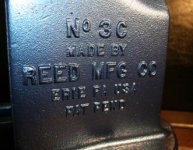
Thanks! I had someone ask me why I didn't outline the letters in another colour. I seriously considered doing them in silver before clearing the base colour, but it was such a stunning reflection with the metallic casting a shine from the lettering that I felt all I could possibly do was make it worse. There's something simplistic about it that just didn't need further refinement, so that's how it remains.
 

drivesitfar

Well-known member
Joined
Oct 23, 2013
Messages
36,046
Location
Pacific Northwest
sorry to hear about the tendinitis, but i'm going to tell you this again. that is one of the nicest restorations I've seen.

just an FYI. since the accountant is on board with the nice vise purchase maybe she'll let you warm up the oven and let you place it inside for a little paint curing/baking. some guys here can get away with that and some actually have an oven in their shops and garages.

I've never been able to swing that yet so not sure what the temp should be but I've heard in the 250 range.

or just let it cure at 70 degrees inside your house for a while and enjoy the view until it lands on your bench.:thumbup:
 

FMC1959

Well-known member
Joined
Feb 9, 2014
Messages
2,319
Location
Montreal, Canada / Upstate NY
There are lots of great looking vintage vise on CG. Yours is up there wth the top restorations, absolutely stunning!

Personally, I would put it in the living room and fire the accountant. ;)
 

KMScott

Well-known member
Joined
Feb 14, 2012
Messages
4,643
Location
Daufuskie Island, South Carolina
Can we hear a bit more about the vise jaws? I've made some vise jaws but nothing that looked like those. Are they hardened or just heat colored? :beer:

Like p0lar mentioned the jaws are made from A-2. I like this steel for a couple of reasons. One is I can buy it cheaper on e-bay and in the nominal width and thickness, even though this Toolsteel is up to 45% of the cost of a new set of jaws. The second reason is that this steel does not warp or twist during heat treating, a trait of air hardening tool steel. The third reason is that it will have to get over 1000 degrees to take the hardness from the steel. The tempering process is used to bring the steel down from over 60 Rockwell to the 54-56 Rockwell hardness I want. The color is requested by me, I have Nitrogen used as the inert gas in the tempering oven.

When I build the jaws, I like cutting a chamfer all around edges that match the depth of the serration cut, the reason is that it does not leave a burr and it keeps the edges from chipping during use. Then they are surface ground flat and square.
 

oldldh

Well-known member
Joined
May 22, 2012
Messages
3,700
Location
Fairhope, AL
I knew that...

You can't fool this old dude...:headscrat:headscrat:headscrat

Everyday stuff!!!!

Now, what the hell did Brother Scott just say???:bowdown::bowdown::bowdown:
 
To avoid these ads, REGISTER NOW!

oldldh

Well-known member
Joined
May 22, 2012
Messages
3,700
Location
Fairhope, AL
Me---would I try to wind somebody up???

Surely you jest...

A chain puller---me???

Ha!!! and Ha!!! again....
 
Last edited:

EOC_Jason

Well-known member
Joined
Jun 25, 2012
Messages
11,388
Location
Bentonville, AR
That is one of the most spectacularly restored Reed vises I have ever seen. :bowdown:

I would not have nearly as much patience polishing all those parts to such a high shine. You really did an A++ job! The pictures don't really do the physical size justice, a 3C is pretty darn big and heavy! I'm guessing (hoping) you took the dynamic out to move it yourself? lol...

Thank you, Mr. Scott! I initially refused the pipe jaws (Modified Wilton C3) and after seeing the vise jaws, it was immediate regret, but the accountant wouldn't have passed that bill.

What was wrong with your pipe jaws? I see they are in the pictures, but there are no clear shots of the jaws themselves.

My only Reed with removable jaws is my 4C, the other three have the cast-in jaws. It does give me an excuse to continue the search though for ones with replaceable jaws, just so they all match... ;)

You know, you could probably hold like an 80" flat screen in those jaws... Visually appealing and practical! ;)
 
OP
P

p0lar

Well-known member
Joined
Jun 15, 2013
Messages
141
That is one of the most spectacularly restored Reed vises I have ever seen. :bowdown:

Thanks! To me, it's been more the journey than the result. I recently also restored a wilton 1750 stamped January, 1971, but it didn't deliver the personal satisfaction that this one has. The only reason that comes to mind is.. "Size matters." :lol_hitti

I would not have nearly as much patience polishing all those parts to such a high shine. You really did an A++ job! The pictures don't really do the physical size justice, a 3C is pretty darn big and heavy! I'm guessing (hoping) you took the dynamic out to move it yourself? lol...

Well, it hasn't moved far since I assembled it on that bench where it currently resides. I've found the best way to move it whole is to retract the dynamic arm a few inches and simply cradle it by the dynamic arm on both sides. It's still not comfortable either way.

What was wrong with your pipe jaws? I see they are in the pictures, but there are no clear shots of the jaws themselves.

My only Reed with removable jaws is my 4C, the other three have the cast-in jaws. It does give me an excuse to continue the search though for ones with replaceable jaws, just so they all match... ;)

I'll get some photos of the jaws. They just have a bit of 'mangle' to them, but they were in satisfactory condition, so it didn't seem worthwhile to replace them. I'll get photos of the original jaws while I'm at it. Are you saying your 3C has cast jaws? That's interesting, and makes me curious as to the history of the 1/2/3/4C series.

You know, you could probably hold like an 80" flat screen in those jaws... Visually appealing and practical! ;)

Ha! I think most of the accountant's friends (and several of mine) think I'm crazy and don't understand the fixation. I can't tell if GJ is a support group or enablement body.

Anyway, back to the subject at hand, does anyone know of a way to date these vises or the general approximation of when they were produced? I didn't find any particular or identifying markings other than a stamped 'EC' on one side of the dynamic jaw, but that could have been one of its original owners.
 
OP
P

p0lar

Well-known member
Joined
Jun 15, 2013
Messages
141
That thing was a dirty slob last time I saw it!!

Hell of a job.

Thanks! Yeah, I'm going to dig those photos out soon. Despite removing what felt like 50 lbs of crud, it's still not easy to relocate, so I probably won't bring it by to demonstrate its steely goodness. Plus, I think you'll bolt it down with security lags to your bench when I'm not looking... :rolleyes2
 

EOC_Jason

Well-known member
Joined
Jun 25, 2012
Messages
11,388
Location
Bentonville, AR
I'll get some photos of the jaws. They just have a bit of 'mangle' to them, but they were in satisfactory condition, so it didn't seem worthwhile to replace them. I'll get photos of the original jaws while I'm at it. Are you saying your 3C has cast jaws? That's interesting, and makes me curious as to the history of the 1/2/3/4C series.

I meant the regular jaws are cast-in... All the pipe-jaws are removable.

The styling started out with the big round nose like on the old-style reeds, cast-in jaws, one lock-down handle, and the set-screw adjustment for the mainscrew nut.

Over time the nose changed from the round to flat style, and from one lock-down handle to two (one on each side). The jaws went from the cast-in to the reversible/replaceable. And finally the nice adjustment screw got replaced with just a plain old pin.

Attached is a pic of an old & new. The ball ends on the old style are also significantly larger.
 

Attachments

  • P1030040 (Large).jpg
    P1030040 (Large).jpg
    134.2 KB · Views: 108

Sheriff Roscoe

Well-known member
Joined
Feb 6, 2014
Messages
189
Location
Great Lakes State
Wow...she's a beauty! Very nice job Polar bear :thumbup:

I have the elusive Reed 2C and am considering a restoration. Been leaning towards a gunmetal gray or gunmetal blue and your color fits the bill. And I drive GM but am digressing...

Too many irons (i.e. projects) in the fire so it may not happen for a while, if at all. Anyway, your's is an excellent example of a restoration.:thumbup::thumbup:
 

drivesitfar

Well-known member
Joined
Oct 23, 2013
Messages
36,046
Location
Pacific Northwest
:beer:

Accountant says I better not be making house calls to polish other guys' Reeds. What's she talking about?? :dunno:

p0lar: since you can't come to our shops to restore our old vises can you give us your shipping address so we can send them to you? we promise to at least clean some of the crud off of them before we ship them. I would recommend a gyro for the tendinitis that really helped almost eliminate my issues so you can keep shining them up.

Bluebolt: i'm still learning the language so apologize for that misprint. I thought that was Kevin's title "Metal Artist" or "Metal Surgeon" or maybe just Dr. Jaws. I think he may have found his bride at one of those places he buys all his steel from and maybe she taught him that language. My gramps was a logger so I speak Wood better than Metal "Artist", but I'm willing to learn.
 

EOC_Jason

Well-known member
Joined
Jun 25, 2012
Messages
11,388
Location
Bentonville, AR
Anyway, back to the subject at hand, does anyone know of a way to date these vises or the general approximation of when they were produced? I didn't find any particular or identifying markings other than a stamped 'EC' on one side of the dynamic jaw, but that could have been one of its original owners.

No, Reed did not stamp theirs with any year info AFAIK...

Judging from your features, I would guess 70's... Though it very well could be as early as the 60's or less probable as late as the 80's...
 

SteveCh

Well-known member
Joined
Dec 21, 2012
Messages
1,053
Even if it was already pretty good under the grime, you did a beautiful job. Work of art.
 
OP
P

p0lar

Well-known member
Joined
Jun 15, 2013
Messages
141
I meant the regular jaws are cast-in... All the pipe-jaws are removable.

The styling started out with the big round nose like on the old-style reeds, cast-in jaws, one lock-down handle, and the set-screw adjustment for the mainscrew nut.

Over time the nose changed from the round to flat style, and from one lock-down handle to two (one on each side). The jaws went from the cast-in to the reversible/replaceable. And finally the nice adjustment screw got replaced with just a plain old pin.

Attached is a pic of an old & new. The ball ends on the old style are also significantly larger.

That's some great information. I was guessing this vise was a 30s or 40s era based on some of its styling cues, but perhaps I was mistaken.

Thanks again for the info - much appreciated! I'd love to have an original print ad for one of these things, so sweet it is!
 
Last edited:
OP
P

p0lar

Well-known member
Joined
Jun 15, 2013
Messages
141
p0lar: since you can't come to our shops to restore our old vises can you give us your shipping address so we can send them to you? we promise to at least clean some of the crud off of them before we ship them. I would recommend a gyro for the tendinitis that really helped almost eliminate my issues so you can keep shining them up.

Heh, the tendonitis was more farcical than anything, though I honestly felt like that's exactly the path I was headed.

The only problem I'd have with a restoration is shipping it back - I love doing it, but the problem is the return and not knowing if it would arrive back to you in the same shape I shipped it. (knowing all the courrier services)

Now, if you happen to be local, it's game one!
 

drivesitfar

Well-known member
Joined
Oct 23, 2013
Messages
36,046
Location
Pacific Northwest
not sure where you live, but i'm guessing it might be outside the limits of a vise restorataion. as my handle says I'll drive it far (car, vise, golf balls, etc...). thank you for offering though.

I don't think I can mention this enough. that is one damn good looking vise after you did your magic to it.
 
OP
P

p0lar

Well-known member
Joined
Jun 15, 2013
Messages
141
not sure where you live, but i'm guessing it might be outside the limits of a vise restorataion. as my handle says I'll drive it far (car, vise, golf balls, etc...). thank you for offering though.

I don't think I can mention this enough. that is one damn good looking vise after you did your magic to it.

Thanks for the kind words from the support group! (lol)

BTW, just wait until I finish the Hein-Werner WS floor jack I recently acquired. This one may top the Reed, if that's possible!
 

EOC_Jason

Well-known member
Joined
Jun 25, 2012
Messages
11,388
Location
Bentonville, AR
Thanks again for the info - much appreciated! I'd love to have an original print ad for one of these things, so sweet it is!

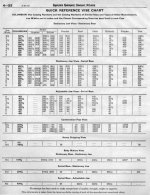
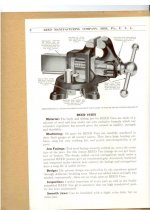
You might be able to find some on eBay, but in the mean time, here are some PDF's you might be interested in.

The last two images show the difference in the New Style vs Old Style.
 

Attachments

  • 1979reedcatalog1.jpg
    1979reedcatalog1.jpg
    138.1 KB · Views: 70
  • 1979reedcatalog2.jpg
    1979reedcatalog2.jpg
    144.1 KB · Views: 60
  • 1959ColumbianChart0001.jpg
    1959ColumbianChart0001.jpg
    137.6 KB · Views: 49
  • Reedchartearh.jpg
    Reedchartearh.jpg
    127.7 KB · Views: 51
  • Reednewstyle-1.jpg
    Reednewstyle-1.jpg
    94.5 KB · Views: 59
  • Reedoldstyle-1.jpg
    Reedoldstyle-1.jpg
    82.9 KB · Views: 65

TMcCay

Well-known member
Joined
Jun 5, 2011
Messages
1,059
Location
SW. Oklahoma
That is a beautiful resto. I don't know if I could stand to use it in fear of chipping or scratching it. Well done!!
 
To avoid these ads, REGISTER NOW!
Top Bottom