I finally finished the full restoration of my Reed 3C bench vise when the weather broke a few days ago. It's been a long journey, so I figured rather than documenting it in the main vise thread, I'll put it here where I can post more photos of this fantastic breed.
My search for a large vise has been ongoing, and with respect to the Reed, wasn't aimed particularly high as I had my hopes set on a 2C, which the seller promptly sold out from under me at the last minute. I really liked the swivel base with dual locks, dual oiling ports, and the fact that you could adjust both the split ring threaded locking collar and main nut to eliminate end-play in the main screw. I rarely use pipe jaws, but liked the fact that these vises had them, and they were well-designed. I digress.. in a momentary lack of judgement, I turned to eBay and found a dirty Reed 3C sitting there for $350 USD plus shipping. That was never going to fly past the household accountant, so I made an offer of $250 and I'd pick it up and pay cash. To my surprise, the gentleman selling the vise agreed, and let me pre-pay via eBay auction with "free shipping" and pick it up several weeks later. Momentary lapse, indeed, I jumped all over it. Naturally, this vise was 7 hours away, but we were headed to Chicago anyway, so I arranged a detour with the household accountant and went about my business.
The day finally came for the drive to Chicago, but the household accountant was not prepared for what was to come. The seller was not home, so he left it on a brick wall for me to pick up. It was about a 45 minute detour, and I don't think the accountant grasped the size of the vise initially. "That thing is the vise?"
"Yeah, isn't it beautiful!?"
<roll>
Problem #1, it weighs 125 lbs
Problem #2, it was filthy (I had a trash bag just in case, but see Problem #1)
Problem #3, we were driving the M3, and it was already full of luggage
After solving all but two of the problems, we were on our way - the car was noticeably slower on traffic merges.
Finally, after getting home from Chicago several days later, the Reed came out and the disassembly began. It was a mess, but there were no problems apart from the usual wear/grime/grit of a 70+ year old vise. My fuel economy decreased, but I was ecstatic.
It spent some time degreasing, then many long hours in the blasting cabinet, then many long hours prepping, polishing and painting, and finally arrived at what you see below. The Plomb 1/2" ratchet is attached for the sake of comparison.
The following photos will depict the various parts of the restoration, though I didn't exactly take photos along the way as really they would only be a dirty representation of the cleaned and finished parts. This vise, despite its grime/grit, was in nearly mint shape beneath all the crud.

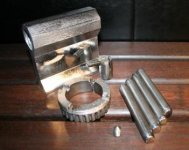
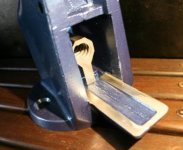
One of the shining pieces of this restoration was not an original piece to the vise, but a piece crafted by one of GJ's finest, Kevin Scott. I cannot overstate enough how fine a job this gentleman and scholar does on his production-quality vise jaws. Seriously, every vise deserves a set of jaws like this. Kevin didn't have a set of Reed 3C jaws from which to produce his, so as soon as he answered my original eMail, without any hesitation or scant second thought, they were in a priority mail box headed to Colorado. Several weeks later, a set arrived back in my mail box.

Whoa. Seriously? Kevin doesn't just make fine tools with firm functionality, this is a work of industrial art. Magnificent does an injustice to the description.
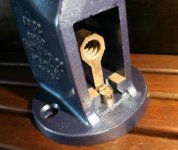
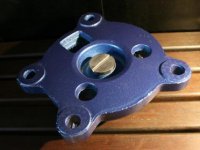
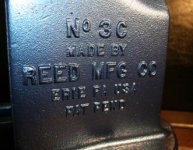
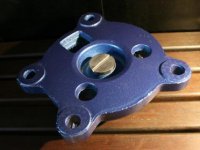
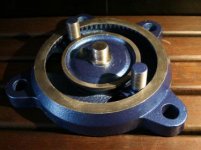
This is a shot showing the oiling port in the middle part of the dynamic arm and also gives some perspective as to how large these vises are. Granted, they're not the biggest things out there, but it absolutely has mass given its size. Any single component isn't bad to handle, but when assembled, it's not fun to lug around.

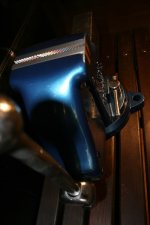
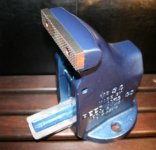
This image shows another angle of the dynamic arm with the jaws affixed. They line up nice and straight when the vise closes and give an idea of the shine/shimmer the paint selection illustrates. This is a General Motors "dark blue metallic". I apologize for the lighting in many of these photos. The flash would fire, but even with the lights on in the room and a separate point-source, they still came out dark. I'll try to get one in the sun.

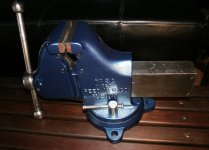
This is just another profile photo of the vise in its entirety.

P.S. YES, this vise is being put back into service, though I doubt it will ever see as hard a life in my garage/man cave as it previously knew. I lobbied to build a stand in the living room for it, even shooting for something as functional as an anchor to hold an LCD TV. All attempts were met with rejection, but it will take up residence in the house until its paint/hard clear coat has sufficiently cured.
My search for a large vise has been ongoing, and with respect to the Reed, wasn't aimed particularly high as I had my hopes set on a 2C, which the seller promptly sold out from under me at the last minute. I really liked the swivel base with dual locks, dual oiling ports, and the fact that you could adjust both the split ring threaded locking collar and main nut to eliminate end-play in the main screw. I rarely use pipe jaws, but liked the fact that these vises had them, and they were well-designed. I digress.. in a momentary lack of judgement, I turned to eBay and found a dirty Reed 3C sitting there for $350 USD plus shipping. That was never going to fly past the household accountant, so I made an offer of $250 and I'd pick it up and pay cash. To my surprise, the gentleman selling the vise agreed, and let me pre-pay via eBay auction with "free shipping" and pick it up several weeks later. Momentary lapse, indeed, I jumped all over it. Naturally, this vise was 7 hours away, but we were headed to Chicago anyway, so I arranged a detour with the household accountant and went about my business.
The day finally came for the drive to Chicago, but the household accountant was not prepared for what was to come. The seller was not home, so he left it on a brick wall for me to pick up. It was about a 45 minute detour, and I don't think the accountant grasped the size of the vise initially. "That thing is the vise?"
"Yeah, isn't it beautiful!?"
<roll>
Problem #1, it weighs 125 lbs
Problem #2, it was filthy (I had a trash bag just in case, but see Problem #1)
Problem #3, we were driving the M3, and it was already full of luggage
After solving all but two of the problems, we were on our way - the car was noticeably slower on traffic merges.
Finally, after getting home from Chicago several days later, the Reed came out and the disassembly began. It was a mess, but there were no problems apart from the usual wear/grime/grit of a 70+ year old vise. My fuel economy decreased, but I was ecstatic.
It spent some time degreasing, then many long hours in the blasting cabinet, then many long hours prepping, polishing and painting, and finally arrived at what you see below. The Plomb 1/2" ratchet is attached for the sake of comparison.
The following photos will depict the various parts of the restoration, though I didn't exactly take photos along the way as really they would only be a dirty representation of the cleaned and finished parts. This vise, despite its grime/grit, was in nearly mint shape beneath all the crud.
One of the shining pieces of this restoration was not an original piece to the vise, but a piece crafted by one of GJ's finest, Kevin Scott. I cannot overstate enough how fine a job this gentleman and scholar does on his production-quality vise jaws. Seriously, every vise deserves a set of jaws like this. Kevin didn't have a set of Reed 3C jaws from which to produce his, so as soon as he answered my original eMail, without any hesitation or scant second thought, they were in a priority mail box headed to Colorado. Several weeks later, a set arrived back in my mail box.
Whoa. Seriously? Kevin doesn't just make fine tools with firm functionality, this is a work of industrial art. Magnificent does an injustice to the description.
This is a shot showing the oiling port in the middle part of the dynamic arm and also gives some perspective as to how large these vises are. Granted, they're not the biggest things out there, but it absolutely has mass given its size. Any single component isn't bad to handle, but when assembled, it's not fun to lug around.
This image shows another angle of the dynamic arm with the jaws affixed. They line up nice and straight when the vise closes and give an idea of the shine/shimmer the paint selection illustrates. This is a General Motors "dark blue metallic". I apologize for the lighting in many of these photos. The flash would fire, but even with the lights on in the room and a separate point-source, they still came out dark. I'll try to get one in the sun.
This is just another profile photo of the vise in its entirety.
P.S. YES, this vise is being put back into service, though I doubt it will ever see as hard a life in my garage/man cave as it previously knew. I lobbied to build a stand in the living room for it, even shooting for something as functional as an anchor to hold an LCD TV. All attempts were met with rejection, but it will take up residence in the house until its paint/hard clear coat has sufficiently cured.
Attachments
-
 reed_with_ratchet_small.JPG133.5 KB · Views: 965
 -
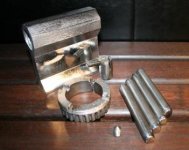 main_nut_small.jpg16.8 KB · Views: 64
 -
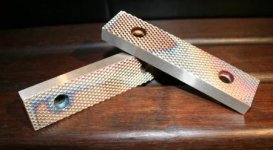 vise_jaws_small.jpg20.3 KB · Views: 934
 -
 profile_2_small.JPG120.9 KB · Views: 917
 -
 profile_small.JPG122.3 KB · Views: 63
 -
 top_down_small.jpg52 KB · Views: 914
 -
 profile_writing_oil_port_small.JPG119.8 KB · Views: 929
Last edited:



 The smooth curves and metallic blue against the satin finished bare metal is very simple yet elegant. Can we hear a bit more about the vise jaws? I've made some vise jaws but nothing that looked like those. Are they hardened or just heat colored?