jakemac
Well-known member
Made in West Germany make it an import from the east, doesn't it ? 

That looks like a stout wee beastie.
That looks like a stout wee beastie.

Made in West Germany make it an import from the east, doesn't it ?
Made in West Germany make it an import from the east, doesn't it ?
That looks like a stout wee beastie.
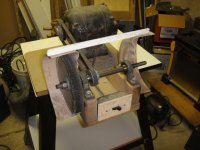
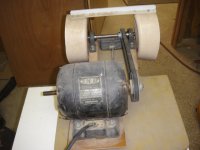
p) in North America, I just can't believe it. Here there's a decent market for vintage cars and motorcycles, but vintage tools and machinery are pretty much ignored. New=better.I built this one in 1958. It has completely worn out 2 sets of stones. The original GE Maytag wringer washing machine motor and belt had to be replaced a year ago. Runs 1700 rpm and I wouldn't trade it for any 3450 rpm grinder I ever used and I've used some good ones.
I built this one in 1958. It has completely worn out 2 sets of stones. The original GE Maytag wringer washing machine motor and belt had to be replaced a year ago. Runs 1700 rpm and I wouldn't trade it for any 3450 rpm grinder I ever used and I've used some good ones.

I'm guessing you maintain belt tension with a hinged mount, as those link belts stretch like crazy.
I made a similar setup 25 years ago when I needed a buffer for my knife hobby. 70 year old Dunlap motor still works fine, but I upgraded the arbor recently. The guards are plastic pail bottoms. Yours looks better!
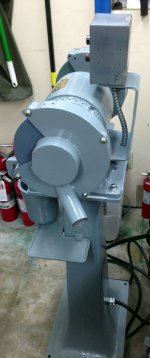
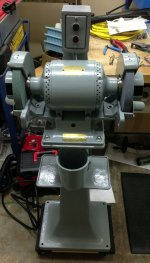
Here's a Cincinnati from the 1930s that I just finished up.
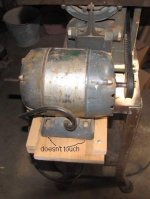
It also had a Resilient base so I made the base to pivot on the front edge and the two screws you can see near the front stabilize it. Those are not tightened. Tension is adjusted with the larger screw in the rear forcing the base down in the rear. It worked so well, when I bought the new motor I purchased one that would fit the same Resilient base.
Actually it pivots on the front edge of the base and the screws near the front are to keep it from squirming because of belt tension.I get it. It pivots on a pair of screws----very similar to the tremolo bar on a Stratocaster. Clever.
I built this one in 1958.
All the more special when it's made by yourself.You've got a pretty clean casting there. I have a similar base that, after sandblasting, looked like it was cast from concrete instead of iron. It was like staring down someone's *******.
 Ain't even gonna ask how you'd know that.


BJ: i'm sure you didn't mean that, but the banana is peeled now.
I'll try the led tomorrow!Oh MY CreteCoater- my eyes aren't that good either. Sometimes a light, with LED bulbs, directed at different acute angles makes some letters and numbers stand out better. Good luck.
Mike: you needed to read the last line in the ad. the grinder isn't included and $50 is just for the stand that will hold a 6 or 8 inch grinder.
Fretters: take a look at this weed killer thread i started last week. i swear i wrote Armageddon in that thread about an hour before you mentioned it on here. http://www.garagejournal.com/forum/showthread.php?t=277402
Fretters: take a look at this weed killer thread i started last week. i swear i wrote Armageddon in that thread about an hour before you mentioned it on here. http://www.garagejournal.com/forum/showthread.php?t=277402
Have you clicked on that link above as yet though? Might find it has a slightly different meaning on there.
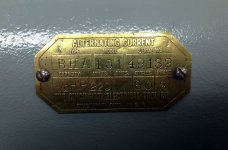
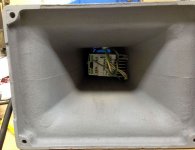
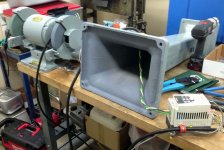
OK guys. Can anyone tell me what I have here? I can't really make it out since the plate is so scuffed.
That is it! Thanks!It looks like my Browm Brockmeyer B Line grinder
Look this brand up on vintage machinery
That is it! Thanks!
Your belt driven buffer and similar equipment, with the base your motor has, can have belt tension self adjusting, via motor weight, by building a shallow box of sorts to set the motor in.I'm guessing you maintain belt tension with a hinged mount, as those link belts stretch like crazy.
I made a similar setup 25 years ago when I needed a buffer for my knife hobby. 70 year old Dunlap motor still works fine, but I upgraded the arbor recently. The guards are plastic pail bottoms. Yours looks better!
Your belt driven buffer and similar equipment, with the base your motor has, can have belt tension self adjusting, via motor weight, by building a shallow box of sorts to set the motor in.
I think you are over-thinking this. For years the tension was handled by motor weight alone, with no shimming required. Attached is a pic of an old Foley belt sander that came with a factory motor pivot. Compensates for belt stretch and exceptional easy to change belt speeds. I recently added a spring to it since those link belts like to jump around under load, but motor weigh alone works pretty well.
The motor weight tensions this belt. I'm not sure you understand the shimming. It just can't get more simplified.I think you are over-thinking this. For years the tension was handled by motor weight alone, with no shimming required. Attached is a pic of an old Foley belt sander that came with a factory motor pivot. Compensates for belt stretch and exceptional easy to change belt speeds. I recently added a spring to it since those link belts like to jump around under load, but motor weigh alone works pretty well.