CA_Tallguy
Well-known member
- Joined
- Sep 4, 2014
- Messages
- 120
Howdy folks -- I am currently building a man cave in a bit of an oddball community with shared power available but I can also install my own electrical service. My questions are about the shared power and meters as I'd like to wire up my new building on this service until I have a need for my own dedicated power from the utility company.
I have two power feeds available to me, each 120v with a meter on the line. These are really setup for 30 amp RV service. But since I have two feeds, I can actually get 240v across them if I set things up right and I just checked the breaker and they are 40 amps. I can ensure that each line is on a different leg (they are fed from the same main panel), with or without a dual pole breaker (that's one question -- is that absolutely essential?) Of course, I'm wondering about any safety issues all this presents.
Update: in doing further research, it seems there could be safety issues if only one leg was energized. The electric car guys work around this with relays http://www.mynissanleaf.com/viewtopic.php?f=26&t=4330
The thing is, the lines are not run directly together. They are not far apart but one leg might end up with about a 60 foot longer run before it came back to my workshop panel. I realize that is less than ideal... just wondering how much less!? I'm not sure about wire sizing but will be checking what exists.
Then, each leg has an individual 120v watt-hour meter on it. I assume that they will still function correctly even if I were to bring the lines back together for 240v service?
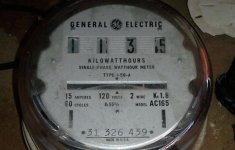
Finally, I was just looking at the meters and they say "120v 15a" on them. 15 amps? Surely these meters must be able to handle more than 15 amps? I can't even imagine a company bothering to offer a power meter that was only rated for 15 amps. This is supposed to be 30amp RV service on this line and I'm sure that the average load in the summer time with air conditioning running has often averaged over 15 amps. Anyone know if this meter is really just rated for 15 amps? Pic is attached.
Please let me know your thoughts!
I have two power feeds available to me, each 120v with a meter on the line. These are really setup for 30 amp RV service. But since I have two feeds, I can actually get 240v across them if I set things up right and I just checked the breaker and they are 40 amps. I can ensure that each line is on a different leg (they are fed from the same main panel), with or without a dual pole breaker (that's one question -- is that absolutely essential?) Of course, I'm wondering about any safety issues all this presents.
Update: in doing further research, it seems there could be safety issues if only one leg was energized. The electric car guys work around this with relays http://www.mynissanleaf.com/viewtopic.php?f=26&t=4330
The thing is, the lines are not run directly together. They are not far apart but one leg might end up with about a 60 foot longer run before it came back to my workshop panel. I realize that is less than ideal... just wondering how much less!? I'm not sure about wire sizing but will be checking what exists.
Then, each leg has an individual 120v watt-hour meter on it. I assume that they will still function correctly even if I were to bring the lines back together for 240v service?
Finally, I was just looking at the meters and they say "120v 15a" on them. 15 amps? Surely these meters must be able to handle more than 15 amps? I can't even imagine a company bothering to offer a power meter that was only rated for 15 amps. This is supposed to be 30amp RV service on this line and I'm sure that the average load in the summer time with air conditioning running has often averaged over 15 amps. Anyone know if this meter is really just rated for 15 amps? Pic is attached.
Please let me know your thoughts!
Last edited:


 But I won't be running the building full time or permanently off such a setup.