To avoid these ads, REGISTER NOW!

Bringing 2 120v lines back together for 240v Service

CA_Tallguy

Well-known member
Joined
Sep 4, 2014
Messages
120
Howdy folks -- I am currently building a man cave in a bit of an oddball community with shared power available but I can also install my own electrical service. My questions are about the shared power and meters as I'd like to wire up my new building on this service until I have a need for my own dedicated power from the utility company.

I have two power feeds available to me, each 120v with a meter on the line. These are really setup for 30 amp RV service. But since I have two feeds, I can actually get 240v across them if I set things up right and I just checked the breaker and they are 40 amps. I can ensure that each line is on a different leg (they are fed from the same main panel), with or without a dual pole breaker (that's one question -- is that absolutely essential?) Of course, I'm wondering about any safety issues all this presents.

Update: in doing further research, it seems there could be safety issues if only one leg was energized. The electric car guys work around this with relays http://www.mynissanleaf.com/viewtopic.php?f=26&t=4330

The thing is, the lines are not run directly together. They are not far apart but one leg might end up with about a 60 foot longer run before it came back to my workshop panel. I realize that is less than ideal... just wondering how much less!? I'm not sure about wire sizing but will be checking what exists.

Then, each leg has an individual 120v watt-hour meter on it. I assume that they will still function correctly even if I were to bring the lines back together for 240v service?

Finally, I was just looking at the meters and they say "120v 15a" on them. 15 amps? Surely these meters must be able to handle more than 15 amps? I can't even imagine a company bothering to offer a power meter that was only rated for 15 amps. This is supposed to be 30amp RV service on this line and I'm sure that the average load in the summer time with air conditioning running has often averaged over 15 amps. Anyone know if this meter is really just rated for 15 amps? Pic is attached.

Please let me know your thoughts!
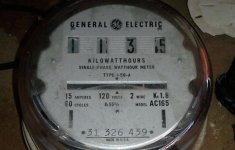
watthour-meter.jpg
 
Last edited:
To avoid these ads, REGISTER NOW!
OP
C

CA_Tallguy

Well-known member
Joined
Sep 4, 2014
Messages
120
After a bit more research, my current thinking is that it seems safe to hook up these two 120v lines using a "Generator Interlock Kit" for my Square-D QO main circuit breaker panel along with dual pole breakers both at the source community panel and on my main breaker panel. The main breaker will be unused for now and reserved for future utility power connection.

Here's the Generator Interlock kit for the Square-D QO panels... (seems like they are also available for Homeline plus GE, siemens etc) http://amzn.to/1Ckef7d (that takes you to the product page at Amazon)

With this mechanical safety device along with dual pole breakers on both sides of the feed, it seems like the relay system that the electric car guys use won't be necessary for safety.

And it looks like the two different meters on L1 and L2 should still measure all loads accurately. I'm still curious if anyone knows about the amp rating for the meter discussed in my first post. See this link if you are interested in the details: https://www.bluesea.com/resources/86

I believe the final piece of the puzzle for safety might be ensuring that the shorter of the 2 120v runs has a beefy neutral, but I'd love to hear from someone more knowledgeable about electricity to confirm this. My research is telling me that the imbalance in load between L1 and L2 will be carried on the neutral, and I'm under the impression that this will try to flow on the path of least resistance (and that should be the shorter of the 2 different 120v L1 and L2 service runs).
 

Aceman

Well-known member
Joined
Jan 28, 2007
Messages
2,513
Location
Eastern Oregon
If you have two separate 120v circuits, you can't simply bring them together legally to get a 240v circuit.
 

wyliesdiesels

Well-known member
Joined
Aug 14, 2012
Messages
20,014
Location
Modesto, CA
Are u sure theyre opposite legs? A lot of RV park setups will use the same leg tonpower several pedestals.

Why not snap some pics of the panels with the covers removed and post them here...

U asked about meter ratings. Yes it appears its rated for 15a.

Yes, the neutral wire in a split phase service does carry the current imbalance between the 2 ungrounded lines.

Why not skip all this madness and just wire in a 120v/240v service.
 
Last edited:
OP
C

CA_Tallguy

Well-known member
Joined
Sep 4, 2014
Messages
120
Are u sure theyre opposite legs? A lot of RV park setups will use the same leg tonpower several pedestals.

This isn't really an RV park. It's a private community for RV owners. I popped open the panels today and there is 240 in the box (checked with my meter) and I can put in a dual pole 40A breaker.

Why not skip all this madness and just wire in a 120v/240v service.

What's mad about it? It seems like it could be pretty straightforward. This gives me a bit more flexibility.

For one, it will allow me to feed in a generator via the same setup (slightly modified). I'm way out in the woods here so I'm sure that will be needed at some point.

If or when I install 200A utility company service, I might repurpose some of this wiring to send 50A split phase over to my RV spot where currently I only have 30A single phase 120v.

I say "if" I setup utility service because I also am into solar and could see how I might not need it at all, especially with this 240v community service to augment my solar and stored energy in a battery bank.

With "boosting" inverters/chargers I could probably get the power I need for welding and more without any solar panels... I have one of these in my RV and may put a couple more in the man cave too...
 

barnjunkie

Well-known member
Joined
Feb 3, 2015
Messages
181
Location
TN
That thing was probably manufactured in the '20s. I'd hang it up on the wall, in my shop as a relic, and feed your 220v service properly.
 

alfredeneuman

Well-known member
Joined
Mar 3, 2011
Messages
4,580
Location
Fullerton, CA
Combining the 2 meter feeds to make 1 feeder is prohibited by the Code.
The violation occurs in the feeders before the meters

300.3 Conductors
(B) Conductors of the Same Circuit. All conductors of the same circuit and, where used, the grounded conductor and all equipment grounding conductors and bonding conductors shall be contained within the same raceway, auxiliary
gutter, cable tray, cablebus assembly, trench, cable, or cord, unless otherwise permitted in accordance with 300.3(B)(1) through (B)(4).
 
Last edited:
OP
C

CA_Tallguy

Well-known member
Joined
Sep 4, 2014
Messages
120
Interesting. Thanks for that AE Neuman. Any idea the reasons behind that? I found this post that says it might be for keeping it simple for future electricians that might work on the system.... http://forums.mikeholt.com/showthread.php?t=58762

While I'm not bound by any code where I am, it seems that the main NEC violation in my case would be any use of 240v derived from the two different circuits. It sounds like feeding different 120v CIRCUITS from two different 120v FEEDS is fine then? Except if I tie the neutrals back together anywhere downstream of the feeding panel (such as a subpanel), then maybe that's not kosher even for 120v.

There are 100 other things, such as a 4 post lift, that I'd like to spend money on other than installing a utility company feed if I can avoid it. Especially since I have no pressing need for more power than I already have available. Having 240v available to fire up a welder now and then would be a nice to have, though I can also fire up a generator. Also, it would be convenient to start wiring my building and being able to feed it from my existing sources too.

Tons of RV people with 50 amp RV's use both simple and complex "cheater boxes" and other devices to feed them from 2 outlets like this.... http://amzn.to/1CnhGM2 and this http://amzn.to/1HVBPaK

And then the electric car guys are also using these devices and creating their own with relays as disused earlier.

Seems like what I'm contemplating is the same thing except it is safer since I'd be using double pole breakers on each end of the 2 feeds and I'd be certain that they'd be 2 different legs. Plus, the wire gauge would be a lot heavier than what would go through those devices.

I could setup two 30 amp outlets from each source near my workshop panel and then have a 50 amp power inlet near those and a generator interlock kit on the panel.... http://amzn.to/1Ckef7d

Then I could use one of the RV cheater boxes at times and also be able to swap a generator feed into the same inlet during power outages. The thinking here is that keeping it more of a temporary nature might be safer? The actual wiring running through the patch devices and outlets/inlet wouldn't be safer, of course. And I doubt the NEC smiles upon these cheater box devices as the net effect is the same thing as what I was originally proposing.
 

alfredeneuman

Well-known member
Joined
Mar 3, 2011
Messages
4,580
Location
Fullerton, CA
Interesting.
While I'm not bound by any code where I am, it seems that the main NEC violation in my case would be any use of 240v derived from the two different circuits.

You're in East Texas
As far as I know, private citizens on National Forest land aren't exempt from Codes.

If you live in a National Forest, the Building Codes are even more restrictive as to their usage
 
Last edited:
OP
C

CA_Tallguy

Well-known member
Joined
Sep 4, 2014
Messages
120
I'm not on National Forest land but am in the National Forest. The National Forest Service manages hundreds of parcels of government owned land here but not all of it. Other land and waterways are Corps of Engineers. And a lot of land is still private too. Like many other members of this board, I'm not subject to codes and permits for most stuff.
 
Last edited:
OP
C

CA_Tallguy

Well-known member
Joined
Sep 4, 2014
Messages
120
That thing was probably manufactured in the '20s. I'd hang it up on the wall, in my shop as a relic, and feed your 220v service properly.

That was my reason for asking about the meters. If they were only 15 amp rating I'd probably replace them but it sound like they are 100. Even so, I am going to inspect them carefully and will replace them along with sockets and even feeds to and from them if they seem deficient. (I do know I'm going to replace at least one feed from them.) These are meters owned by our association, not the utility, so I can do whatever I want with them as long as the association doesn't mind. We just use them to divide up the master power bill.
 
Last edited:

ishiboo

Well-known member
Joined
Oct 27, 2010
Messages
9,481
Location
Oshkosh, WI
I believe the meters are really only 15 amps, and they are QUITE old.

For temporary 240v service, you can use one of each hot if they're fed from the same place. Do not combine the neutrals. Use only the shorter (read: lowest resistance) of the two neutrals. Do this with your own external box plugged in. There's not much that can really go wrong, if they get switched and end up each on the same phase, you end up with 0v and you'll know something is amiss :)

For permanent service, it's really time to have the power company bring in service for you.
 

alfredeneuman

Well-known member
Joined
Mar 3, 2011
Messages
4,580
Location
Fullerton, CA
Any idea the reasons behind that?

One reason is that any ferrous metal in between the phases or neutral will cause the metal to heat up, due to inductive heating. It gets hot enough, in some cases, to burn holes in the metal.
(A byproduct of this is it will cause your bill to be higher due to the wasted energy)

conduitheating.jpg


That includes conduits, cabinets, panels, boxes, etc.
 
Last edited:

Charles (in GA)

Well-known member
Joined
Jan 11, 2006
Messages
12,489
Location
50 mi south of Atlanta
Sounds like the OP has a breaker panel with 240v in it. Just install a DP breaker and run a new circuit. Don't try to jury rig some other ****. I know that RV people have all kinds of adapters on had for all kinds of situations they encounter on the road, and thats OK, but for a permanent installation, its not OK. Do it right.

Charles
 
OP
C

CA_Tallguy

Well-known member
Joined
Sep 4, 2014
Messages
120
Some of the only information I have been able to find about the meter... says it was made from 1948 to 1990. http://www.watthourmeters.com/generalelectric/i50.html

This collector shows a similar model but 240v on Youtube and it also says 15 amperes on the plate but the guy says it is a "class 100 meter which means it is rated for 100 amperes"

The one the guy shows above is an i55 which superseded the i50, which I have. The first site I posted above has a better description of this meter and says "The I-55 superseded the self-contained I-50 meter, increasing the overload capacity from 60A to 100A, partly from using heavier wire on the current coils and introducing better overload compensation (667% instead of 400%)"
http://www.watthourmeters.com/modern/i55.html

And then the page for the subsequent model goes into more details about "full load" rating and overload rating... "The I-60S was the final evolution of the I-50's design. This meter had a full-load rating of 30 amps and using the 667% overload compensation introduced with the I-55 meant this meter could safely handle up to 200 amps, superseding the 50-amp I-50S meter (which used 400% overload compensation)."
http://www.watthourmeters.com/modern/i60.html

The I-60's list 30A on the plate and it appears that this is when they also added the TA label. This seems to suggest that the 15A on the I50 and I55 were also TA. I don't know if TA is "test amps" or the base/"full" load rating or what. Sounds like a continuous rating to me.

So, based on the three pages from the watthourmeter site, it sounds like i50's were rated to 15A TA & 60A CAPACITY, i55's to 15A TA & 100A capacity and then i60's 30A TA & 200A capacity. (Or the i50 may be 50a as noted in the watthourmeter i60 page.. but I think it is 60A as they say on the i55 page.... 400% of 15a TA)

This seems to make perfect sense. I can't imagine GE having a meter only rated to 15A max even back from 1948 to 1990 when my i50 meter was in production.

We have dozens of these meters providing 40 amp service all over our property and I know for a fact that they have been run at 20/25+ amps continuous for months at a time without any problem. For many years. So I can't imagine 15a being max load capacity and that they are inappropriate for our use here.
 
Last edited:
OP
C

CA_Tallguy

Well-known member
Joined
Sep 4, 2014
Messages
120
Sounds like the OP has a breaker panel with 240v in it. Just install a DP breaker and run a new circuit. Don't try to jury rig some other ****. I know that RV people have all kinds of adapters on had for all kinds of situations they encounter on the road, and thats OK, but for a permanent installation, its not OK. Do it right.

Well, installing a DP breaker is my plan but the only way I can really use this power is if I run L1 and L2 separately through these 120v meters in different locations. I'd probably get pushback from the association if I proposed reworking it all to go through a single 240v meter. I don't need any special permission for anything at all as long as I can stick within the confines of the 2 existing 120v meters @ 40 amp circuit each.

Of course, there isn't any question of safety if I just keep them separate and I don't try to get 240v out of it. That was my original plan until I realized that it would be super simple to get 240v out of it too if routing L1 and L2 separately via a dual pole breaker isn't going to burn the place down. I'll probably only use 240V once a month, if even that. I don't even have a 240v welder at present or an other 240v devices, though I'd probably get some 240 equipment if I had it.
 
Last edited:
OP
C

CA_Tallguy

Well-known member
Joined
Sep 4, 2014
Messages
120
For temporary 240v service, you can use one of each hot if they're fed from the same place. Do not combine the neutrals. Use only the shorter (read: lowest resistance) of the two neutrals. Do this with your own external box plugged in. There's not much that can really go wrong, if they get switched and end up each on the same phase, you end up with 0v and you'll know something is amiss :)

For permanent service, it's really time to have the power company bring in service for you.

Sounds good. Thanks for the tip about just 1 neutral. Makes sense. If I go this route, I'll likely rewire that whole leg of the circuit (and probably both circuits) with mobile home service entry cable.
 
To avoid these ads, REGISTER NOW!
OP
C

CA_Tallguy

Well-known member
Joined
Sep 4, 2014
Messages
120
I've been trying to wrap my head around the reasons behind the code saying you can't split the conductors in the circuit and how the heating happens. Here's an article that I believe discusses the issue.... (please correct me if I'm wrong)...
http://www.mikeholt.com/technical.p...ed/EMIKarl&type=u&title=Power Quality Article

I had been wondering if adding an autotransformer to the setup might help, because that could cancel out any current on the neutral by completely balancing L1 and L2. But after reading that article, it sounds like that could just make the problem worse as ALL current on both L1 and L2 would be unmatched by another conductor where they were split.

I still don't know exactly "how bad" of a situation I would be creating by splitting the conductors. (How much heating and how big of a magnetic field would be created if average load on the circuit is, say less than 10 or 20 amps?) That article on MikeHolt.com suggests that these types of situations are created all the time by wiring errors. What are the practical effects for a small circuit? It sounds like it could throw off an electron microscope within 50 feet, for example!!

QUESTION: Is there any kind of transformer or device, maybe an isolation transformer, that could safely recombine the two 120v L1 and L2 sides into 240v?

While it would feel a lot more clean to wire up my new panels with 240 service, maybe I'll just split things up for now and only feed 120 service -- keeping the two 40 amp circuits separate so I could ensure matching current on the neutrals running with both L1 (circuit A) and L2 (circuit B).

BUT... perhaps I'll cheat just a tiny bit and wire up a dedicated 240V panel in one corner of the workshop that for the most part is unused and disconnected. OR... just have two 30 amp plugs next to each other, one on each circuit, and then just use one of the RV 50 amp adapters on the very infrequent occasions when I want to run a 240v load. (See this http://amzn.to/1CnhGM2 and this http://amzn.to/1HVBPaK as posted earlier)
 
Last edited:

alfredeneuman

Well-known member
Joined
Mar 3, 2011
Messages
4,580
Location
Fullerton, CA
There's no "right way" to do something the wrong way.
Do it right or not at all. Quit trying to justify it.

I'm sure The Association would not give you as much static to install a double pole breaker in the correct panel as they would if you caused a Forest Fire.
 
OP
C

CA_Tallguy

Well-known member
Joined
Sep 4, 2014
Messages
120
There's no "right way" to do something the wrong way.
Do it right or not at all. Quit trying to justify it.

I'm sure The Association would not give you as much static to install a double pole breaker in the correct panel as they would if you caused a Forest Fire.

There is absolutely no issue with installing a double pole breaker. I CAN DO THAT. The question I'm discussing is running the conductors separately.

If you re-read my last post, you will see that nearly every option I discuss is the RIGHT WAY to do it, save for using one of the RV adapters maybe once every 3 months for 10 minutes! For example, I ask about isolation transformers and discuss that I might just keep the two 120v feeds completely separate.
 
OP
C

CA_Tallguy

Well-known member
Joined
Sep 4, 2014
Messages
120
Running the conductors separately is in fact, the wrong way.

Again, if I keep the 120v circuits separate, AND DERIVE NO 240, then there are no conductors run separately! I simply have two 120v feeds, as I do now. One happens to be on L1 and one happens to be on L2. There is no need for a double pole breaker because these are 120v circuits! Basically, this is an abandonment of plans to semi-permanently setup 240v service!
 

alfredeneuman

Well-known member
Joined
Mar 3, 2011
Messages
4,580
Location
Fullerton, CA
I'm glad you clarified that you are not planning to continue with the 240 volt option.
It doesn't make any difference however.

There is still the problem of having 2 different legs hook up to the same panel.
The original problem still exists in the circuitry, you will have 240v available at the panel

You just don't understand how electricity works, and that could be disastrous

Why not install (2) 120 volt panels instead ?
Problem eliminated!
 
Last edited:
OP
C

CA_Tallguy

Well-known member
Joined
Sep 4, 2014
Messages
120
I don't see how the original problem exists if the 240v panel is only feeding 120v circuits. All circuits have conductors that are run together, not separately. The conductors for the 240v feeding that panel are all run together, then the conductors for the 120v circuits are also run together (though the two circuits are run separately, as is the case for almost all 120v circuits run off any panel).

The only code violation would be if I derive 240v at the end off of the two separate 120v circuits, for example, with the RV adapters. That wouldn't be a code violation in the circuit wiring (since the adapter isn't part of the permanent circuit) but the practical effect would be the same. I'm not pushing that option but rather noting that the option exists if I want to break the rules the same way the RV and electric car folks do for temporary use. And there is a big *IF* that I would do that -- as I've previously stated, I currently don't even have a need for 240v since I don't have any 240v loads.
 
OP
C

CA_Tallguy

Well-known member
Joined
Sep 4, 2014
Messages
120
You just don't understand how electricity works, and that could be disastrous

Why not install (2) 120 volt panels instead ?
Problem eliminated!

If you re-read my recent previous posts, that is exactly what I am saying is the best way to feed my loads!
 
OP
C

CA_Tallguy

Well-known member
Joined
Sep 4, 2014
Messages
120
Form a couple of posts back.....

While it would feel a lot more clean to wire up my new panels with 240 service, maybe I'll just split things up for now and only feed 120 service -- keeping the two 40 amp circuits separate so I could ensure matching current on the neutrals running with both L1 (circuit A) and L2 (circuit B).
 
OP
C

CA_Tallguy

Well-known member
Joined
Sep 4, 2014
Messages
120
This exercise has been fruitful for me in helping me to realize that I don't really need my own utility company service AND I can eventually get 240v in my building since I am going to be installing a lot of solar equipment.

More than likely, I will have a device (or more than one device) like this...

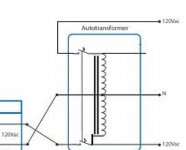
In my case, instead of kicking on a generator for peak loads, I'll simply use the community power feed available to me. I may have to hang an autotransformer off a 120v panel if I need to feed in 240v, but I'm currently researching if these devices have the ability to function as an autotransformer themselves. Under this scenario, I'll only have 20 amps of 240v to augment the inverter power output but that will likely be sufficient. That is, unless I want to break the code rules and derive 240v with differently routed L1-L2 for these spikes (for up to 40 amps of 240v).... which should at least be a lot safer than pulling 240v all the time to feed ALL my loads.

But again, if I can live with 20A of 240v to augment the inverter/charger output, then I can get that with an autotransformer off of just one leg, and that *should* be perfectly safe and up to code.
 
Last edited:

wyliesdiesels

Well-known member
Joined
Aug 14, 2012
Messages
20,014
Location
Modesto, CA
Can u post some pics of the service with covers off? Im trying to picture what u have...

Do u have several RV power pedestals next to each other fed by a 3-wire feeder?

If so, why not reconfigure it, buy a 4 jaw meter pan and meter and wire up a 3-wire 120v/240v service for yourself...About a days work including material run and problem solved!
 
OP
C

CA_Tallguy

Well-known member
Joined
Sep 4, 2014
Messages
120
Therein lies the problem.

I give up trying to explain why

There isn't a difference between the circuits I describe and any code compliant residential 120v circuit in north america! We obviously are having a communication problem.

The circuits I describe are your normal, everyday, 120v circuits. 100% code compliant circuits coming off a panel fed by 120/240v split phase. I am talking about the upstream FEED panel - the community panel. Not MY panel. There is nothing special about the 120v circuits run from this box. I have not modified my electrical system and this is exactly what exists today. This is what has existed in every house I have ever owned!

I think you have it in your head that I'm still talking about hacking together a 240v sub panel in my building off these two circuits and I am NOT saying that. I do agree with you about the practical effect if I do derive 240v in any way whatsoever off of L1 and L2 from these TWO circuits, routed completely separately. I don't see how I could be any more clear about this except by not discussing the RV adapters.

You yourself said a few posts back that I should just install two 120v sub panels and the problem would be solved. I've tried to explain that is what I'm talking about. But I don't even need to install those sub panels because they currently exist! You are suggesting that I have a problem in my electrical system as it exists, if I do nothing!
 

Zeke

Well-known member
Joined
Aug 13, 2009
Messages
17,176
Location
Long Beach CA, the sewer by the sea.
Been reading since the thread opened. I think there is a 'communication' problem. Tallguy, you have heard from some of the most well informed electricians you will find on any board including Mike Holt. You have indicated that you now won't try to combine feeds from different panels or the main panel or from the closest cloud.

That should settle it. From the beginning this was a simple matter, two legs NOT in the same carrier are not to be used in any way shape or form or there could be resultant problems. Good luck (seriously) with the solar. That seems to be the future.

This thread should go into some kind of electrical Wiki for others to see why this is NOT done.

I'll admit I have little knowledge of autotransformers but did you just throw a dart at the donkey's tail on that?
 
OP
C

CA_Tallguy

Well-known member
Joined
Sep 4, 2014
Messages
120
Can u post some pics of the service with covers off? Im trying to picture what u have...

Do u have several RV power pedestals next to each other fed by a 3-wire feeder?

If so, why not reconfigure it, buy a 4 jaw meter pan and meter and wire up a 3-wire 120v/240v service for yourself...About a days work including material run and problem solved!

I had to google 4 jaw meter pan but now I get what you are saying. Unfortunately, for the community power, it isn't likely that the association would allow me to install a 240v meter. They'd probably feel it was opening a can of worms with other types of requests from other members about special connections to the power system. Their position would likely be "you have a 40 amp circuit per meter and you can use it how you want! but that's what you get!"

See below for a drawing of the community setup. The two meters need to stay located where they are and they have to remain 120v each. This isn't much of a problem for me. This is plenty of power for my needs. The 240v would be a "nice to have" and it would simplify wiring my workshop sub panels since I'd have 2 legs. Instead, I'll just have to install two 120v panels in the workshop if I want to make use of both circuits (if I want to do it the "right" way).

I can still get 240v off an autotransformer or via other solar equipment if I want to . Or I can get dedicated utility service, but I don't see a need for that.

electrical.jpg
 
OP
C

CA_Tallguy

Well-known member
Joined
Sep 4, 2014
Messages
120

alfredeneuman

Well-known member
Joined
Mar 3, 2011
Messages
4,580
Location
Fullerton, CA
OK 1 more attempt at trying to explain why a panel with 2 different feeds would be problematic, even if you just are supplying 120V loads.

If you just hookup the neutral from L1 and L2 is being used current would still be flowing in the neutral on L1, and vice versa.

If you hookup up both neutrals the load would be split up evenly between the 2 neutrals and 1/2 the current would still be flowing through the neutral of the other circuit.

Since you are planning on installing 2 completely separate panels in your outbuilding there is no problem.
 
Last edited:
OP
C

CA_Tallguy

Well-known member
Joined
Sep 4, 2014
Messages
120
OK 1 more attempt at trying to explain why a panel with 2 different feeds would be problematic, even if you just are supplying 120V loads.[/b]

I do understand this and have for awhile -- I'm just sorry that hasn't been coming through. And I don't want to sound ungrateful for your contributions to this thread and especially for bringing up the NEC section early on. I hope that you can see by the additional research I've done as a result (like finding the MikeHolt.com article) that I have valued your input. In fact, if it were not for your input I'd probably be going down the path of feeding a panel directly of the two 120v legs.

FWIW, however, I still might plug in one of those RV adapters in a pinch! :shocking: But I won't be running the building full time or permanently off such a setup.
That is, until I spend a boatload of money on solar equipment to get more peak amps in my building + 240v.... safely and I believe code-compliant, even though a lot of the power will still be coming off these community feeds.
 

404

Well-known member
Joined
Aug 23, 2014
Messages
3,463
Location
Mass
Fact of the matter is that a load on L1 and an equal load on L2 result in no current in the neutral. So that 240 volt "derived" service will have less or equal load on the neutral than 2 separate circuits would. If there is electrically conductive material between L1 and L2 then a shorted secondary transformer is created. So theoretically even the wet ground could draw off energy.

An electrician will never agree with what the OP hopes to do, so asking for permission is fruitless.
 
OP
C

CA_Tallguy

Well-known member
Joined
Sep 4, 2014
Messages
120
Yep, that is the same conclusion I reached in my first post to this thread this morning after reading the MikeHolt.com article and pondering the use of an autotransformer to balance the legs. Now I just might just use an autotransformer to instead get 240v off of a single 120v leg.

autotransformer.jpg

Or I'll just use the RV type adapters for infrequent 240v needs. By coincidence, I fried my 120v harbor freight welder about an hour ago!! DOH! Suddenly I'm wishing that I did have 240v and a 240v welder.
 
To avoid these ads, REGISTER NOW!
Top Bottom