
You are using an out of date browser. It may not display this or other websites correctly.
You should upgrade or use an alternative browser.
You should upgrade or use an alternative browser.
picts of your in-floor heat set ups.
- Thread starter E.rodz
- Start date
here's an internet guy who installed radiant as a retro fit under floorboards with aluminum flashing. his site is all about low-cost living, so he breaks down exactly how much it costs and the electric kwh etc.
http://www.mrmoneymustache.com/2015/02/06/the-radiant-heat-experiment-did-it-work/
http://www.mrmoneymustache.com/2015/02/06/the-radiant-heat-experiment-did-it-work/
mygarageone
Well-known member
you guys ever used "Onyx" brand trade name tubing? which isn't exactly or only PEX? It's the only popular black tubing i've seen. is Viega simply black pex? anything unusual about it? thanks in advance, A
Onyx is a watts radiant tubing product . I have installed several 1000 ft of the stuff including my own home.
It's pricy but it makes installation very easy in a basement with joists and especially a crawl Space.
If your doing a slab I would stick with radiant pex .
I also want to advise strongly against using foam in any joist space against the tubing , you'll be tearing the whole system out because it won't heat . A builder in this area thought he was a radiant x -pert and had the home owner foam his joist cavity , cost the home owner $1000's in redoing the whole 5000 sq ft house . Tearing out drywall , foam and tubing .
Last edited:
BadgerBoilerMN
Well-known member
Viega is a saline PEX, rubber hose if for cars and gardens.
Foam is a common sub-floor insulation. We will be foaming 5500' under WarmBoard. There are applications of sub-floor systems where spray foam is not appropriate, such as a suspended tube radiant floor, but this system should rarely be used.
In other words, if you don't know what you're doing; you shouldn't.
Foam is a common sub-floor insulation. We will be foaming 5500' under WarmBoard. There are applications of sub-floor systems where spray foam is not appropriate, such as a suspended tube radiant floor, but this system should rarely be used.
In other words, if you don't know what you're doing; you shouldn't.
mygarageone
Well-known member
Viega is a saline PEX, rubber hose if for cars and gardens.
Foam is a common sub-floor insulation. We will be foaming 5500' under WarmBoard. There are applications of sub-floor systems where spray foam is not appropriate, such as a suspended tube radiant floor, but this system should rarely be used.
In other words, if you don't know what you're doing; you shouldn't.
I have noticed you are very anti staple up for radiant tubing and 95% of the time it's the only way to install in an existing home and as for onyx tubing it has proven it's self but then. I remember when PVC drainage pipe came out , there was howling and bashing of the pipe but it has proven it's self and so has rubber tubing as you call it . I wouldn't personal use it under concrete but for existing open joist homes it's the only way to go.
Like anything else , proper installation is the key , I have never been called back on a job I have done for lack of the house heating and have been call in regarding jobs done by unqualified installers.
Remember when we were using soft copper tubing for Infloor heating , that was a disaster and it hurt the industry greatly , it took years to rebuild confidence in radiant floor systems again.
Viega is a saline PEX, rubber hose if for cars and gardens.
Foam is a common sub-floor insulation. We will be foaming 5500' under WarmBoard. There are applications of sub-floor systems where spray foam is not appropriate, such as a suspended tube radiant floor, but this system should rarely be used.
In other words, if you don't know what you're doing; you shouldn't.
Are you using the warm board on the first and second floors? I have used when remodeling and building new over a slab. On my rebuild the only way would be stable up in many areas.
2011laramie
Well-known member
question for you guys.
I built my garage a few years ago and roughed in slab heat with insulation. I never got around to hooking up the slab heat as I installed a modine hot dog heater. I am now debating hooking up the slab heat in the garage.
got 2 options
1) I have 220V power supply out there for a welder plug, would it be possible to just run an electric boiler and have it plugged in to the outlet?
2) I sleaved a supply and return line and a wire for thermostat to the house mechanical room for the option of tying it into the house infloor heat system if I ever hooked up that up (was unsure if I wanted to hook it up as the builder skipped insulation under the slab!!! cheap *****)
I built my garage a few years ago and roughed in slab heat with insulation. I never got around to hooking up the slab heat as I installed a modine hot dog heater. I am now debating hooking up the slab heat in the garage.
got 2 options
1) I have 220V power supply out there for a welder plug, would it be possible to just run an electric boiler and have it plugged in to the outlet?
2) I sleaved a supply and return line and a wire for thermostat to the house mechanical room for the option of tying it into the house infloor heat system if I ever hooked up that up (was unsure if I wanted to hook it up as the builder skipped insulation under the slab!!! cheap *****)
BadgerBoilerMN
Well-known member
Electric boiler yes.
As for staple-up. The definition is: attaching radiant pipe directly to the sub-floor of a radiant floor panel with pneumatic driven staples.
We design for others and install locally, many "sub-floor" heating systems like the one I am sitting on at the moment. We no longer "staple-up" since it is hardly ever "ideal" or best practice in most cold climates like Minneapolis. We use extruded aluminum plates with outputs 175% of a direct staple-up or suspended tube radiant system.
Staple-up should never be done. It is fast, it can be cheap--unless you use expensive pipe--and it will be relatively inefficient, requiring higher supply water temperatures that would be necessary with proper aluminum heat transfer plates or even the marginally better "suspended tube" sub-floor systems.
I was on the RPA technical committee and advocated for the then HeatWay design ideas believing that some, particularly the high temp solid fuel crowd would benefit from high temperatures and make radiant affordable to more people.
One of my first radiant floors--now over 25 years old--was a direct PB barrier tube stapled directly to the sub-floor of an old 4-square with an 1 1/2" of solid flooring over it. The supply temp is 180F. They love it and their fuel bills went down.
Fast forward to 2015, extruded plates and condensing boilers with outdoor reset.
Lower fuel bills, better response time and more comfort.
If you don't have a dedicated software for heat loads that can model output you really take a risk that the stapled up garden hose will not keep up in cold weather. We see this a lot here in kitchen remodels where old cast iron radiators are replaced with cabinets and refrigerators leaving marginal room for radiant floors.
We get the call, when the general and his "staple-up" plumber insist the system is working fine...
Finally. If "failure" is defined by 50-plus years of service before one of many sub-slab copper (or steel) radiant loops starts to leak, I want that kind of failure!
I consult on many Frank Lloyd Wright projects across the country and have seen many sub-slab systems going strong. Even more were installed in a plastered ceiling and very few have failed unless physically damaged from the outside.
What hurt the hydronic industry was a guy named Carrier that persisted with that dang cooling thing until everybody and to have it. Just like that pesky Edison guy.
Polybutylene, increased wealth and education brought hydronic heating back and PEX has assured its future.
As for staple-up. The definition is: attaching radiant pipe directly to the sub-floor of a radiant floor panel with pneumatic driven staples.
We design for others and install locally, many "sub-floor" heating systems like the one I am sitting on at the moment. We no longer "staple-up" since it is hardly ever "ideal" or best practice in most cold climates like Minneapolis. We use extruded aluminum plates with outputs 175% of a direct staple-up or suspended tube radiant system.
Staple-up should never be done. It is fast, it can be cheap--unless you use expensive pipe--and it will be relatively inefficient, requiring higher supply water temperatures that would be necessary with proper aluminum heat transfer plates or even the marginally better "suspended tube" sub-floor systems.
I was on the RPA technical committee and advocated for the then HeatWay design ideas believing that some, particularly the high temp solid fuel crowd would benefit from high temperatures and make radiant affordable to more people.
One of my first radiant floors--now over 25 years old--was a direct PB barrier tube stapled directly to the sub-floor of an old 4-square with an 1 1/2" of solid flooring over it. The supply temp is 180F. They love it and their fuel bills went down.
Fast forward to 2015, extruded plates and condensing boilers with outdoor reset.
Lower fuel bills, better response time and more comfort.
If you don't have a dedicated software for heat loads that can model output you really take a risk that the stapled up garden hose will not keep up in cold weather. We see this a lot here in kitchen remodels where old cast iron radiators are replaced with cabinets and refrigerators leaving marginal room for radiant floors.
We get the call, when the general and his "staple-up" plumber insist the system is working fine...
Finally. If "failure" is defined by 50-plus years of service before one of many sub-slab copper (or steel) radiant loops starts to leak, I want that kind of failure!
I consult on many Frank Lloyd Wright projects across the country and have seen many sub-slab systems going strong. Even more were installed in a plastered ceiling and very few have failed unless physically damaged from the outside.
What hurt the hydronic industry was a guy named Carrier that persisted with that dang cooling thing until everybody and to have it. Just like that pesky Edison guy.
Polybutylene, increased wealth and education brought hydronic heating back and PEX has assured its future.
Last edited:
BadgerBoilerMN
Well-known member
Are you using the warm board on the first and second floors? I have used when remodeling and building new over a slab. On my rebuild the only way would be stable up in many areas.
Warmboard is a bargain for upper level new construction. I can be used over an existing slab but in new construction I can' abide the waste of a perfectly good slab, so the PEX is in the slab and 3/4" hard wood.
mygarageone
Well-known member
Electric boiler yes.
As for staple-up. The definition is: attaching radiant pipe directly to the sub-floor of a radiant floor panel with pneumatic driven staples.
We design for others and install locally, many "sub-floor" heating systems like the one I am sitting on at the moment. We no longer "staple-up" since it is hardly ever "ideal" or best practice in most cold climates like Minneapolis. We use extruded aluminum plates with outputs 175% of a direct staple-up or suspended tube radiant system.
Staple-up should never be done. It is fast, it can be cheap--unless you use expensive pipe--and it will be relatively inefficient, requiring higher supply water temperatures that would be necessary with proper aluminum heat transfer plates or even the marginally better "suspended tube" sub-floor systems.
I was on the RPA technical committee and advocated for the then HeatWay design ideas believing that some, particularly the high temp solid fuel crowd would benefit from high temperatures and make radiant affordable to more people.
One of my first radiant floors--now over 25 years old--was a direct PB barrier tube stapled directly to the sub-floor of an old 4-square with an 1 1/2" of solid flooring over it. The supply temp is 180F. They love it and their fuel bills went down.
Fast forward to 2015, extruded plates and condensing boilers with outdoor reset.
Lower fuel bills, better response time and more comfort.
If you don't have a dedicated software for heat loads that can model output you really take a risk that the stapled up garden hose will not keep up in cold weather. We see this a lot here in kitchen remodels where old cast iron radiators are replaced with cabinets and refrigerators leaving marginal room for radiant floors.
We get the call, when the general and his "staple-up" plumber insist the system is working fine...
Finally. If "failure" is defined by 50-plus years of service before one of many sub-slab copper (or steel) radiant loops starts to leak, I want that kind of failure!
I consult on many Frank Lloyd Wright projects across the country and have seen many sub-slab systems going strong. Even more were installed in a plastered ceiling and very few have failed unless physically damaged from the outside.
What hurt the hydronic industry was a guy named Carrier that persisted with that dang cooling thing until everybody and to have it. Just like that pesky Edison guy.
Polybutylene, increased wealth and education brought hydronic heating back and PEX has assured its future.
Well like everything in this industry there are installs that are very successful , that according to the RPA won't work . I have yet to sit on any kind of board with out people personal bias coming into play.
I have more than one I stall with onyx that have been working flawlessly.
One in perticular is a 2 story 5000 sq foot house sitting hi on the hill right off Lake Superior , they experience high winds and - 30 temps the last two yrs ,
(the system has been in for 6 yrs now.)
Anyhow the operating temp is 150 degrees and no a peep out of them , in fact I called last winter to ask and all he could do is rave about the system .
It is staple up onyx , no plates .
I don't dissagree about the plates but there are 2 issues with them , the very high Install cost and the noise , yea I know you say it doesn't happen but no one I have talked to likes them or wants them And there are a lot of installs in this part of the country. By several very reputable contractors.
I have been on I believe 4 jobs were aluminum plates were used by other installers. Customer complaints the noise !
P.S some of my first installs (for other companies ) was in the summit county Colorado back in 1974. I saw some crazy stuff and didn't argue as I was working for them but I do know 3 of the commercial buildings are still working just fine. I happen to stop and talk to the maintance guys , these were equipments garages for the snow cats
How many times I have heard you can't do it that way , yet it's done and still working.
Last edited:
As for staple-up. The definition is: attaching radiant pipe directly to the sub-floor of a radiant floor panel with pneumatic driven staples.
We design for others and install locally, many "sub-floor" heating systems like the one I am sitting on at the moment. We no longer "staple-up" since it is hardly ever "ideal" or best practice in most cold climates like Minneapolis. We use extruded aluminum plates with outputs 175% of a direct staple-up or suspended tube radiant system.
The only retrofits I have done have used the extruded plates -- it has been a while. I did two sets of plates running parallel in the joists. The plate was attached with screws and the tube snapped in. I forget where mine came from it has been so long. What type do you use now? I did not like or use the larger (thinner) ones that went over the tube.
Warmboard is a bargain for upper level new construction. I can be used over an existing slab but in new construction I can' abide the waste of a perfectly good slab, so the PEX is in the slab and 3/4" hard wood.
Do you glue down the wood?
I built a one story addition: 18 x 20 foundation/slab. Used poly and 2x's on the flats as sleepers with 1.5 rigid insulation between -- warm-board attached to the 2x's and 3/4 T&G flooring. The room was an extension of the existing house. I matched the flooring from existing to new. I went with this setup as I did not want to change all the controls -- I piped directly into the plate loops under the old floors.
Don't you find a slow response with the slab with wood over it? I was uncomfortable without the warm-board? The warm-board is a nice product .. expensive.
When you use it do you simple fill the whole space or do you route out around things?
Heatway: Was that the duel rubber stuff?
Well like everything in this industry there are installs that are very successful , that according to the RPA won't work . I have yet to sit on any kind of board with out people personal bias coming into play.
I have more than one I stall with onyx that have been working flawlessly.
One in perticular is a 2 story 5000 sq foot house sitting hi on the hill right off Lake Superior , they experience high winds and - 30 temps the last two yrs ,
(the system has been in for 6 yrs now.)
Anyhow the operating temp is 150 degrees and no a peep out of them , in fact I called last winter to ask and all he could do is rave about the system .
It is staple up onyx , no plates .
I don't dissagree about the plates but there are 2 issues with them , the very high Install cost and the noise , yea I know you say it doesn't happen but no one I have talked to likes them or wants them And there are a lot of installs in this part of the country. By several very reputable contractors.
I have been on I believe 4 jobs were aluminum plates were used by other installers. Customer complaints the noise !
P.S some of my first installs (for other companies ) was in the summit county Colorado back in 1974. I saw some crazy stuff and didn't argue as I was working for them but I do know 3 of the commercial buildings are still working just fine. I happen to stop and talk to the maintance guys , these were equipments garages for the snow cats
How many times I have heard you can do it that way , yet it's done and still working.
Did they use the extruded plates that go on first. The ones I used were attached with 10 screws and then the tube (pex) was snapped in .. no glue. The others were thin pressed AL with a grove. The pex was attached at the ends of the joist run with staples and then the plates went over the tube .. staples in between the plates. I think they recommended glue (silicone). I remember seeing a guy staple the plate to the underside of the floor -- so the plate held the tube. Very loose
mygarageone
Well-known member
Did they use the extruded plates that go on first. The ones I used were attached with 10 screws and then the tube (pex) was snapped in .. no glue. The others were thin pressed AL with a grove. The pex was attached at the ends of the joist run with staples and then the plates went over the tube .. staples in between the plates. I think they recommended glue (silicone). I remember seeing a guy staple the plate to the underside of the floor -- so the plate held the tube. Very loose
Out of the 4 houses I went to ,only one had an open joist that wasn't insulated. Or covered yet .
That house had the plate snap onto the Pex and attach to the bottom of the floor
When the system came on it sounded like the metal was being crumped up into a ball , snap ,crack and poping just like rice krispys
I know there are people who swear by the plates but I just can't get past the noise they make , what heck am i missing ?
BadgerBoilerMN
Well-known member
Properly installed radiant floor systems, in new construction, do not make noise. As you know the plates are but one component. Like the 74 summit county job, many plated floors are were not installed properly.
The need for plates is determined by the room-by-room heat loads and the floor coverings. Suspended PEX systems have similar performance to direct staple up without noise. If you have low heat loads this may be the answer, but plates will always lower the design water temperature and this will always lower the operating cost and even the heat load in some cases.
150°F SWT is certainly acceptable but far from ideal for a radiant floor. In Europe the standard is 140°F SWT for any hydronic system and essentially assures optimum return water temperatures for condensing boilers--the bulk of our business.
I don't have a problem with the new Onix and if you can buy it at a discount, direct from the rep. and save labor, more power to you. Is it better than PEX and plates? Not a chance.
The need for plates is determined by the room-by-room heat loads and the floor coverings. Suspended PEX systems have similar performance to direct staple up without noise. If you have low heat loads this may be the answer, but plates will always lower the design water temperature and this will always lower the operating cost and even the heat load in some cases.
150°F SWT is certainly acceptable but far from ideal for a radiant floor. In Europe the standard is 140°F SWT for any hydronic system and essentially assures optimum return water temperatures for condensing boilers--the bulk of our business.
I don't have a problem with the new Onix and if you can buy it at a discount, direct from the rep. and save labor, more power to you. Is it better than PEX and plates? Not a chance.
I posted this on a new thread in the heating and AC section and did not receive any replies. I was hoping I would have better luck here.
I am in the initial planning steps of building a new 30x40 woodshop and after reading threads on here for months I have decided to go with radiant heat. I knew absolutely nothing about the setup for radiant heat so I have to thank all of the people on here who contribute so much of their time. If it were not for you guys I would be lost. With that being said, I would like to make sure my design is going to work before I start purchasing anything.
I have attached a diagram of my plan, so feel free to chime in on mistakes and ideas that would be cheaper or more efficient. FWIW I would like to keep the design as simple as possible. Right now the total is about $1600 without the copper fittings
General Specs:
2x6 walls with r19
9' ceilings on lower level
8\12 attic trusses
(4) 300' loops on 1 zone
2" Rigid Foam
Tagaki H3M-DV-N Condensing HWH. I know the condensing boilers are better and if I can swing it I may.
I am in the initial planning steps of building a new 30x40 woodshop and after reading threads on here for months I have decided to go with radiant heat. I knew absolutely nothing about the setup for radiant heat so I have to thank all of the people on here who contribute so much of their time. If it were not for you guys I would be lost. With that being said, I would like to make sure my design is going to work before I start purchasing anything.
I have attached a diagram of my plan, so feel free to chime in on mistakes and ideas that would be cheaper or more efficient. FWIW I would like to keep the design as simple as possible. Right now the total is about $1600 without the copper fittings
General Specs:
2x6 walls with r19
9' ceilings on lower level
8\12 attic trusses
(4) 300' loops on 1 zone
2" Rigid Foam
Tagaki H3M-DV-N Condensing HWH. I know the condensing boilers are better and if I can swing it I may.
Attachments
BadgerBoilerMN
Well-known member
Looks like you are on the right track. You should consider one of the smaller ModCons, Knight, HTP, or Bosch. You want the outdoor reset and you can do it all with one pump. IN the case of the Bosch the only pump and expansion tank you will need is built in.
Crazy68Dart
Well-known member
Looks like you are on the right track. You should consider one of the smaller ModCons, Knight, HTP, or Bosch. You want the outdoor reset and you can do it all with one pump. IN the case of the Bosch the only pump and expansion tank you will need is built in.
Which unit (model number) are you referring to that has the pump and expansion tank built-in? From a service/reliability standpoint what is your experience?
BlueBomber
Well-known member
My garage and system is similar to yours, but I paid considerably more (about twice as much) for my components. I bought a kit from a company, so the costs may be lower if you assemble the parts yourself. My Takagi alone was about a grand - maybe they're cheaper now.I posted this on a new thread in the heating and AC section and did not receive any replies. I was hoping I would have better luck here.
I am in the initial planning steps of building a new 30x40 woodshop and after reading threads on here for months I have decided to go with radiant heat. I knew absolutely nothing about the setup for radiant heat so I have to thank all of the people on here who contribute so much of their time. If it were not for you guys I would be lost. With that being said, I would like to make sure my design is going to work before I start purchasing anything.
I have attached a diagram of my plan, so feel free to chime in on mistakes and ideas that would be cheaper or more efficient. FWIW I would like to keep the design as simple as possible. Right now the total is about $1600 without the copper fittings
General Specs:
2x6 walls with r19
9' ceilings on lower level
8\12 attic trusses
(4) 300' loops on 1 zone
2" Rigid Foam
Tagaki H3M-DV-N Condensing HWH. I know the condensing boilers are better and if I can swing it I may.
Don't forget to include shutoff valves and hose bibs to allow for filling and/or maintenance work on the system.
Good luck!
Looks like you are on the right track. You should consider one of the smaller ModCons, Knight, HTP, or Bosch. You want the outdoor reset and you can do it all with one pump. IN the case of the Bosch the only pump and expansion tank you will need is built in.
My sister-in-law works for Bosch so I get a discount that is why I was looking into them. I read through the specs and did not see that it has a pump built in. Do all condensing boilers have pumps built in?
This is a link to the one I was thinking about.
http://tinyurl.com/omokkvh
I would think the Greenstar 57 Model ZBR 16-3 would be sufficient, no?
My garage and system is similar to yours, but I paid considerably more (about twice as much) for my components. I bought a kit from a company, so the costs may be lower if you assemble the parts yourself. My Takagi alone was about a grand - maybe they're cheaper now.
Don't forget to include shutoff valves and hose bibs to allow for filling and/or maintenance work on the system.
Good luck!
Thanks BlueBomber. Where is the best place to put the hose bib for filling and draining?
BadgerBoilerMN
Well-known member
All ModCons do not have a built-in pump. It is rare.
The 57 should do it but I would run the heat load before ordering any heat source.
The 57 should do it but I would run the heat load before ordering any heat source.
BlueBomber
Well-known member
I don't know about "best" but mine are on either side of the expansion tank with a valve in the middle to force the water to run through the system and back to the other hose bib.Thanks BlueBomber. Where is the best place to put the hose bib for filling and draining?
BadgerBoilerMN
Well-known member
All Bosch Greenstar Boilers include the 3 Speed Grundfos Integrated Pump.
Going to bring this one back because its my turn.
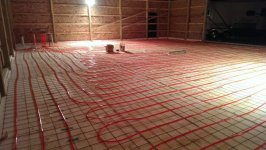
40X48 pole barn, 12' x 40' room with bathroom. 2 zones one for room and other for shop. Just under 1900 foot of pex, 1.5" of eps foam under concrete and 3" around perimeter, heating with a Takagi T-H3M-DV-N natural gas.
Fired it up last week to test it (due to warm temps) but everything is right where I expect it.
40X48 pole barn, 12' x 40' room with bathroom. 2 zones one for room and other for shop. Just under 1900 foot of pex, 1.5" of eps foam under concrete and 3" around perimeter, heating with a Takagi T-H3M-DV-N natural gas.
Fired it up last week to test it (due to warm temps) but everything is right where I expect it.
Attachments

BadgerBoilerMN
Well-known member
We staple tubing to the foam and wire over all. We do not use tankless water heaters for dedicated space heating, even though they are cheaper than a real boiler with indispensable weather responsive controls.
One pump would serve the entire shop, which it appears you have zoned with actuators.
Otherwise all looks in order.
One pump would serve the entire shop, which it appears you have zoned with actuators.
Otherwise all looks in order.
If I did it over again I would staple the pex to the foam, less labor. A boiler was out of the question due to cost, I realize the efficency is better but could not justify it, it's a barn. The manifold does not have actuators on it, all manual. Two zones with two pumps.
BlueBomber
Well-known member
Going to bring this one back because its my turn.
40X48 pole barn, 12' x 40' room with bathroom. 2 zones one for room and other for shop. Just under 1900 foot of pex, 1.5" of eps foam under concrete and 3" around perimeter, heating with a Takagi T-H3M-DV-N natural gas.
Fired it up last week to test it (due to warm temps) but everything is right where I expect it.
Looks good, CJC! We'll be interested in hearing your update when those Michigan temps are below zero!
BadgerBoilerMN
Well-known member
I see. Well, I think you will be well radiated and can afford a new water heater every 10 years if you need one.
The worst radiant system is better than the best forced air. So good on ya!
The worst radiant system is better than the best forced air. So good on ya!
mcirish101
Well-known member


bloomingtonmike
Well-known member
Here are a few pics of my newly installed combi boiler heat system done by a local professional - critiques and positive comments welcome!
Looks Very professional to a newbie untrained observer like me. CONGRATS!!!
Starting to get chilly in IL.
bloomingtonmike
Well-known member
Built mine based on the Hydro Shark Integrator panel pictures. Used Grundfos UPS26-99FC pumps and an electric 27kw Ecosmart instant water heater.

70R
Well-known member
Finally got my system installed. More pics in my build thread. It's been running for a week or so and it is amazing. First time for radiant heat. Thanks to the many people here providing valuable info.
Original plan was to build a partition wall and have two zones. Scrapped the wall idea and went with one zone.


Original plan was to build a partition wall and have two zones. Scrapped the wall idea and went with one zone.
BoostAddiction
Well-known member
Why are the lines from the boilers or heaters going to the slabs always uninsulated in most of the installs? Is the length from the boiler to the slab so small that it doesn't matter? It seems to me that the cost of insulating them is quite small, and that over time it would pay off.
Flexia
Well-known member
The uninsulated pipes are usually emitting heat in the same room that your heating. So it really makes no differenceWhy are the lines from the boilers or heaters going to the slabs always uninsulated in most of the installs? Is the length from the boiler to the slab so small that it doesn't matter? It seems to me that the cost of insulating them is quite small, and that over time it would pay off.
70R
Well-known member
70R,
Looks like pretty much the same setup I was planning on doing. Do have a list or sketch of the setup you have there?
I put the details in post #31 in my build: http://www.garagejournal.com/forum/showthread.php?t=181127
Hopefully it helps!
Joe

