To avoid these ads, REGISTER NOW!

Hot Dawg 45K Heater Install

csp

Well-known member
Joined
Mar 23, 2010
Messages
5,719
Location
Franktown, CO
The only joint you need to seal is where single wall enters double wall (B vent) and it should be high temp RTV in the void between the inner wall and outer wall of the B vent.

B vent to B vent joints snap or twist together and single to single should be screwed together in three locations per joint.
 
To avoid these ads, REGISTER NOW!
OP
D

D45

Well-known member
Joined
Mar 21, 2014
Messages
4,834
Location
NW INDIANA
4_zpsmy2yrsbh.jpg


I need to start planning a mounting location for the heater

The low-temp tstat also arrived today
 
OP
D

D45

Well-known member
Joined
Mar 21, 2014
Messages
4,834
Location
NW INDIANA
"Do not install units below 7' measured from the bottom of the unit to the floor in commercial applications (unless unit is properly guarded to provide user protection from
moving parts) and 5' measured from the bottom of the unit to the floor in residential applications."


"A minimum of 12" straight pipe is recommended from the flue outlet before turns in the vent pipe."
 
OP
D

D45

Well-known member
Joined
Mar 21, 2014
Messages
4,834
Location
NW INDIANA
I took the side panel off, to look inside

Looks like this has a motor/fan inside, to help push the fumes out the duct work?
 

csp

Well-known member
Joined
Mar 23, 2010
Messages
5,719
Location
Franktown, CO
Yes, they have an inducer fan. Any unit heater that has horizontal venting as an option has this as horizontal venting doesn't have any natural draft to gravity vent.
 

rlitman

Well-known member
Joined
Oct 18, 2010
Messages
24,599
Location
Long Island
I took the side panel off, to look inside

Looks like this has a motor/fan inside, to help push the fumes out the duct work?

Not help. The draft inducer fan does all the pushing. In your unit, it pulls air in from the room and blows it out through the combustion chamber, and out the exhaust.
 

Mr. Roboto

Well-known member
Joined
Dec 11, 2012
Messages
2,160
Location
New Hampshire
Are you going to be pulling a permit for the install of this? Reading through this thread, it does not sound like you have a firm grasp of what's required to install this to code. Not trying to sound like a jerk or anything, just trying to prevent any surprises when it comes time for inspection.
 
OP
D

D45

Well-known member
Joined
Mar 21, 2014
Messages
4,834
Location
NW INDIANA
Inspection? Permit?

Heck no, absolutely not

I am trying to do my research first and SAFELY install it over the course of the next few months
 

Mr. Roboto

Well-known member
Joined
Dec 11, 2012
Messages
2,160
Location
New Hampshire
Inspection? Permit?

Heck no, absolutely not

I am trying to do my research first and SAFELY install it over the course of the next few months

Well if that's what you're choosing to do, you're obviously more than welcome, but just know that if there are ever any issues and it (god forbid) catches your house on fire, than your homeowners insurance will NOT cover you and you will be SOL.
 
OP
D

D45

Well-known member
Joined
Mar 21, 2014
Messages
4,834
Location
NW INDIANA
1) I do not need a permit where I live, for anything I do on my own property
2) I do need an inspection where I live, for anything I do on my own property

Thanks for the concern though

I will continue to research and ask questions, as needed.......to ensure this is installed properly and safely, and done MYSELF
 

rlitman

Well-known member
Joined
Oct 18, 2010
Messages
24,599
Location
Long Island
Well if that's what you're choosing to do, you're obviously more than welcome, but just know that if there are ever any issues and it (god forbid) catches your house on fire, than your homeowners insurance will NOT cover you and you will be SOL.

This statement is misleading, at best.
 

Mr. Roboto

Well-known member
Joined
Dec 11, 2012
Messages
2,160
Location
New Hampshire
1) I do not need a permit where I live, for anything I do on my own property
2) I do need an inspection where I live, for anything I do on my own property

Thanks for the concern though

I will continue to research and ask questions, as needed.......to ensure this is installed properly and safely, and done MYSELF


Sorry if I struck a nerve, like I said, I really was not trying to come off as a jerk, I was just inquiring. Believe me, I installed my hot dawg myself, I had several questions as well. It can be overwhelming.
 

manwithtools

ALLIANCE MEMBER
Joined
Aug 24, 2015
Messages
13,841
Location
Lebanon, TN
I will continue to research and ask questions, as needed.......to ensure this is installed properly and safely, and done MYSELF

I applaud your determination to do this yourself.

You might want to double check the manufacturers current recommendation on venting as well as any local codes. I think it may now be required to be Category III venting, not B-vent.

I'd look it up on their web site to get the latest info.
 

rlitman

Well-known member
Joined
Oct 18, 2010
Messages
24,599
Location
Long Island
I applaud your determination to do this yourself.

You might want to double check the manufacturers current recommendation on venting as well as any local codes. I think it may now be required to be Category III venting, not B-vent.

I'd look it up on their web site to get the latest info.

Suggestions to check the instructions are appreciated.
Misleading answers are not.

I JUST installed a new Hot Dawg 45K last fall (with the sealed combustion kit). It came with instructions for single wall or B vent (I used a combination of the two with single wall exiting the unit and B vent through the thimble, as provided for in the Hot Dawg instructions, and the instructions provided by the thimble manufacturer). The correct answer for the OP would be to consult the instructions that came with HIS EXACT heater, NOT any old current instructions (even if the online instructions are for the same model heater; they may be for a newer revision). This should be provided by the manufacturer.
 

Mr. Roboto

Well-known member
Joined
Dec 11, 2012
Messages
2,160
Location
New Hampshire
I applaud your determination to do this yourself.

You might want to double check the manufacturers current recommendation on venting as well as any local codes. I think it may now be required to be Category III venting, not B-vent.

I'd look it up on their web site to get the latest info.

Category III is only required for a horizontal venting situation (and technically, only if the heater was manufactured after 2011), and it sounds as though he will be going vertically through the roof, so B vent is fine. You also only need the B vent where it passes through an unconditioned space, most commonly the attic space in between a finished ceiling and roof. You can use single wall pipe in the finished space.

Don't forget, you'll need a cleanout tee at the turn from horizontal to vertical as well. Some kits just come with an elbow, which is not advisable.
 

Mr. Roboto

Well-known member
Joined
Dec 11, 2012
Messages
2,160
Location
New Hampshire
This statement is misleading, at best.

Again, I apologize. Everywhere I have ever lived has required a permit for both any modification to a gas pipe and/or gas or oil fired heating equipment, and proof that one had been obtained would need to be provided to the home insurance company in the event of any claim. This doesn't appear to be the case where he lives, and for that I am sorry.
 

finn

Well-known member
Joined
Mar 27, 2005
Messages
16,247
Location
The UP, God's country
You should check with the manufacturer to make sure a low temperature thermostat is suitable for your heater.

The equivalent Beacon Morris (Sterling) heater has a warning in the installation manual to not use a low temperature stat / room temperature setting below 50 degrees to avoid condensation in the heat exchanger and subsequent corrosion failure / CO release into the room.

Your unit may be different.....
 
To avoid these ads, REGISTER NOW!

manwithtools

ALLIANCE MEMBER
Joined
Aug 24, 2015
Messages
13,841
Location
Lebanon, TN
Suggestions to check the instructions are appreciated.
Misleading answers are not.

I JUST installed a new Hot Dawg 45K last fall (with the sealed combustion kit). It came with instructions for single wall or B vent (I used a combination of the two with single wall exiting the unit and B vent through the thimble, as provided for in the Hot Dawg instructions, and the instructions provided by the thimble manufacturer). The correct answer for the OP would be to consult the instructions that came with HIS EXACT heater, NOT any old current instructions (even if the online instructions are for the same model heater; they may be for a newer revision). This should be provided by the manufacturer.

Well, thank you for reading my post and cheery picking my statements.

From Modines own manual I found the following:

Installation must conform with local building codes or in the
absence of local codes, with the National Fuel Gas Code,
ANSI Z223.1 (NFPA 54) - latest edition. In Canada,
installation must be in accordance with CSA-B149.1.


It does not say get the owners manual from your 1999 unit heater and follow everything it says in regards to installation requirements and ignore all local and national codes..... I suspect it has said this for years as any manufacture knows that codes take presence.

If you noticed, my post said " I think" and "you might", I did not say you are an idiot and must do it the way I did "last Fall" when I did mine.

I also did not say use any OLD instructions he found online, I suggested he check the manufacturers web site for the latest instructions - my simple logic would lead me to look up the instructions for the model he has. Codes and requirements change. I have no idea what the vintage of that heater is and it really does not matter, this is a new installation and should be done to the latest code requirements.

Your wisdom and overseeing knowledge have taken me to task and I'll quietly bow out now. Thanks for the constructive input - not.
 

csp

Well-known member
Joined
Mar 23, 2010
Messages
5,719
Location
Franktown, CO
The B-vent and low temp thermostat are 100% compatible with the OPs intended use, code (unless trumped by local code), and the manufacturer's current requirements.

I install at least 6 of these per year along with Reznor and Sterling unit heaters and all are permit jobs with inspections.
 
Last edited:

finn

Well-known member
Joined
Mar 27, 2005
Messages
16,247
Location
The UP, God's country
Just checked the Moline website. Their Hot Dawg heaters are designed for use in ambient temperatures of 40 to 90 degrees. That is, as long as you maintain 40 degrees, you're good to go.
 

csp

Well-known member
Joined
Mar 23, 2010
Messages
5,719
Location
Franktown, CO
That recommendation is for those placed into continuous use.

The reality is that a good number of these are not used continuously. Joe Homeowner has his turned off during the day when he's at work. He turns it on when it's 10 degrees in the garage when he gets home so that it's warm when Mrs. Homeowner lets him go out to work on his hobby car after dinner.
 

rlitman

Well-known member
Joined
Oct 18, 2010
Messages
24,599
Location
Long Island
That recommendation is for those placed into continuous use.


The reality is that a good number of these are not used continuously. Joe Homeowner has his turned off during the day when he's at work. He turns it on when it's 10 degrees in the garage when he gets home so that it's warm when Mrs. Homeowner lets him go out to work on his hobby car after dinner.


Correct, and that long run to warm up from 10F will surely burn off any condensation.
If you were short cycling at 40F, then perhaps you might leave some condensation behind.
 

finn

Well-known member
Joined
Mar 27, 2005
Messages
16,247
Location
The UP, God's country
Yes: The unit is spec'd to fire at -40 degrees, but operating ambient (thermostat setting) minimum is +40 per the Moline installation manual.

Although not as explicit as the instructions in the Sterling/ Beacon Morris unit, the Moline specifications indirectly indicate that a low temperature thermostat shouldn't be used.
 

csp

Well-known member
Joined
Mar 23, 2010
Messages
5,719
Location
Franktown, CO
And again, that's assuming a continuous use situation. As rlitman correctly stated, the issue is condensation prematurely corroding the heat exchanger.
 
OP
D

D45

Well-known member
Joined
Mar 21, 2014
Messages
4,834
Location
NW INDIANA
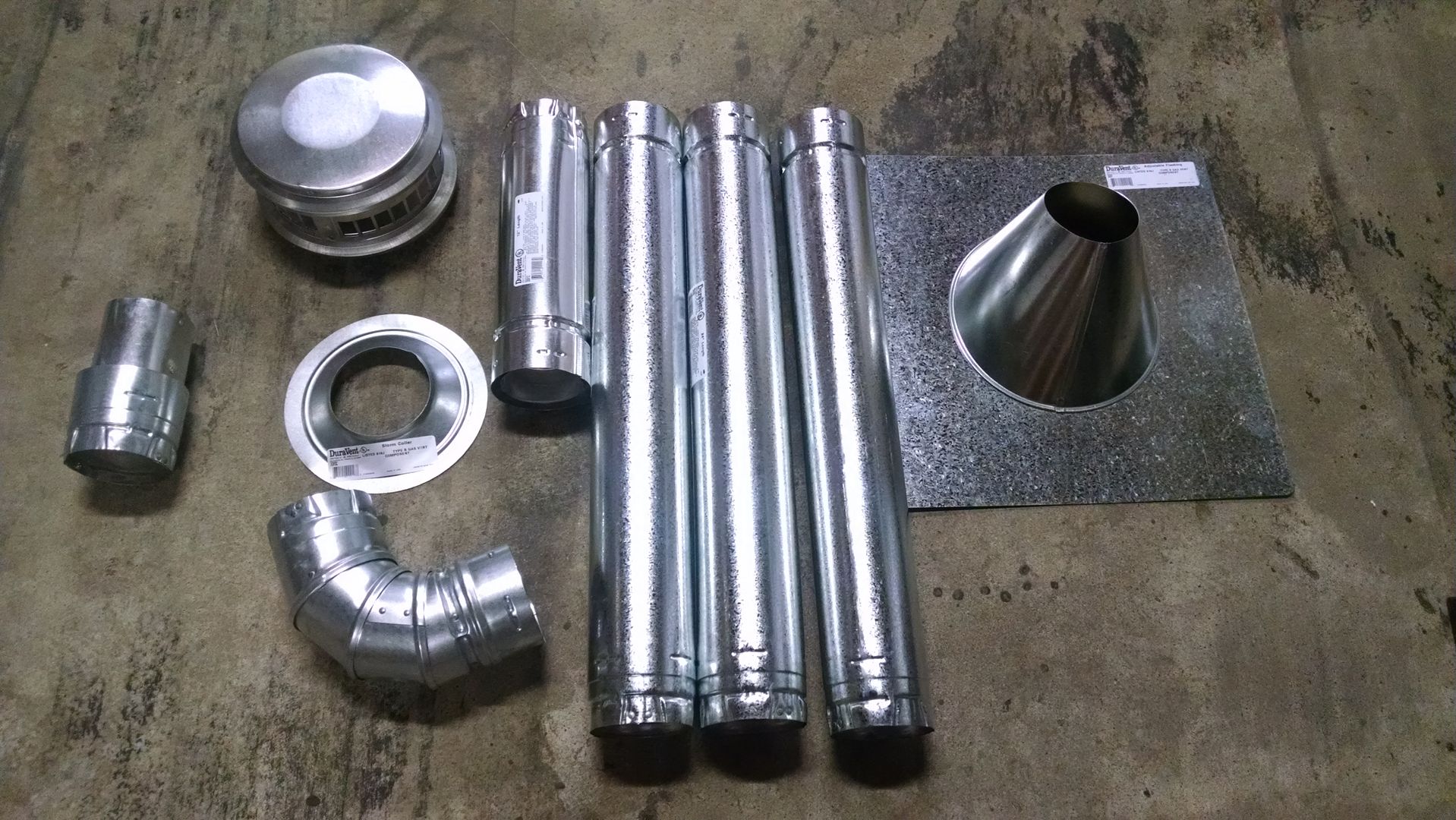
For $85.00 shipped, this looks like a good kit

DuraVent Vent Unit Heater Kit — 3in. Vertical, Model# 0370

http://www.ebay.com/itm/252249914650?_trksid=p2060353.m1438.l2649&ssPageName=STRK:MEBIDX:IT

Includes:
(3) 24 in. long pipe lengths
(1) 12 in. pipe length
(1) roof flashing
(1) storm collar
(1) cap
(1) 90° elbow
(1) draft hood connector

Item# 28794
Fuel Type Natural gas or liquid propane
Pipe Design Single wall
Product Style Venting kits
Pipe Diameter (in.) 3
Length (in.) 24
Mounting Type Vertical mount
Degree of Angle ( ° ) 90
Adjustable Yes
Material Type Steel

I bought this kit today.....couldn't beat the price

Next, some high temp RTV and metal tape for the joints

Then, work on the gas line and electrical
 

rlitman

Well-known member
Joined
Oct 18, 2010
Messages
24,599
Location
Long Island
Well, thank you for reading my post and cheery picking my statements.

From Modines own manual I found the following:

Installation must conform with local building codes or in the
absence of local codes, with the National Fuel Gas Code,
ANSI Z223.1 (NFPA 54) - latest edition. In Canada,
installation must be in accordance with CSA-B149.1.


It does not say get the owners manual from your 1999 unit heater and follow everything it says in regards to installation requirements and ignore all local and national codes..... I suspect it has said this for years as any manufacture knows that codes take presence.

If you noticed, my post said " I think" and "you might", I did not say you are an idiot and must do it the way I did "last Fall" when I did mine.

I also did not say use any OLD instructions he found online, I suggested he check the manufacturers web site for the latest instructions - my simple logic would lead me to look up the instructions for the model he has. Codes and requirements change. I have no idea what the vintage of that heater is and it really does not matter, this is a new installation and should be done to the latest code requirements.

Your wisdom and overseeing knowledge have taken me to task and I'll quietly bow out now. Thanks for the constructive input - not.

As I said above, the "latest" instructions would be the wrong instructions, unless his unit was manufactured today.
lf I read the latest instructions for my Ruger, I'd be inclined to think that it has a loaded chamber indicator, when it most certainly does not (as it predates that feature).
The ONLY correct instructions are the ones printed that go with a serial number range that matches his unit. Period. The manufacturer should be able to supply these.

The point is, that this heater is a UL Listed appliance. In order to maintain that rating (which is the ONLY thing an insurance company when handling a claim will care about, unlike what was said some comments above), the correct instructions must be followed to the letter.
My unit has sealed combustion, and there are clear instructions about how the intake can be placed with respect to the exhaust. These instructions (perhaps the "latest", perhaps not, I couldn't say for sure) would be quite misleading to the OP.

As for your reference to National Fuel Gas Code, et al, they are immaterial. The manufacturer's instructions will tell you how to install the appliance to maintain that UL rating. It is up to the installer to follow necessary code to provide gas and electrical supplies, as these are outside the scope of the appliance itself. That is why the instructions reference them.

The venting is an interesting subject, because it may, or may not be part of the appliance. In the case of any single wall tube, it is covered under the manufacturer's instructions. The manufacturer allows for that single wall tube (at least in my unit's instructions) to be vented out a wall, so long as you maintain the proper 6" gap. It's not a path most users would want to take, but might make sense in say a greenhouse application.
They also allow for connecting to B vent, but once you add that, you've added a separate UL rated system, and now you need to follow the B vent (or wall thimble) manufacturer's instructions too.
 

csp

Well-known member
Joined
Mar 23, 2010
Messages
5,719
Location
Franktown, CO
No, there's just one as I already mentioned earlier in this thread. Just the gap between the inner wall and outer wall of the B-vent where single wall is attached via screws. The joint between the unit and section of single wall does not require sealing. There's nothing to be gained from RTV or tape on the joints other than a warm fuzzy feeling like an extra precaution was taken.

That sealing on the first piece of B-vent is for thermal reasons, not to seal combustion gases from getting out of the pipe. The natural draft of vertical venting takes care of that all by itself provided that the height of the pipe relative to the roof is correct.
 
Last edited:
OP
D

D45

Well-known member
Joined
Mar 21, 2014
Messages
4,834
Location
NW INDIANA
Don't forget, you'll need a cleanout tee at the turn from horizontal to vertical as well. Some kits just come with an elbow, which is not advisable.

Tell me more about this "cleanout tee".....what does it do and what is the purpose of it

I looked at and have seen quite a few hanging heaters, including the one we have at work (municipal vehicle garage), that does not have any cleanout tee
 

rlitman

Well-known member
Joined
Oct 18, 2010
Messages
24,599
Location
Long Island
Tell me more about this "cleanout tee".....what does it do and what is the purpose of it

I looked at and have seen quite a few hanging heaters, including the one we have at work (municipal vehicle garage), that does not have any cleanout tee

Well, you shouldn't be needing to clean soot from a natural gas power vented stack (one purpose for it), but another would be to stop condensation from dripping back into the heat exchanger.

However, if you use the unit in a way that ensures you burn off all condensation (you should), I'd say this is of dubious utility.
 

csp

Well-known member
Joined
Mar 23, 2010
Messages
5,719
Location
Franktown, CO
D45, just follow your the venting instructions that are specific to your unit. There's no use for a cleanout tee on a modern gas fired appliance and the manufacturer is aware of that.
 
OP
D

D45

Well-known member
Joined
Mar 21, 2014
Messages
4,834
Location
NW INDIANA
I got the DuraVent Vent Unit Heater Kit for pretty darn cheap, IMHO

$63.75 shipped.........very pleased for my FREE heater

3in. Vertical, Model# 0370

Includes:
(3) 24 in. long pipe lengths
(1) 12 in. pipe length
(1) roof flashing
(1) storm collar
(1) cap
(1) 90° elbow
(1) draft hood connector
 
OP
D

D45

Well-known member
Joined
Mar 21, 2014
Messages
4,834
Location
NW INDIANA
I am going into the crawl to run a "T" off the gas line and a short stub into the garage, which will be capped off (till I can find the proper location where I want to put the heater)
 
OP
D

D45

Well-known member
Joined
Mar 21, 2014
Messages
4,834
Location
NW INDIANA
Seems like a solid kit, I was expecting some very thin walled metal........but not the case here

For under $65, I am VERY pleased

IMG_20160617_175706944_HDR_zpszxirt0ip.jpg


IMG_20160619_205119875_HDR_zpsfmpjnf0e.jpg


IMG_20160619_205128709_zpso7urcg6c.jpg


IMG_20160619_205247329_zpssuadvfvl.jpg


IMG_20160619_205259410_zpskrlvplbe.jpg


IMG_20160619_205230490_HDR_zpslekpxb3r.jpg


IMG_20160619_205312560_zpsc1j5ajwb.jpg


IMG_20160619_205218861_zpsalrxer8b.jpg


IMG_20160619_205155199_zps6uret9gn.jpg


IMG_20160619_205143226_zpslwhiqxvv.jpg
 
To avoid these ads, REGISTER NOW!
Top Bottom