To avoid these ads, REGISTER NOW!

Solid Rivets 101

Joined
Jul 27, 2016
Messages
7
I'll certainly try. If you live anywhere near the North Bay region of California, you'd be welcome to stop by and we'll figure it out.

KDub

Thank you!…

I am located in Southern California. If it comes down to it, I would make the drive to finish this project.

Here is the reel as it came from the factory in Japan, made by Shimano:
349fpqx.png

2nte6px.png


The original rivets are a combination of a semi-tubular button head on top and a solid countersunk head on bottom. The finish is immaculate, as it should be for a product costing $500+.

The rivets were drilled out because both the rivets and the reel foot are stainless steel, which would not survive the anodizing process. After complete disassembly, I had the frame anodized black.

Here are pictures of the current state of the project:
10prcqb.jpg

14ainh3.jpg

2exbk88.jpg


I was able to source some solid rivets from an aircraft repair shop. These will work. But I have 2 questions:

1. Is it possible/what will I need to set the solid rivets correctly and can that be done with a round or buttonhead finish on top?

2. Could I go one up and duplicate the semi-tubular button head/solid countersunk head combo like Shimano did?

Here is my attempt to spec-out the remains of the original factory rivets that I drilled out:
2163p3.jpg
 
Last edited:
To avoid these ads, REGISTER NOW!

racingtadpole

Well-known member
Joined
Dec 3, 2011
Messages
2,029
Location
The far side of crazy.. but sometimes Australia
Looks like there is enough room for a squeezer in there at least.

Couple of ways you could do it..

I would put the countersunk through and go at it with a domed former to squeeze it. You may need to practice on some scrap to get the length of the rivet correct to get it to form the dome right.

You could do it in reverse and put a dome head through and force it into the countersink, but you are then working around a curved surface which in my head increases the degree of difficulty a bit. Again you would need to practice on some scrap to get the length right..

Or just buy a couple of M3 Stainless Countersunk machine screws and and dome nuts. :lol:

Hope that is some help.
 
Joined
Jul 27, 2016
Messages
7
Looks like there is enough room for a squeezer in there at least.

I would put the countersunk through and go at it with a domed former to squeeze it. You may need to practice on some scrap to get the length of the rivet correct to get it to form the dome right.

Can you name or post links to the tooling I would need to do it this way? Will a domed former put that shape on the rivets I have pictured above? (The ones that are countersunk on one end and cyllindrical shaped on the other).

And can this be done without scratching/damaging/contacting the aluminum?
 

racingtadpole

Well-known member
Joined
Dec 3, 2011
Messages
2,029
Location
The far side of crazy.. but sometimes Australia
Can you name or post links to the tooling I would need to do it this way? Will a domed former put that shape on the rivets I have pictured above? (The ones that are countersunk on one end and cyllindrical shaped on the other).

And can this be done without scratching/damaging/contacting the aluminum?

Contact Shimano and buy the OEM parts, it will work out cheaper.
 

Kevin54

MEMBER EMERITUS
Joined
Jan 12, 2005
Messages
29,341
Location
Urbana, Ohio
Are you putting stainless back in? I don't have a squeezer but I can make you a rivet set. to achieve what you want. Cost would be very minimal. PM me if you are interested
 
Joined
Jul 27, 2016
Messages
7
Contact Shimano and buy the OEM parts, it will work out cheaper.

That would cancel all that I have done; Shimano can only offer another frame that is gold colored. They will in no way, shape or form repair or repress new rivets for me. Otherwise I would have them do so. Thanks though!
 
Joined
Jul 27, 2016
Messages
7
Are you putting stainless back in? I don't have a squeezer but I can make you a rivet set. to achieve what you want. Cost would be very minimal. PM me if you are interested

I tried to PM you, I am not sure if it went through, if not please let me know...
 
OP
M

machine_punk

Well-known member
Joined
May 14, 2011
Messages
2,540
Location
Napa Valley, California
If you were close by, we could do that in a few minutes...I have all the tooling needed.

I'd want to buy extra rivets to practice on scrap, before actually setting the real thing.

What material are you planning for the rivet? Stainless Steel, aluminum?

KDub
 

porschedude996TT

Well-known member
Joined
Oct 28, 2007
Messages
2,384
Location
Santa Maria, California
It looks like the original rivet was set, they used a dimple set on the upset side of the rivet. I would suggest using an 1/8" Universal Head rivet and set on the inside which mates with AN470 rivets and a tube rivet set to make the "Upset Side" of the rivet on the outside where the reel meets the rod. Normally rivet lenght is sized by using the diameter of the rivet. The lenght showing on the tail of the rivet, should be 1-1/2 times the diameter prior to upsetting the rivet.

1/8" Universal Head Rivet Set:
http://www.ebay.com/itm/1-8-AN470-U...hash=item53ef58e40b:m:ms77M63oIENr_eeg_SGUkOw

1/8" Tube Rivet Set:
http://www.ebay.com/itm/Rivet-Squee...590217?hash=item3effbda209:g:rNUAAOxycD9TVpZZ

Hand Squeezer:
http://www.ebay.com/itm/1-Hand-Rive...071178?hash=item2a4c7fd00a:g:BHQAAOSwBahU51GV

To match the exact dimple you may need to grind the face of the tube rivet set.
 
OP
M

machine_punk

Well-known member
Joined
May 14, 2011
Messages
2,540
Location
Napa Valley, California
I've looked at the pictures again and here is what I think they did originally (and if not, then this is how *I* would duplicate the original rivet).

- This is a universal rivet (see the flattened spot on the domed side?) That means it CAN be driven with a domed-head rivet set OR a flat rivet set. The underside is cut shorter than you would for a standard aircraft rivet, and fills the countersink to form the shop head.

I use this technique, when I need the back side of the rivet to be flush...cut a countersink into the material on the shop-head-side of the rivet. Then squeeze (or, if you're feeling talented, use a rivet gun) the rivet and the shop head will deform and fill the countersink. NOTE: You need to practice this several times on a similar piece of material...you will have to figure out how long to cut the rivet to get the correct amount of material to fill the countersink, but not stick out too much.

NEVER use this technique on an aircraft. It is NOT (NO HOW, NO WAY) authorized for airframes. This technique should never be used when lives are at stake. I have used this technique successfully in non-critical joints, on artistic projects.

If you want to have the equipment to do this, I would suggest a aircraft rivet squeezer. Any number of places sell the Chinese version for relatively few dollars. I like Brown Aviation Tools, because the sell American versions of most tools, for a few more dollars.

The economy version:
http://www.browntool.com/Listview/tabid/344/CategoryID/54/Level/a/ProductID/3260/Default.aspx

The American-made version, by Tatco. NOTE: You need to pick your rivet squeezer up front. The yokes for the economy version do NOT fit the Tatco version. The rivet SETS WILL fit either version (they both have a 3/16" pin to mount them).
http://www.browntool.com/Listview/tabid/344/CategoryID/54/Level/a/ProductID/180/Default.aspx

You will also need the appropriate rivet set for the SIZE and HEAD style of rivet you choose. I see an offer above to have tooling made for you...PM Kev54, if you want him to cut custom tooling for you. I'd have a couple of the rivets to send him, so he can cut one exactly (this is an artistic project).

If you're going to do this by yourself, PRACTICE before you get the actual project.

If you are in LA, the company I use for non-aircraft rivets is right there, Hanson Rivet
http://www.hansonrivet.com/

Since appearance is your main goal (well, aside from strength), I'd make sure I practiced several times, until I could get consistent results, before moving to the final project.

Kevin
 

no704

Well-known member
Joined
Apr 27, 2016
Messages
5,203
Any knowledge on spun rivits? I have a '68 corvette with the fuel filler door that was attached with them and need to reattach it.
 

gben

Banned
Joined
Jul 16, 2016
Messages
54
Fashion always makes me sad. Seeing people walk around who have ripped the aesthetics of eras and crafts they have little or no real connection to, which they use as jewelry for their insecure egos. It is pathetic and shallow.

I have had to wear safety glasses with side-shields as a requirement of my employment for many years, and it is always sad when someone walks up to me and says how cool my eyeglasses are, that they are "steampunk" or they hang some other fashionable label on them.

My definition of Hipster are those walking around slathering themselves with a past and/or aesthetic they never actually lived or had any real connection to, they are actors, imposters and fakes.

Maybe they can make something with their hands, but if all they make is jewelry or "art" for sale to hipsters then they have actually made nothing at all, their talents are wasted.
 

jimgood

Well-known member
Joined
Aug 4, 2014
Messages
2,394
Location
Marshall, VA
Fashion always makes me sad. Seeing people walk around who have ripped the aesthetics of eras and crafts they have little or no real connection to, which they use as jewelry for their insecure egos. It is pathetic and shallow.

I have had to wear safety glasses with side-shields as a requirement of my employment for many years, and it is always sad when someone walks up to me and says how cool my eyeglasses are, that they are "steampunk" or they hang some other fashionable label on them.

My definition of Hipster are those walking around slathering themselves with a past and/or aesthetic they never actually lived or had any real connection to, they are actors, imposters and fakes.

Maybe they can make something with their hands, but if all they make is jewelry or "art" for sale to hipsters then they have actually made nothing at all, their talents are wasted.
So, what's your point? That solid rivets are a fashion statement? If not, in what way is this a contribution to this thread?
 

Kevin54

MEMBER EMERITUS
Joined
Jan 12, 2005
Messages
29,341
Location
Urbana, Ohio
Any knowledge on spun rivits? I have a '68 corvette with the fuel filler door that was attached with them and need to reattach it.

Spun rivets as you call them are done on an orbital riveter. Most manufacturing places that use rivets will have one or a few orbital riveting machines. but as far as for home use, I seriously doubt that anyone on here has an orbital riveter. I used to make punches for them on a daily basis. The punch sets in a head at a 5 degree angle and the machine spins the head at a very high speed while feeding down. The orbital riveter is used a lot for hardened rivets that you can't normally set with a hand held squeezer. The machines we used at work were Taumel Orbital Riveters. They were used a lot to rivet the wiper arms on aircraft which were 3/16" diameter stainless steel rivets. And the punches are different than your normal punch. For example, to get a round head on a rivet when you set it, you had to use a punch with a straight sided pocket in it. And the punches take a deal more of figuring out as you have to hold a specific length within +/-.001 to get it to work correctly. Anything else will throw the punch off of center when it rotates.

Here is a pic of how the punch sets in the head

orbitformcombo.jpg


T-8dim.jpg


I use this technique, when I need the back side of the rivet to be flush...cut a countersink into the material on the shop-head-side of the rivet. Then squeeze (or, if you're feeling talented, use a rivet gun) the rivet and the shop head will deform and fill the countersink. NOTE: You need to practice this several times on a similar piece of material...you will have to figure out how long to cut the rivet to get the correct amount of material to fill the countersink, but not stick out too much.

NEVER use this technique on an aircraft. It is NOT (NO HOW, NO WAY) authorized for airframes. This technique should never be used when lives are at stake. I have used this technique successfully in non-critical joints, on artistic projects.

Machine Punk.....there are certain applications on aircraft where this type of setting of a rivet is used. We have used it where one component fits inside of another component and is riveted together. And to achieve the correct height where it is set into the countersink, a rivet shaver is used to achieve it. Again, not a lot of applications that use this process, but there is a few on aircraft.

And for ones that may not know, and think a rivet is a rivet and it doesn't matter how things are riveted together as long as they hold, you could not be further from the truth. Riveting itself, especially o aircraft, is a close tolerance process. You can't have rivets too long, or too short. Only certain diameters are used. Mainly 1/16", 3/32", 1/8", 5/32", and 1/4" for most applications of the components inside of an airplane. Then you have soft rivets, hard rivets, stainless rivets, round head, flat head, universal head rivets, and tubular rivets. Very rarely are pop rivets used. Now in the automotive industry, except for some small components, you either have screws, bolts, or pop rivets. Solid rivets are hardly ever used like they are in aircraft. But in the end, especially in the aircraft industry, riveting is a precision process.
 
Joined
Jul 27, 2016
Messages
7
@machine punk:
"This is a universal rivet (see the flattened spot on the domed side?) That means it CAN be driven with a domed-head rivet set OR a flat rivet set. The underside is cut shorter than you would for a standard aircraft rivet, and fills the countersink to form the shop head."

I think you are right, but it appears to me that the semi-tubular rivet is being filled by the counter sink, I think. ??

Here is a picture of the OEM rivets from Shimano Japan factory after they were drilled out. I figure that will help you guys better decode what Shimano did and therefore what we might be able to do as well.

2cdg9z9.jpg

You can see what remains of the counter-sunk rivet still stuck inside the semi-tubular rivet.

Nevertheless, what you said makes a lot of sense to me, I suspect the OEM process used the two rivets, one already counter-sunk and the other already button-head with the flat spot, and I would think a special machine to press them together, only contacting the rivets and nothing else. If what I think Shimano did, makes sense and is something you can do, then that would be great. I am still having a hard time sourcing rivets in the right size. I got some samples from Jay-Cee, they look great and are labeled 1/8" but are a loose fit (should they be?).

I would like to duplicate what Shimano did if possible. That means stainless steel rivets for sure, and unless there was a power tool set up that would ensure no damage to the aluminum frame (no not even coming into contact with it), then this job will require hand tools.

The holes in the reel frame have been drilled out (prior to anodizing) to 1/8" diameter.

Here are my criteria that would need to be met:
1. Stainless Steel rivets
2. Semi-Tubular Button Head w/flat spot on top
3. Counter-Sunk on bottom
4. No damage or scratching can be done to the anodized frame whatsoever
5. Final results should be strong, treat this job like a real air craft where lives are at stake.

If I understand correctly, I think that once I have the right rivets, the hand squeezer would do the job, and would only contact the rivets themselves, not the aluminum frame or stainless steel reel foot. The counter-sunk rivet seems easy, it doesn't need to change shape, it only needs to be compressed. And if the button-head on top already has a flat spot, then again, its just a matter of compressing these two rivets and plugging the hole.

Is my understanding right?
 
Last edited:

Whiskeymike

Well-known member
Joined
Oct 31, 2013
Messages
775
Location
Austin, TX
Hopefully this is relevant to the thread. I'm building a box for a squirrel fan blower filter for the shop. What rivets would you recommend to affix 18gauge sheet to 1"x1/8" angle iron? Looking for size, length, and material.

I plan to weld a frame from the angle iron with supports for the fan and then sheet it in 18 gauge, probably affixing the top with sheet screws so it can be removed for maintenance.

I got a solid rivet kit from Eastwood earlier this year and it will be my first project after some practice.
 

Whiskeymike

Well-known member
Joined
Oct 31, 2013
Messages
775
Location
Austin, TX
I did some searching and found this video which was helpful.
. I also noticed that in the first page or two of this thread, an image describes the same.

It basically says:

To calculate diameter of rivet: Thickest piece of material * 3.

Thickest piece for me is 1/8 or .125 * 3 = .375 or 3/8th diameter for the rivet

To calculate length of rivet: 1.5* rivet diameter + total thickness of material

1/8 angle or .125 + 18 gauge sheet or .05 + (1.5 * 3.75) = .693 so 11/16ths is too small, so I'll look for a 3/4 length.

So I believe I need a 3/8th rivet, 3/4" long. Now I'm going to do some research on which metal to use.
 
Last edited:
Joined
Jul 27, 2016
Messages
7
i have another question: is it possible to start with a single piece, button head rivet, and to make the cylindrical end take the shape of a countersunk head? in other words, you would then have the original button head shape on the top, and a countersunk head shape on the bottom. is that even possible?
 

racingtadpole

Well-known member
Joined
Dec 3, 2011
Messages
2,029
Location
The far side of crazy.. but sometimes Australia
i have another question: is it possible to start with a single piece, button head rivet, and to make the cylindrical end take the shape of a countersunk head? in other words, you would then have the original button head shape on the top, and a countersunk head shape on the bottom. is that even possible?

Yes, it is possible, you will need to spend some time on getting the length of the rivet right to start with (ie a few practices). You may also need to spend some time shaping the dies so they fit the constraints of the part without damaging them.
 
To avoid these ads, REGISTER NOW!
OP
M

machine_punk

Well-known member
Joined
May 14, 2011
Messages
2,540
Location
Napa Valley, California
@machine punk:
"This is a universal rivet (see the flattened spot on the domed side?) That means it CAN be driven with a domed-head rivet set OR a flat rivet set. The underside is cut shorter than you would for a standard aircraft rivet, and fills the countersink to form the shop head."

I think you are right, but it appears to me that the semi-tubular rivet is being filled by the counter sink, I think. ??

Here is a picture of the OEM rivets from Shimano Japan factory after they were drilled out. I figure that will help you guys better decode what Shimano did and therefore what we might be able to do as well.


You can see what remains of the counter-sunk rivet still stuck inside the semi-tubular rivet.

Nevertheless, what you said makes a lot of sense to me, I suspect the OEM process used the two rivets, one already counter-sunk and the other already button-head with the flat spot, and I would think a special machine to press them together, only contacting the rivets and nothing else. If what I think Shimano did, makes sense and is something you can do, then that would be great. I am still having a hard time sourcing rivets in the right size. I got some samples from Jay-Cee, they look great and are labeled 1/8" but are a loose fit (should they be?).

I would like to duplicate what Shimano did if possible. That means stainless steel rivets for sure, and unless there was a power tool set up that would ensure no damage to the aluminum frame (no not even coming into contact with it), then this job will require hand tools.

The holes in the reel frame have been drilled out (prior to anodizing) to 1/8" diameter.

Here are my criteria that would need to be met:
1. Stainless Steel rivets
2. Semi-Tubular Button Head w/flat spot on top
3. Counter-Sunk on bottom
4. No damage or scratching can be done to the anodized frame whatsoever
5. Final results should be strong, treat this job like a real air craft where lives are at stake.

If I understand correctly, I think that once I have the right rivets, the hand squeezer would do the job, and would only contact the rivets themselves, not the aluminum frame or stainless steel reel foot. The counter-sunk rivet seems easy, it doesn't need to change shape, it only needs to be compressed. And if the button-head on top already has a flat spot, then again, its just a matter of compressing these two rivets and plugging the hole.

Is my understanding right?

Whew...lotsa questions in here...I'll try to hit them all.

1. I think I see what you are saying about the hollow universal head/solid countersunk head combination on the OEM rivets. I am personally not familiar with that (doesn't mean it doesn't exist...just means I don't know about it). I'll have to see if I can find something out about that style of rivet.

If someone else DOES know about it, please speak up...so we can all learn something new.

2. Based on what I personally know how to do, I stick to my recommendation of how I would re-fasten this...a universal head stainless steel rivet, cut short enough to fill the countersink as it is squeezed/expanded.

I recognize this may not meet your goals for the project. Your focus seems to be to complete the repair 'as OEM as possible, except with a different color.' It is simply 'how I would do it,' with the skills and knowledge I have.

If I were doing this, I'd set up several practice holes, before I ever tried on the real piece. Even I don't rivet enough to get it right every time.

3. YES! Properly-sized solid rivets SHOULD BE 'loose' in the hole, before you drive them. The first part of driving the rivet expands the rivet OUTWARD to fill the hole, then continues to 'squish' (the technical term) the shop head into the rivet.

4. I have pneumatic rivet squeezers and that is probably how I would do this...BUT I would NOT buy one just to do this (about $1,600 USD brand new. I didn't pay nearly that for the 3 used models I have). I would stick with the hand-operated rivet squeezer. It has much more control than the other option, the rivet gun, which is not for the faint of heart (or those new to riveting who are worried about scratching the anodizing on a high-value project). Again, either the import or US-made version (TATCO) will do.

OK--I think I hit the majority of your questions. If you are set on going with the OEM rivets, you're going to have to source those somewhere. I'm not familiar with them, but that doesn't mean they don't exist.

My recommendation above will NOT change the appearance from OEM. It won't be a two-piece rivet, but that fact will be hidden in the hole. Someone else would have to destructively investigate to determine you did not use the OEM-style rivet.

Whichever route you go, I cannot stress enough that I would set up several holes with exactly the same depth and countersink and practice until you can get about 5 in a row perfect, before going to the actual project.

Good luck! Please let me know, if there is anything else I can answer.
KDub
 
OP
M

machine_punk

Well-known member
Joined
May 14, 2011
Messages
2,540
Location
Napa Valley, California
Machine Punk.....there are certain applications on aircraft where this type of setting of a rivet is used. We have used it where one component fits inside of another component and is riveted together. And to achieve the correct height where it is set into the countersink, a rivet shaver is used to achieve it. Again, not a lot of applications that use this process, but there is a few on aircraft.

Thanks for the info! You learn something new every day. I always appreciate the input from the 'pro's' on this thread.

KDub
 
OP
M

machine_punk

Well-known member
Joined
May 14, 2011
Messages
2,540
Location
Napa Valley, California
i have another question: is it possible to start with a single piece, button head rivet, and to make the cylindrical end take the shape of a countersunk head? in other words, you would then have the original button head shape on the top, and a countersunk head shape on the bottom. is that even possible?

YES! This is exactly my recommendation to you. The only way for anyone to tell this is not the OEM rivet configuration is to drill it out and look for themselves. I cannot imagine it destroying any value on the reel (well, certainly no more than annodizing it in a non-OEM color would).

I'm sure there is some way to calculate what length you would need, but when I use this technique, I just keep testing until I get it right. It will be critical for you to set up test holes of the same depth, with the same countersink, to figure this out before moving to the final project.

KDub
 
Last edited:
OP
M

machine_punk

Well-known member
Joined
May 14, 2011
Messages
2,540
Location
Napa Valley, California
Any knowledge on spun rivits? I have a '68 corvette with the fuel filler door that was attached with them and need to reattach it.

Kevin54 did a great job of explaining spun (orbital) rivets for you (please see his post above).

You aren't going to be able to 'spin' the rivet at home. If you'll post some pics of the effect you are looking for (a picture of a complete fuel door, even if it is not 'yours,' then I'll try to recommend something which will get you close.

KDub.
 
Last edited:
OP
M

machine_punk

Well-known member
Joined
May 14, 2011
Messages
2,540
Location
Napa Valley, California
Hopefully this is relevant to the thread. I'm building a box for a squirrel fan blower filter for the shop. What rivets would you recommend to affix 18gauge sheet to 1"x1/8" angle iron? Looking for size, length, and material.

I plan to weld a frame from the angle iron with supports for the fan and then sheet it in 18 gauge, probably affixing the top with sheet screws so it can be removed for maintenance.

I got a solid rivet kit from Eastwood earlier this year and it will be my first project after some practice.

It is ABSOLUTELY relevant to this thread! Thanks for stopping by.

Good job on getting a solid riveting kit! What got you into solid rivets?

This is a great project to practice riveting on. I look forward to seeing pics of any of your riveting projects.

This is the LONG answer...skip to the summary below, if you don't care 'why' I am recommending a certain size)...
1. As far as the actual size of the rivet (rivets are sized by their shank diameter, in 32nds of an inch), that is all up to you. For general projects, I use a lot of -5 rivets (pronounced "dash five"). These would be 5/32" in diameter. That's just my 'go to' rivet size, for the size of projects I usually build. I keep the largest variety of rivet lengths, rivet materials, tooling and clecos in this size. I have the stuff to work in any size, but I default to -5's when there is no compelling reason to use another size. It's just an artistic choice I made in my studio.

You can go larger (though NOT likely needed, for strength, in this application). You can go smaller, since this is hardly a critical application (nobody is going to die, if it fails--other than the squirrels in the cage). You will have to decide what you like for appearance.

You also need to determine what you want, as far as spacing between rivets. If you are going with 'aircraft' spacing, then ANY size rivet will be enough for this application--just make your choice based on what you prefer in appearance. If you're only going to put one rivet every 3 inches, you'll probably want to stick to a -5 (5/32nds) or -6 (3/16ths).

2. Material: Generally, you would be advised to use the same material for the rivet that the project is made from. For this situation that would be steel.

Now me...I'd probably still use aluminum for this. I use aluminum rivets to fasten sheet steel all the time. No...scratch that...I'd use brass. That would look WAY COOL (and I stock brass and copper rivets in all sizes, so it would be a no-brainer in my studio). I haven't used steel rivets yet. I suspect they are a bit harder than aluminum rivets. If you choose steel, I'd go with a smaller rivet, to make it easier to set.

Generally, when you stick non-similar metals together, you end up with essentially a battery, which increases corrosion of the part. That doesn't really bother me, because I am not building aeroplanes--I am building functional art. If it corrodes a little, that just adds to the vintage look I am going for. I even actually damage, then rivet a patch over the damage, in every project I build...just so it looks cooler.

If you really want to use dissimilar metals and don't want corrosion, you can dip the rivets in wet primer right before you set them. This method is often used in the assembly of aeroplanes to ward of corrosion.

3. Length: The rivet should be approximately 1.5 diameters longer than the material thickness.

If you choose a -5 rivet, this will be 0.234 sticking out...just under 1/4".
0.125" for the angle iron
-PLUS-
0.048" thickness of 18 ga steel
-PLUS-
0.234 for the shop head
-EQUALS-
rivet length of 0.407 length.

Rivets come in lengths to the nearest 1/16". So, you will use either a '-6' (dash 6) in length (0.375") or a '-7' in length (0.438"). They aren't commonly sold in the 'odd' lengths, so I'd pick the -6.

They make a great little gauge, which quickly measures stick-out for you.
http://www.browntool.com/Listview/tabid/344/txtSearch/gauge/ProductID/38/Default.aspx

4. Drill Bit: You didn't specifically ask, but it is kinda important. You need to size the hole correctly. Don't go looking for fractional bits in your big-box-store drill bit set. You're going to need 'number' sizes for this task:
-3 use #40 drill bits
-4 use #30 drill bits
-5 use #21 drill bits
-6 use #10 drill bits

I generally mark the spacing on one piece, then drill the first hole through both pieces. Put a cleco in that hole and drill another. (I usually drill all #40 hole first, no matter what size rivet I will end up using, cleco with #40 clecos, then go back and drill to proper size and use the correct cleco for that size). If you don't have clecos yet, you'd be surprised how far 2 dozen in each size go on projects like this...just make sure you buy the cleco pliers too.

If you don't already have a favorite place to buy numbered drill bits, see my sources at the beginning of this thread (the aircraft supply stores listed).

Sorry...that was probably a MUCH longer answer than you wanted (I'll bet you thought that driving the rivets would be the hard part!).

Here is the simplified version:
- Brass rivets (base on appearance-completely an artistic decision)
- Universal head (rounded with a flat spot...fits the most-common tooling)
- "-5" (dast five, 5/32nds) diameter.
- "-6' (dash six, 6/16ths) in length
- use a #21 drill for your holes.

NOW...on to your second question...being able to remove the panel, so you can service the blower.

Look into nut plates or anchor nuts (2 names for the same thing), which would allow you to rivet a captive nut to the frame, then use your favorite machine screw (you know...socket head cap screws) to fasten the panel you want to be able to remove. If you go this route, you are also going to need a supply of -3 countersink head rivets in the correct length for the 1/8" angle iron.

You could move to the 'blind'/pop rivet side for this and choose rivnuts (another way to put a threaded hole in the angle frame, for easy removal of the service panel. You DO need the special installation tool, though, since a standard pop rivet gun won't do it) There are plenty of videos out there on rivnuts.

Of course, for this non-critical application, you could also just drill and tap the angle iron and use your favorite machine screw (i.e. socket head cap screws) to fasten the panel. It would be perfectly adequate, strength-wise, to complete that task for this project. (this is probably the way I'd go, on this project). Any of these options would be MUCH better looking than just using self-tapping sheet metal screws.

Hope this helps.

If I've confused you, please ask for clarification.

Above all, POST PICS of whatever you do.

KDub
 
Last edited:

Whiskeymike

Well-known member
Joined
Oct 31, 2013
Messages
775
Location
Austin, TX
That's awesome, very helpful. I decided to go with 3/16ths or -6 since that's what came in the Eastwood kit. Appreciate the insight. I'll post up some photos when done.
 

DirtyWhiteBoy

Well-known member
Joined
Aug 18, 2009
Messages
141
Location
Byrdstown,TN
I just wanted to pop in and say thanks to Machine Punk for this thread. It put a project in my head back when. I finally got around to building something with rivets and will be doing more. Thanks for taking the time to share knowledge!
 

Attachments

  • IMAG4647s.jpg
    IMAG4647s.jpg
    72.6 KB · Views: 153
  • IMAG4681s.jpg
    IMAG4681s.jpg
    59 KB · Views: 129
OP
M

machine_punk

Well-known member
Joined
May 14, 2011
Messages
2,540
Location
Napa Valley, California
The Bomber Seats look GREAT. I cannot quite figure out which car you are putting them in.

Fabulous job on the riveting.

Thanks for stopping by and posting pictures of your projects.

KDub
 
OP
M

machine_punk

Well-known member
Joined
May 14, 2011
Messages
2,540
Location
Napa Valley, California
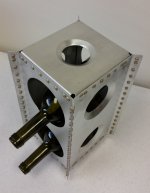
Here is a project I finished recently...
 

Attachments

  • Aero Wine Rack Inscription.jpg
    Aero Wine Rack Inscription.jpg
    40.6 KB · Views: 129
  • Aero Wine Rack Front b.jpg
    Aero Wine Rack Front b.jpg
    100.6 KB · Views: 124
  • Aero Wine Rack Topb.jpg
    Aero Wine Rack Topb.jpg
    112.6 KB · Views: 123
Last edited:

Whiskeymike

Well-known member
Joined
Oct 31, 2013
Messages
775
Location
Austin, TX
I noticed above the comment was made - "YES! Properly-sized solid rivets SHOULD BE 'loose' in the hole, before you drive them."

When using a hand punch to punch the hole, the punch size appears to be exactly the same as the minimum diameter specified in the sizing. Is the minimum sizing enough for it to be considered loose? Or does using a standard hand punch cause issues and I should consider buying off size rivets or something?

The reference for sizing, I got from here - https://www.vansaircraft.com/public/Specs.htm
 
OP
M

machine_punk

Well-known member
Joined
May 14, 2011
Messages
2,540
Location
Napa Valley, California
A hand punch is not what is normally used for creating holes for rivets.

They are normally drilled, using "number size" drills. "Letter" and "Number" size drills fit between the normal 'fractional' size drill bits. They are most commonly sized for things like taps--or, in this case, rivets.

Number size drills go from 1 to 80, with 80 being the smallest.

-3 (3/32nds) rivets use: #40 drill
-4 (1/8th) rivets use: #30 drill
-5 (5/32nds) rivets use: #21 drill
-6 (3/16ths) rivets use: #10 drill

I don't know, off the top of my head, what that actually translates to...you'd have to look at a drill chart to see.

This gives you the proper, loose fit for the rivet size you are using. The first thing a rivet does, when you set it, is to fill up the hole and pull everything into alignment. Then, it squishes lengthwise, to form the shop head of the rivet.

I've been thinking a lot about moving to punching holes for rivets...it would be faster. BUT...I plan to have the correct size punch made for me (based on the number size drills recommended for the rivets I use). I'd like to have a punch made up for each of the 4 sizes I use.

If I remember correctly, you are building a picture frame. That is hardly requires aerospace tolerances (nothing is going to fall out of the sky, if you don't have quite the strength the rivet was designed to provide).

If I were building one project with rivets and I already had the punch and rivets I planned to use, I'd build a test piece and try it out. If it gives you the results you need, there isn't anything wrong with what you are doing...especially if this is art and not aerospace.

It is VERY common for me to build test pieces, before the final project, even with the amount of experience I have. I definitely recommend creating a test piece to practice your riveting technique, ANY TIME you are about to rivet on a real project. I simply don't rivet enough to knock out perfect technique, every time I pick up a rivet gun.

I've heard that when they have projects where people 'help build a plane,' the standard rule is that you much shoot 50 perfect rivets in a row, on a practice piece, before you are ever allowed to work on the real plane.

Kev.
 
Last edited:

racingtadpole

Well-known member
Joined
Dec 3, 2011
Messages
2,029
Location
The far side of crazy.. but sometimes Australia
You can use a punch for rivets, I use my Whitney #5 in preference to a drill around places it will fit, less mess and is faster. Roper Whitney make die sets off the shelf many of their manual punches in rivet clearance sizes. The last #30 set I bought was about $14 from memory
Table 1 in the link below has clearance drill sizes and max/min sizes for holes for the particular size rivets.

https://www.engineersedge.com/rivet_application.htm

And the Roper catalogue of punch and dies

https://www.roperwhitney.com/product-category/punching/punches-and-dies/
 

Whiskeymike

Well-known member
Joined
Oct 31, 2013
Messages
775
Location
Austin, TX
Thanks guys. Picked up a Roper Whitney Hand Punch this week, so I’ll try it soon. From looking at the charts, the drill size recommended always seems like on the small side of the midway point between minimum and max. I hate using normal drill bits on sheet metal, so i’m Hoping this works for me.

E.g. - 3/16
#11 (0.191)
#10 (0.194)
0.187 min
0.202 max

And the punch (that comes in kit) is .187 or 3/16ths.
 

shortykorte

Well-known member
Joined
Sep 1, 2014
Messages
8,034
Location
Tallahassee, Fl
Thanks Tad for posting link to tables. I picked up the Whitney punch at an estate sale last year and the setting tool and bucks a month ago. Time to get some rivets


Sent from my iPhone using Tapatalk
 

Craptain

Well-known member
Joined
Apr 18, 2013
Messages
4,026
Location
Tampa Bay FL
Thanks Tad for posting link to tables. I picked up the Whitney punch at an estate sale last year and the setting tool and bucks a month ago. Time to get some rivets


Sent from my iPhone using Tapatalk
Hey Shorty, I found some rivets in the parts drawers I picked up this weekend. [emoji16]

Now I need the tools.

Sent from my SM-G930T using Tapatalk
 

shortykorte

Well-known member
Joined
Sep 1, 2014
Messages
8,034
Location
Tallahassee, Fl
Hey Shorty, I found some rivets in the parts drawers I picked up this weekend. [emoji16]

Now I need the tools.

Sent from my SM-G930T using Tapatalk


I have a spare rivet set and bucking bar if needed. Not sure if I have extra cleco pliers.


Sent from my iPhone using Tapatalk
 
To avoid these ads, REGISTER NOW!
Top Bottom